Egg Fiction – for a bowl by Deirdre Burnett

Unbelievably, I didn’t take a decent photo of the third ceramic piece to become a poem in my Tees Women Poets @ MIMA residency, but here are some examples of Deirdre Burnett’s other work to give you a flavour. The one on the right is closest in colour and finish, but imagine it looking much more like an eggshell. The porcelain is also eggshell-thin, and quite small (ostrich egg?)

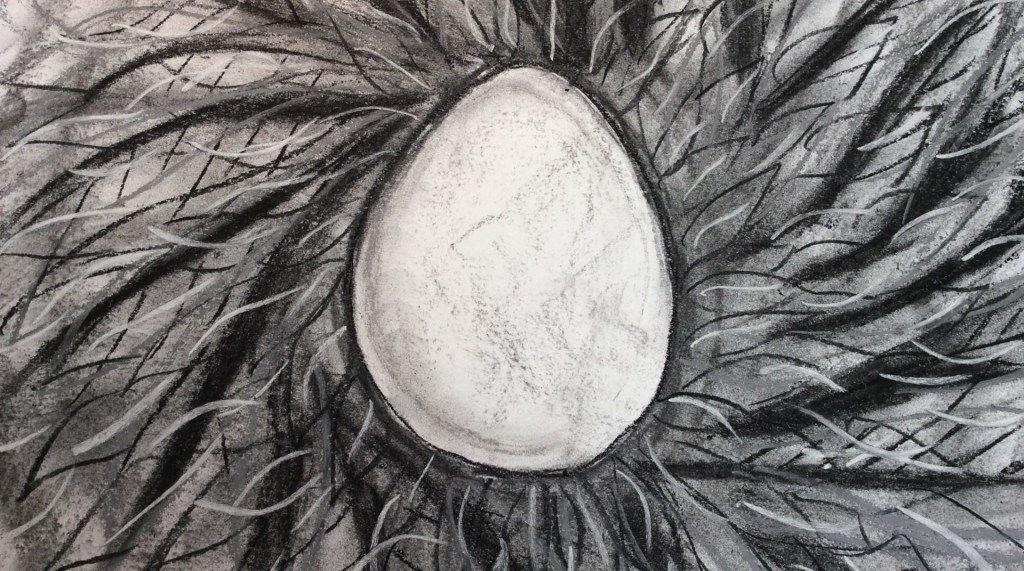
Egg Fiction draws on my own memories of collecting eggs and family folklore about witches’ boats. I learned charcoal animation for the resulting digital poem, and tried to keep a childlike feeling to the flow of images. I named the poem Egg Fiction because it is in no way an actual biography of Burnett’s route into ceramics.

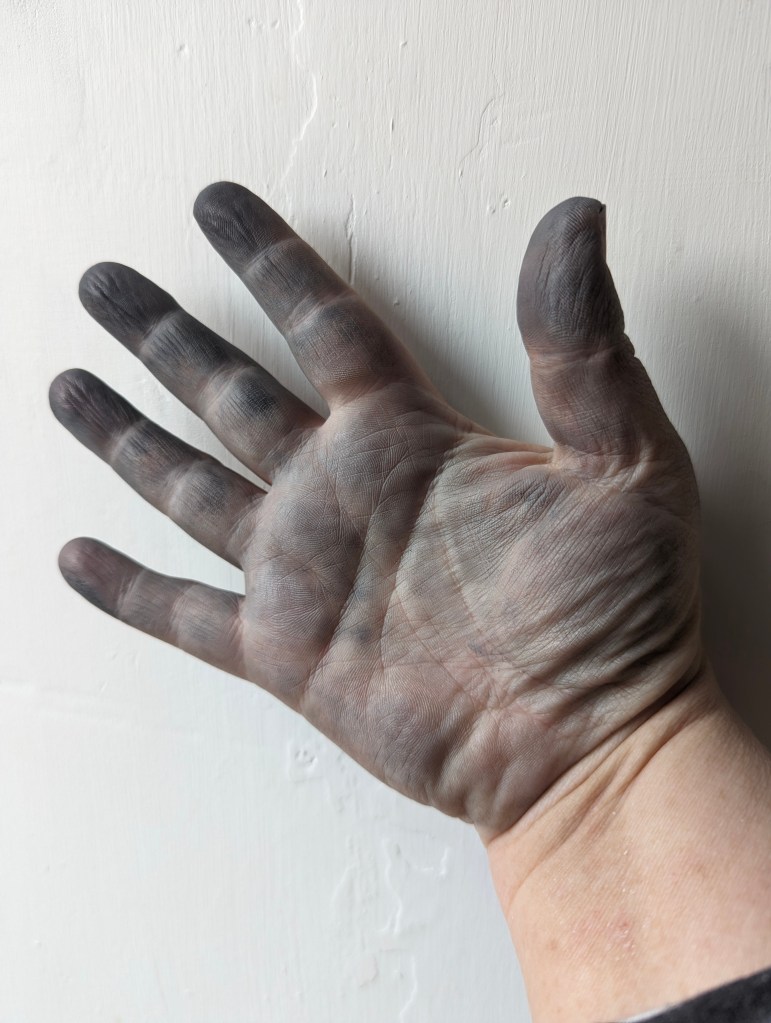
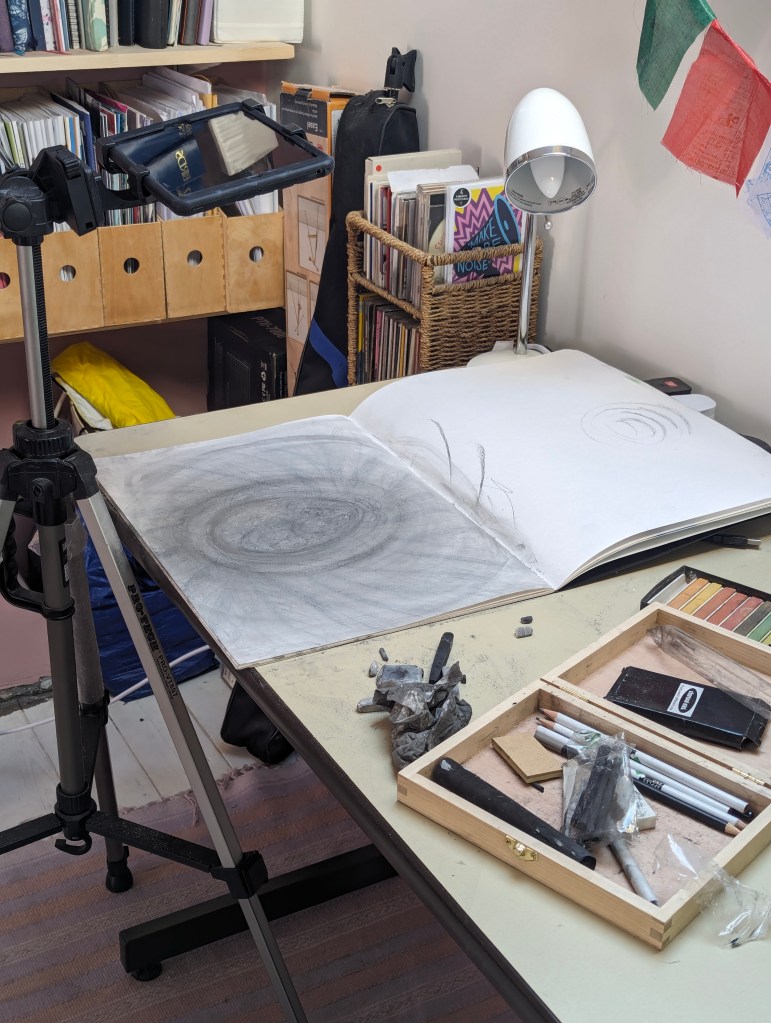
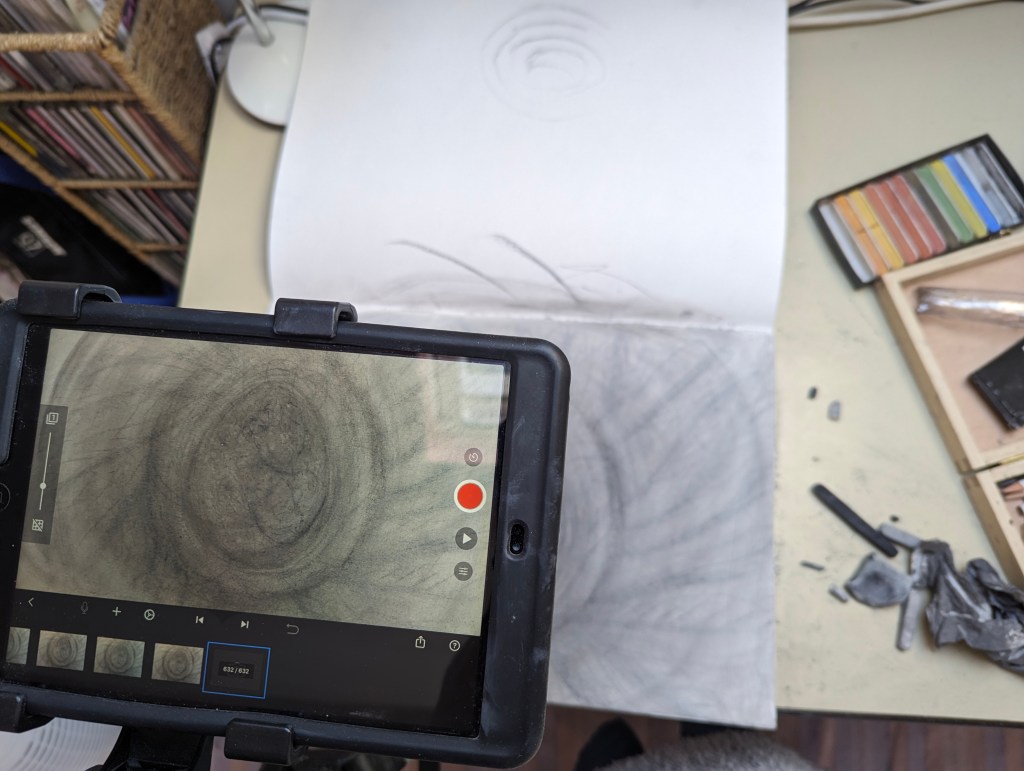
The animation was entirely unplanned and freeform. I used a central egg motif, and simply kept doodling in and around it using charcoal and chalk, taking 2 shots every couple of marks made, using the free app StopMotion on my ancient reconditioned iPad mini. I didn’t do separate drawings frame by frame, every frame was drawn on the same piece of paper. Rubbing in, sweeping off dust, erasing, chalking over, layer upon layer over a combined total of around 8 hours, until my desk was grey and grubby! Completely backbreaking, utterly obsessive…

1500 frames later, having made a whole 58 seconds of film, I recorded the voice track for the poem and was devastated to see it come in at nearly 3 minutes long! Nooooo!!!! Radical editing of words ensued, but I was still only half way with the visuals. Physically unable to continue with hand-drawn animation, I came up with an ingenious solution to triple the length of the film. Importing the original animation into iMovies, I duplicated and layered the sequence over itself, using the editing app’s greenscreen feature to set first the darkest parts and then the lightest parts of each frame as a greenscreen. In this way, the rapidly metamorphing egg began to ghost itself…

Here’s the text for this most challenging and enjoyable piece. When I show you all four finished films in my next blog, you’ll hear that the voiceover for this poem is not me speaking. In fact, I had my first foray into AI-generation by using a text-to-voice app. There were many accents to choose from, and male and female voices of different age profiles. When you read the poem below, what voice can you ‘hear’ in your head? What accent would you have chosen in my place?

Egg Fiction

nanna sent her to steal an egg
fresh from the straw
the darkness clucked

it was the end of the world
it was a rite of passage
don’t trip!
don’t smash it!

don’t smash it too soon
soft-boiled children must learn
the tap the crack the dip the scoop

now smash the empties!
scuttle the coracles
so witches can’t sail to sea
with their wicked, wicked storms

but that warm, smooth weight
had ordained her palm

it’s enough to make her grow up a potter
throwing porcelain
not to shatter, but
to release the paradox-
strength and fragility are twins
this is the earth whose yolk brews wings

this is the earth that knows fire
in the kiln it turns into a little sun
little pitchers become themselves
or smithereen…

look, this bowl has hatched a dragon!
half-shell with a scorched equator

and in the bottom
freckle-speckles
like the memory
of a hen’s egg

The Tees Women Poets are currently open to applications for their autumn residency at MIMA’s Towards New Worlds exhibition. If you’re a woman poet in Teesside, especially if you identify as disabled or neurodiverse, take a look at the info and apply here.
79 AD – for a Fuchs tazza

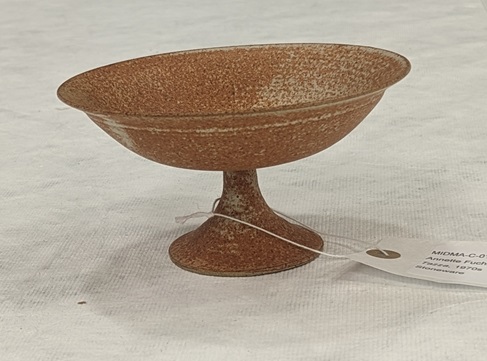
It’s small, about 18cm high maybe? Just looking at it, there is a classical, visual beauty in the proportions and the terracotta. But when you pick it up, the perfection of its balanced weight is breathtaking.

The second of my four digital poems for ceramic pieces in MIMA was written for a tazza, or serving dish on a pedestal and foot, wheel-turned out of earthenware by ceramicist Annette Fuchs. It made me imagine Roman society and murals, which in turn led me to think about Pompeii and Herculaneum. Pliny the Younger described the cloud of smoke that preceded the eruption of Vesuvius in 79AD as “a pine tree, for it shot up to a great height in the form of a very tall trunk, which spread itself out at the top”, a description which reminded me of the tazza shape. On this tazza, a pale razor-blade-shaped void has been left in the red surface, perhaps deliberately, as superstitious people will sometimes add a smudge to their make-up so the gods don’t get jealous…

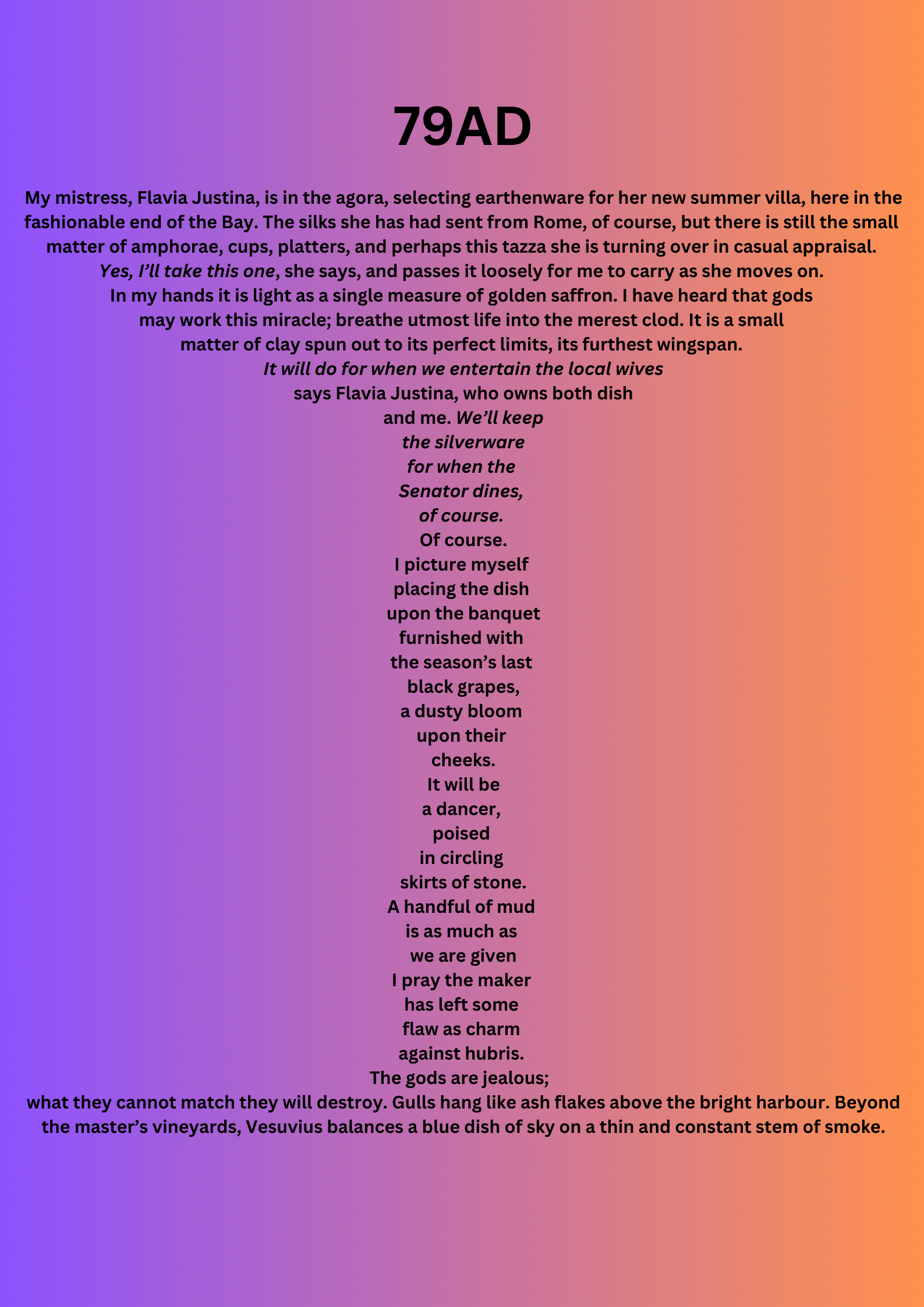
This poem has had a couple of concrete incarnations – the one above, which I made especially for this blog post, and the version in the micro-pamphlet handout produced by MIMA to accompany the exhibition, which had eight stanzas each shaped like a tazza. Can you guess where the stanza- and line-breaks came?

This extract from the visuals of the digital poem should give you a clue!

This is again made in Canva videos, using a textured background duplicated and flipped mirror-image along a vertical axis to enhance the tazza-shape of the stanzas. I then overlaid the texture with a free clip of a puff of smoke, to foreshadow the eruption of the volcano. The film clip was actually in a long, thin, landscape orientation. I have enlarged it, flipped it the portrait orientation, mirrored it along the same midline of the frame, and dialed down the transparency so it is a ghost of its former self…

What sounds would you choose to accompany this digital poem?

I’ll post all four completed pieces, with soundtracks, in my fourth blog. Watch this space for curved kinetic typography, charcoal animation, and weird adventures in Audacity and AI…

If you’re a woman, a poet, and you live in Teesside, then why not apply to be the next TWP poet-in-residence at MIMA’s Towards New Worlds exhibition this autumn? Information and application form here.

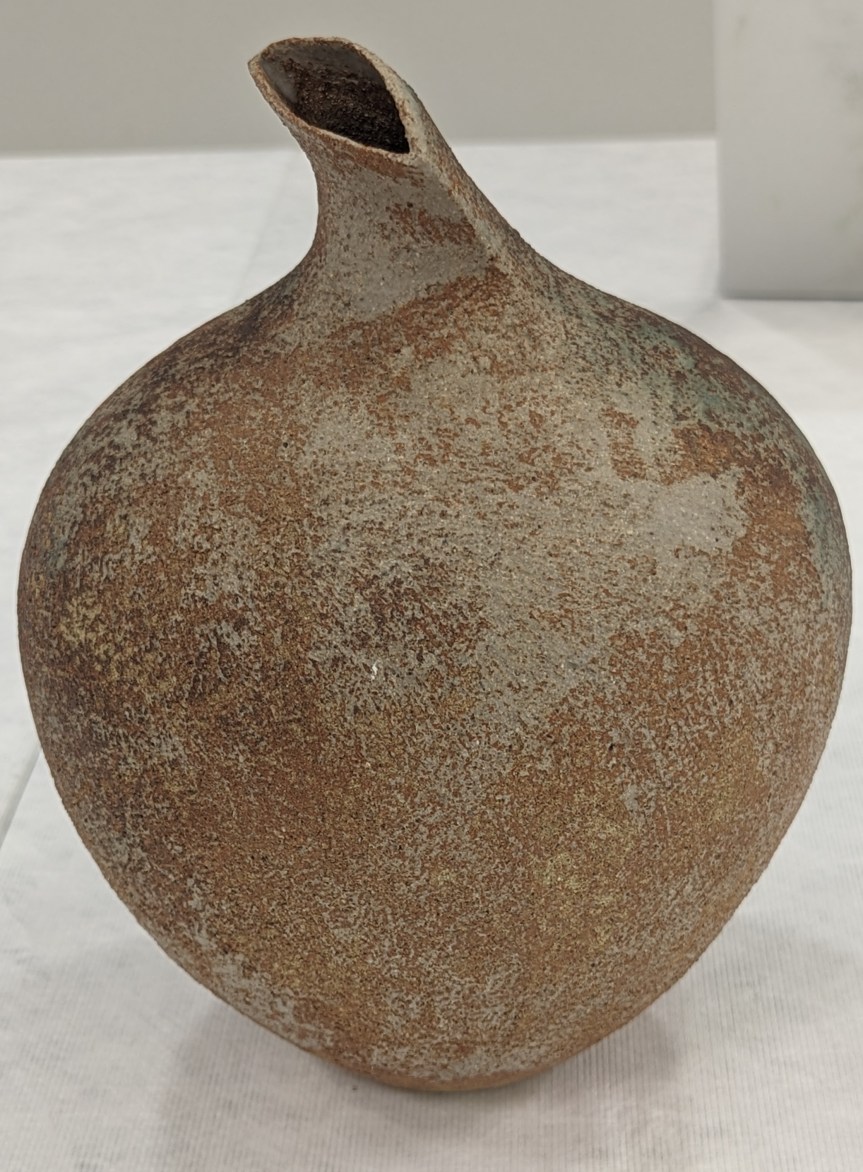
Origin Story – for a Betty Blandino vase

Now that my digital poems have finished their run at MIMA, I’m bringing you all four of them with some info on my process.

This first poem was written for a “leaning-neck vase” by Betty Blandino (1927-2011). As the poem states, the piece is made of coiled stoneware and is unexpectedly light when picked up – the rough finish makes it look like a natural stone, so the expectation of weight was there, and I did literally start talking to this pot when I held it.

My first step was to handle the pot, feel my responses, write notes, draw the vase to get its shape into my muscles…(and later use it for some gelli plate experiments, like you do)

Next step was to go away and write a poem from it. After a few edits, this poem then became a short film using a Canva video template (specifically, the Black White Minimalist the End template). I chose it because it features moving, soft focus lights with reddish-orange hues that made me think of the vase’s rusty-orange surface.

It also seemed to fit with an atmosphere of fairy stories/origin stories/when you were just a twinkle in my eye – the feelings of the poem, if not the specific details of the words. I changed the Canva template’s typefaces and text positioning, and played with how and where the text should arrive on each slide, changed the tempo to suit, and downloaded.

So far, everything I’ve used has been free and easily accessible. This was the result.

Now, that is not the final version of the digital poem – all four poems had soundtracks added before they were shown at MIMA, but you’ll have to wait because I’m going to talk about that, and show you the final looped installation, in a few blogs’ time! You could subscribe, if you like, then you won’t mis any of them?

But I will show you the last iteration of the poem right now, which is as a concrete poem. This was printed in the programme that accompanied the screening, with the following artist’s statement:

Origin Story was written for a coiled stoneware vase with a ‘leaning neck’ made by Betty Blandino (1927-2011). Handling this pot was a sensory overload for me, as it looks like a stone, feels like weathered rust, and is unexpectedly weightless. The shape is reminiscent of an amphora, a pot made specifically to store foodstuffs like wine or oil, but it is kept hollow, and sonorous.  I found myself speaking to it like a sentient creature, and continued that conversation into the poem, imagining myself telling the vase myths about itself like bedtime stories for a child. Little pitchers have big ears.

The observant among you may notice that there are some differences between the texts of the two versions, which just goes to show that poems are never quite finished.

Watch out for the next digital poem, which will be 79AD, written in response to an earthenware tazza by Annette Fuchs.