What exactly does a poet-in-residence do?

How long is a piece of string?!

Residencies for poets are few and far between. At one end of the scale, a residency offers time and often a dedicated space away from home life, in which to explore your craft and make progress on new work. Most of these will be a commercial proposition where the poet is the one that pays. Sometimes it’s subsidised, and with hen’s-teeth rarity the poet is paid just to be a poet – living the dream!!

On the other end of the scale, you are paid but the emphasis is firmly on delivering a set of outcomes for the venue who is hiring you, whether that be an agreed number of poems in a prescribed format, and/or a set number of participatory activities for groups of people important to the venue. The more participatory the brief, the more likely it is that you’ll be working with children, families, and possibly with groups that have specific access needs of various kinds. For this kind of residency to be a residency rather than a short-term hire or a commission, there should be some wiggle room to make new work on your own terms, but there is a real need to align your professional ambitions with the needs of the host – and the host is probably thinking in terms of foot-fall and engagement.

An ideal residency should have elements of both valuable outputs and independent creative experimentation, and an expectation that the exact methods of delivery might be decided through co-creation and negotiation between artist and staff teams. You still need to pitch a good idea, though, and that can feel a bit like having to be telepathic, guessing at what the venue might really need or having some experiential knowledge of how commissioning organisations operate on a day-to-day basis. For example, is their staff team small and overwhelmed, might you need to foreground your ability to self-manage or include social media activity in your pitch?
My current residency at MIMA for Tees Women Poets has been a real joy. The expectations of the host venue were clear – create digital poems in response to the Contemporary Ceramics collection in a format that could be used on a flat screen within the gallery, within a very specific timescale. Be able to self-organise and meet deadlines to present the work at MIMA Art Social #17 on 20th June. Offer two workshops to ensure the public and the TWP are getting developmental benefit, but also develop my own creative practice by learning new skills.

What does that look like in terms of my activity? It’s involved

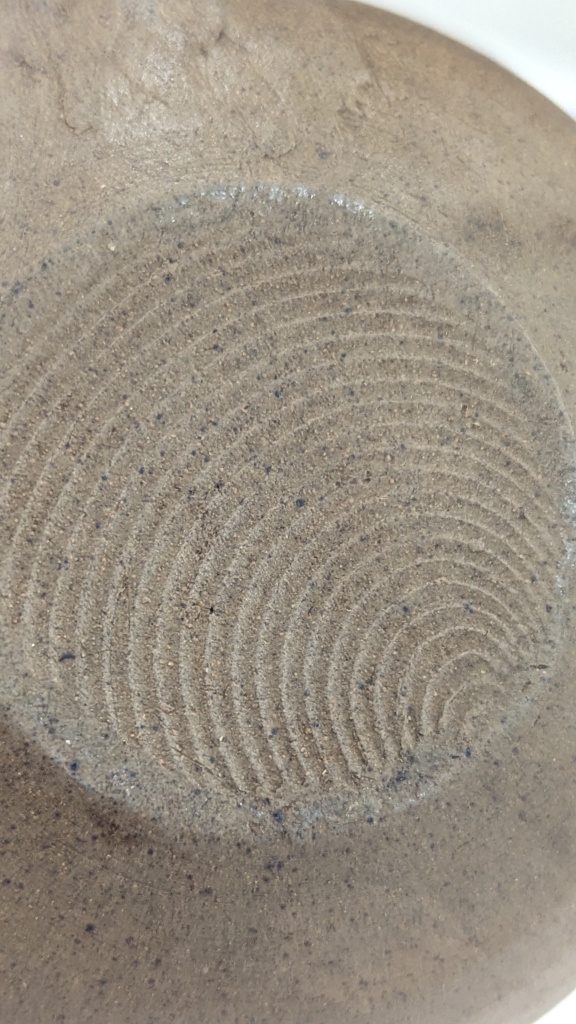
  • an in-person pottery handling session with the curatorial team
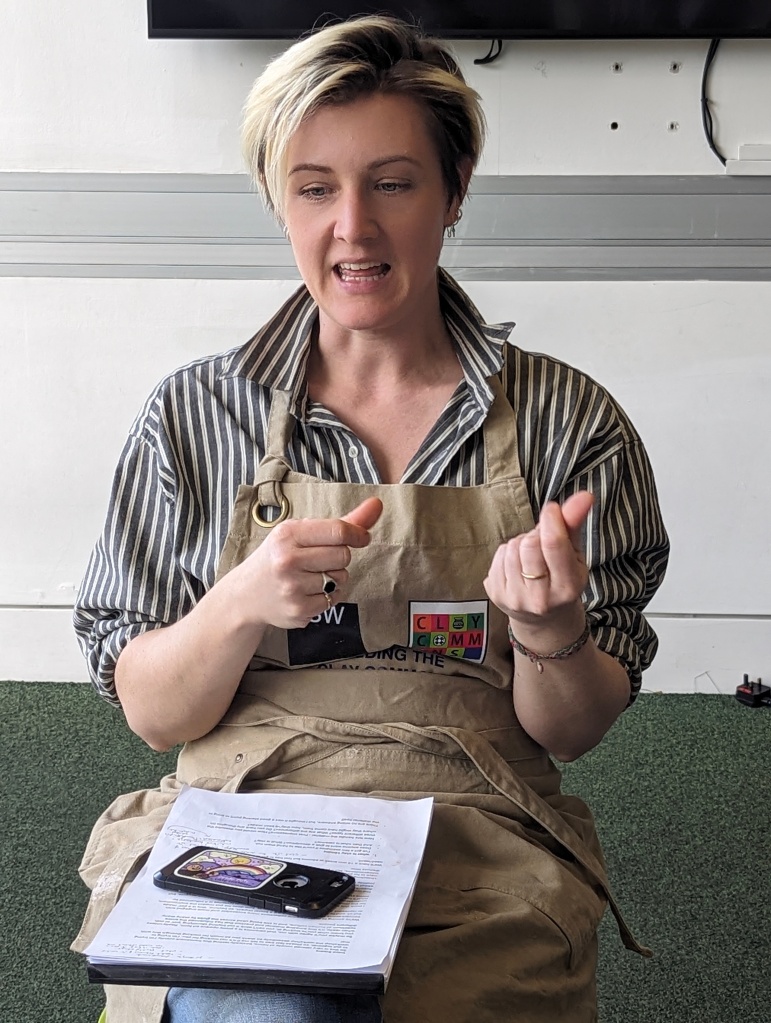
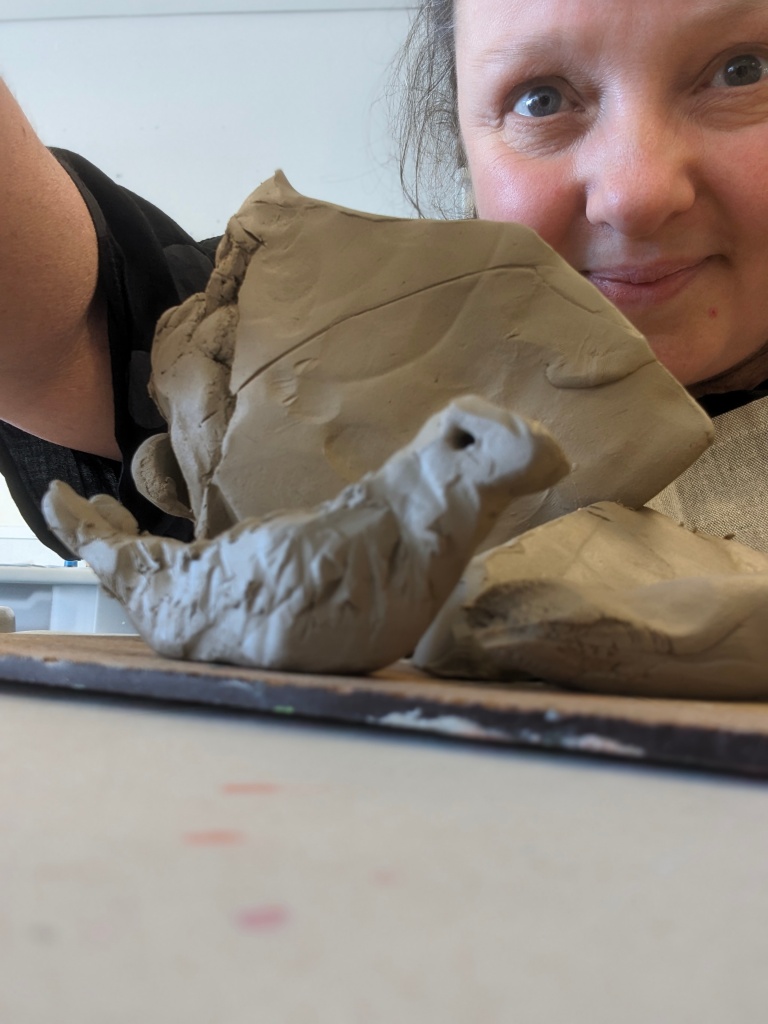
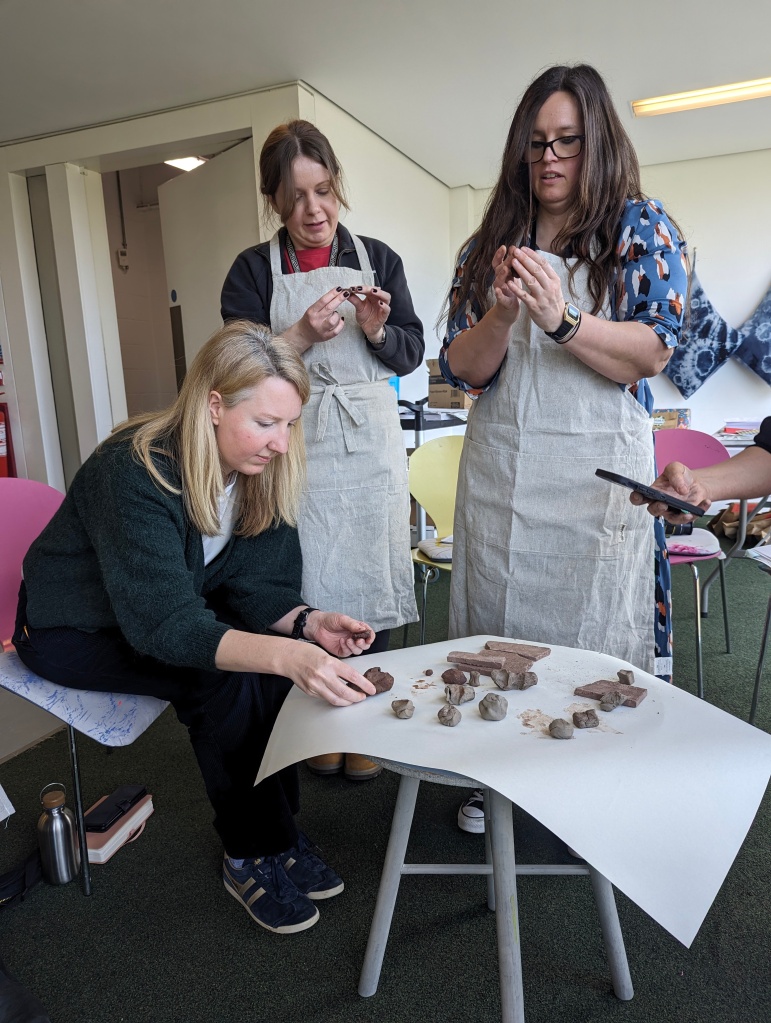
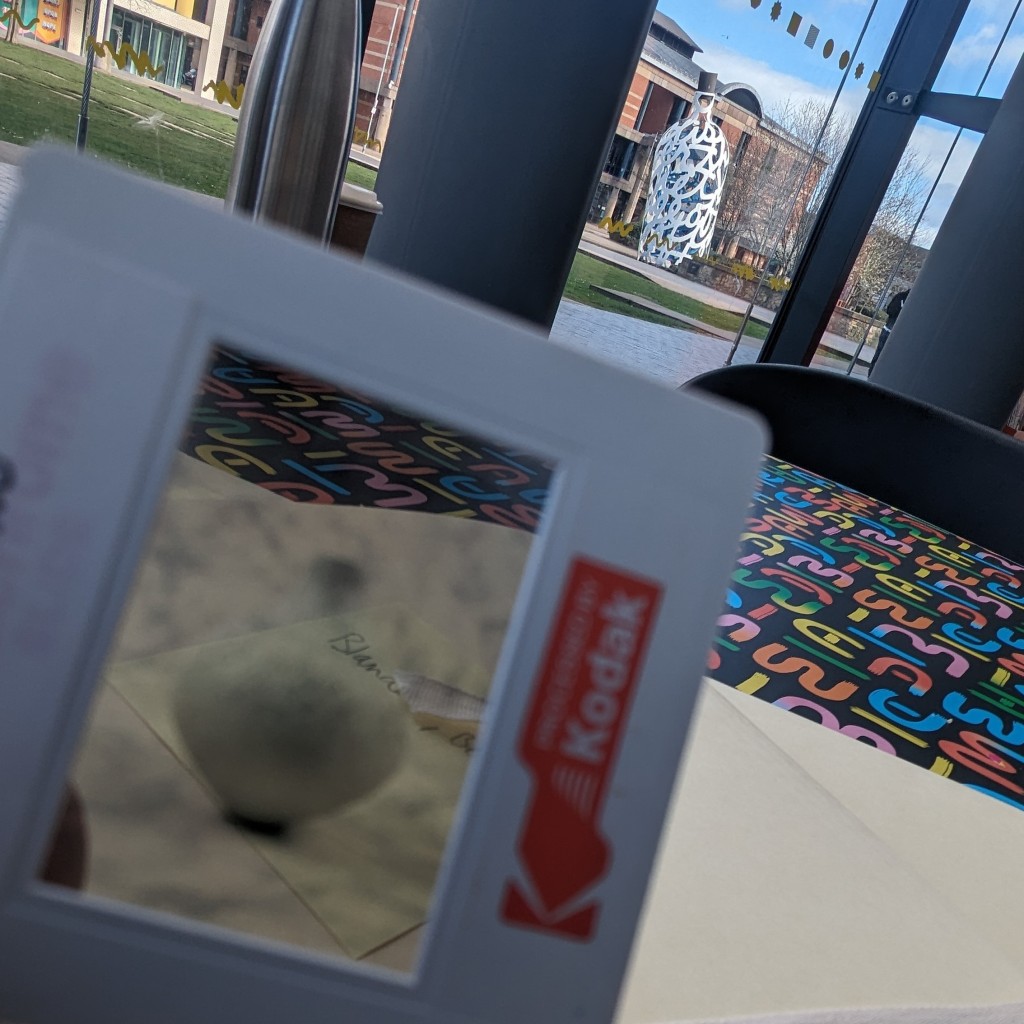
  • my attendance at a workshop about de-colonializing ceramics curation, again with the staff team (see the slideshow above)
  • several days of writing and editing poems in response to handling pots
  • delivering a creative writing workshop with exercises inspired by the ceramics
  • making film-poems from participants’ work in Reels
  • delivering a round-table discussion about residencies for TWP members who would like to apply for future opportunities
  • learning how to make kinetic typography digital poems in Canva
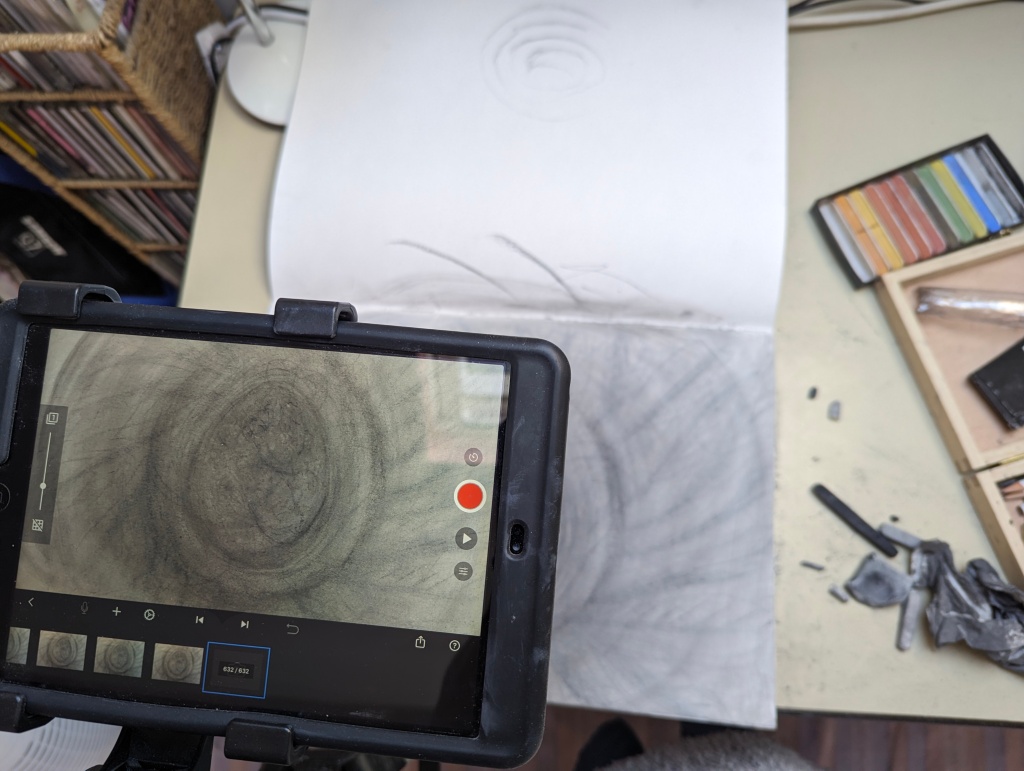
  • learning how to make charcoal animations
  • experimenting with AI-generated voice-overs
  • learning how to create soundtracks in Audacity
  • the creation of four digital poems ready to reveal in June.

To find out more about my process and poems, please come to MIMA Art Social #17 on Thursday 20th June, 5.30-8pm at MIMA, and I’ll reveal all!!
Reflections on Renga

Last month I led my first renga, or rather my first “quarter-renga”. We didn’t have the minimum five hours it takes to lead a group of poets through the collaborative creation of a linked chain of twenty haiku-alternating-with-couplets that is the shortest possible version of a traditional renga.

Now, I have a lot more learning to do about the intricacies of different renga patterns and how to lead people through them skillfully. They remind me of increasingly complex versions of card games – draw the Queen of Spades and pick up the discard, red sevens reverse the direction of play, mention the season once and you must mention it in the next 3 verses, only one verse about the moon per page.

The not-even-quarter renga we created in the sun-warmed vestry at 17nineteen in Sunderland (otherwise known as Holy Trinity church) cherry-picked some of the rules. We opened by establishing a sense of place, then deepened it in the next couplet. Then we allowed the moon to peek into a verse, before closing with a couplet open to any theme. As renga-master, those were the choices I made about the poem’s direction of flow. Four verses took just over an hour.

In keeping with the traditional method of renga, once the direction had been said for the verse in hand, everyone wrote, and everyone then read out the previous verse plus their new addition. As renga-master, I then chose the verse that would take us forward as a group. For the first two, I combined lines from two or more contributors; for the second two, the “correct” verse arrived fully-formed from a single source.

Eight poets took part, and although the final words only derive from five pens, all of us are considered to be co-authors of the resulting work, because it takes everyone’s energy, focus, and revealed words to weave the invisible field of connection in which the renga gestates.

It is a sacred space. It needs space.

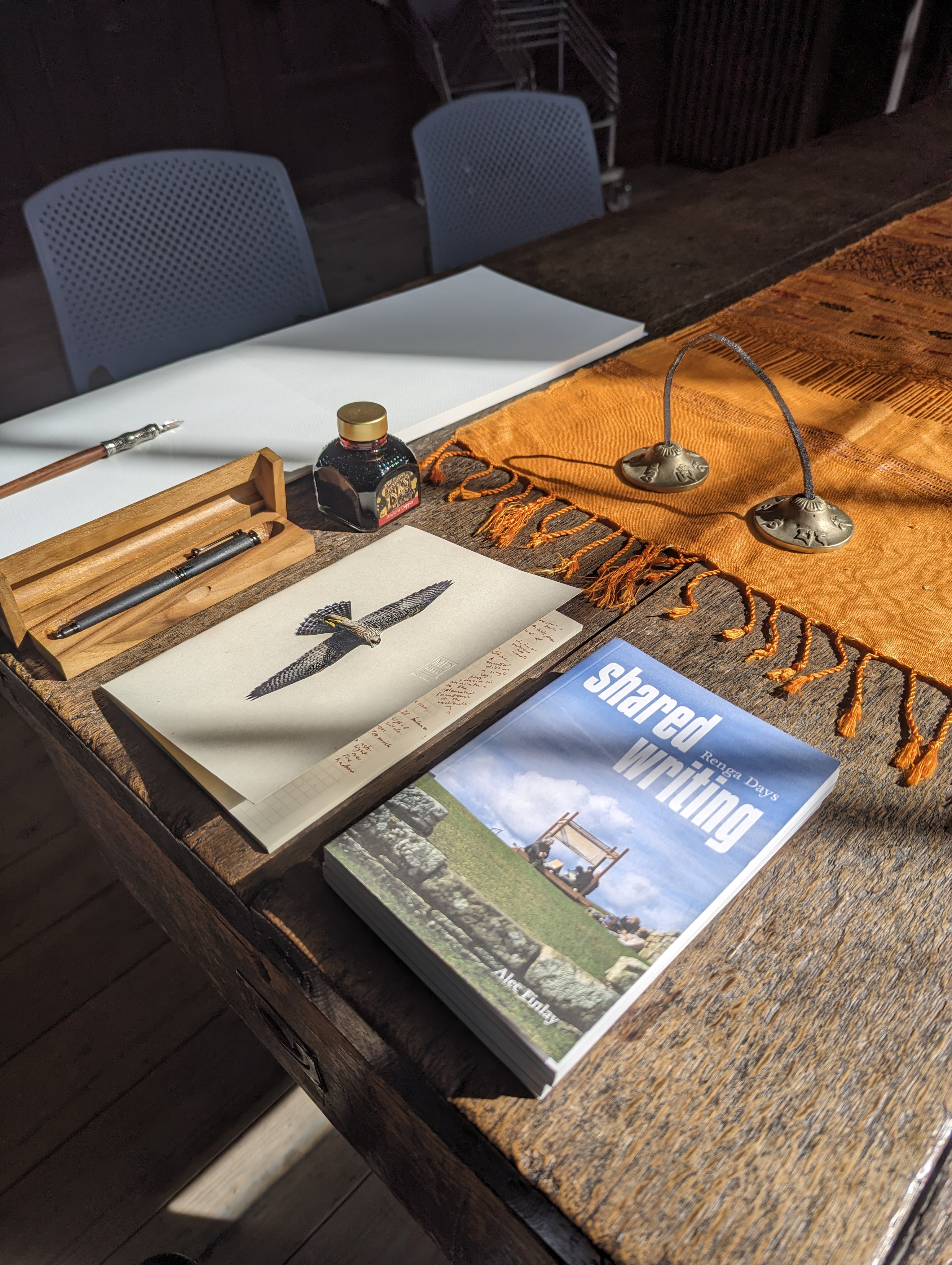
sunlight slants onto an old wood table, laid out beautifully with a deep yellow silk table runner, a fountain pen and ink bottle, a pair of Buddhist chimes, a notebook with a buzzard on the cover, and a copy of Shared Writing handbook of renga

With each circuit of the table, alternative poem-chains open out, fractal branching, seedlings of all possible poems grow ghostly, pale and eventually wither. Like my amateur gardening, I feel guilt and regret with every verse I thin out, death of so many. A smile when someone’s words are chosen, against their expectations. My inner wince away from too-clever, too-polished; my confused frustration when people get caught in syllables and don’t quite open the door to the poem – can you feel it? Like a birdcall, words at the right moment, and never too many. The unchoreographed sigh of recognition from everyone when the right lines arrive, when I choose correctly, when we are becoming the hivemind that spins together.

My approach to creating the conditions for the renga to arise was firstly to run two previous workshops about haiku, to provide renga participants with some insights and practice in the form. But several people turned up for the first time for the renga! So I also used Alec Finlay’s book Shared Writing and had us read out some 20-verse renga. I have two copies of the book, so we could do it in pairs, call and response, which was a beautiful way to hear how this way of writing unspools dreamlike dialogue resonant with association, echo and surprise.

A demarcated physical space really helps. Ours was a room, other projects have used a canopied platform. There is something qualitatively different about joint effort within a dedicated space, our combined attention builds an invisible structure that needs the trellis of a protective physical space up which to climb. I believe it would be possible to carry a mobile platform of stakes and flags, or meet in the wilds and create the space with foraged rocks or marks made in sand.

I also set up the energetic space for the renga by leading some brief meditation, and setting aside time for participants to move around the entire venue in silence in order to open their senses and minds to the latent poetry all around us. Even though the writing was done in the vestry, everyone brought with them details of everything from the wind in the trees outside to the halo lamps above the nave (white moons shining down).

In previous workshops I’d been able to do some basic qi gong with the poets, drawing on a previous life as a shiatsu/qi gong practitioner – it’s a useful, possibly essential preparation for poets who may be more used to starting with a focus on inner turmoil than on the observable world. Though makers in other disciplines would no doubt use the metaphors most related to their practices (haiku alternates with couplet, warp and weft, ones and zeroes) for me the rhythm of the chain felt very much like a walking qi gong where the weight must shift to the side before stepping forward. A quieter verse may make the better stepping stone. Not all can be Alpine grandeur, some must be saxifrage and gentian.

Here is what we wrote:

Three Gold Heads

Bright sunlight / Through high windows/ Inside, three gold heads

Water splashed on infants / Bless you, darling

On the dark side of the garden / A broken teacup saucer / In finger-nailed soil

The daffs need deadheading / Let’s leave them another week

And here are some favourite lines that didn’t make the cut – what would you have made with them?

Sun warms the wood / for centuries, this drawer / is it locked?

Sparrow chirp / ricochet on brick

Like the sky / my blue and white top / is colder than it looks

The lid of the poor box / is so heavy

Corinthian columns / the silver birches can’t quite touch / the window

Cholera corpses / standing room only

Lungs and moon full / I rub sleep from my eyes / another lonely night

The plural of haiku is haiku

Every so often, I get re-smitten by haiku.

They are simple, but not easy.

They are small, but contain vast spaces – like an atom.

They are a practice.

Last Saturday I led a workshop on writing them, in which we played with fridge magnet haikus to get that old 5-7-5 syllable counting thing off our chests before going out into the world for a walk to find our seasonal signifiers, our moments of subtle intersection with (urban) nature.

Here are some thoughts from that day…

  • Really do cut out words if they’re only there to make up the syllable count. Up to 17 syllables is fine – if you do this, you will find an expansive sense of ambiguity and open up the poem to reader interpretation. The space created when you cut an unnecessary ‘is’, ‘but’, or ‘that’ is much more haiku than finger-counting the dum-dum-dum.
  • Two things that don’t go together. Put them together. Do not try to build a bridge with words. Allow the reader to make the bridge for themselves, with resonance. Two things striking each other, like wind chimes. The poem is the note; the note is the white space.
  • Of all poetics, haiku care the least about what you mean. Stop meaning. Start looking and feeling simultaneously. In a glass building, having a complicated conversation, watching pigeons fly through their own reflection.
  • I say feeling, but this is not about getting it all out on paper. How Western! Stay still a little longer, the ivy may have something to say about that.

My next workshop on 13th April is going to be a mutual exploration space looking at how to bring haiku into film, using Reels. I’ve been trying and I have no firm conclusions!

This was my favourite out of the 5 haiku I wrote myself that day – why?

Complex birdsong
Simple flowers
I don’t know

I Love The World – conversation and poetry

I confess, sometimes I forget that conversation with strangers is part of my creative practice. It sounds odd to put it like that, but it’s true – one of the ways I make art is to start by talking.

So for example, when I made and toured a spoken word theatre show to accompany the release of my first collection, The Trouble With Compassion, I spoke to groups of people about what compassion meant to them and incorporated their definitions into an audience-participation section of the show. I also spent some time with individuals, actively listening to them describe their perfect day, and then describing it back to them as a visualisation-meditation, which I recorded for them to use as a relaxation tape. On several other occasions, I’ve been commission to write poems based on group conversations about things like climate change; poems which have included verbatim phrases, or have been recorded, sampled, and turned into soundscapes.

So having my own ‘conversation bench’ at Middlesbrough Art Week was a natural addition to this practice. I spent a day inviting people to sit with me and choose a slip of paper from my bowl. On it they’d find a quote from a poem (mostly Mary Oliver poems) with something to say about loving this world. That would be our conversation prompt. The conversations themselves *were* the art, as far as MAW was concerned – but of course, I wrote small poems for them anyway, and here they are.

Beth Loves The World
“What do I eat and who do I stain?” – from Blackberries, by Mary Oliver

She knows the viscous crimson slime of viscera in the hand;
The tough tug of the knife from anus to silver throat, she knows.
She learned survival in the wild; but after that gutting she struck camp,
got hooked on videos of battery farms, and changed.
Nowadays when she comfort-eats, the lasagna is veggie.
Her kitchen is stocked with the fruit of family labours
on allotments, those scrappy remnants of the commons.
True sovereignty may well look like brambles – it would be good
if it were easy for everyone to live this way, if profit’s pressure
hadn’t uprooted us from a wholesome normality.
There must be something she can say in all this noise?
So many battles to pick, but one truth to hold tight –
she doesn’t want to stain this world with blood.
Asha Loves The World
“I had wanted an easy way out: decision on high, co-ordinated war effort: not how an ecosystem works” – from Cassandra: The Second End by Sasha West

Her feet hurt, and she has no words in my tongue to tell me
if the world will get better, or if this is as good as it gets;
a bench on which to rest in the flat white light of a Saturday mall,
easing the ache, surrounded by all the numb abundance.

For a while we try to open up single words like portholes
to call through, one world to another. Mum-dad-sister-wife-shopping.
Her ankles over her Sketchers are puffy as her winter jacket,
shapeless and durable as coats I’ve seen worn by rickshaw drivers
high up in the freezing villages above Manali. India? I try.

She spreads her stubby hands, to show each ashy knuckle
flashes garnets and coils of yellow Indian gold,
extravagant and bright as galaxies. She has no words
that I can understand to tell me about what she’s seen,
and if I could follow her, would I even believe it?
Katharine Loves The World
“Look, I want to love this world
as though it’s the last change I’m ever going to get
to be alive
and know it”
		from October by Mary Oliver

there is this world, and also
He has prepared a world to come

in that world there is gold and light
pure spirit and praise

in this world there are pangolins
and recycling bins

the daily effort to choose, to decide
living by His word

at the pulpits a call is rising
for all to be stewards of Creation

by reducing
single use plastics

not spiritual enough! 
some are disappointed by the mundane

but if God speaks through the light of stained glass
why not also through glass milk bottles?

what else is stewardship if not the constancy
of small actions?

what is this world but the choices we make, not waiting
but hoping for the next world?
Caroline Loves The World
“What does barbed wire feel like when you grip it, as though it were a loaf of bread, or a pair of shoes?” – from Rain by Mary Oliver

In one way, the world is a wild openness
where weather, danger and even death may spring an ambush on her
but so too may vivid joy come to her blood and breath.
On balance, it’s worth the bus ride,
or calling out the lifeboat when the current is surprising.

In another way, the world is brick-built and she can read it,
scanning plate glass for usage, the centre for footfall, testing edges
of stone steps for skateboarder damage
like some folk check houseplants for stress and pests.

In both spaces she sticks to her own two feet,
alive to risk but undeterred, her body and her wits
moving the wire away from any blocked stile, on any path
where she knows she has the right to roam.
Claire and Rowan Love The World
“And therefore I look upon everything
as a brotherhood and a sisterhood”

- from When Death Comes by Mary Oliver

and a siblinghood, for those of us as apart from the binary as a tree,
served by our own folklore, and containing our own spirit -
be it anxious, or be it puckish, it is our magic

we ourselves are miles away from our siblings, and have let go our children.
in this turning season of our lives, we are choosing
new ways to know ourselves, and change our worlds

we’ve beach-combed nail-paring plastic wrack and nurdles the size of lentils,
collaged them in a making that re-makes us as artists,
invoked S.I.C.K. as a slogan-sigil that explains it all, inner and outer

and we say

identifying winter buds is just like being a wizard, so we’re filling
emptied hours with learning trees; remembering our family
called us Blossom in the pink spring of our life

remembering how we all climbed that tree in the nearby woods,
how one summer we found it felled for some planner's ring-roaded future,
our friend and all their siblings. How their deaths changed our world.

The ballad of the benches

“If a tree falls in a forest and no one is around to hear it, does it make a sound?” Yes, yes, interesting thought experiment, but more to the point – if a tree falls on a housing estate in Norton, does it get chipped for mulch, OR….does it get carved into stunning benches for the community????

Well obviously, the latter! I found out about it when the Tees Valley Wildlife Trust asked me to write a celebratory poem for the unveiling of the benches on May of this year. What was only intended as a short piece to be spoken at the end of the launch day turned into a full-on performance presented in stages as a huge retinue of school children, TVWT staff, community members, and the mayor of Stockton all processed from bench to bench across the length of Roseworth Estate.

The story of the tree felt absolutely like a folk tale to me, one that should be made into a rhyming story that people could learn or set to music if they wanted – a tale of how a huge loss was turned into beauty, utility, and community pride through the actions of passionate, creative people. So what shape of poem should I use?

The tree itself was an elm, once the iconic shape of the English natural landscape, but now rare due to the ravages of Dutch Elm Disease. And the traditional English poetry form for folk poems, and folk songs, is the ballad – it’s what most people use when they start to write poetry, it’s the form behind most nursery rhymes and rhyming kid’s books too. You’ll know it – diddle de diddle de diddle de DUM, diddle de diddle de DEE?

So the choice was easy – I needed a ballad to tell the tale…

Two elms stood at the heart of the Roseworth Estate in Norton, Stockton-on-Tees. When one was severely damaged by Storm Arwen, local people, councilors, and the Tees Valley Wildlife Trust stepped in to make sure the wood was kept in the community. A Big Local grant allowed them to commission artist Steve Iredale to carve the fallen wood into benches and play structures for two local primary schools, and SEN school, and a local church.

Each bench has its own motif – dragonfly, angel wings, mythical serpent-dragon, and acorn. Steve also carved a standing stump at the Kiora Hall North-East Autism Society school into a matching sculpture of barn owls. It was impossible not to give each piece its own verse!

Here is the poem as it appears in the latest members’ magazine from the Tees Valley Wildlife Trust. If you would like to support their work bringing nature to people and people to nature, if you would enjoy a regular magazine full of information about the wildlife on our doorsteps, then why not become a member now?

Quiet skies over Seaton

One last log from the little tern nesting site at Seaton Carew…

“It just took a skitter-flight!”

I wasn’t surprised that it was Tony who saw the fledgling’s first meaningful attempt at flight. A daily presence on the volunteer warden team, his deep affection for these birds and his hundreds of hours of experience have heightened his attention to their shapes, movements and behaviours. He and warden Emma had been conducting one the the regular sector-by-sector counts of adults and chicks, moving methodically from marker post to marker post, surveying the intervening ground in both directions to cover all angles. I had been tagging along beside them, observing, and had still barely noticed the fledgling testing its wings.

All three of us immediately searched it out; and found it, wings spread, catching the edge of the wind like a child’s kite seeking uplift from the sand. A raise, a rise, and suddenly – a full lift! In just one second it was airborne, angling a low slicing flight over the top of the protective fence and away to the shore beyond. The definitive change from vulnerable fledgling to self-sufficient juvenile adult had happened right before our eyes, a moment that felt so miraculous that tears came to us all. In this difficult breeding season, plagued by kestrel predation, every one of these flights becomes more precious than ever…and to see a first flight happen is an unbelievable moment of grace.

Juvenile little tern in flight by Matthew Livesey

I wrote that journal entry just over two weeks ago, after a visit to touch base with the terns before I went away for a week. I was scheduled to volunteer three more times this month and was looking forward to seeing more juveniles take to the skies, but by the time I returned the entire colony had fledged and begun its beach-hopping journey back to Africa. Accelerated by the kestrel attacks, chicks had gained their independence as quickly as possible, some exiting the breeding ground to take their chances further along the shingle outside what had become something of a raptor buffet. By the end of the season, a hungry and entitled kestrel had taken to walking through the half-pipes intended as chick shelters, looking confused when their ready-meals proved absent.

“Clever girl…” – velociraptor levels of cunning from the (male) kestrel, captured by Matthew Livesey

But although the predation was persistent, it did not continue at the same shocking levels seen by the team in those first few dreadful days. After the initial terrified paralysis had worn off the flock, the little terns rallied their defenses and once again took after their attacker in huge shrieking mobs. Attempts by the kestrel became less frequent, and less certain of a result, thanks to the heroic and exhausting efforts of these tiny birds. Where once there seemed a possibility of total chick loss, there now is the probability that around 70 new fledglings are out there in the world.

I say probability because exact numbers, never 100% certain, were harder to come by this year than usual. Ringing chicks involves entering the breeding ground and disturbing the brooding mothers, and although it doesn’t physically harm them it does cause alarm, stress, and defensive flying. With stress levels already so high among the birds because of the continued predation, ringing was kept to a minimum this year. Numbers were taken through heat-camera spot counts at night, and daytime observation with numbers extrapolated across sectors. These extrapolated numbers suggest 211 chicks hatched, with only 67 achieving adulthood. We know that one of ‘our’ ringed juveniles was spotted at Spurn Head, a shingle peninsula and nature reserve at the mouth of the Humber, but there are a good few birds that can’t be tracked and are now flying ringless into their precarious futures.

Ringing a little tern chick by Chris Brown

By the time I returned, the only bird visible on site was one ringed plover on her fifth week brooding evidently dead eggs. I watched her fuss and shuffle around her scrape, and by the following day she too was gone. The cedar fence now squares off nothing, the air above it is still and silent. Their departure has come even sooner than it did last year, which was also counted as an early farewell. The fence will remain until early August, but for now all that remains is to litter-pick the site, celebrate seventy beautiful new birds in the world, and wait for April to come again so we can see – will the terns return for a seventh year?

Support the work of your local Wildlife Trust by becoming a subscribed member or volunteering, and protect nature today.

Threat level – intense

More from Seaton Carew’s little tern colony

Horus, the Egyptian god of sun and sky, is depicted as a falcon. Sometimes he is almost a man, but bird-headed, and sometimes he is fully bird. In his hieroglyph he is a falcon perched in profile, but in decorative icons he takes on the silhouette of a hovering raptor, wings outspread. I never understood the awe and terror this shape could inspire – not until the kestrel came.

It had been two days since my first stint with the little tern wardens at Seaton Carew, and I was looking forward to another afternoon of watching fluffy chicks bimble on their wibbly legs, and chatting to the passing public. I’d muted the warden WhatsApp group for a bit, so I’d missed the first avalanche of notifications. Kestrel attack. Chick taken. Kestrel attack. Chick taken. Kestrel attack. Adult taken. Kestrel attack, attack, attack.

Attempts had been coming around every twenty minutes all through the long hours of June sunlight. With chicks of his own to feed, the male kestrel had been taking advantage of perfect visibility and a concentrated population of chicks at their most vulnerable stage, hatchlings mostly unable to take cover under the pipes and pallets provided. The sheer speed of the predation was shocking to witness, and the decision was made in the warden chat group to stop the blow-by-blow reports of loss in favour of a slightly less traumatising end-of-day round-up. But as the numbers mounted, it was difficult not to think darkly – if this rate of attrition were to continue, would any chicks survive to fledge and escape along their migration route to Africa?

Wardens are well aware of all the ways these little birds can be taken. Gulls can smash and gobble eggs, dogs can chase and catch fledglings when they first head to the water’s edge. By night, foxes try their luck and are seen off with laser pens, as is the little white cat that night warden Dean has nicknamed Ghost. Even hedgehogs get in on the action, swimming through shallow tidal pools to get to the prize of an egg. But nothing is quite like the kestrel.

All wardens are trained in the use of this laser pointer, which deters night predators like foxes without causing any damage to them. This image and featured image of mother with chicks both by Steve Lindsay.

Other threats can be seen coming and counteracted by the human guardians with laser and air horn, or with screeching and mobbing by the feisty little terns. Although as the UK’s smallest seabird they seldom land any pecking blows, clouds of dozens of birds are usually successful in bothering the lumbering herring gulls away. But nothing is quite like the kestrel!

A little tern mobs a herring gull, which turns its head in mid-air to scream at the smaller bird
Image by Matthew Livsey

As soon as I get out of the car, I can hear the absence of bird chatter. Anyone who’s seen a sparrowhawk strike in their garden will know the stunned hush that follows it, often for days, as the survivors hunker away in fear. For the little terns there is nowhere to hide, and a real air of exhaustion and despair has washed over the colony. Whatever they do to deflect the kestrel, he simply ignores them, swinging round again and again with indestructible focus for the hunt. The raids have been so frequent that the mobs of defenders, small and intimidated in the first place, have now dwindled into desultory attempts by half a dozen or less against an undeflected foe.

Three little terns mob an unconcerned kestrel against a pink clouded sky at dusk
Image by Matthew Livsey

The kestrel watches from a distant roof, unseen as a sniper. The kestrel moves neither gaze nor intent. The kestrel circles higher and higher until it is a dot, and then a trick of the eye a blue mile above. The kestrel slides in front of the sun; and I see it then! How Horus came into the minds of people a millennia ago, majesty and death and the blinding brightness of a god! But I can no longer see the real bird.

We are still craning upwards in fear, lost in the heat-thin clouds, when he strafes in low over the perimeter fence. It’s a split second, but by the time we turn and cry out, he is already making the horrifying grip-and-yank gesture of feeding. Another chick is lost, and there are five more hours of daylight left. More hours again tomorrow as the year builds to its solstice. No respite from the intensity of this threat.

Can the colony rally? Will any chicks make it to adulthood? The next few days will prove critical, as fledging begins…

More to come soon!

You can support the work of the Tees Valley Wildlife Trust by subscribing as a member here, or perhaps by volunteering your time to the little tern crew – or one of the many other conservation projects the Trust runs. Not in Teesside? Wildlife Trusts exist across the UK, have a look for your local opportunities!

One good (little) tern deserves another, and another, and another…

How did Teesside’s little tern colony go from 3 successful fledglings in 2021, to 141 survivors in 2024? A case study in positive human intervention, dedication and persistence…

“That’s a nice lift” says Tony, as the adult slice upwards from their invisible nests among the sandy shingle at the southernmost end of Seaton Carew beach. A regular volunteer watching over the terns, he loves the way they barrel roll so their bellies catch the sun bright white, then suddenly flip their pale grey backs towards us so that against the blue-grey haze of the horizon the birds disappear.

They are a constant magic trick. Although I can hear their little raspy screeches before I even get out of the car, they are only easily visible when in motion, and they drop into rest on their nests like flipping the switch on a cloaking mechanism.

Today is a finer day than when I last came, bundled up against a sudden wind-harried drop in May’s temperature. On that day everything was grey, and the male terns were spending every ounce of their energy on constant forays to the tide for sand eels. For a courting tern, nothing says “have chicks with me” like a beakful of silvery sand eel. The warden that day, Emma, told me that the eel numbers seemed good and that mating was taking place all over the strand. Occasional flappings of raised wings like little white flares in all the grey showed me where breeding pairs were getting down to business. A month later and the same brief flashings of wing-white erupt where birds land and settle on their shallow scrapes – an estimated 80 nests – where both eggs and chicks are now present.

Colin volunteers to show me a chick through the huge tripod scope set up on the promenade for curious passers-by to learn more about this protected site. I’m looking at the fluffball for a good 20 seconds before I even see it, the speckled, sandy camouflage markings are so successful. More chicks hunker under one of the half-pipe ridge tiles laid out across the site as emergency shelters, looking like a clumpy sand-drift. Only movement gives them away; living as they do under a panopticon sky full of predatory larger gulls and hungry kestrels, their natural instinct is to stay very, very still.

The Tees Valley Wildlife Trust looks after this site, working together with Durham Wildlife Trust, which protected this tern colony when it was breeding north of here at Crimdon. Tony tells me how they migrate here in April from the Gambia, looking for shingle beaches and spits to inhabit. He waits for their arrival, and feel properly ’empty nest’ when they leave again.

Tidal activity being what it is, those shingles the terns seek can change their topography year on year, or disappear completely, and even during the course of a breeding season the colony can get washed out by high tides and storms – so the birds are flexible about where exactly they settle. When the colony started to fail in Crimdon, they moved south to Seaton. This year’s colony has been joined later in the season by birds believed to have been washed out of their first nests at Long Nanny near Beadnell.

The warden on duty today, Derek, tells me that in the six years this site has been active, the local people have taken it to heart. Teessiders have always pitched in to help protect the terns, whose eggs are so vulnerable to predators and accidental damage, and who will simply leave their nests to die if disturbed by humans. In volunteering to go on watch, I’m following in my mother’s footsteps – she watched them at weekends in the 1980s, when their breeding site was over the other side of the Tees mouth in South Gare.

Having a warden and volunteers is a huge part of the success story that has seen fledgings increase exponentially at Seaton. From 2021 to 2022, the jump in chick numbers surviving to migration stage was 3 to 89! What changed? The Trust got funding for a fence. A simple fence. Split cedar pales hammered into the sand to warn off dog-walkers, information signage, and paid wardens with the back up of dedicated and knowledgeable volunteers who can explain and engage. The global population of little terns is classified by the IUCN as ‘of least concern’, despite their acknowledgement of a 30% decrease in overall populations in the last decade – like every species, they definitely need protecting now, as rising sea levels and increased storm severity will undoubtedly make their survival difficult in the decades to come.

As I’m standing at the promenade wall, sketching the scene, a young lad jumps up onto the wall and is quickly warned down by Derek. But it’s not Derek’s style to be punitive, that gets you nowhere. Instead he always makes a point to talk with people encroaching on to the site, and in no time he has the whole family chatting, observing nests, and checking out the chicks through the scope. I talk to the mother and the younger sister, who are entranced by the fluffy babies and had no idea the birds came here every year. It’s excellent to pass on the little bit of information I’ve learned, tentatively trying to forge another link in the chain of connection between humans and nature. It’s a small start towards finding my own way to act as a custodian and a good ancestor.

If you’d like to do something positive, meaningful and sustainable about nature, biodiversity and climate, you should absolutely start by giving what you can (membership, donations, volunteering) to the organisations already on the ground, doing the work. That could be a global charity or your local wildlife trust.

For my fellow Teesside readers, please if you can, become a member of the Tees Valley Wildlife Trust and consider becoming a volunteer warden. If that’s not possible right now, check out other ways you can benefit from the Trust’s amazing work, for example by visiting one of their reserves or taking part in their 30 Days Wild challenge with the family.

Mixed emotions in eco-poetry

Not an essay, though there is probably a whole dissertation hidden in this title. Just a Sunday selection of a few poems I’ve read recently that have said something recognisable to me about how the act of witnessing climate collapse elicits a whole load of emotions, a grab-bag of throat-lumps, a pick and mix of angers, a bran tub of what the f**k do I do with this now?

Not only do the emotions come in a tangle, but they are inevitably either linked to, or fighting for mental space, against all the other absolute horrors that simultaneously require our attention, activism, energy, anger, empathy, time and money. Scroll on.

This is Not a Matter For by Tjawangwa Dema (pt 1)
This is Not a Matter For by Tjawangwa Dema (pt 2)

This poem is from the beautiful An/Other Pastoral by Tjawajgwa Dema, illustrated by Tebogo Cranwell, and published by No Bindings Press (sadly sold out). Parenting during pandemic, anyone would be forgiven for having no mental space to contemplate climate crisis; but the enormity of some environmental disasters force their way into our consciousness, shedding light on the interconnectedness of all our systems of exploitation and oppression.

Morality Play by Caroline Bird (pt 1)
Morality Play by Caroline Bird (pt 2)

An astounding number of people would rather simply not believe the evidence of science and their own damn eyes when it comes to climate stuff. It’s less terrifying that way, perhaps? You can shrug off the need for any personal responsibility and be a little pixie of conspiracy quirks; you can look away from the gut-wrenching realisation that literally no-one in power is going to make the right decisions to save us; you can keep prioritising the pleasures of your consumption. This poem is so full of the human – narcissism, denial, failures of empathy, fear of death, the uncertainty around meaning, purpose, what’s it all for… does it act on you as a wake up call? You can find it, and the following poem, in Out of Time: Poetry from the Climate Emergency ed. Kate Simpson by Valley Press.

Wild Camp by Jo Clement

In Dema’s poem, a huge eco-disaster intrudes into an already pandemic-fraught life. In this one, biodiversity loss and our current steady mass extinction pops up during what should be an idyllic time in Nature. It’s not even the first issue to raise it’s head, but it effectively shuts down the conversation – the last thing in the poem. This is every conversation I have these days – a litany of appalling things interspersed with attempts to look around and appreciate my surroundings or the luck of my life, all of it eventually cut dead by listen, the birds are dying off – until I rally myself for the next attempt at normality and joy. I try not to say the dead birds bit out loud to most people, just in case I stopped getting invited to parties! And I do feel lots of joy! But also, I do count birds…

It’s poems like this that remind me there really isn’t (or shouldn’t be?) any such thing as nature poetry anymore. Nature has been used as a salve and an escape and an inspiration and a metaphor for human yearnings and philosophies for so many centuries. We’d like to keep doing that, it’s beautiful. But it’s tainted. Is it even possible anymore to look, but not to see what we’ve done, what we do?

Inheritance by Holly Hopkins
Inheritance by Holly Hopkins (pt 2)

I’m finishing with this banger from Holly Hopkins’ collection The English Summer from Penned in the Margins, which I heartily recommend. Here’s parenting again, with the added ingredient of feminism. Every word of it true! I love it, and I absolutely acknowledge that this is one of the HUGE drawbacks to climate activism that focuses on individual responsibility – the work of clearing up messes of any kind is likely to fall much more heavily on women. At least, it always has done, no reason to think anything will change any time soon when you look at the rising popularity of brutal misogyny absolutely bloody everywhere. Its a problem. I ain’t got no solution – but I’m offering you this little selection of poems I suppose as a provocation to see how it’s all linked. The sexism, the fascism, the consumerism, the capitalism, the genocide, the racism, the ecocide.

All the same death grip.

There you go, nice little blog for a Sunday!

Nature as Co-Creator

This week I posted a photo of next doors’ cat, Ziggy, sitting on the recycled paper I was drying on my studio table in preparation for what I hope will be a piece of art. I labelled him ‘co-creator’, as a joke – and then of course my weekend sent me down a very enjoyable rabbit-hole of real artists making real collaborations with the non-human. So I thought I’d share some with you.

Losing Track, Holding Traces is a beautiful exhibition of works in mud, twig, felt, charcoal, paper, and fabric, created by three artist-friends out of their walks through the countryside of the Derwent river valley. Look at these altar-like displays of found objects and process notes that greet you as you enter! The swatches testing organic dyes, the photos of drawing in the rain, the treasures of lichened wigs and twisted grasses! Honestly, I think I love notebooks and the ephemera of creative practice more than the finished product sometimes; but in this case I also loved the finished works because the exhibition continued to be jointly-conceived, modular, free-flowing, and as full of playfulness as a mud pie.

I particularly loved the use of rain as a co-creator, which reminded me of Andy Goldsworthy’s rain shadows where he lies down when the rain starts and gets up when it stops, leaving his dry silhouette on the land. The willingness of it, to relinquish creative control to the weather.

Also, making by walking – yes please. Since reading Sonia Overall’s Heavy Time a couple of weeks ago, my intermittent habit of making poetry through walking has been given a boost, so it was gorgeous to see the same practice applied to visual and fibre arts too.

Finally, big shout out for modular installation! The piece I’m working on at the moment will take 200 squares of hand-made paper threaded together to make it complete. It’s astonishing how the act of repetition is enough to elevate a simple object or action to a greater level of significance. In poetry this happens in anaphora, when words of phrases are repeated to the point almost of incantation. In the Gateshead exhibition, the repeated mud and charcoal paper tiles achieve something similar – one simple act of painting, an infinite number of possible outcomes. Fingerprints of earth.

So now here I am, footling around in the internet to look for nature as co-creator projects. There are loads of course, but here are a few that I love the sound of:

Forest Is The Artist is an exhibition of canvases left in a Korean rainforest for a year so the forest could ‘paint’ them, which is awesome but not something we can all replicate; but we could do some painting with weather like conservation worker and artist Katherine Owen.

Bio-feedback music with plants is a vibe – check out work by Masterplants or Natural Symphony; and I’m pretty sure Newcastle-based poet Amelia Loulli has done spoken word/film-poetry using bio-feedback but I can’t find any links so maybe I hallucinated that!

There is a load of fascinating practice going on at the intersection of sculpture, textiles and fibre art, and fungi – mycelial sculpture is everywhere! Vases, gloriously weird animal head sculptures, mushroom book-shelves grown by our local fun-guys Threads in the Ground. You could spend a very long time finding out more about mycelial fabrics

In April last year, Nature was added as a credited artist on Spotify, allowing musicians and sounds artists using field recordings to raise royalty income for climate initiatives. There are folks out there co-creating sculptures with bees. Folks, it’s wild times for re-thinking how to interact with the non-human!

So what might that mean for a poet? Not sure yet, but I wonder whether I can update my side-practice of erasure poetry and ditch the paint-and-ink blackout method in favour of a temporary composting methodology? Bury a page for 6 months and see which words remain un-rotted when I dig it up? It’s got to be worth a try, right?

Life on Mars

I saw this post and thought of Elon and all the tech-bro would-be-kings of the next frontier, spending all the wealth they’ve harvested from environmental death here on earth on big little boy rockets zoom-zoom-zooming them away from us whining plebs to all the new, empty planets they’d like to fuck…

I have a pamphlet coming out on 20th February with The Braag. It’s called Offworld and it’s full of weird little sci-fi flash fic poems that came out of a 2019 residency at MIMA.

All the titles are deliberate mistranslations of Portuguese exhibition and artwork titles I found in the archive folder for Brazilian artist Brigida Baltar, whose large photographic piece Cloud Collecting is in the Middlesbrough Collection. From this starting point, I prompted myself to create writing that embraced experimentation and narrative – a story of sorts emerged, about a girl and her friend Sai, and how they ended up drifting through the dustbowl dregs of a collapsing galactic empire, witnessing the slow degradation of endeavour and intention from utopian to authoritarian…

Wherever we go, there we are.

It should be available for pre-order soon, and there will be a launch at the Lit & Phil in Newcastle on 20th February, followed I hope by a Teesside launch, and online launch, and a bunch of readings around the country if I can get my shit together. I’ll keep you posted.

Plastic passions are hard to handle

Christmas blinking manically all around me, polyester charity-shop Shein-retrieval billowing brightly on my back, pen pausing in my hand mid-migration to its landfill destiny, clingy flutter of the Lotus wrapper tipping my thumb, toothed hoop holding my hair back like a best mate in the late-night ladies’ loos, keyboard carrying my mind to yours, boot soles carrying my body past window-gluts of tat in all shades of desperation and desire, blister-packs of ease for my symptoms, fugitive molecules circulate in my plumbing and the beading of my blood vessels, micro, macro, plastic, factual.

Plastic is oil. The international treaty on reducing plastic waste has failed to reach an agreement, with oil-producing nations pushing against the most stringent restrictions. It figures.

Figures. 400 million tonnes of plastic waste per year, 109 million in rivers, 30 million in the oceans. Predicted to treble by 2060 if we don’t stop now.

Trying to find a decent poem out there (finding lots of bad ones). Somewhere there’s Cindy Botha’s prize-winning poem about a hermit crab in a doll’s head. Somewhere in me there must be things to say, but what is there unsaid?

Teesside has the world’s first recycling facility capable of turning formerly end-of-life and unrecyclable plastics into liquid hydrocarbons. They employ 50 people. Teesside is a major manufacturing hub for Sabic, a global firm who produce over a third of all the polyethylene needed to make single-use plastics. They employ 800+ and bring £400m into our local economy. Some staff occasionally do voluntary beach cleans. The UK wanted the plastics treaty to work at it’s strongest; Saudi Arabia not so much. Sabic is a Saudi-owned company.

I can’t make the pieces fit. I’m a shucked crab, calling a dolls-head ‘home’. A pair of ragged claws.

The World Counts plastic ocean dump figures – real-time counter.

Ocean plastic tracker – where might your plastic end up if it reaches the sea?

Stories of Stuff – watch and share feature length and animated shorts showing the lifecycles of plastics, recycling, microfibres, microbeads

Plastic Count – see how much the UK wastes and take part in this annual citizen-science project monitoring plastic use and waste in UK households and schools

PlanetCare – install a microfibre filter on your washing machine outlet and reduce micro-plastic pollution in the water cycle

Bird-shaped holes in the world

Why declare climate emergency? Because of the absences I see everywhere.

The five sparrows on the wall when two years ago there were twenty .

The way the starling murmurations reduced from an abstract flash mob to sad little squiggles the year after their roosting site was knocked down for housing development.

How long it’s been since I cringed at an evening influx of daddy-long-legs, creepy-crawly bane of all childhood camping trips – I saw one on a bus stop this summer and stopped to take a photo, it had been so long. Bad luck for the bats, dunlins, plovers, choughs and crows and others that feed on them.

I’ve lived long enough and been watching, idly but enough to see baselines shift and biodiversity plummet, and I can’t even really look closely at the true numbers without wanting to scream. I’m taking a different road to my mum’s these days so I don’t have to look at the wrenched-up hedges and ravaged fields of another fucking housing estate going up. Hedgehog corridors gone, berries for the migrating flocks gone, everything gone, for brick-loads of mortgage debt and two-car driveways in an unwalkable development without amenities or green infrastructure, built with extractive materials we have no carbon budget for – my mind rants on and on!

Does anyone else get this clutching panic just looking at how many of us there are? And thinking about how much consumption and destruction we seem to find normal?

Does anyone else look out over the incredible skies of Teesside and imagine walking the marshes as a pre-historic hunter-gatherer, seeing not this era’s scratty gap-toothed off-cut skeins of geese but endless sashiko stitches of bird-flocks?

Lynn Pederson does something like this in her prose-poem ‘A Brief History of the Passenger Pigeon’, and I’m so glad to find it. I hope you enjoy it too.

A Brief History of the Passenger Pigeon

Not to be confused with messenger pigeons, birds sent behind enemy lines in war, but think passengers as in birds carrying suitcases, sharing a berth on a train, or traveling in bamboo cages on a ship, always migrating on a one-way to extinction. How would extinction look on a graph? A steady climb, or a plateau, then a precipitous cliff at the dawn of humans?

Nesting grounds eight hundred square miles in area. Skies swollen with darkening multitudes. Days and days of unbroken flocks passing over. Ectopistes migratorius.

And the last of the species, Martha, named for Martha Washington, dies in a cage in 1914 at the Cincinnati Zoo.

Forget clemency. We are the worst kind of predator, not even deliberate in our destruction. Our killing happens à la carte, on the side (side of Dodo?).

And because the nineteenth century did not enlist a battlefield artist for extinctions, there are no official witnesses to the slaughter, just participants. If you could somehow travel back to this scene, through the would-be canvas, you would run flailing your arms toward the hardwood forests and the men with sticks and guns and boiling sulphur pots to bring birds out of the trees, as if you could deliver 50,000 individual warnings, or throw yourself prostrate on the ground, as if your one body could hold sway.

So maybe this is the point of poets and poetry in the context of declaring climate emergency. To imagine forward and backward through out own lifetimes and beyond, to paint a picture of biodiversity as it was and should be, to keep alerting new generations to the baseline shift so they don’t unthinkingly accept the new normal of silent dead-scape.

I’m going to share one of my own poems as well, this one published in Passerine (where all the poems are called Dear Sophie)

9 October

Dear Sophie,

The clouds today are the blue-black of eye bags.

The trees blaze against them, rebels to a sapling.
Pointillist berries transport the green shadows with scarlet.
The haws are set, thumb-prick carmine, and the sloes are blue as ravens.

Along the old embankment, crowds of rosebay have withered
to a froth of seed-split pods swaying on rattles of madder leaves.

The grey wind.

Long-vacated, you melt into the arms of the earth, sockets deep as inkwells.
In twelve years, the scientists say, the damage will be irreversible.
Your son’s lifespan, again.

A break in the clouds reveals the trees
are full of fluttering shadow-puppets, telling folktales
about the beginnings and ends of worlds.