Why declare climate emergency? Because of the absences I see everywhere.
The five sparrows on the wall when two years ago there were twenty .
The way the starling murmurations reduced from an abstract flash mob to sad little squiggles the year after their roosting site was knocked down for housing development.
How long it’s been since I cringed at an evening influx of daddy-long-legs, creepy-crawly bane of all childhood camping trips – I saw one on a bus stop this summer and stopped to take a photo, it had been so long. Bad luck for the bats, dunlins, plovers, choughs and crows and others that feed on them.
I’ve lived long enough and been watching, idly but enough to see baselines shift and biodiversity plummet, and I can’t even really look closely at the true numbers without wanting to scream. I’m taking a different road to my mum’s these days so I don’t have to look at the wrenched-up hedges and ravaged fields of another fucking housing estate going up. Hedgehog corridors gone, berries for the migrating flocks gone, everything gone, for brick-loads of mortgage debt and two-car driveways in an unwalkable development without amenities or green infrastructure, built with extractive materials we have no carbon budget for – my mind rants on and on!
Does anyone else get this clutching panic just looking at how many of us there are? And thinking about how much consumption and destruction we seem to find normal?
Does anyone else look out over the incredible skies of Teesside and imagine walking the marshes as a pre-historic hunter-gatherer, seeing not this era’s scratty gap-toothed off-cut skeins of geese but endless sashiko stitches of bird-flocks?
Lynn Pederson does something like this in her prose-poem ‘A Brief History of the Passenger Pigeon’, and I’m so glad to find it. I hope you enjoy it too.
A Brief History of the Passenger Pigeon

Not to be confused with messenger pigeons, birds sent behind enemy lines in war, but think passengers as in birds carrying suitcases, sharing a berth on a train, or traveling in bamboo cages on a ship, always migrating on a one-way to extinction. How would extinction look on a graph? A steady climb, or a plateau, then a precipitous cliff at the dawn of humans?

Nesting grounds eight hundred square miles in area. Skies swollen with darkening multitudes. Days and days of unbroken flocks passing over. Ectopistes migratorius.

And the last of the species, Martha, named for Martha Washington, dies in a cage in 1914 at the Cincinnati Zoo.

Forget clemency. We are the worst kind of predator, not even deliberate in our destruction. Our killing happens à la carte, on the side (side of Dodo?).

And because the nineteenth century did not enlist a battlefield artist for extinctions, there are no official witnesses to the slaughter, just participants. If you could somehow travel back to this scene, through the would-be canvas, you would run flailing your arms toward the hardwood forests and the men with sticks and guns and boiling sulphur pots to bring birds out of the trees, as if you could deliver 50,000 individual warnings, or throw yourself prostrate on the ground, as if your one body could hold sway.
So maybe this is the point of poets and poetry in the context of declaring climate emergency. To imagine forward and backward through out own lifetimes and beyond, to paint a picture of biodiversity as it was and should be, to keep alerting new generations to the baseline shift so they don’t unthinkingly accept the new normal of silent dead-scape.
I’m going to share one of my own poems as well, this one published in Passerine (where all the poems are called Dear Sophie)
9 October

Dear Sophie,

The clouds today are the blue-black of eye bags.
The trees blaze against them, rebels to a sapling.
Pointillist berries transport the green shadows with scarlet.
The haws are set, thumb-prick carmine, and the sloes are blue as ravens.

Along the old embankment, crowds of rosebay have withered
to a froth of seed-split pods swaying on rattles of madder leaves.

The grey wind.

Long-vacated, you melt into the arms of the earth, sockets deep as inkwells.
In twelve years, the scientists say, the damage will be irreversible.
Your son’s lifespan, again.

A break in the clouds reveals the trees
are full of fluttering shadow-puppets, telling folktales
about the beginnings and ends of worlds.
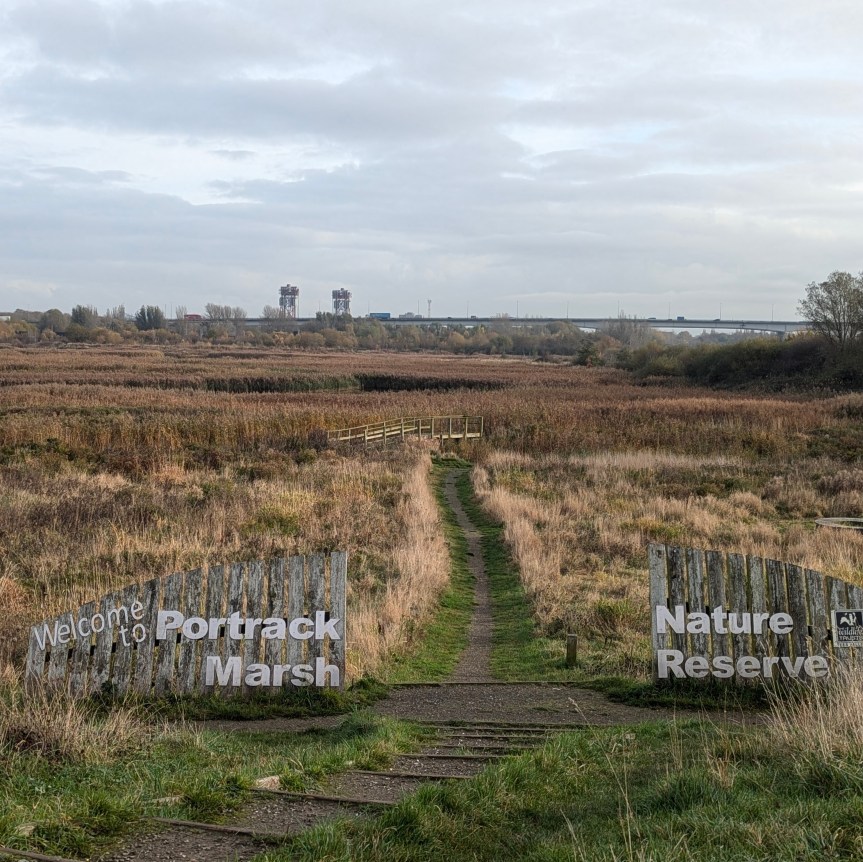
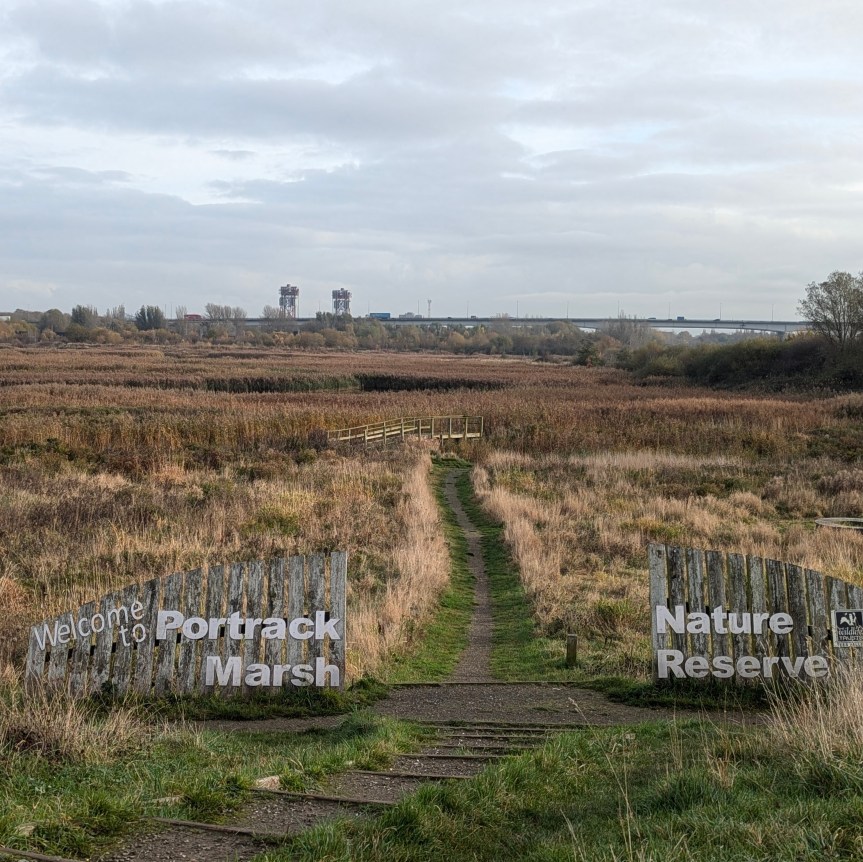
Last week I was joined in my climate emergency drop-in by my wonderful friend and fellow poet Jo Colley. Together we explored Portrack Marshes managed by the Tees Wildlife Trust, an area of crucial reedbeds and open water just the other side of the embankment from the manicured whitewater runs and jogging paths of the Tees Barrage.
Reedbeds and marshes, along with salt creeks like the one that has been restored at Greatham, are essential to the flood resilience of the Tees riverway as extreme weather events become the norm and sea levels push upwards from Teesmouth. I was conference poet at the launch of the Tidelands partnership last year, a multi-agency project to protect and restore habitats like these which provide a place for flooding to run off safely, to be reabsorbed into the river system with minimal damage to human infrastructure – and preserve biodiversity in the meantime.
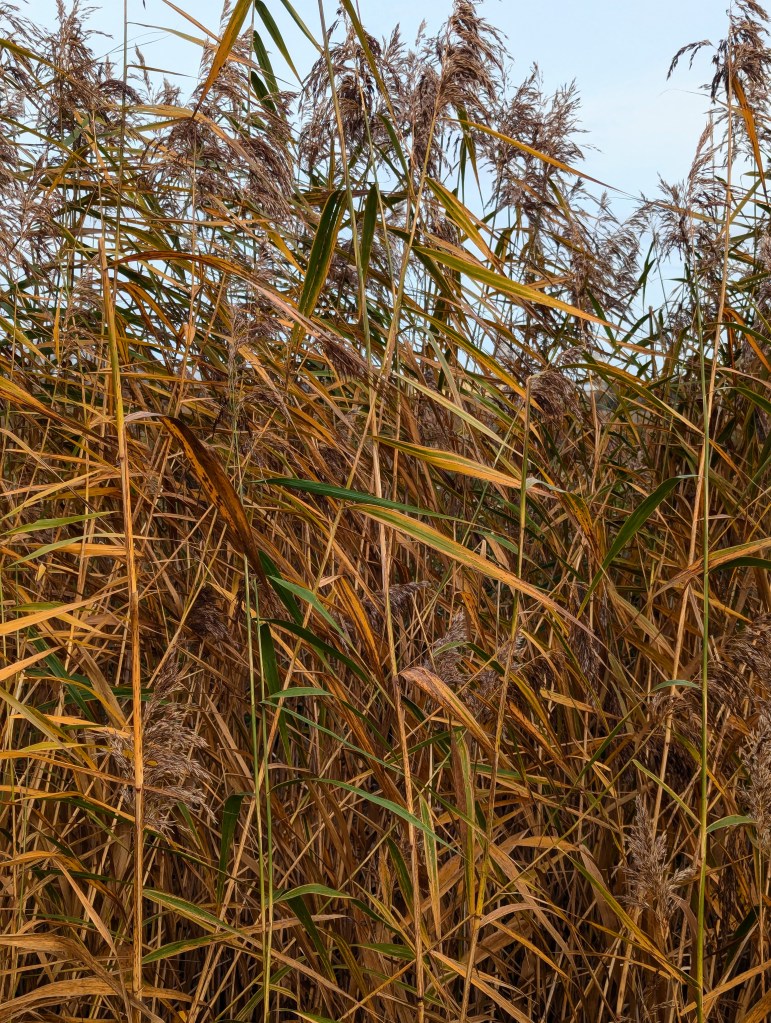
Susurrating marsh soughs seed-head rush-hush shiver-silver the open pannes of water standing shining among the signing stems of Portrack’s sun-struck panoply with its scattering of warblers.
You can read my full conference poem at the end of this blog…
Jo and I have spoken before about climate collapse and our feelings around it, which are often feelings of grief, panic, anger and impotence. As poets we realised we have something of a tendency to elegy! We’ve both lived long enough to notice the absences, the gaps where the birds should be flitting, the silences where the insects should be humming. People growing up now won’t notice there’s anything out of the ordinary, they have nothing to compare it with, any more that we can fully credit C19th accounts of the mouth of the Tees literally boiling with the abundance of fish. It’s called a shifting baseline, and its one way in which we collectively forget, deny, or protect ourselves from the truth of ecological erosion.
Because the truth of it is overwhelming, and extremely hard to handle without sinking under the weight of it or else disconnecting into distraction and denial. As Jo and I walked, our conversation ranged from thoughts about how genocide and ecocide are dark twins born from the worst human drives; how political systems are stacked against urgent, rapid, change; how the free market will kill us all; how Trump really is The Last Trump for all kinds of hopes.
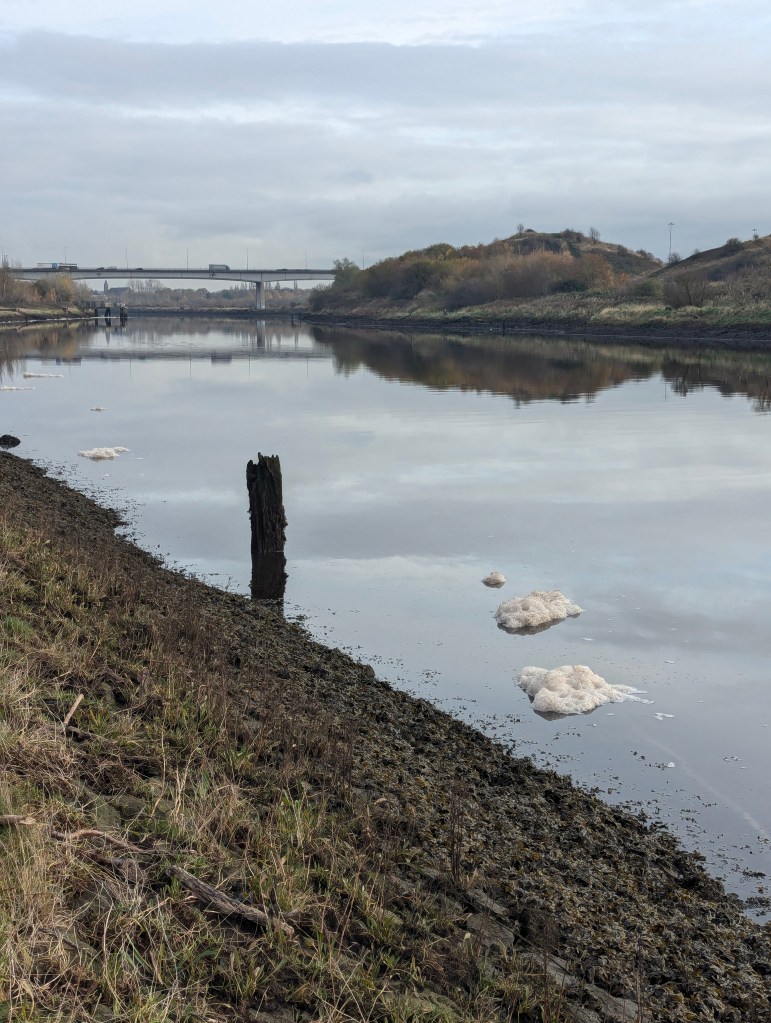
We also saw white egrets and serene herons, families of long-tailed tits and winter sun backlighting frothy reed-heads and exploded bullrushes. We saw pollution, but praised the “ugly” edgelands where we leave nature alone rather than spend effort and money on “improving” it. We tried to imagine what the genius loci of this place would look and sound like, and what it would take for us to be motivated for the fight by a sacred relationship with our land the way indigenous land-defenders are. We moved in the sunlight, enjoying the rightness of the chill in the November air, and as we moved our thoughts and emotions flowed with us.
Helpful thoughts and commitments to ourselves:
When we think deeply about nature, we will walk in nature – movement helps us process, and being outside gives us a floodplain to contain unexpectedly big emotions.
We will notice beauty – anywhere it appears, in however small a detail or embattled a location, and we will praise it.
We will take strength from what we’ve already done – when looking for more ways to help the planet and adapt to climate change, we will not start by berating ourselves and nagging ourselves and others into despair; instead we will acknowledge and share the choices we’ve made to green our lives, in the hopes it will inspire others and lend energy to our resolve. A low-consumption lifestyle is not actually a hardship!
We will practice hopefulness – and we will persist in making sustainable changes to behaviours and choices that are within our gift.
Some things we and our loved ones already do – how about you? Give me more ideas in the comments!
Eating veggie/vegan – all the time, or increasing to most of the time
Only buying second-hand clothes
Only buying reconditioned electronic devices
Buying dry groceries from refill shops whenever possible
Repairing rather than replacing laptops – I use Kingfisher in Hartlepool
A common thread in my last two drop-ins have been conversations around the environmental impact of server farms, AI, and the ecological weight of the internet generally. We don’t want to use fossil-fuel-generated electricity and precious water just to keep a bunch of random photos alive on the Cloud. So our next small, sustainable change is:
Setting a monthly standing appointment to download and/or delete our videos, photos, and old emails.
I’ll be spending some of my time at this Thursday’s drop-in doing a digital clear-out, and if you’d like to join me for a chat while we clean the Cloud please do! I’ll be downstairs in ARC Stockton cafe from 2-4pm.
Tidelands
Written for the launch of the Tees Tidelands Partnership, 9/11/23

Prologue

Those of us who live at the edge, we know
how water breathes, hour to hour and moon to moon,
how the sea drags her swollen belly around the clock, around the planet,
how she presses it into the river’s mouth.
Season to season, we watch as placid sapphire
is chased away by furious greys, and we say
those are winter waves
as storms spit the wrack line up on to the coast road
and take another chomp out of the Prom.
We know the sea will come.

Humans, when we feel a push, our instinct is – resist!
Blockade, force, and dominate whatever suits itself ahead of us.
(The shadow of bold conquerors hides fear and disgust -
unruly nature! Disobedient water!)
200 years, we’ve broken these “waste-lands” to industry’s bridle.
Drain, constrain, reclaim; always a tussle for territory,
a concept so entrenched that barricades once seemed common sense -
build high and hard the flood defense!
What we can’t control must be a threat,
lace tight the river’s corset, never let loose the tourniquet!

Stand your ground – but estuarine grounds should not stay still.
Better that silts should shift than baselines -
our new normals, denatured and denuded,
squeezing memories of abundance back in time
until true tales of delta waters boiling with fish
appear to us as fantastical myths.

200 years under carbonized, tatterdemalion smokestack skies,
fingers deep in money pies, and pride, and livelihoods
prospering without heed for the need of carbon sequestering snugly in the mud
of Greatham’s meanders…
Well, we raised that Lazarus creek.
We’ve turned back toxic tides before.
We can and must do more…

1. Restore

From the Amoco pipeline to Majuba Road
Wildflowers grow in their poor, perfect homes		   restharrow, black medick
Their names a natural poem
								                                   spike rush, milkwort, melitot
Enough forgotten to sound now arcane
								                                    creeping thistle, biting stonecrop,
Tenacity. Vulnerability, What’s in a name?

We call them for their colours	                                    red clover, white campion
                                                                                                               yellow rattle, that root-starves
the bullying grass holds space
for even smaller jewels		                                            sea mouse-ear – miniscule!

So many speak of animals		                                     cats-ear, toadflax, fleabane

So many speak of niche			                                      marsh orchid, hedge bedstraw

Flora-fauna-habitat a tangle of vivid nomenclature
given when we knew their characters,
observed affinities.

We must restore						                        ourselves
to patient knowledge passed on in a chain			un-sundered
forged in fresh air, away from desk and test			sun, wind, rain
a schooling spoken						                        shown
and known as children’s stories are				        heart-known
We must restore paths						                connect
our unhindered spaces, and walk				                green corridors
with our eyes open						                        together

2. Reconnect

Susurrating marsh soughs seed-head rush-hush
shiver-silver the open pannes of water standing
shining among the signing stems of Portrack’s
sun-struck panoply with its scattering of warblers.

White flames the egret,
scarlet flares the dragonfly,

and shhhhh – shhhhhh

Underneath the reed-roots sleep, holding fast
to the memory of sea, like a dream they once had
of their mother.

part salt part sweet part water part land

This is an orphaned place.

When century storms surge and inundate
the surface rises, a spectacular drowning,
becomes a kettled lake, denied egress –

Long ago, we cut the umbilicus.

And so it saturates under circumstances
that can only keep repeating, until
all becomes brackish beyond the bounds of life,
but for we
who can see where withered tributaries
may be honoured into revival
may be connected to our own survival.

3. Realign

We’re all trying for a win-win
Tide goes out, tide comes in

Is welcomed into arms of marsh
The wash, the swash, the back and forth

Resistance is – pretty useless
To be soft is true resilience

Praise the hawthorn saplings, they promise rebalance
But please don’t nick our coir rolls, thanks

We’re going for 20:80 effort to result – smart!
Looks like 80% science, 20% weird land art

I’m here for it! Never too late
to breed breakwaters that self-replicate

It’s polytunnels now for future forests of seagrass
It’s threading more salmon through a better fish-pass

It’s keyhole surgery, it’s controlled breaches
It’s a river running freely to its natural reaches

On haul-outs grey seals dream of more eels
Ghost islands lurk inside our fields

Stand now, shoulder to shoulder to shoulder
This project’s new – the flood plain’s older…

Epilogue

And we know, those of us here at the edge,
we know the sea is coming,
and climate change won’t listen to a cabinet of Canutes.
But we will not stand mute.
We are not a lone voice, and this is not wilderness but treasure –
the tidelands are our lands.
It will be the work of our hands
to bring them back to fullness, together.






 Kirsten Luckins