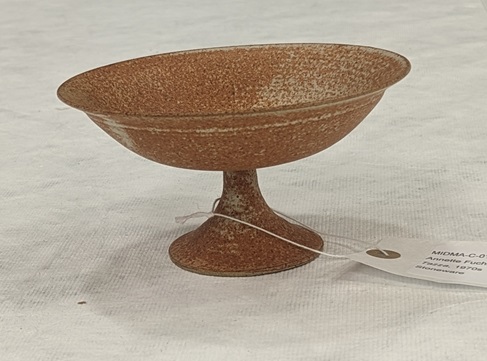
79 AD – for a Fuchs tazza

It’s small, about 18cm high maybe? Just looking at it, there is a classical, visual beauty in the proportions and the terracotta. But when you pick it up, the perfection of its balanced weight is breathtaking.

The second of my four digital poems for ceramic pieces in MIMA was written for a tazza, or serving dish on a pedestal and foot, wheel-turned out of earthenware by ceramicist Annette Fuchs. It made me imagine Roman society and murals, which in turn led me to think about Pompeii and Herculaneum. Pliny the Younger described the cloud of smoke that preceded the eruption of Vesuvius in 79AD as “a pine tree, for it shot up to a great height in the form of a very tall trunk, which spread itself out at the top”, a description which reminded me of the tazza shape. On this tazza, a pale razor-blade-shaped void has been left in the red surface, perhaps deliberately, as superstitious people will sometimes add a smudge to their make-up so the gods don’t get jealous…
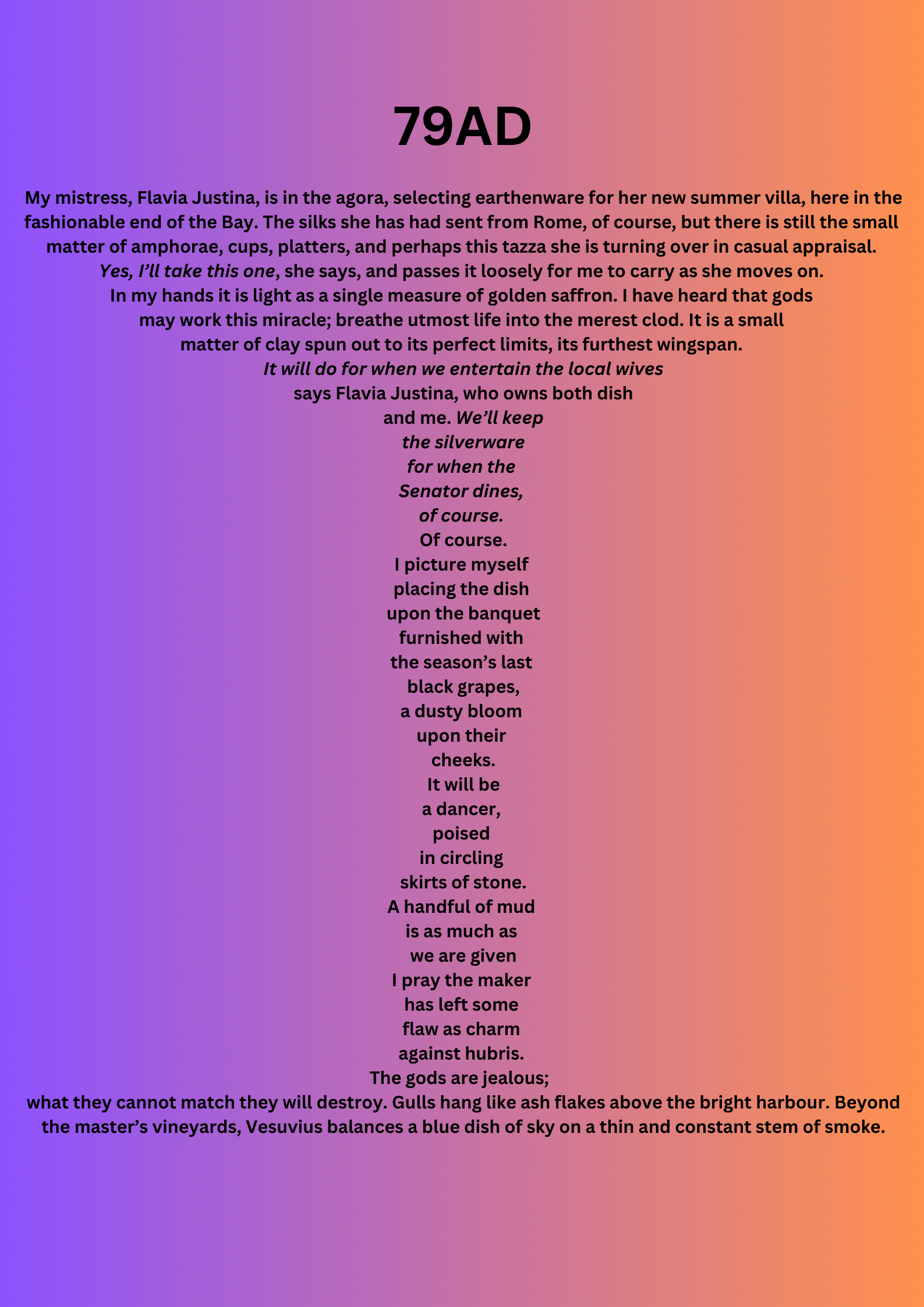
This poem has had a couple of concrete incarnations – the one above, which I made especially for this blog post, and the version in the micro-pamphlet handout produced by MIMA to accompany the exhibition, which had eight stanzas each shaped like a tazza. Can you guess where the stanza- and line-breaks came?

This extract from the visuals of the digital poem should give you a clue!

This is again made in Canva videos, using a textured background duplicated and flipped mirror-image along a vertical axis to enhance the tazza-shape of the stanzas. I then overlaid the texture with a free clip of a puff of smoke, to foreshadow the eruption of the volcano. The film clip was actually in a long, thin, landscape orientation. I have enlarged it, flipped it the portrait orientation, mirrored it along the same midline of the frame, and dialed down the transparency so it is a ghost of its former self…

What sounds would you choose to accompany this digital poem?

I’ll post all four completed pieces, with soundtracks, in my fourth blog. Watch this space for curved kinetic typography, charcoal animation, and weird adventures in Audacity and AI…

If you’re a woman, a poet, and you live in Teesside, then why not apply to be the next TWP poet-in-residence at MIMA’s Towards New Worlds exhibition this autumn? Information and application form here.
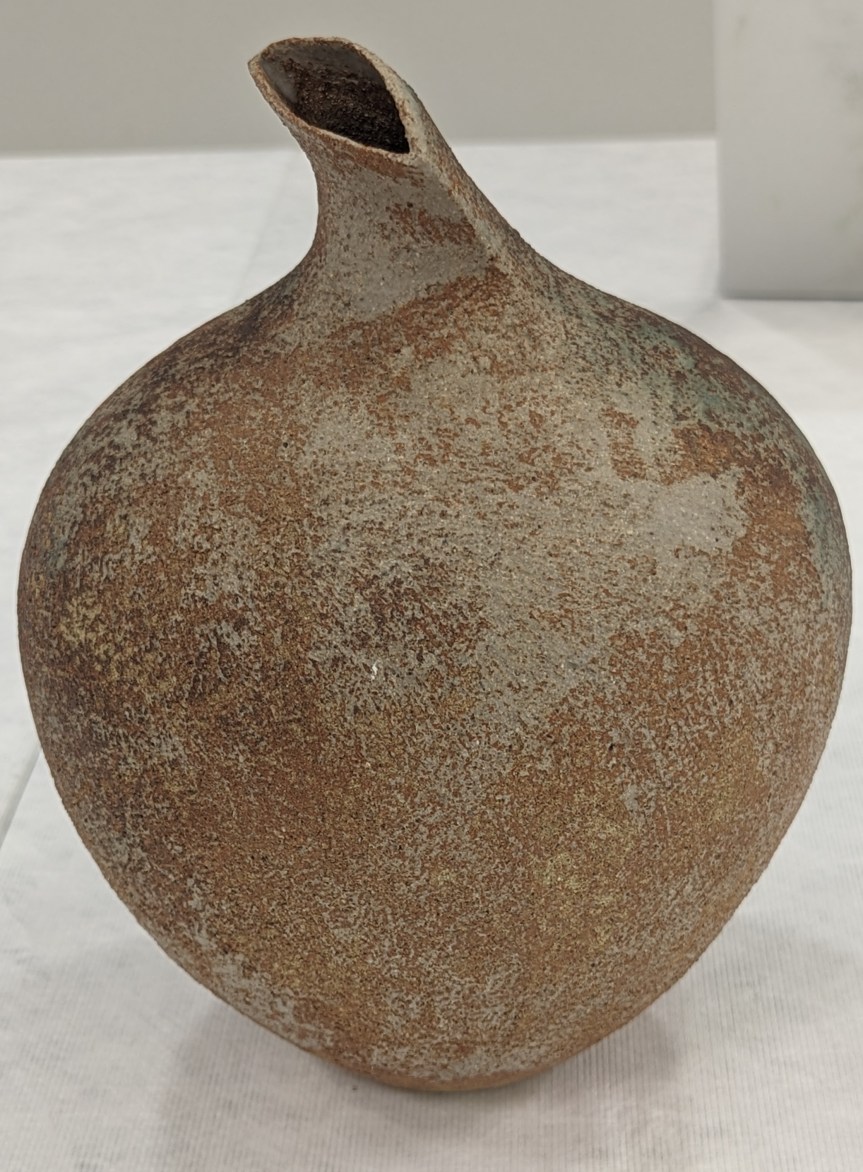
Origin Story – for a Betty Blandino vase

Now that my digital poems have finished their run at MIMA, I’m bringing you all four of them with some info on my process.

This first poem was written for a “leaning-neck vase” by Betty Blandino (1927-2011). As the poem states, the piece is made of coiled stoneware and is unexpectedly light when picked up – the rough finish makes it look like a natural stone, so the expectation of weight was there, and I did literally start talking to this pot when I held it.

My first step was to handle the pot, feel my responses, write notes, draw the vase to get its shape into my muscles…(and later use it for some gelli plate experiments, like you do)

Next step was to go away and write a poem from it. After a few edits, this poem then became a short film using a Canva video template (specifically, the Black White Minimalist the End template). I chose it because it features moving, soft focus lights with reddish-orange hues that made me think of the vase’s rusty-orange surface.

It also seemed to fit with an atmosphere of fairy stories/origin stories/when you were just a twinkle in my eye – the feelings of the poem, if not the specific details of the words. I changed the Canva template’s typefaces and text positioning, and played with how and where the text should arrive on each slide, changed the tempo to suit, and downloaded.

So far, everything I’ve used has been free and easily accessible. This was the result.

Now, that is not the final version of the digital poem – all four poems had soundtracks added before they were shown at MIMA, but you’ll have to wait because I’m going to talk about that, and show you the final looped installation, in a few blogs’ time! You could subscribe, if you like, then you won’t mis any of them?

But I will show you the last iteration of the poem right now, which is as a concrete poem. This was printed in the programme that accompanied the screening, with the following artist’s statement:

Origin Story was written for a coiled stoneware vase with a ‘leaning neck’ made by Betty Blandino (1927-2011). Handling this pot was a sensory overload for me, as it looks like a stone, feels like weathered rust, and is unexpectedly weightless. The shape is reminiscent of an amphora, a pot made specifically to store foodstuffs like wine or oil, but it is kept hollow, and sonorous.  I found myself speaking to it like a sentient creature, and continued that conversation into the poem, imagining myself telling the vase myths about itself like bedtime stories for a child. Little pitchers have big ears.

The observant among you may notice that there are some differences between the texts of the two versions, which just goes to show that poems are never quite finished.

Watch out for the next digital poem, which will be 79AD, written in response to an earthenware tazza by Annette Fuchs.