Voyager -for a ‘poem bowl’ by Rupert Spira – and all four digital poems!

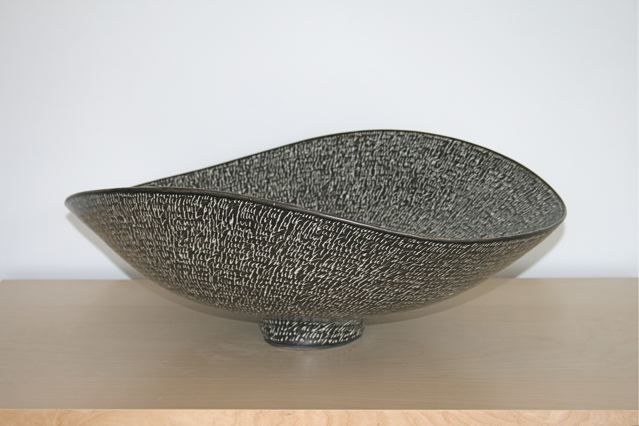
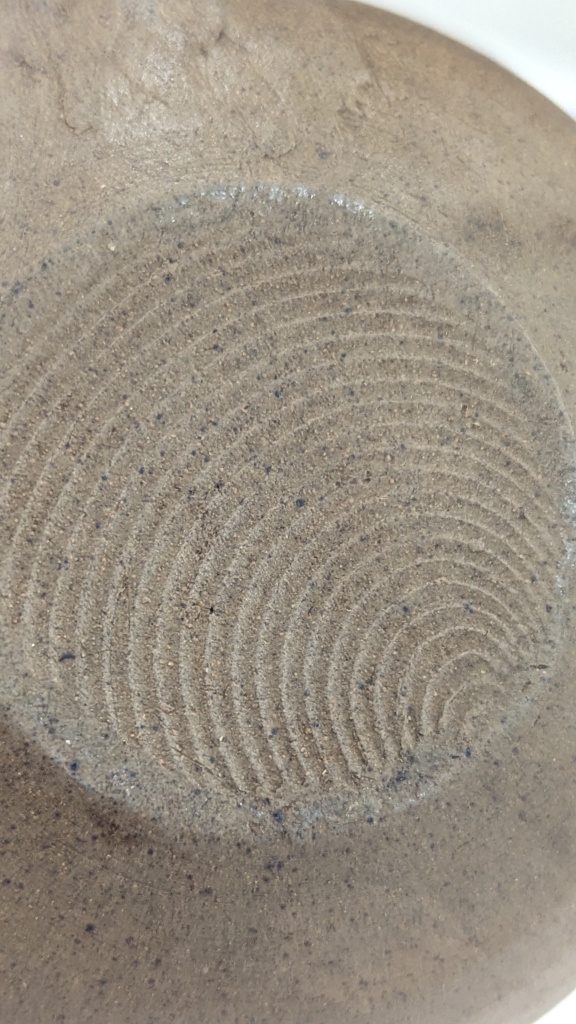
The fourth and final digital poem I made for my MIMA/Tees Women Poets residency was Voyager, written for Poem Bowl by potter, writer and philosopher Rupert Spira (b.1960). A vast black dish, it is decorated inside and out with a mostly illegible hand-written text that has been incised through the black glaze. Certain words can be made out, and these have been incorporated into the poem.

My inspirations for the imagery in the poem comes from the way the dish reminded me of both a warped vinyl record and a radio dish. Combined with the only partial legibility of the decoration, it led me to play with ideas of decaying signals and transmissions through space. The audio accompanying the digital poem features a short sample from “I’ll Be Seeing You” by Billie Holliday, which was the last message sent by NASA to the Mars Rover Opportunity before it ‘died’ in 2019.

The sound track for this poem was the most complicated, featuring free samples of for example vinyl record clicks and Cold War numbers stations alongside my own voice pushed through echo and distortion effects, and the poem text run through AI voice generators. All of this was put together using free Audacity software, which also allows you to create blocks of static interference.

The digital poem was also the most complex in terms of the kinetic typography, even though it was made in Canva in exactly the same way at 79AD and Origin Story. Drawing on the circular nature of the bowl, and all the images of records, radio dishes etc that are in the poem, I made the typography follow arcing pathways. The sections of text overlap and ‘degrade’, just like the audio. To make the effect of degradation I reduced the transparency of the text by degrees, sometimes in arcs that were offset so the faded echoes can still be read; and once in a fully-aligned circle with text blacked out except for certain selected letters.

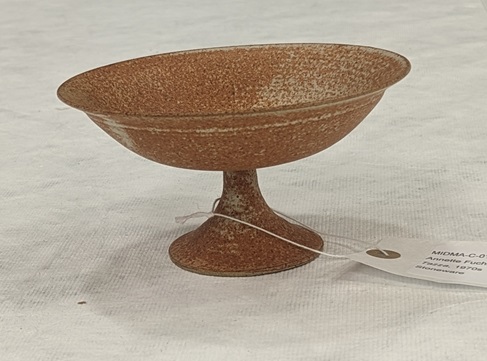
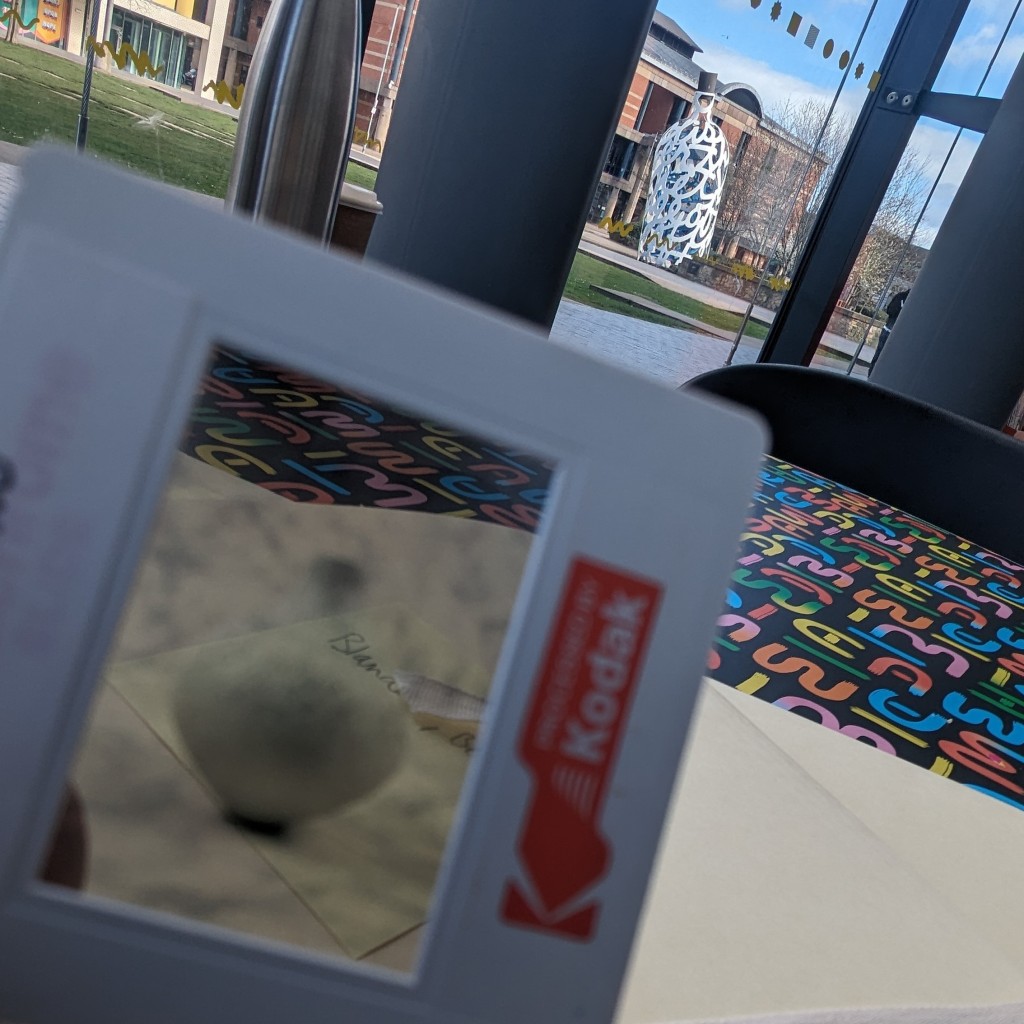
I’m really proud of these digital poems! Here’s a reminder of the ceramics that inspired them – a leaning neck vase by Betty Blandino (Origin Story); a tazza by Annette Fuchs (79AD); a bowl by Deirdre Burnett (Egg Fiction); and a poem bowl by Rupert Spira (Voyager).

  • A rough and rusty-looking vase with a neck that is bent to the left.

And here are the finished digital poems in the loop as it appeared at MIMA. Headphones on!

For those that are interested in the sounds, here’s a list of all the sound clips I used – see if you can tell which poems they appeared in!

  • Volcano lava
  • Dripping cave
  • Message 4
  • Chickens
  • Seagull flock
  • Vinyl scratch skip loop
  • Cave music
  • Chucks Egg classic arcade game
  • Little chicken
  • Needle drop
  • Numbers station 332241
  • Seagull short
  • Vinyl scraped
  • Vinyl crackle 33rpm

79 AD – for a Fuchs tazza

It’s small, about 18cm high maybe? Just looking at it, there is a classical, visual beauty in the proportions and the terracotta. But when you pick it up, the perfection of its balanced weight is breathtaking.

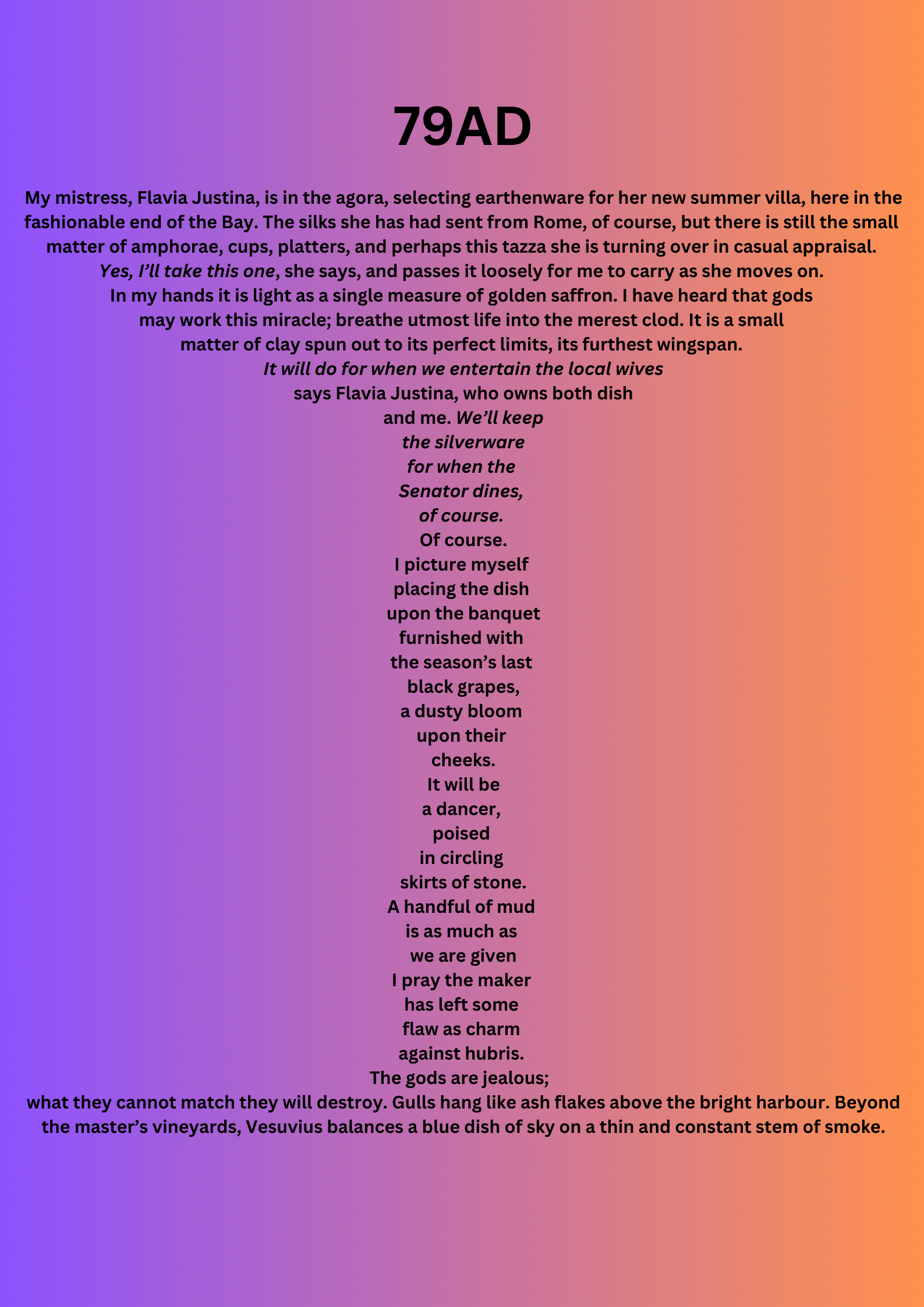
The second of my four digital poems for ceramic pieces in MIMA was written for a tazza, or serving dish on a pedestal and foot, wheel-turned out of earthenware by ceramicist Annette Fuchs. It made me imagine Roman society and murals, which in turn led me to think about Pompeii and Herculaneum. Pliny the Younger described the cloud of smoke that preceded the eruption of Vesuvius in 79AD as “a pine tree, for it shot up to a great height in the form of a very tall trunk, which spread itself out at the top”, a description which reminded me of the tazza shape. On this tazza, a pale razor-blade-shaped void has been left in the red surface, perhaps deliberately, as superstitious people will sometimes add a smudge to their make-up so the gods don’t get jealous…

This poem has had a couple of concrete incarnations – the one above, which I made especially for this blog post, and the version in the micro-pamphlet handout produced by MIMA to accompany the exhibition, which had eight stanzas each shaped like a tazza. Can you guess where the stanza- and line-breaks came?

This extract from the visuals of the digital poem should give you a clue!

This is again made in Canva videos, using a textured background duplicated and flipped mirror-image along a vertical axis to enhance the tazza-shape of the stanzas. I then overlaid the texture with a free clip of a puff of smoke, to foreshadow the eruption of the volcano. The film clip was actually in a long, thin, landscape orientation. I have enlarged it, flipped it the portrait orientation, mirrored it along the same midline of the frame, and dialed down the transparency so it is a ghost of its former self…

What sounds would you choose to accompany this digital poem?

I’ll post all four completed pieces, with soundtracks, in my fourth blog. Watch this space for curved kinetic typography, charcoal animation, and weird adventures in Audacity and AI…

If you’re a woman, a poet, and you live in Teesside, then why not apply to be the next TWP poet-in-residence at MIMA’s Towards New Worlds exhibition this autumn? Information and application form here.

What exactly does a poet-in-residence do?

How long is a piece of string?!

Residencies for poets are few and far between. At one end of the scale, a residency offers time and often a dedicated space away from home life, in which to explore your craft and make progress on new work. Most of these will be a commercial proposition where the poet is the one that pays. Sometimes it’s subsidised, and with hen’s-teeth rarity the poet is paid just to be a poet – living the dream!!

On the other end of the scale, you are paid but the emphasis is firmly on delivering a set of outcomes for the venue who is hiring you, whether that be an agreed number of poems in a prescribed format, and/or a set number of participatory activities for groups of people important to the venue. The more participatory the brief, the more likely it is that you’ll be working with children, families, and possibly with groups that have specific access needs of various kinds. For this kind of residency to be a residency rather than a short-term hire or a commission, there should be some wiggle room to make new work on your own terms, but there is a real need to align your professional ambitions with the needs of the host – and the host is probably thinking in terms of foot-fall and engagement.

An ideal residency should have elements of both valuable outputs and independent creative experimentation, and an expectation that the exact methods of delivery might be decided through co-creation and negotiation between artist and staff teams. You still need to pitch a good idea, though, and that can feel a bit like having to be telepathic, guessing at what the venue might really need or having some experiential knowledge of how commissioning organisations operate on a day-to-day basis. For example, is their staff team small and overwhelmed, might you need to foreground your ability to self-manage or include social media activity in your pitch?

My current residency at MIMA for Tees Women Poets has been a real joy. The expectations of the host venue were clear – create digital poems in response to the Contemporary Ceramics collection in a format that could be used on a flat screen within the gallery, within a very specific timescale. Be able to self-organise and meet deadlines to present the work at MIMA Art Social #17 on 20th June. Offer two workshops to ensure the public and the TWP are getting developmental benefit, but also develop my own creative practice by learning new skills.

What does that look like in terms of my activity? It’s involved

  • an in-person pottery handling session with the curatorial team
  • my attendance at a workshop about de-colonializing ceramics curation, again with the staff team (see the slideshow above)
  • several days of writing and editing poems in response to handling pots
  • delivering a creative writing workshop with exercises inspired by the ceramics
  • making film-poems from participants’ work in Reels
  • delivering a round-table discussion about residencies for TWP members who would like to apply for future opportunities
  • learning how to make kinetic typography digital poems in Canva
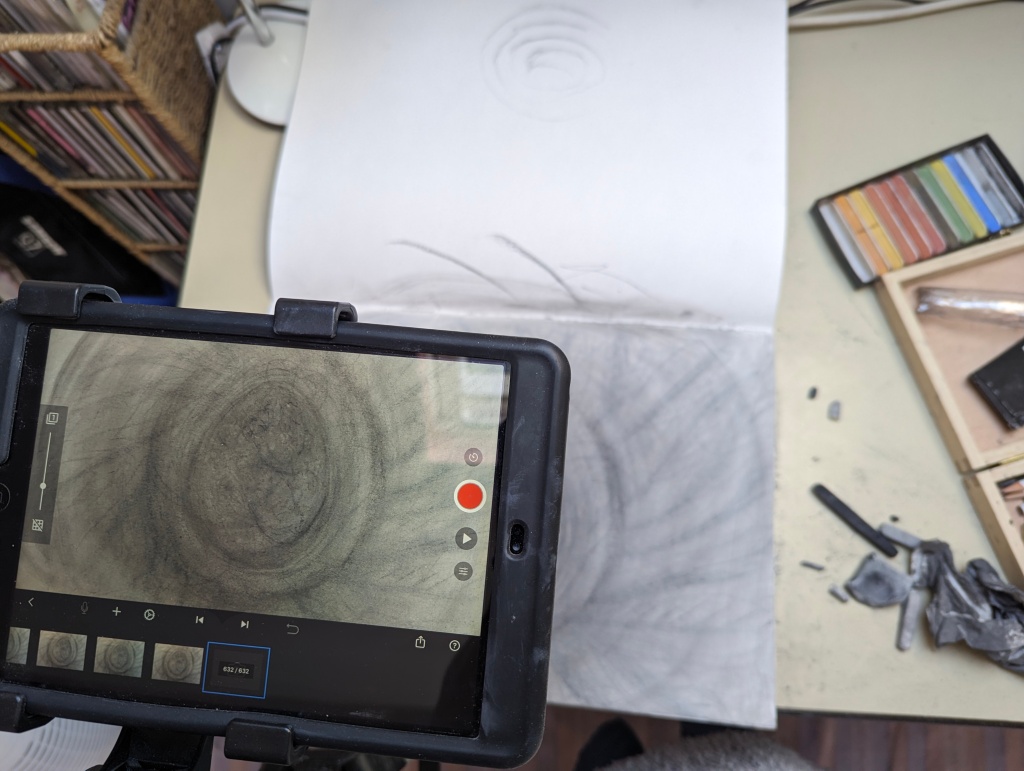
  • learning how to make charcoal animations
  • experimenting with AI-generated voice-overs
  • learning how to create soundtracks in Audacity
  • the creation of four digital poems ready to reveal in June.

To find out more about my process and poems, please come to MIMA Art Social #17 on Thursday 20th June, 5.30-8pm at MIMA, and I’ll reveal all!!

Teeny Tiny Writing

It’s a truth universally acknowledged that one collaged found poem does not a writing residency make.

(To catch a hold of what I’m blethering on about, read how I am inventing my own residency, and have a neb at my first piece of work.)

Next steps, therefore, must be to produce more, more, more, MORE work. Dutifully, I turned my attention to the ‘treatment proposal’ document pertaining to Toussaint L’Ouverture by Lubaina Himid. I took that report, and I cut it into strips, and I shuffled it around, and I thought about how we should treat each other with the kind of loving attention that a conservator lavishes on an Old Master, and – well. Turns out either the language of art conservation is truly lacking in poetry, or I am much worse at this than I thought. Darnit.

I managed to glean two micro-poems, two tiny little ‘treatment proposals’. The first is a kind of instruction about treating your own self with patience.

Surface, glazed – a decision made

The second is more about treating others with compassion.

Whilst inherently unstable,
small tears can be repaired by
supporting

Then, because they were so teeny-tiny, I spent some time bigging them up via the application of Some Slightly Flashier Techniques, making one into a stop-motion film,

and the other into both a stop-motion and a collage.

Treatment Proposal 1 collage after Himid
The upshot is that I quite like the end products! The collage is on cardboard, something I’ve been meaning to try for ages, and which I felt duty-bound to do now because Himid’s work is on cardboard. It’s a fantastically accessible material, which I’m sure is a political statement on her part, and of course it’s a better environmental choice than buying art paper especially. I think I’ll keep on using cardboard in future projects.

The stop-motions are fairly crude, but I do love the process. I played around with filters for the first time, and liked the way a black-and-white resulted in great gashes of light appearing in the animation. It’s good to know that even if my lighting conditions at home are desperately amateur, I might still be able to salvage or even improve footage by using the right built-in cheats.

Next time, I combine erasure poetry with stop-motion, and try to pay homage to Himid’s politics. While I’m gone, here’s an automatic haiku generator for you to play with.

Lubaina Himid’s Sexy Slapdash Squares

I’m in the second-floor gallery at mima. I’m surrounded by an amazing array of art. I need to choose maybe half a dozen artworks as my focus. I’m a writer-in-residence. I’m going to use their archived records as source texts for erasure poems, but I have no idea what kind of documents are kept on file. What do I choose?

My first choice, without a moment’s hesitation, is Toussaint L’Ouverture by Lubaina Himid. It’s huge, bold, and contains loads of brilliant collage elements. I know that I want to use collage as an erasure technique in my found poems. Himid is definitely a good choice.

mima envelopeSkip forward a few weeks, and I’m at home when an enormous padded envelope arrives from the mima team. Inside is a ream of photocopied archive documents, including several about Himid’s work. There is an extensive biography, an acquisition statement, and a detailed condition report from a conservator. This last document includes a thorough treatment proposal, full of technical suggestions on how to repair and maintain the painting.

I start from waaaay inside my comfort zone – a tiny found poem spied in the condition report, simple and quite abstract. It’s all about colour, but not about race. I know I’ll have to work out how to respond to Himid with some shred of socio-political consciousness, but I haven’t thought it through yet. I just want to do some erasure using collage squares that are as exuberant as the ones that Himid has used to make the floor under Toussaint’s boots.

Himid collage squares

I ransack my stack of magazines for images featuring gold and yellow, cut them into rough squares, and set about it with a Pritt stick. Bliss.

“Gold has yellowed….yellowed…yellows”

Gold Yellows collage after Himid

Is this developing my creative practice? It’s not so far away from work I’ve made in the past, although I’ve never made a process video before. I love time lapse! OK, I will try to do more of these videos, and framed better, without so much of my belly-bulge showing. But first I have a hankering to do some stop-motion.

Tune in next week to find out what I manage to squeeze from a treatment proposal, and why I start regretting the whole endeavour…