11.01 Northbound, the song of the rails And footie fans
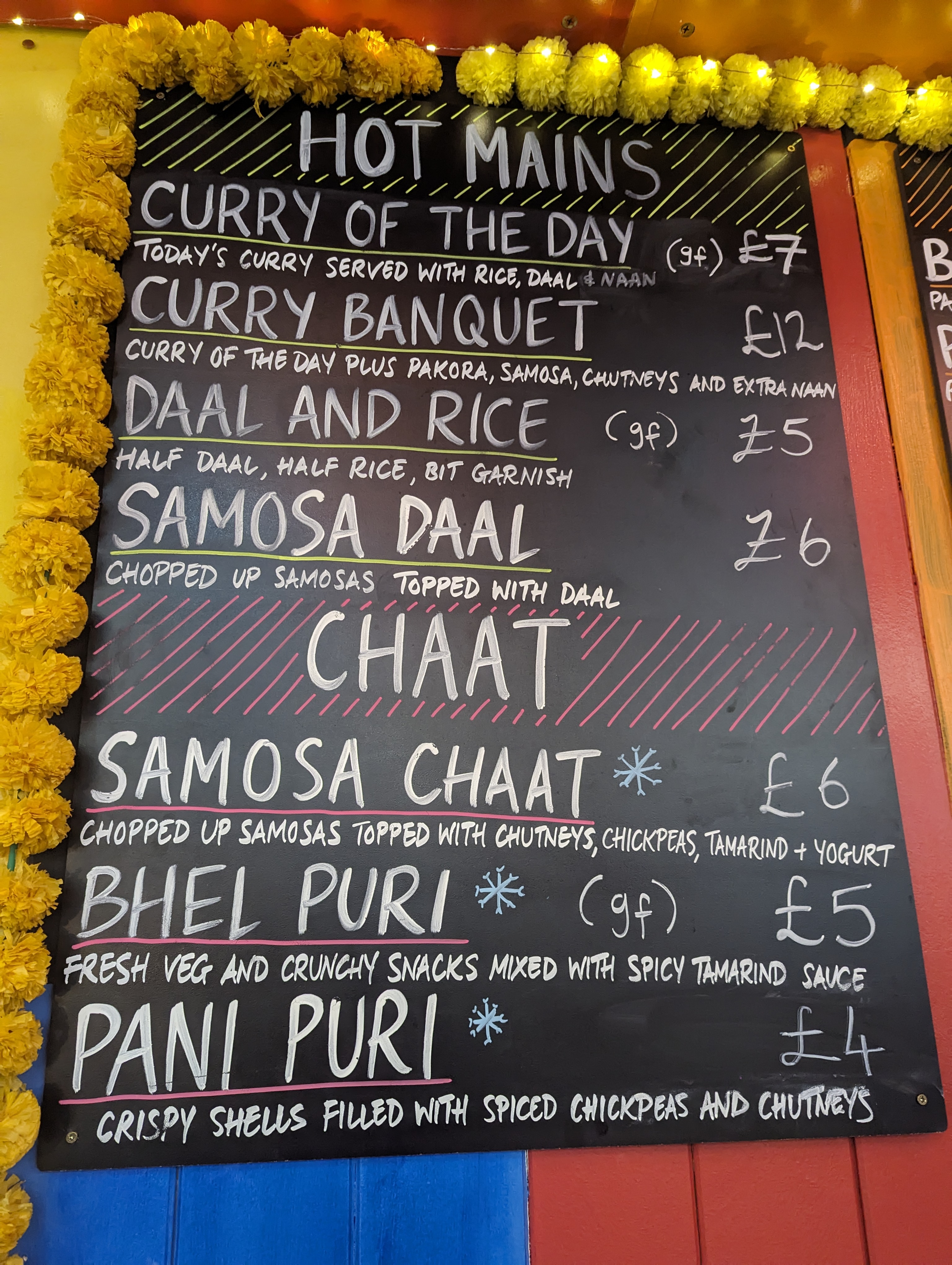
Bright tongue-punch of tamarind – I’d go miles for pani puri
New builds on brownfields Fennel glades, teazels, finches Unhomed
Kestrel’s cliff scraped clean of roots Bloody cranesbill
Street food, not sawdust In the covered market; ghosts… Skinned hares, white tripes
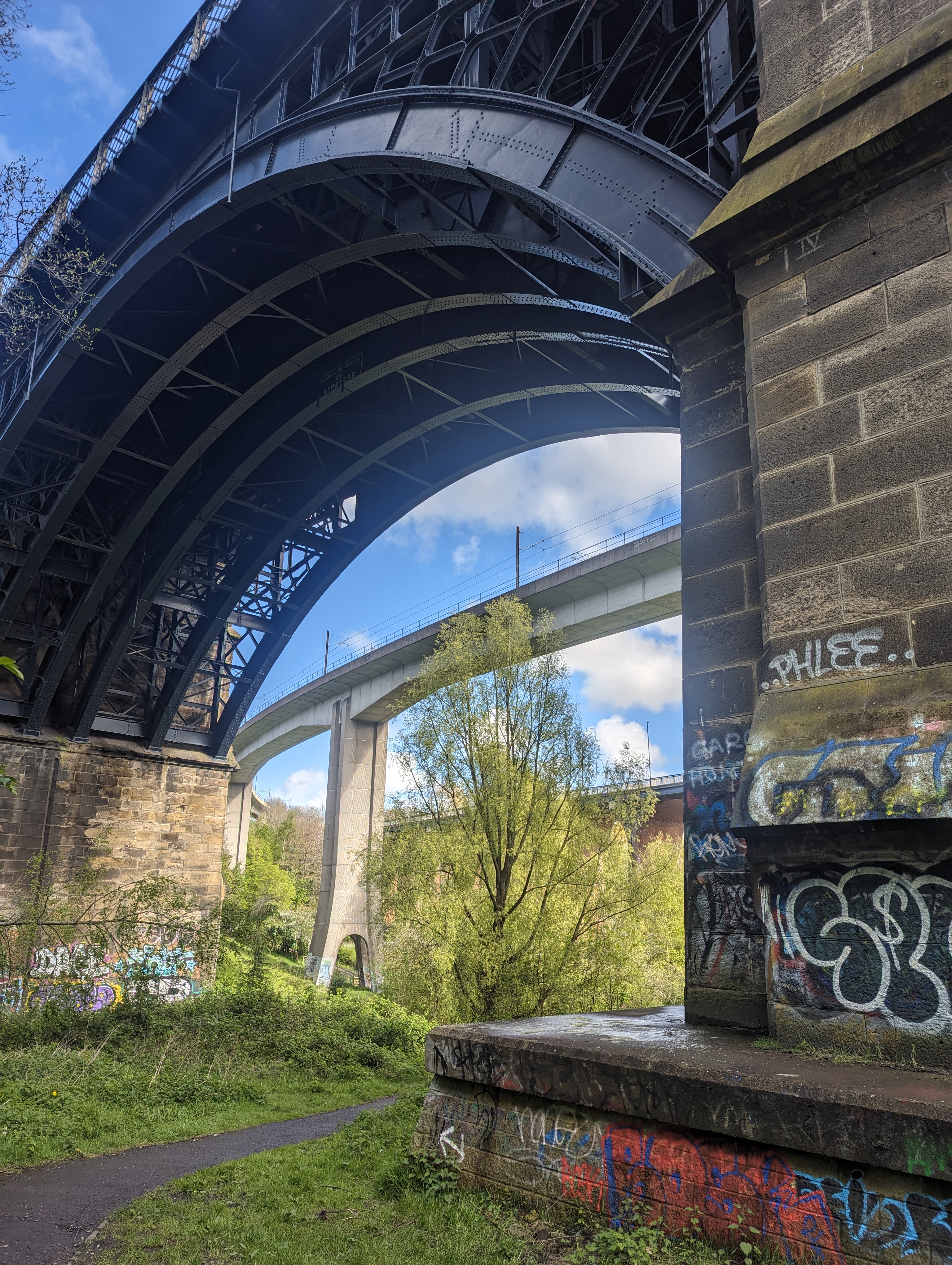
Kittiwakes scream from the bridge No-one wants a terraced house
Everyone is fine Talking to thin air these days – Pods. Buds. Our blue teeth.
Shop fronts like cast shells Waiting for crabs
Guts hanging out Sliding doors wedged open Cataract windows
The Laing’s a drum, deaf with rain Paintings sign to each other
Bloodlust and faith Objects in oils and suspense Gilt-framed
Gulls after a lightning strike – The Age Concern social group
Do you paint? Used to. But the girl I showed them to Never loved me back.
Sap green Scorched earth
Where you see a storm I see a girl tucking in To a ham sandwich
Things, alone in their thingness But, a field of attention
Smashed rainbow The old snooker hall windows Be Gay, Do Crime
Three white clouds; the blossom trees Next to Manors car park
Tall cakes, short coffees In your head, they’re still fighting – This cafe has changed
The basic anatomy Of buildings eludes my pen
I am surprised By the skyline we worked for; Its absences
Ten years in the mirror That body is lost to me
The hotel shower – Skylight in a downpour Headful of pictures
Looks like she ate all the pies Exhibition in a bathtub
Close to shame Wouldn’t do that one (After grabbing)
Shit on the pigeon netting Echoes fall down Dog Leap Stairs
Cities are dreams People too are mostly dreams, New builds on goldfields
The waters of Tyne… They run between me and me
Continuing experiments with renga, though this doesn’t really count as not many people believe a single poet can write a renga – you need at least one other person with whom to collaborate. Let’s say this is me collaborating with the ghosts of former selves as I take a writing day around Newcastle, where I lived and worked for twelve years.
I’ve now lived in Hartlepool longer than I lived in Newcastle, but of course with it being just up the road it’s still very current for me, so the disconnect is not as strong as I might find going back to other old haunts in search of psychogeography. I filled half an old journal with sense impressions and random free writes over the day, then pulled these fragments out. Like emptying your pockets after a foraging walk.
Last month I led my first renga, or rather my first “quarter-renga”. We didn’t have the minimum five hours it takes to lead a group of poets through the collaborative creation of a linked chain of twenty haiku-alternating-with-couplets that is the shortest possible version of a traditional renga.
Now, I have a lot more learning to do about the intricacies of different renga patterns and how to lead people through them skillfully. They remind me of increasingly complex versions of card games – draw the Queen of Spades and pick up the discard, red sevens reverse the direction of play, mention the season once and you must mention it in the next 3 verses, only one verse about the moon per page.
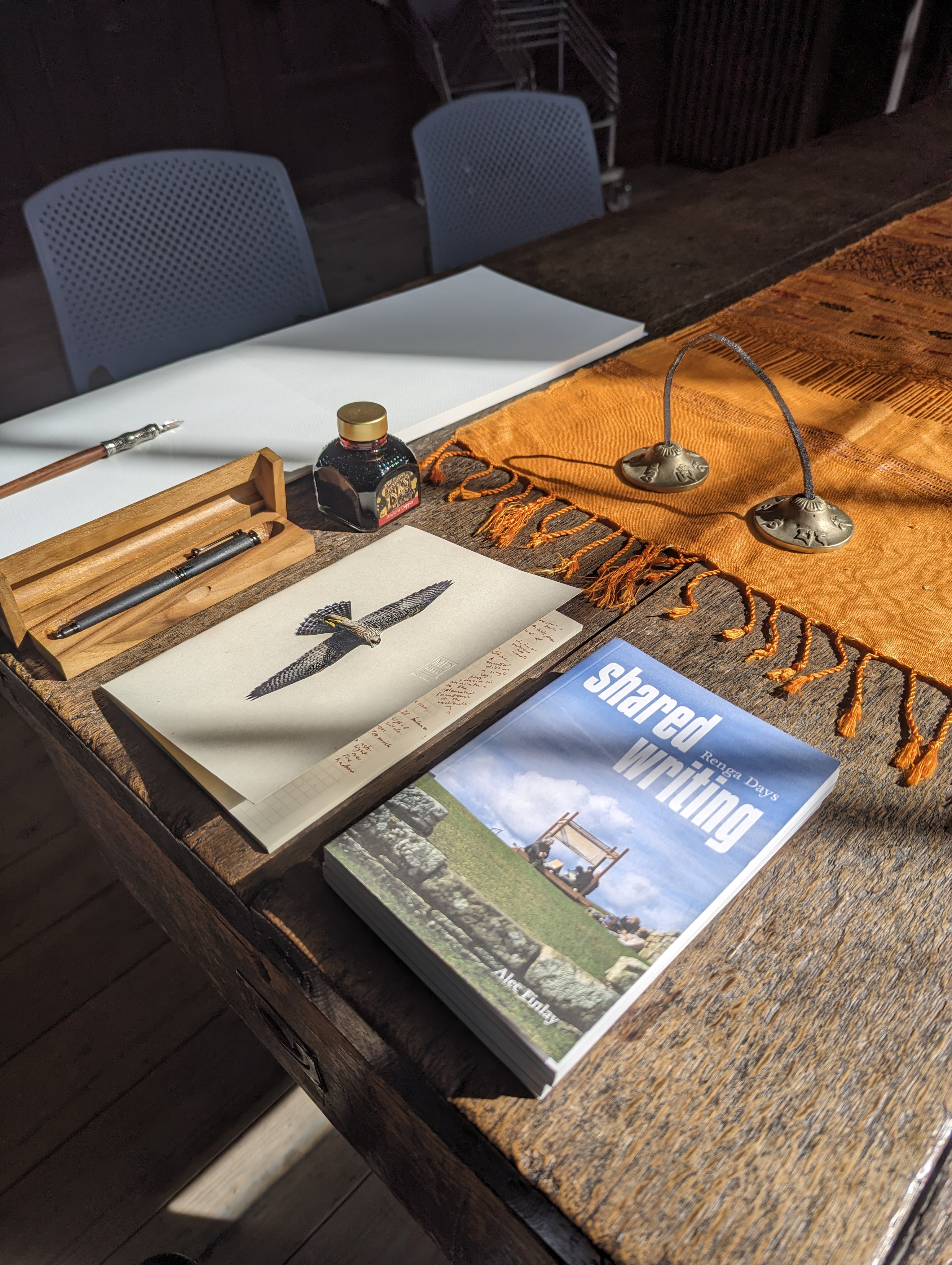
The not-even-quarter renga we created in the sun-warmed vestry at 17nineteen in Sunderland (otherwise known as Holy Trinity church) cherry-picked some of the rules. We opened by establishing a sense of place, then deepened it in the next couplet. Then we allowed the moon to peek into a verse, before closing with a couplet open to any theme. As renga-master, those were the choices I made about the poem’s direction of flow. Four verses took just over an hour.
In keeping with the traditional method of renga, once the direction had been said for the verse in hand, everyone wrote, and everyone then read out the previous verse plus their new addition. As renga-master, I then chose the verse that would take us forward as a group. For the first two, I combined lines from two or more contributors; for the second two, the “correct” verse arrived fully-formed from a single source.
Eight poets took part, and although the final words only derive from five pens, all of us are considered to be co-authors of the resulting work, because it takes everyone’s energy, focus, and revealed words to weave the invisible field of connection in which the renga gestates.
It is a sacred space. It needs space.
With each circuit of the table, alternative poem-chains open out, fractal branching, seedlings of all possible poems grow ghostly, pale and eventually wither. Like my amateur gardening, I feel guilt and regret with every verse I thin out, death of so many. A smile when someone’s words are chosen, against their expectations. My inner wince away from too-clever, too-polished; my confused frustration when people get caught in syllables and don’t quite open the door to the poem – can you feel it? Like a birdcall, words at the right moment, and never too many. The unchoreographed sigh of recognition from everyone when the right lines arrive, when I choose correctly, when we are becoming the hivemind that spins together.
My approach to creating the conditions for the renga to arise was firstly to run two previous workshops about haiku, to provide renga participants with some insights and practice in the form. But several people turned up for the first time for the renga! So I also used Alec Finlay’s book Shared Writing and had us read out some 20-verse renga. I have two copies of the book, so we could do it in pairs, call and response, which was a beautiful way to hear how this way of writing unspools dreamlike dialogue resonant with association, echo and surprise.
A demarcated physical space really helps. Ours was a room, other projects have used a canopied platform. There is something qualitatively different about joint effort within a dedicated space, our combined attention builds an invisible structure that needs the trellis of a protective physical space up which to climb. I believe it would be possible to carry a mobile platform of stakes and flags, or meet in the wilds and create the space with foraged rocks or marks made in sand.
I also set up the energetic space for the renga by leading some brief meditation, and setting aside time for participants to move around the entire venue in silence in order to open their senses and minds to the latent poetry all around us. Even though the writing was done in the vestry, everyone brought with them details of everything from the wind in the trees outside to the halo lamps above the nave (white moons shining down).
In previous workshops I’d been able to do some basic qi gong with the poets, drawing on a previous life as a shiatsu/qi gong practitioner – it’s a useful, possibly essential preparation for poets who may be more used to starting with a focus on inner turmoil than on the observable world. Though makers in other disciplines would no doubt use the metaphors most related to their practices (haiku alternates with couplet, warp and weft, ones and zeroes) for me the rhythm of the chain felt very much like a walking qi gong where the weight must shift to the side before stepping forward. A quieter verse may make the better stepping stone. Not all can be Alpine grandeur, some must be saxifrage and gentian.
Here is what we wrote:
Three Gold Heads
Bright sunlight / Through high windows/ Inside, three gold heads
Water splashed on infants / Bless you, darling
On the dark side of the garden / A broken teacup saucer / In finger-nailed soil
The daffs need deadheading / Let’s leave them another week
And here are some favourite lines that didn’t make the cut – what would you have made with them?
Sun warms the wood / for centuries, this drawer / is it locked?
Sparrow chirp / ricochet on brick
Like the sky / my blue and white top / is colder than it looks
The lid of the poor box / is so heavy
Corinthian columns / the silver birches can’t quite touch / the window
Cholera corpses / standing room only
Lungs and moon full / I rub sleep from my eyes / another lonely night
They are small, but contain vast spaces – like an atom.
They are a practice.
Last Saturday I led a workshop on writing them, in which we played with fridge magnet haikus to get that old 5-7-5 syllable counting thing off our chests before going out into the world for a walk to find our seasonal signifiers, our moments of subtle intersection with (urban) nature.
Here are some thoughts from that day…
Really do cut out words if they’re only there to make up the syllable count. Up to 17 syllables is fine – if you do this, you will find an expansive sense of ambiguity and open up the poem to reader interpretation. The space created when you cut an unnecessary ‘is’, ‘but’, or ‘that’ is much more haiku than finger-counting the dum-dum-dum.
Two things that don’t go together. Put them together. Do not try to build a bridge with words. Allow the reader to make the bridge for themselves, with resonance. Two things striking each other, like wind chimes. The poem is the note; the note is the white space.
Of all poetics, haiku care the least about what you mean. Stop meaning. Start looking and feeling simultaneously. In a glass building, having a complicated conversation, watching pigeons fly through their own reflection.
I say feeling, but this is not about getting it all out on paper. How Western! Stay still a little longer, the ivy may have something to say about that.
My next workshop on 13th April is going to be a mutual exploration space looking at how to bring haiku into film, using Reels. I’ve been trying and I have no firm conclusions!
This was my favourite out of the 5 haiku I wrote myself that day – why?
“As I write these words there are semi-naked women playing beach volleyball in the middle of the Horse Guards Parade immortalised by Canaletto. They are glistening like wet otters and the water is plashing off the brims of the spectators’ sou’westers.”
In this quote, Boris demonstrates two things. Firstly, a certain deftness with sentence construction, a breadth of vocabulary and an almost proprietorial familiarity with fine art history that is entirely fitting in one who has received so staggeringly privileged and expensive an education. Secondly, a terrifying ignorance of the tendency of otters, according to Japanese folklore, to shapeshift into beautiful women with the express purpose of seducing, killing and eating unwary men.
As the official NaPoWriMo prompt for today is to write a fan letter, I have chosen to write from some imaginary Japanese shape-shifting man-eating volleyball-playing otter-women to the Mayor of London. (My cavalier use of ungrammatical pronouns is intended to give an eerie, ‘demonically-possessed baby doll’ feeling to the piece, not an uncomfortably racist ‘JaJa Binks’ vibe, just FYI)).









 In this quote, Boris demonstrates two things. Firstly, a certain deftness with sentence construction, a breadth of vocabulary and an almost proprietorial familiarity with fine art history that is entirely fitting in one who has received so staggeringly privileged and expensive an education. Secondly, a terrifying ignorance of the tendency of otters, according to Japanese folklore, to shapeshift into beautiful women with the express purpose of seducing, killing and eating unwary men.
 Kirsten Luckins