Director - Tees Women Poets
Project Manager - Rebecca Swift Foundation #WomenPoetsPrize
Collection 'Passerine' available from Bad Betty Press, longlisted for Laurel Prize for Eco-Poetry 2021
Last week I put out a blog that contained twenty small and small-ish changes individuals and households could make to get a little more planet-friendly – things that me and my friends actually do; that lots of people do. It prompted some really interesting conversations on my socials, and highlighted a very real and common reaction that many people have …”what good will individual action do, when governments and corporations do nothing? What about systems change?“
But also, the need for the big doesn’t invalidate the benefit of the small. “What-aboutery” is the name for the kind of reaction that sounds like an intellectual, rational, realistic, politically sophisticated response to any suggestion that we make individual changes. But it’s also a deflection, an emotional opting out, a shifting of blame that cuts the difficult journey of change dead in its tracks. Going straight to “what about” can snuff out the flame of hope, which we desperately need if we’re to remain committed, resilient, united and innovative in the storms to come.
Society is made up of individuals moving together in culture shifts…
I vote, but I am not a government.
I purchase, but I am not a corporation.
Where does my sphere of influence actually extend?
How am I willing to act within it?
In documenting those actions, who might I take with me?
In asking others for their experiences and ideas, what strength might I gain?
So, here ‘s a couple more ideas and stories of individual actions with wider implications. First up is this article just dropped into my inbox by Triodos Bank, with a bunch of festive sustainability tips for you. You’ve probably seen this kind of thing before? I’ve been doing charity shop and home-made gifts for years, mostly because I work in the arts and have sod-all money, but hey I’ll take the eco-credit for it too!
But seriously, what do you do with your money, those of you who have any? Triodos supports a Friends of the Earth initiative called Money Movers, which shows you how to use your current, savings and pensions accounts to help support climate action. Individual action, collective results. Systems are made up of people, we can play our part with intention.
Secondly I want to share OFFSHORE, a fantastic short film about oil, gas and wind powered energyindustries – no really, it’s phenomenal! Beautifully shot, fascinating footage on the rigs, and an absolutely brilliant insight into how some highly-skilled rig workers themselves are making the move to, and the case for, wind turbines. The dangers, challenges, and systemic/economic barriers to change are all laid out in the most gripping and relatable ways, please take a look and see how individuals and this system inter-relate.
Fossil fuels and community cohesion are in the DNA of the north east. I live on the so-called East Durham Coal Coast. I wrote this a while back with a community group at Hawthorn, County Durham, thanks to a commission from No More Nowt.
We come from a land of beauty and blackness -
Wooded denes and fertile fields,
wide rivers, far horizons, and the soft limestone coast
where the east wind draws mists from the sea and rainbows arc;
Black coal threaded below, ugly and precious,
ancient plants pressed into seams of fuel.
We come from a land of villages, of community, of closeness,
people linked together in work and in love.
A land of regeneration, making the best of what we have,
Strong and caring, a kind and canny land
Finally, I’d like to show you this resource created by Bridget McKenzie, founder of Climate Museum UKand co-founder of Culture Declares Emergency. I’m currently doing Bridget’s Earth Talk training, learning more about how to hold difficult climate conversations with folks both inside and outside my echo chamber. I’m very much a beginner, very much prone to doom-loading and freaking out, but I really want to find a way to hold space for all of the complexities of fact, myth, and emotion that we all feel. This infographic helps me to think about where my different actions and choices fall, and where there might be opportunities to make a difference that are both meaningful and sustainable. What do you see in this wheel? Where are you? Would you like to talk about it with friends? Drop in on me at ARC Stockton, 2-4pm every Thursday or email me on teessideclimatecreatives@gmail.com
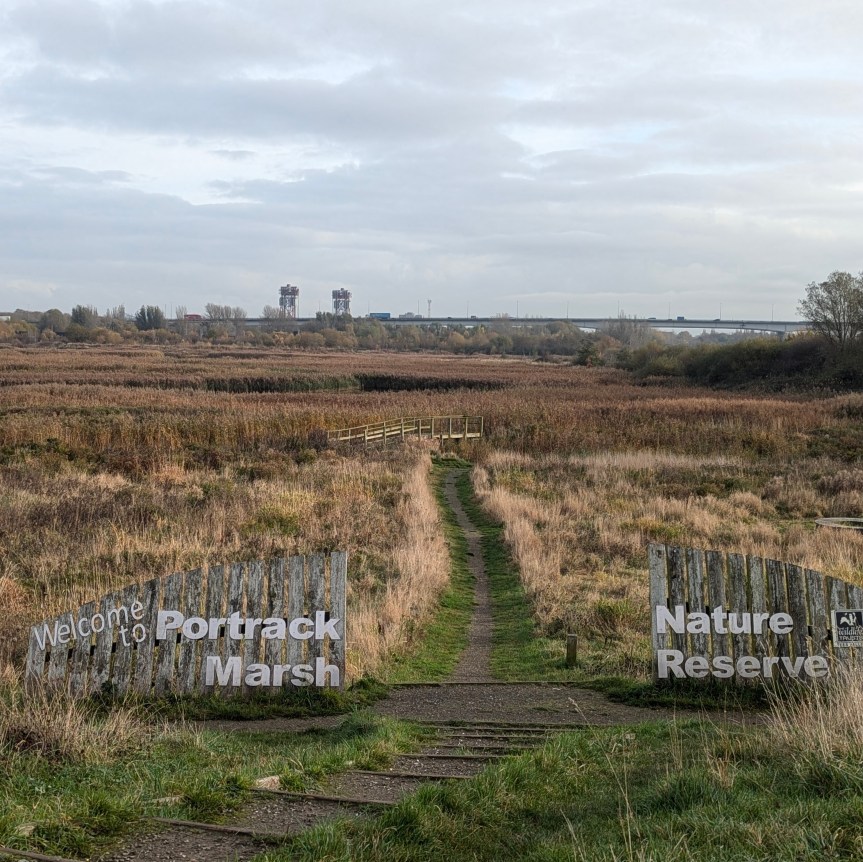
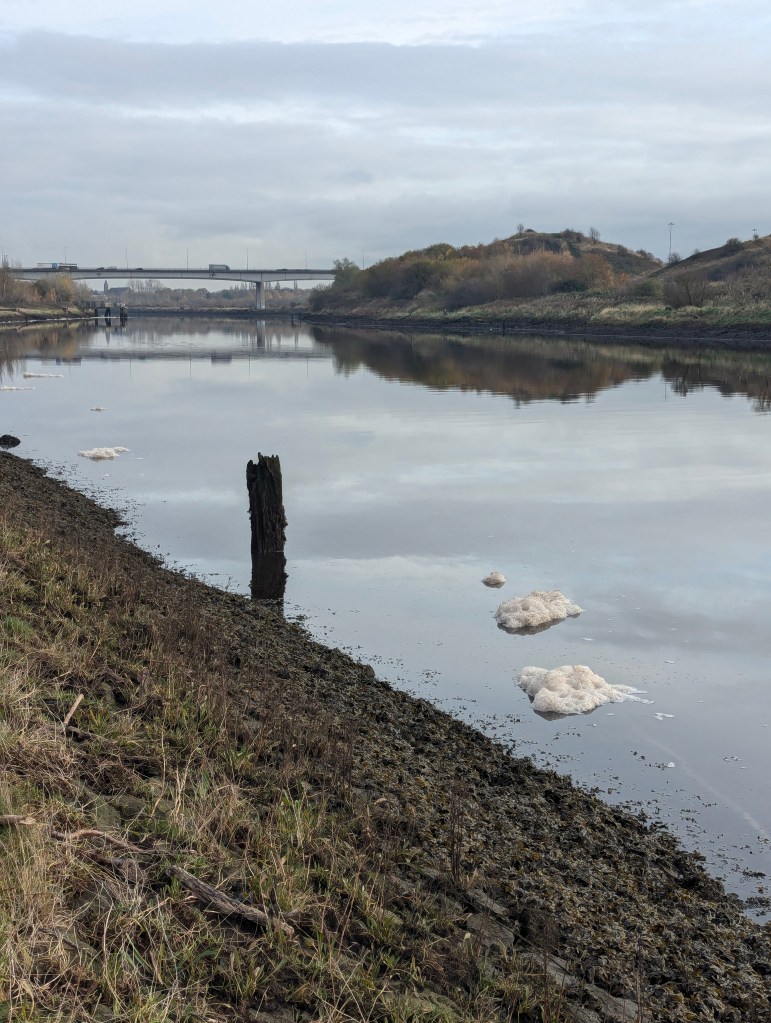
Last week I was joined in my climate emergency drop-in by my wonderful friend and fellow poet Jo Colley. Together we explored Portrack Marshes managed by the Tees Wildlife Trust, an area of crucial reedbeds and open water just the other side of the embankment from the manicured whitewater runs and jogging paths of the Tees Barrage.
Reedbeds and marshes, along with salt creeks like the one that has been restored at Greatham, are essential to the flood resilience of the Tees riverway as extreme weather events become the norm and sea levels push upwards from Teesmouth. I was conference poet at the launch of the Tidelands partnership last year, a multi-agency project to protect and restore habitats like these which provide a place for flooding to run off safely, to be reabsorbed into the river system with minimal damage to human infrastructure – and preserve biodiversity in the meantime.
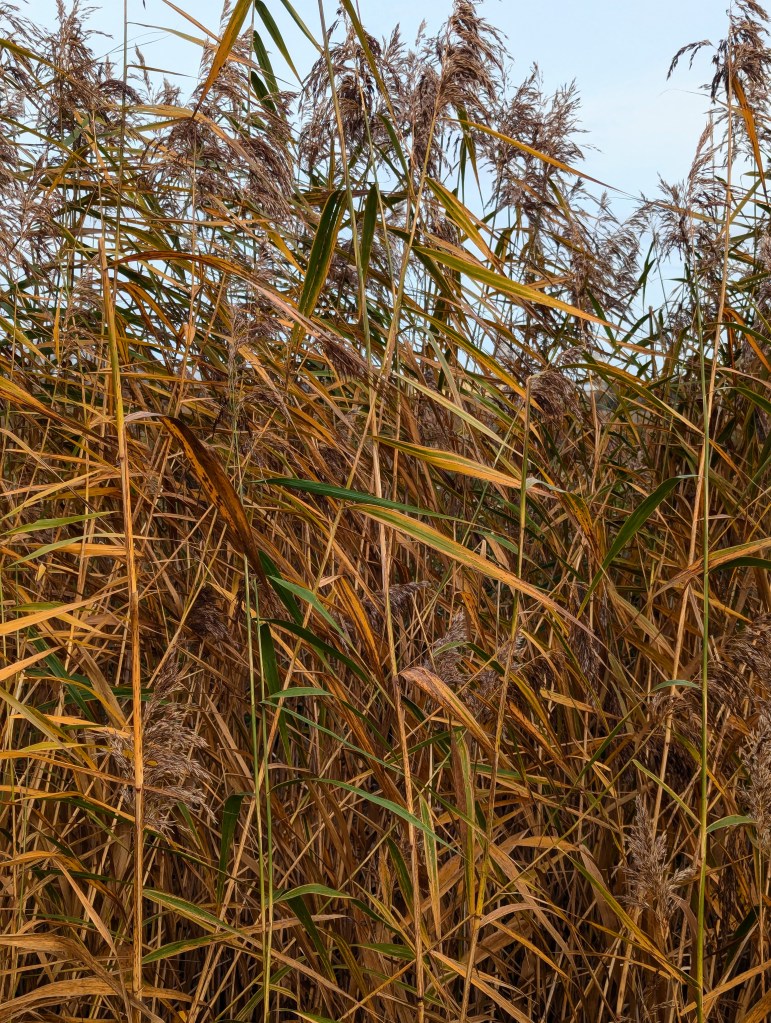
Susurrating marsh soughs seed-head rush-hush shiver-silver the open pannes of water standing shining among the signing stems of Portrack’s sun-struck panoply with its scattering of warblers.
You can read my full conference poem at the end of this blog…
Jo and I have spoken before about climate collapse and our feelings around it, which are often feelings of grief, panic, anger and impotence. As poets we realised we have something of a tendency to elegy! We’ve both lived long enough to notice the absences, the gaps where the birds should be flitting, the silences where the insects should be humming. People growing up now won’t notice there’s anything out of the ordinary, they have nothing to compare it with, any more that we can fully credit C19th accounts of the mouth of the Tees literally boiling with the abundance of fish. It’s called a shifting baseline, and its one way in which we collectively forget, deny, or protect ourselves from the truth of ecological erosion.
Because the truth of it is overwhelming, and extremely hard to handle without sinking under the weight of it or else disconnecting into distraction and denial. As Jo and I walked, our conversation ranged from thoughts about how genocide and ecocide are dark twins born from the worst human drives; how political systems are stacked against urgent, rapid, change; how the free market will kill us all; how Trump really is The Last Trump for all kinds of hopes.
We also saw white egrets and serene herons, families of long-tailed tits and winter sun backlighting frothy reed-heads and exploded bullrushes. We saw pollution, but praised the “ugly” edgelands where we leave nature alone rather than spend effort and money on “improving” it. We tried to imagine what the genius loci of this place would look and sound like, and what it would take for us to be motivated for the fight by a sacred relationship with our land the way indigenous land-defenders are. We moved in the sunlight, enjoying the rightness of the chill in the November air, and as we moved our thoughts and emotions flowed with us.
Helpful thoughts and commitments to ourselves:
When we think deeply about nature, we will walk in nature – movement helps us process, and being outside gives us a floodplain to contain unexpectedly big emotions.
We will notice beauty – anywhere it appears, in however small a detail or embattled a location, and we will praise it.
We will take strength from what we’ve already done – when looking for more ways to help the planet and adapt to climate change, we will not start by berating ourselves and nagging ourselves and others into despair; instead we will acknowledge and share the choices we’ve made to green our lives, in the hopes it will inspire others and lend energy to our resolve. A low-consumption lifestyle is not actually a hardship!
We will practice hopefulness – and we will persist in making sustainable changes to behaviours and choices that are within our gift.
Some things we and our loved ones already do – how about you? Give me more ideas in the comments!
Eating veggie/vegan – all the time, or increasing to most of the time
Only buying second-hand clothes
Only buying reconditioned electronic devices
Buying dry groceries from refill shops whenever possible
Repairing rather than replacing laptops – I use Kingfisher in Hartlepool
A common thread in my last two drop-ins have been conversations around the environmental impact of server farms, AI, and the ecological weight of the internet generally. We don’t want to use fossil-fuel-generated electricity and precious water just to keep a bunch of random photos alive on the Cloud. So our next small, sustainable change is:
Setting a monthly standing appointment to download and/or delete our videos, photos, and old emails.
I’ll be spending some of my time at this Thursday’s drop-in doing a digital clear-out, and if you’d like to join me for a chat while we clean the Cloud please do! I’ll be downstairs in ARC Stockton cafe from 2-4pm.
Tidelands
Written for the launch of the Tees Tidelands Partnership, 9/11/23

Prologue

Those of us who live at the edge, we know
how water breathes, hour to hour and moon to moon,
how the sea drags her swollen belly around the clock, around the planet,
how she presses it into the river’s mouth.
Season to season, we watch as placid sapphire
is chased away by furious greys, and we say
those are winter waves
as storms spit the wrack line up on to the coast road
and take another chomp out of the Prom.
We know the sea will come.

Humans, when we feel a push, our instinct is – resist!
Blockade, force, and dominate whatever suits itself ahead of us.
(The shadow of bold conquerors hides fear and disgust -
unruly nature! Disobedient water!)
200 years, we’ve broken these “waste-lands” to industry’s bridle.
Drain, constrain, reclaim; always a tussle for territory,
a concept so entrenched that barricades once seemed common sense -
build high and hard the flood defense!
What we can’t control must be a threat,
lace tight the river’s corset, never let loose the tourniquet!

Stand your ground – but estuarine grounds should not stay still.
Better that silts should shift than baselines -
our new normals, denatured and denuded,
squeezing memories of abundance back in time
until true tales of delta waters boiling with fish
appear to us as fantastical myths.

200 years under carbonized, tatterdemalion smokestack skies,
fingers deep in money pies, and pride, and livelihoods
prospering without heed for the need of carbon sequestering snugly in the mud
of Greatham’s meanders…
Well, we raised that Lazarus creek.
We’ve turned back toxic tides before.
We can and must do more…

1. Restore

From the Amoco pipeline to Majuba Road
Wildflowers grow in their poor, perfect homes		   restharrow, black medick
Their names a natural poem
								                                   spike rush, milkwort, melitot
Enough forgotten to sound now arcane
								                                    creeping thistle, biting stonecrop,
Tenacity. Vulnerability, What’s in a name?

We call them for their colours	                                    red clover, white campion
                                                                                                               yellow rattle, that root-starves
the bullying grass holds space
for even smaller jewels		                                            sea mouse-ear – miniscule!

So many speak of animals		                                     cats-ear, toadflax, fleabane

So many speak of niche			                                      marsh orchid, hedge bedstraw

Flora-fauna-habitat a tangle of vivid nomenclature
given when we knew their characters,
observed affinities.

We must restore						                        ourselves
to patient knowledge passed on in a chain			un-sundered
forged in fresh air, away from desk and test			sun, wind, rain
a schooling spoken						                        shown
and known as children’s stories are				        heart-known
We must restore paths						                connect
our unhindered spaces, and walk				                green corridors
with our eyes open						                        together

2. Reconnect

Susurrating marsh soughs seed-head rush-hush
shiver-silver the open pannes of water standing
shining among the signing stems of Portrack’s
sun-struck panoply with its scattering of warblers.

White flames the egret,
scarlet flares the dragonfly,

and shhhhh – shhhhhh

Underneath the reed-roots sleep, holding fast
to the memory of sea, like a dream they once had
of their mother.

part salt part sweet part water part land

This is an orphaned place.

When century storms surge and inundate
the surface rises, a spectacular drowning,
becomes a kettled lake, denied egress –

Long ago, we cut the umbilicus.

And so it saturates under circumstances
that can only keep repeating, until
all becomes brackish beyond the bounds of life,
but for we
who can see where withered tributaries
may be honoured into revival
may be connected to our own survival.

3. Realign

We’re all trying for a win-win
Tide goes out, tide comes in

Is welcomed into arms of marsh
The wash, the swash, the back and forth

Resistance is – pretty useless
To be soft is true resilience

Praise the hawthorn saplings, they promise rebalance
But please don’t nick our coir rolls, thanks

We’re going for 20:80 effort to result – smart!
Looks like 80% science, 20% weird land art

I’m here for it! Never too late
to breed breakwaters that self-replicate

It’s polytunnels now for future forests of seagrass
It’s threading more salmon through a better fish-pass

It’s keyhole surgery, it’s controlled breaches
It’s a river running freely to its natural reaches

On haul-outs grey seals dream of more eels
Ghost islands lurk inside our fields

Stand now, shoulder to shoulder to shoulder
This project’s new – the flood plain’s older…

Epilogue

And we know, those of us here at the edge,
we know the sea is coming,
and climate change won’t listen to a cabinet of Canutes.
But we will not stand mute.
We are not a lone voice, and this is not wilderness but treasure –
the tidelands are our lands.
It will be the work of our hands
to bring them back to fullness, together.
With the world’s biggest climate change denier strutting back into power over at the world’s second-biggest carbon emitting nation, it’s a grey day to be thinking about the very niche impact of poetry as climate activism. Or so I thought, as I took my lunchtime walk around the wintery streets of Stockton, preparing for my second weekly Declaration drop-in.
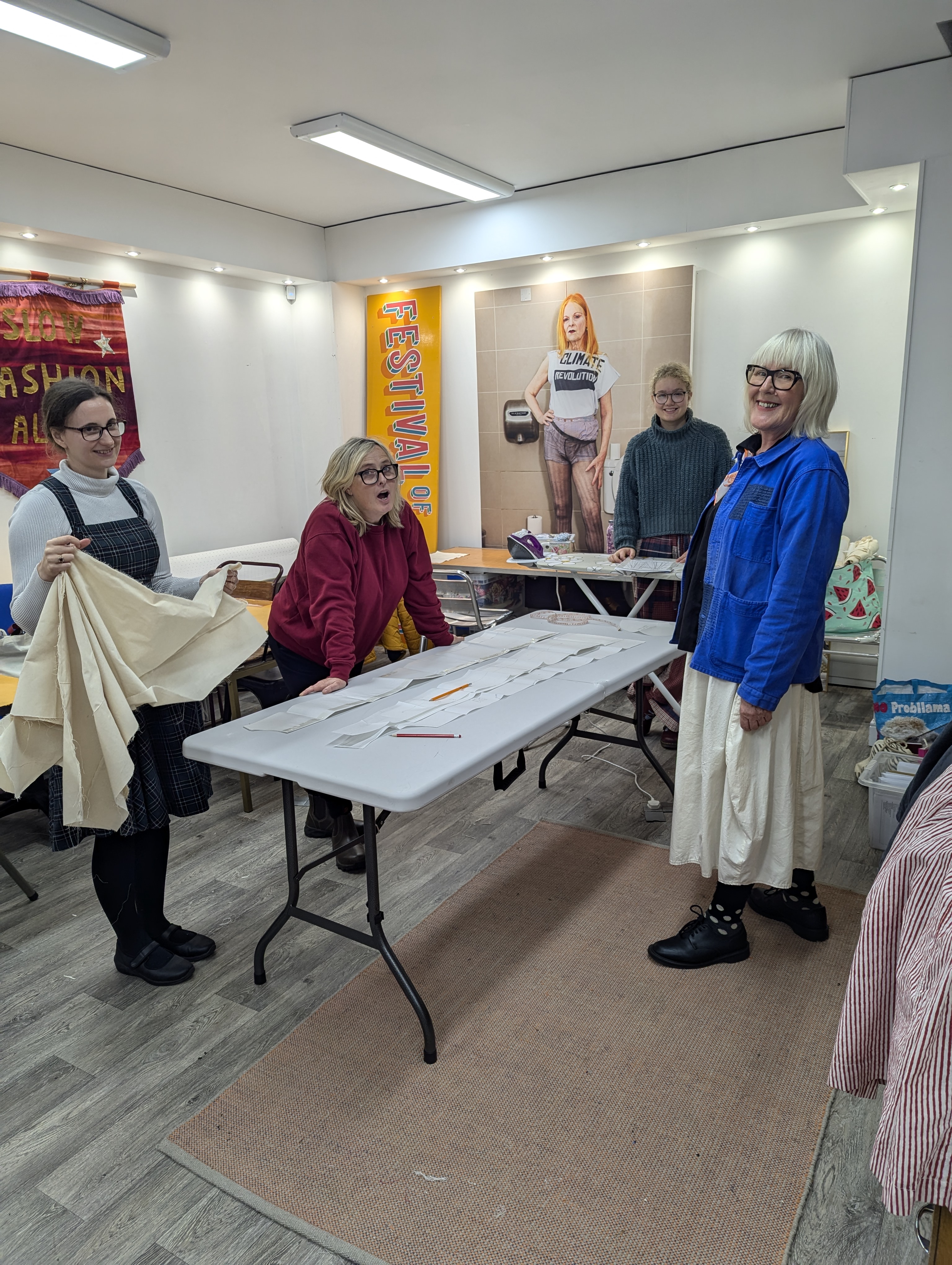
Wandering down Silver Street, I saw that there were people doing exciting things with sewing machines and pattern-cutting in the gorgeous yellow Institute of Thrifty Ideas, the activities hub ofFestival of Thrift. Popping in to say hi to tutor Lindsay and her group, I learned something that made me so happy – poetry was exactly the comfort some people sought when the news of Trump’s re-election hit!
What was the poem they sent each other to express solidarity, to offer solace, to remind each other of the need for renewed hope and commitment to nature? This one, of course…
The Peace of Wild Things by Wendell Berry
When despair for the world grows in me
and I wake in the night at the least sound
in fear of what my life and my children’s lives may be,
I go and lie down where the wood drake
rests in his beauty on the water, and the great heron feeds.
I come into the peace of wild things
who do not tax their lives with forethought
of grief. I come into the presence of still water.
And I feel above me the day-blind stars
waiting with their light. For a time
I rest in the grace of the world, and am free.
Later that afternoon I was joined by the lovely Amy Lord – author, blogger and digital marketer. We had a fascinating chat about the carbon footprint of digital work now that AI is everywhere, sucking up lakefuls of coolant. How can she mitigate against this in her work as a freelance marketer? With a Declaration, might she use her own stated climate ethics as a way to connect with clients who share her values? Can she use her marketing powers to tell the good stories of organisations who are embedding sustainability? As an author and blogger, will she lend her weight to the cause of Fossil Free Books in the wake of the Baillie Gifford litfest-funding kerfuffle? All brilliant thoughts and questions, which Amy has taken away to ponder further…
And for myself, I finally made a Declaration, one which will serve to connect me to the CDE community while I work on a larger creative response and continue to audit my practice. Its a start!
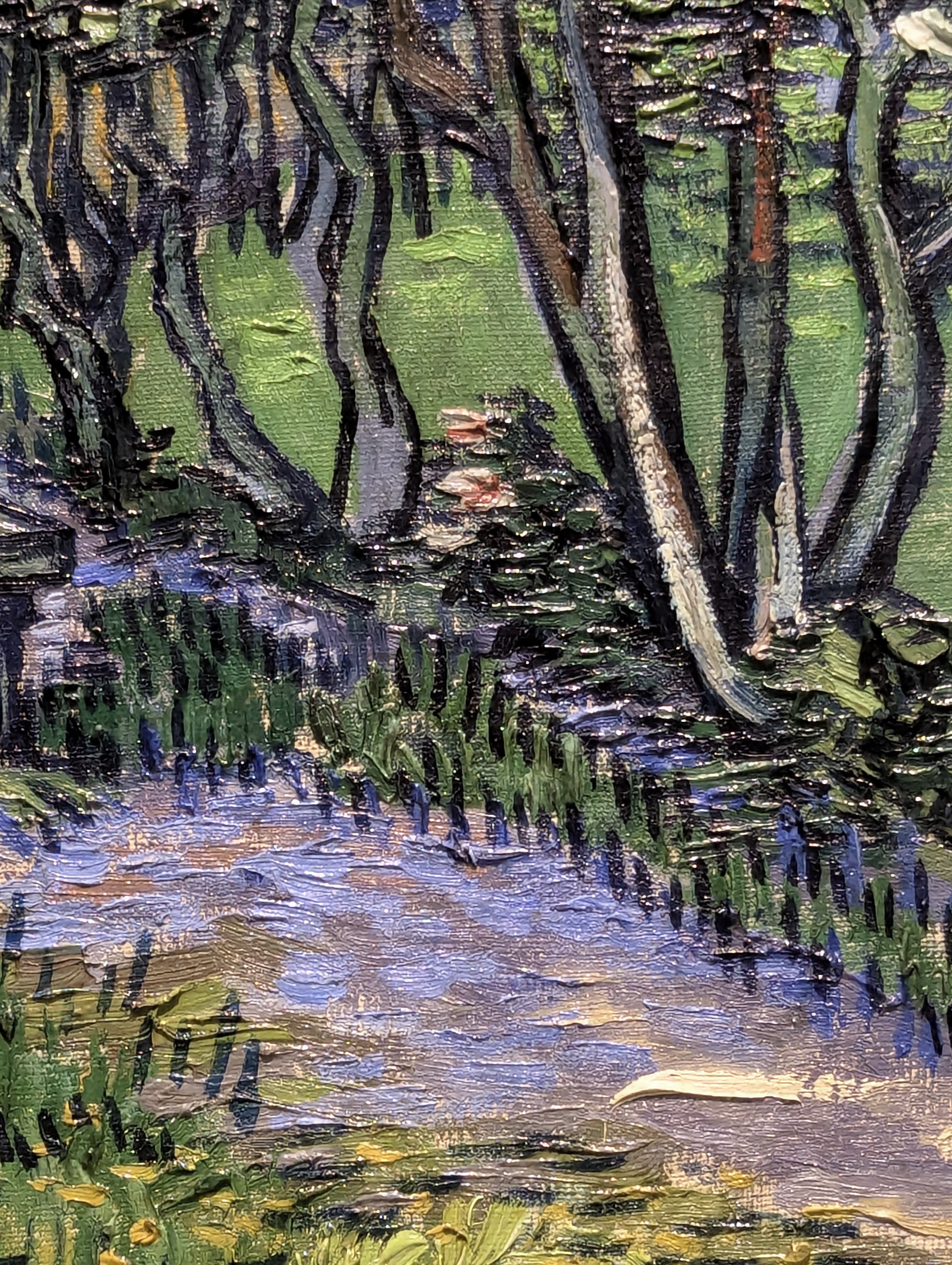
For you – a drawing in progress inspired by Klimt’s forests; looking for the peace of wild things at Billingham Beck nature reserve; close-up of a Van Gogh seen at the National Gallery this weekend.
My next Declaration drop-in will be a walk-and-talk on Tuesday 12th November, meeting 10.00am at the Whitewater Way car park for Portrack Marsh Nature Reserve – location and parking info here.
Want to be in touch about Teesside climate stuff for creatives and cultural practitioners? Email me
Today I began looking in earnest at why and how to join Culture Declares Emergency, something I’ve been considering for most of this year; and I’m looking for other Teesside creatives to join me, because frankly I feel like we all need a bit of solidarity, accountability, and witness for this kind of stuff.
I’m starting by exploring Declarations other individuals have made, and I’m loving this durational intervention by Johannes-Harm Hovinga, who made confetti out of the huge official climate collapse reports that every government is ignoring. It makes me want to do a piece of durational blackout poetry, something I’ve fancied for ages but not known what source document to use. Hmm, ok, log that as Idea #1…
An inspirational individual Declarer local to me is Justine Boussard, who is an Amateur Ancestor – great concept! – coming at Climate Emergency through the lens of museum curation. I love the clarity and verve of her declaration – something I’m definitely going to try to emulate. And of course there’s the brilliant Lady Kitt, whose mentoring I hope to write about later…
Or how about the mysteriously-monikered XYZ Poetics? I love how their Declaration talks about joining the dots, which makes me imagine experimental ways to format my eco-poems as text-art installations dot-linked like murder investigation boards. Hmm, (overly-ambitious) Idea #2…
And I’m very exited by this STONKING Declaration from Threads In The Ground, a self-described “climate hope organisation”. They are one of the artist/groups to receive a Culture House commission – a list that also includes me and my colleague Ellie Clewlow working together on a recycled junk mail/community poem project. (I’ll blog more about that on another day)
The other thing I’ve done today is I’ve eaten delicious soup and had fascinating conversations with ARC staff at their monthly Climate Cafe, a space for sharing both anxieties and good news. We talked about everything from the hidden water costs of AI searches to the absolute swag available in Stockton for charities through a council scheme that re-homes unwanted office equipment and computers – I’m now hungry for a free whiteboard, to UNLEASH STRATEGIC PLANNING upon!
I applied for a small climate-themed commission from ARC Stockton‘s ‘Make New Work’ grant scheme, and although I wasn’t successful, I ‘m profoundly thankful that they liked my ideas enough to find a chunk of change down the back of their metaphorical sofa and offer me support towards opening up a space for Teesside Climate Creatives to connect in an informal way while I try to keep myself on track with my own thinking.
I’m going to hang out at ARC most Thursday afternoons for the rest of the year, working my way through Culture Declares Emergency resources and toolkit blueprint for change. I’m going to reflect on my personal practice, my organisation (Tees Women Poets), and what I can do in terms of environmental policies, processes, manifestos…and I’m offering an open invitation to any creative or cultural practitioner in Teesside to join me whenever they can. Together we can hopefully come to our individual Declarations.
If all goes well, I will write a Declaration that is a long-form poem. I will then write out that poem in liquid papier mache and let it dry into large sheets of paper lace, which will then get exhibited in ARC’s gallery next February. If lots of other artists join me, perhaps there can be a group exhibition of art that makes a Declaration of climate emergency, and which communicates our resolve to be part of meeting that emergency head on with all the creative tools at our disposal.
If you’d like to be involved, you can email me here for all the dates I’ll be here.
Over at the Tees Women Poets, there have been some fascinating recent experiments with the relationship between AI, poetry, and ways to describe women. I’d like to share one of my experiments here.
The following poem is one I wrote for a TWP performance at Drake the Bookshop, for Feminist Book Fortnight. It is inspired by the non-fiction book Going with the Boys by Judith Mackrell, an account of six of the very first official female war correspondents, many of them from privileged yet problematic backgrounds, some of them trading on personal and sexual relationships (e.g. with Hemingway) to get their big breaks, and at least one of them ending up spying and smuggling people out of Nazi-held territories. All of them using femininity as a tool and a disguise, to divert danger and obtain information.
How To Get Ahead As A Female War Correspondent, 1930

So, daddy left mommy?
Daddy beat mommy?
Daddy didn’t love you?
Daddy loved you too much? – whatever,
	Heiress, It Girl, bluestocking, black sheep,
Hitch your long legs around a brand new Daddy and make the wild leap.
You’re a bright girl, and you’re restless, so choose your ride judiciously –
Aristocrat? Diplomat? Editor? Author?
Who do you have to screw around here for the chance to prove
you are more than a gossip reporter?

Outrage them.
Hook Hemingway in Florida, and before you can say ‘exclusive’
you could be reporting the war in Spain, dancing
around the rubble and each morning’s wet and sudden stains,
your gold bangles clinking and your fox-fur neat.
Ignore the hacks and hounds who scoff no matter what
you wear on your pretty little feet.

Outdrink them, and outcharm them
in beleaguered Barcelona, in Berlin’s cellar bars,
at country house shoots and by candlelight
in Libya, Moscow, Bechtesgarten; play nice
with generalissimos of every stripe -
	Hitler, Stalin, William Randolph Hearst,
some men are all the same, hungry for the bloodbath
that will make their name.

Feed their vainglory. Smile, darling, and they won’t refuse -
You’d look great if you made a little effort!
You gotta schmooze to get the news!
just don’t mention that your relatives are Jews –
that’s when the shadow men slide after you in their quiet cars
that’s when you feel your nape prick at the telephone’s flat click -

Outwit them.
They underestimate your brains, your bravery –
Pretty little polyglot
Cub reporter, trot, trot, trot
In the embassy limo, finesse your way through border lines
Bat your eyes, a shopping trip, too blonde for spies,
Just can’t get Schiaparelli in a city prepped for siege,
Just happen to glimpse the Panzer ranks, the massed Blitzkrieg,
Stash that in your boutique bags, quick
Glitz and ditz your way back ‘home’ to the last hotel open,
the one international phone, and –

Scoop! Outwrite them!
When they say you’re getting reckless, threaten to quit.
Forge exit visas for thousands, hold your nerve, get away with it,
You could not have covered society pages for one more minute!

So
When adrenalin gets you pumping,
When your mean heart’s bomb-blast-thumping,
When ambition gets you jumping to catastrophe’s rhythm, say
you don’t know where the boys are going
but by god you’re going with them.
I fed the poem into craiyon.com with the prompt “Create a photo based on this poem”. I tried the entire piece, and then experimented with using it in sections. Our hypothesis was that the first words were likely to influence the overall composition, like an ingredient list on a food packet showing you the highest percentage ingredient first.
What do you think of these images?
I wondered where some of the people of colour have come from, was the mention of Libya enough to get some of the North African vibes in the first slide? It’s much more than I expected. Why is the AI weighted in that direction? Where is Moscow, or Florida?
I was unsurprised to see that the bot is a leg man and a foot fetishist!
I was most irritated that I didn’t know to save screenshots, so was clicking the Save To Collection button only to lose everything several times. The very first results were incredible in their Paula Rego-esque looming dark surrealism, I felt like they absolutely captured the atmosphere of threat and danger I tried to portray in the poem. Each subsequent attempt got weaker results. Alas, you will have to take my word for it – that the long legs were flung higher and stranger, and there were orphanage-camps full of sheep-headed babies and women with slits in their feet…
My conclusions?
Still pending, but I know I’m not interested in generating sweet, neat, pretty and complete images, therefore I’m actually quite taken with these. I am still haunted by the images lost (the literally upholstered society lady, her eight hands caressing the limousine door, the slutty nurse with the several legs). What if I tried now to draw these images and the ones I remember, using charcoal perhaps? Is this essentially a good way of making preparatory sketches?
One thing I have learned – with the image-stream of AI, you really never can step into the same river twice.
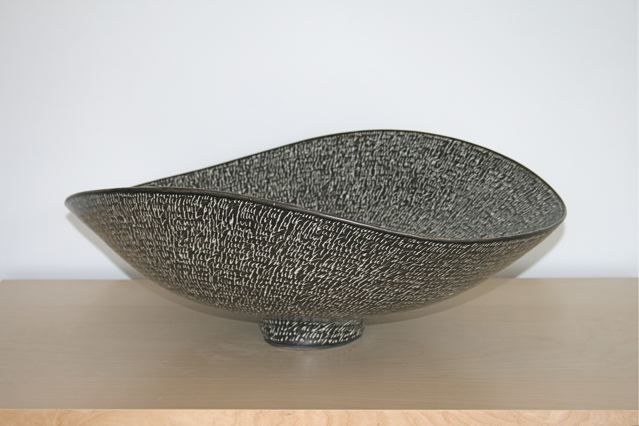
The fourth and final digital poem I made for my MIMA/Tees Women Poets residency was Voyager, written for Poem Bowl by potter, writer and philosopher Rupert Spira (b.1960). A vast black dish, it is decorated inside and out with a mostly illegible hand-written text that has been incised through the black glaze. Certain words can be made out, and these have been incorporated into the poem.
My inspirations for the imagery in the poem comes from the way the dish reminded me of both a warped vinyl record and a radio dish. Combined with the only partial legibility of the decoration, it led me to play with ideas of decaying signals and transmissions through space. The audio accompanying the digital poem features a short sample from “I’ll Be Seeing You” by Billie Holliday, which was the last message sent by NASA to the Mars Rover Opportunity before it ‘died’ in 2019.
The sound track for this poem was the most complicated, featuring free samples of for example vinyl record clicks and Cold War numbers stations alongside my own voice pushed through echo and distortion effects, and the poem text run through AI voice generators. All of this was put together using free Audacity software, which also allows you to create blocks of static interference.
The digital poem was also the most complex in terms of the kinetic typography, even though it was made in Canva in exactly the same way at 79AD and Origin Story. Drawing on the circular nature of the bowl, and all the images of records, radio dishes etc that are in the poem, I made the typography follow arcing pathways. The sections of text overlap and ‘degrade’, just like the audio. To make the effect of degradation I reduced the transparency of the text by degrees, sometimes in arcs that were offset so the faded echoes can still be read; and once in a fully-aligned circle with text blacked out except for certain selected letters.
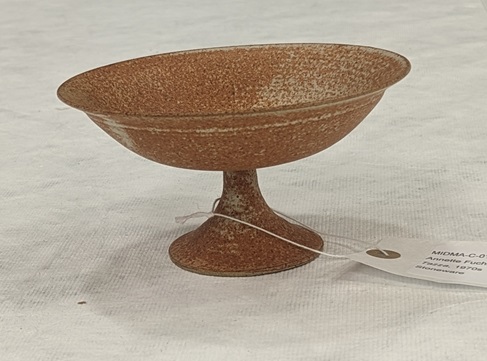
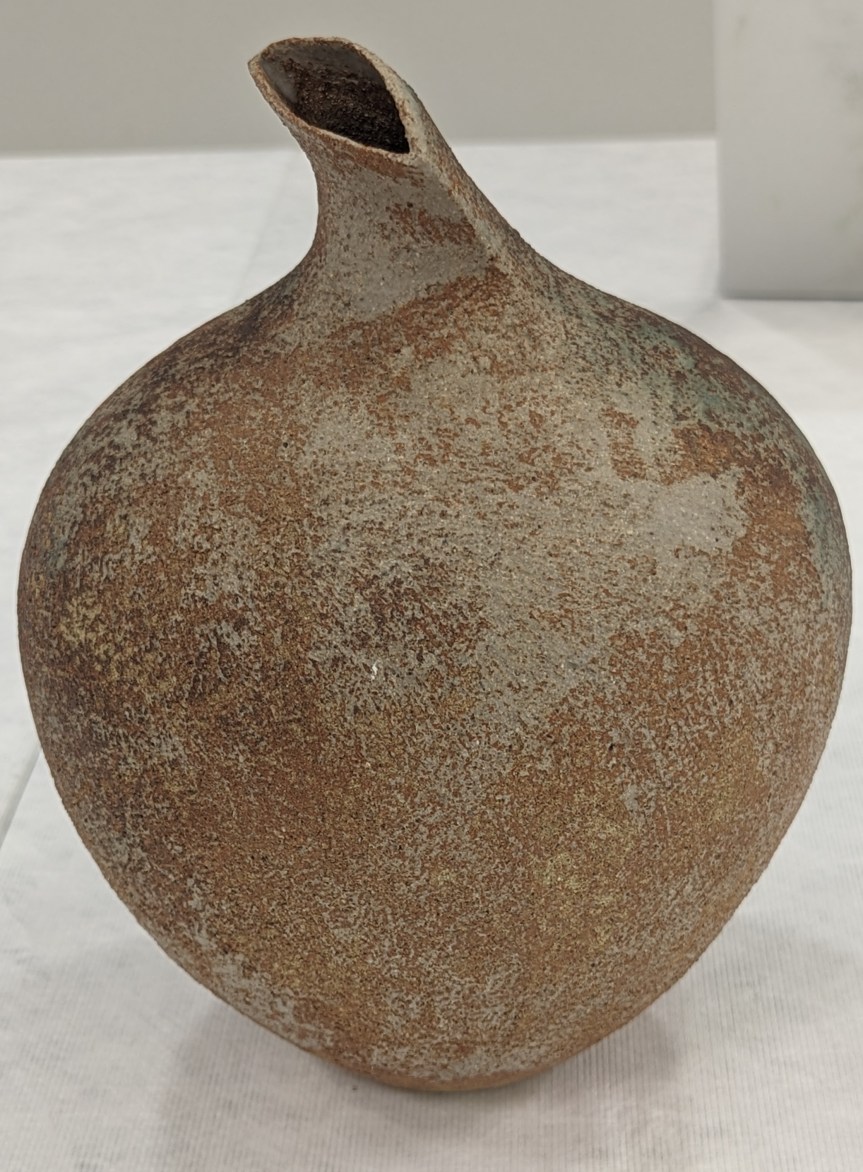
I’m really proud of these digital poems! Here’s a reminder of the ceramics that inspired them – a leaning neck vase by Betty Blandino (Origin Story); a tazza by Annette Fuchs (79AD); a bowl by Deirdre Burnett (Egg Fiction); and a poem bowl by Rupert Spira (Voyager).
And here are the finished digital poems in the loop as it appeared at MIMA. Headphones on!
For those that are interested in the sounds, here’s a list of all the sound clips I used – see if you can tell which poems they appeared in!
Unbelievably, I didn’t take a decent photo of the third ceramic piece to become a poem in my Tees Women Poets @ MIMA residency, but here are some examples of Deirdre Burnett’s other work to give you a flavour. The one on the right is closest in colour and finish, but imagine it looking much more like an eggshell. The porcelain is also eggshell-thin, and quite small (ostrich egg?)
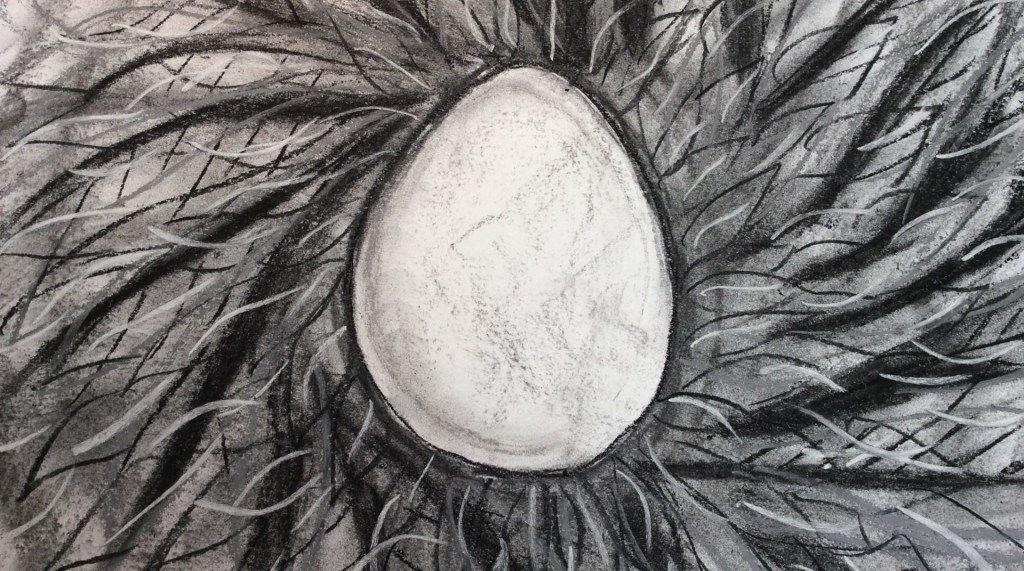
Egg Fiction draws on my own memories of collecting eggs and family folklore about witches’ boats. I learned charcoal animation for the resulting digital poem, and tried to keep a childlike feeling to the flow of images. I named the poem Egg Fiction because it is in no way an actual biography of Burnett’s route into ceramics.
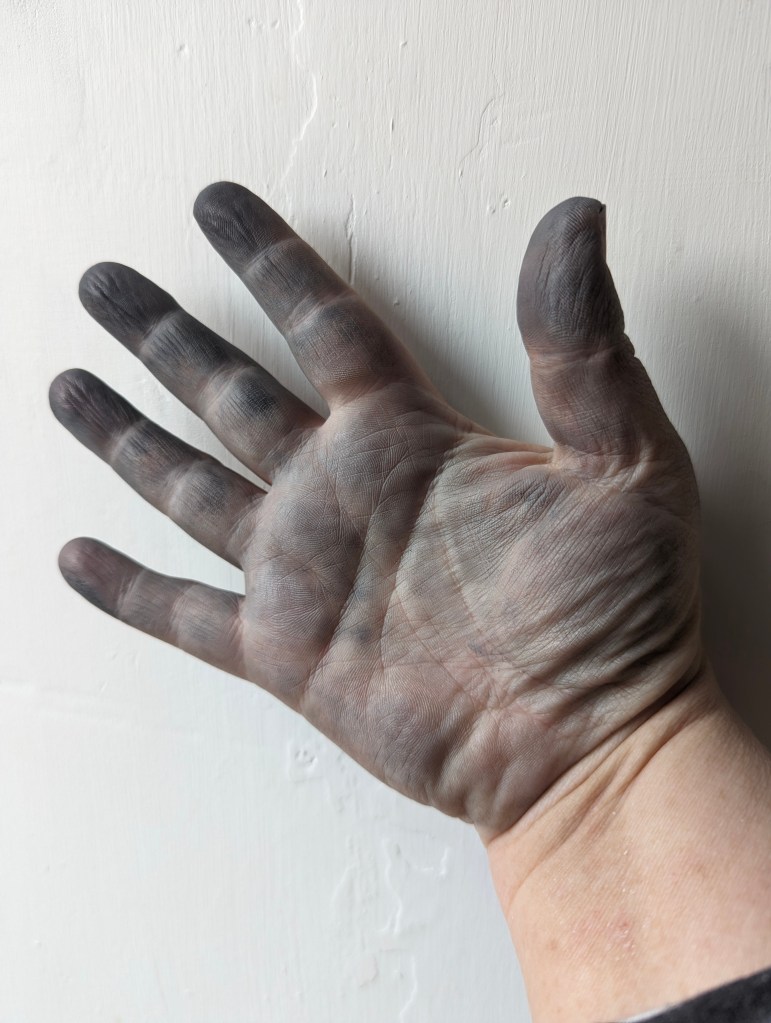
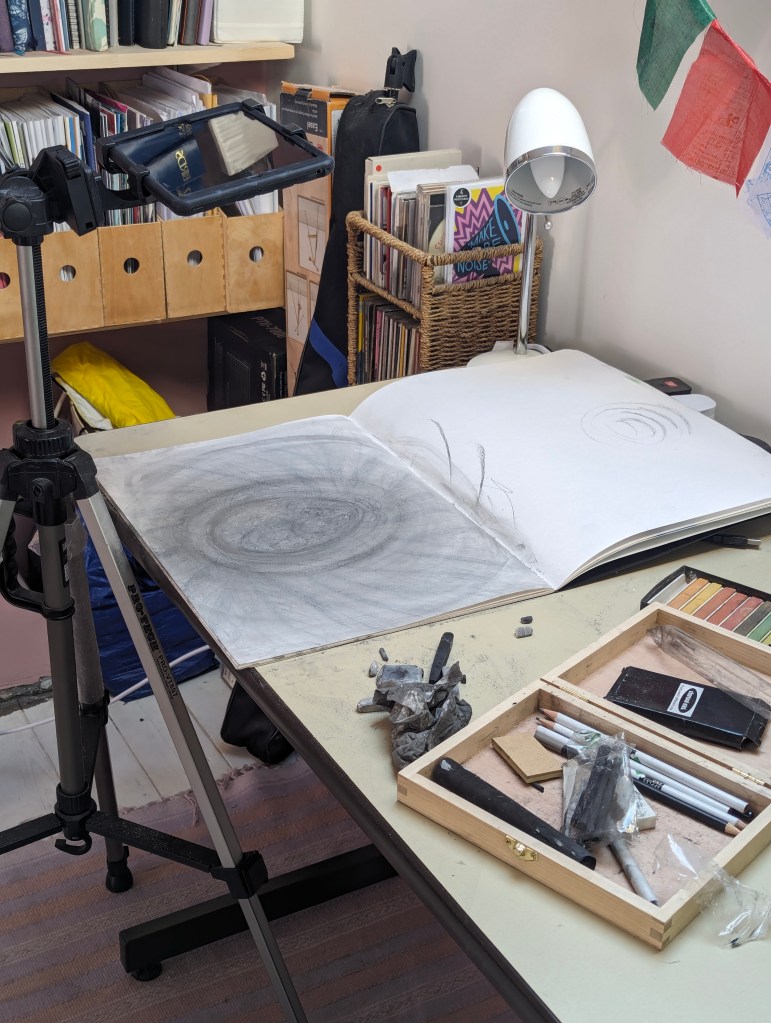
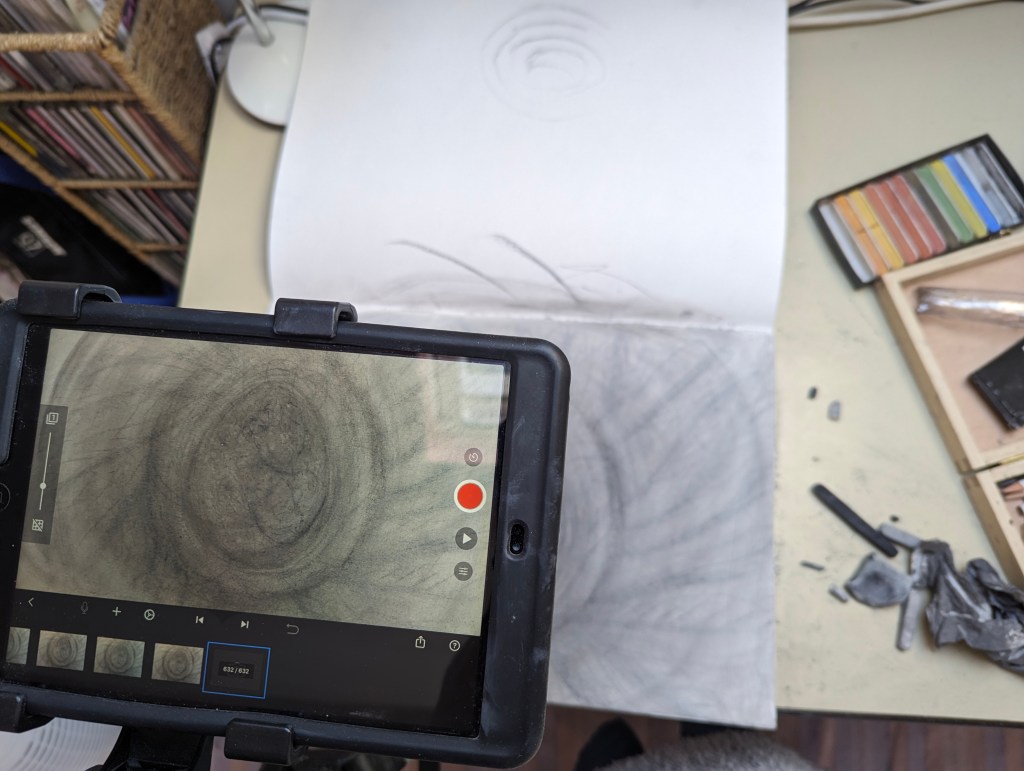
The animation was entirely unplanned and freeform. I used a central egg motif, and simply kept doodling in and around it using charcoal and chalk, taking 2 shots every couple of marks made, using the free app StopMotion on my ancient reconditioned iPad mini. I didn’t do separate drawings frame by frame, every frame was drawn on the same piece of paper. Rubbing in, sweeping off dust, erasing, chalking over, layer upon layer over a combined total of around 8 hours, until my desk was grey and grubby! Completely backbreaking, utterly obsessive…
1500 frames later, having made a whole 58 seconds of film, I recorded the voice track for the poem and was devastated to see it come in at nearly 3 minutes long! Nooooo!!!! Radical editing of words ensued, but I was still only half way with the visuals. Physically unable to continue with hand-drawn animation, I came up with an ingenious solution to triple the length of the film. Importing the original animation into iMovies, I duplicated and layered the sequence over itself, using the editing app’s greenscreen feature to set first the darkest parts and then the lightest parts of each frame as a greenscreen. In this way, the rapidly metamorphing egg began to ghost itself…
Here’s the text for this most challenging and enjoyable piece. When I show you all four finished films in my next blog, you’ll hear that the voiceover for this poem is not me speaking. In fact, I had my first foray into AI-generation by using a text-to-voice app. There were many accents to choose from, and male and female voices of different age profiles. When you read the poem below, what voice can you ‘hear’ in your head? What accent would you have chosen in my place?
Egg Fiction

nanna sent her to steal an egg
fresh from the straw
the darkness clucked

it was the end of the world
it was a rite of passage
don’t trip!
don’t smash it!

don’t smash it too soon
soft-boiled children must learn
the tap the crack the dip the scoop

now smash the empties!
scuttle the coracles
so witches can’t sail to sea
with their wicked, wicked storms

but that warm, smooth weight
had ordained her palm

it’s enough to make her grow up a potter
throwing porcelain
not to shatter, but
to release the paradox-
strength and fragility are twins
this is the earth whose yolk brews wings

this is the earth that knows fire
in the kiln it turns into a little sun
little pitchers become themselves
or smithereen…

look, this bowl has hatched a dragon!
half-shell with a scorched equator

and in the bottom
freckle-speckles
like the memory
of a hen’s egg
The Tees Women Poets are currently open to applications for their autumn residency at MIMA’s Towards New Worlds exhibition. If you’re a woman poet in Teesside, especially if you identify as disabled or neurodiverse, take a look at the info and apply here.
It’s small, about 18cm high maybe? Just looking at it, there is a classical, visual beauty in the proportions and the terracotta. But when you pick it up, the perfection of its balanced weight is breathtaking.
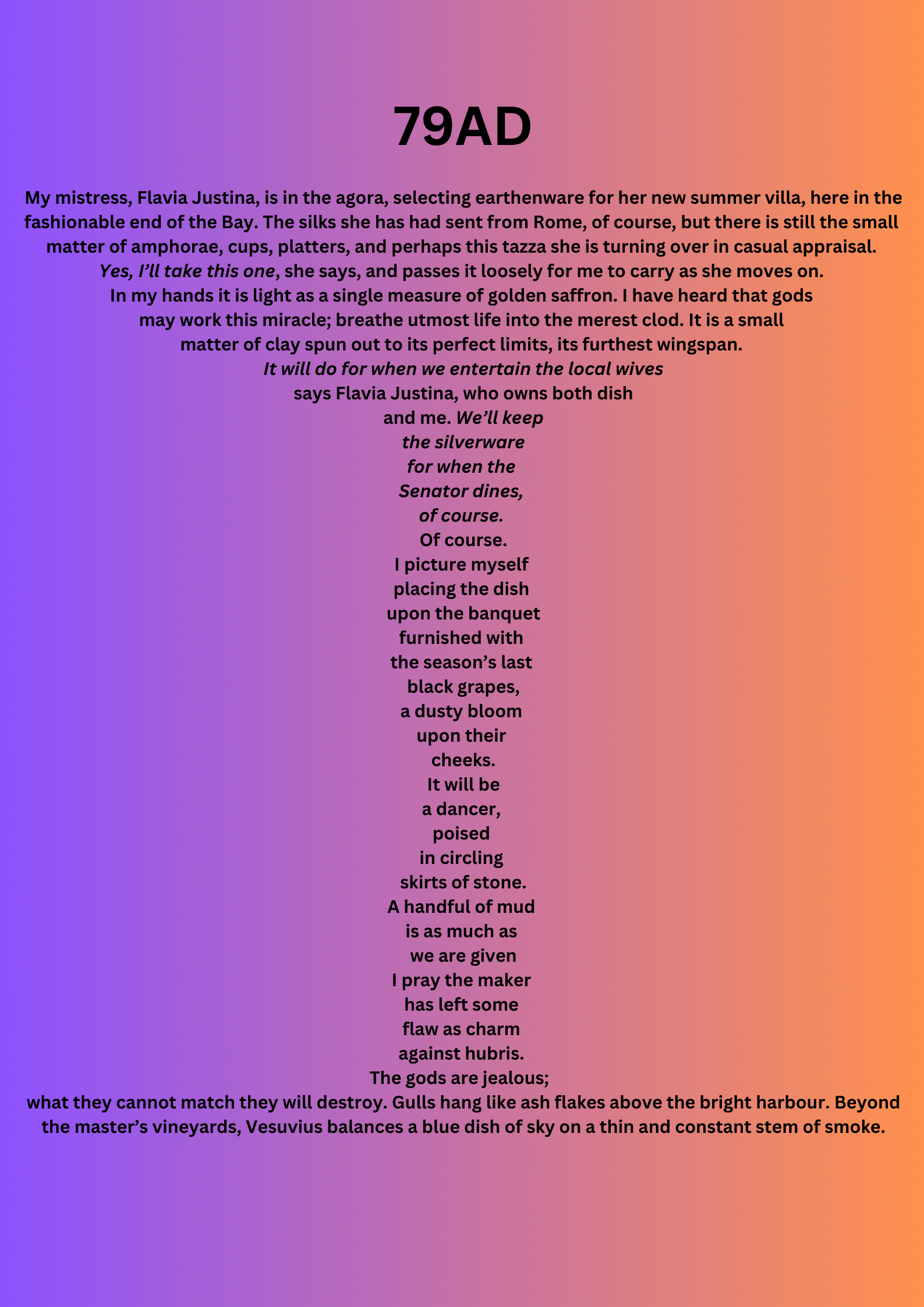
The second of my four digital poems for ceramic pieces in MIMA was written for a tazza, or serving dish on a pedestal and foot, wheel-turned out of earthenware by ceramicist Annette Fuchs. It made me imagine Roman society and murals, which in turn led me to think about Pompeii and Herculaneum. Pliny the Younger described the cloud of smoke that preceded the eruption of Vesuvius in 79AD as “a pine tree, for it shot up to a great height in the form of a very tall trunk, which spread itself out at the top”, a description which reminded me of the tazza shape. On this tazza, a pale razor-blade-shaped void has been left in the red surface, perhaps deliberately, as superstitious people will sometimes add a smudge to their make-up so the gods don’t get jealous…
This poem has had a couple of concrete incarnations – the one above, which I made especially for this blog post, and the version in the micro-pamphlet handout produced by MIMA to accompany the exhibition, which had eight stanzas each shaped like a tazza. Can you guess where the stanza- and line-breaks came?
This extract from the visuals of the digital poem should give you a clue!
This is again made in Canva videos, using a textured background duplicated and flipped mirror-image along a vertical axis to enhance the tazza-shape of the stanzas. I then overlaid the texture with a free clip of a puff of smoke, to foreshadow the eruption of the volcano. The film clip was actually in a long, thin, landscape orientation. I have enlarged it, flipped it the portrait orientation, mirrored it along the same midline of the frame, and dialed down the transparency so it is a ghost of its former self…
What sounds would you choose to accompany this digital poem?
I’ll post all four completed pieces, with soundtracks, in my fourth blog. Watch this space for curved kinetic typography, charcoal animation, and weird adventures in Audacity and AI…
If you’re a woman, a poet, and you live in Teesside, then why not apply to be the next TWP poet-in-residence at MIMA’s Towards New Worlds exhibition this autumn? Information and application form here.
Now that my digital poems have finished their run at MIMA, I’m bringing you all four of them with some info on my process.
This first poem was written for a “leaning-neck vase” by Betty Blandino (1927-2011). As the poem states, the piece is made of coiled stoneware and is unexpectedly light when picked up – the rough finish makes it look like a natural stone, so the expectation of weight was there, and I did literally start talking to this pot when I held it.
My first step was to handle the pot, feel my responses, write notes, draw the vase to get its shape into my muscles…(and later use it for some gelli plate experiments, like you do)
Next step was to go away and write a poem from it. After a few edits, this poem then became a short film using a Canva video template (specifically, the Black White Minimalist the End template). I chose it because it features moving, soft focus lights with reddish-orange hues that made me think of the vase’s rusty-orange surface.
It also seemed to fit with an atmosphere of fairy stories/origin stories/when you were just a twinkle in my eye – the feelings of the poem, if not the specific details of the words. I changed the Canva template’s typefaces and text positioning, and played with how and where the text should arrive on each slide, changed the tempo to suit, and downloaded.
So far, everything I’ve used has been free and easily accessible. This was the result.
Now, that is not the final version of the digital poem – all four poems had soundtracks added before they were shown at MIMA, but you’ll have to wait because I’m going to talk about that, and show you the final looped installation, in a few blogs’ time! You could subscribe, if you like, then you won’t mis any of them?
But I will show you the last iteration of the poem right now, which is as a concrete poem. This was printed in the programme that accompanied the screening, with the following artist’s statement:
Origin Story was written for a coiled stoneware vase with a ‘leaning neck’ made by Betty Blandino (1927-2011). Handling this pot was a sensory overload for me, as it looks like a stone, feels like weathered rust, and is unexpectedly weightless. The shape is reminiscent of an amphora, a pot made specifically to store foodstuffs like wine or oil, but it is kept hollow, and sonorous. I found myself speaking to it like a sentient creature, and continued that conversation into the poem, imagining myself telling the vase myths about itself like bedtime stories for a child. Little pitchers have big ears.
The observant among you may notice that there are some differences between the texts of the two versions, which just goes to show that poems are never quite finished.
Watch out for the next digital poem, which will be 79AD, written in response to an earthenware tazza by Annette Fuchs.
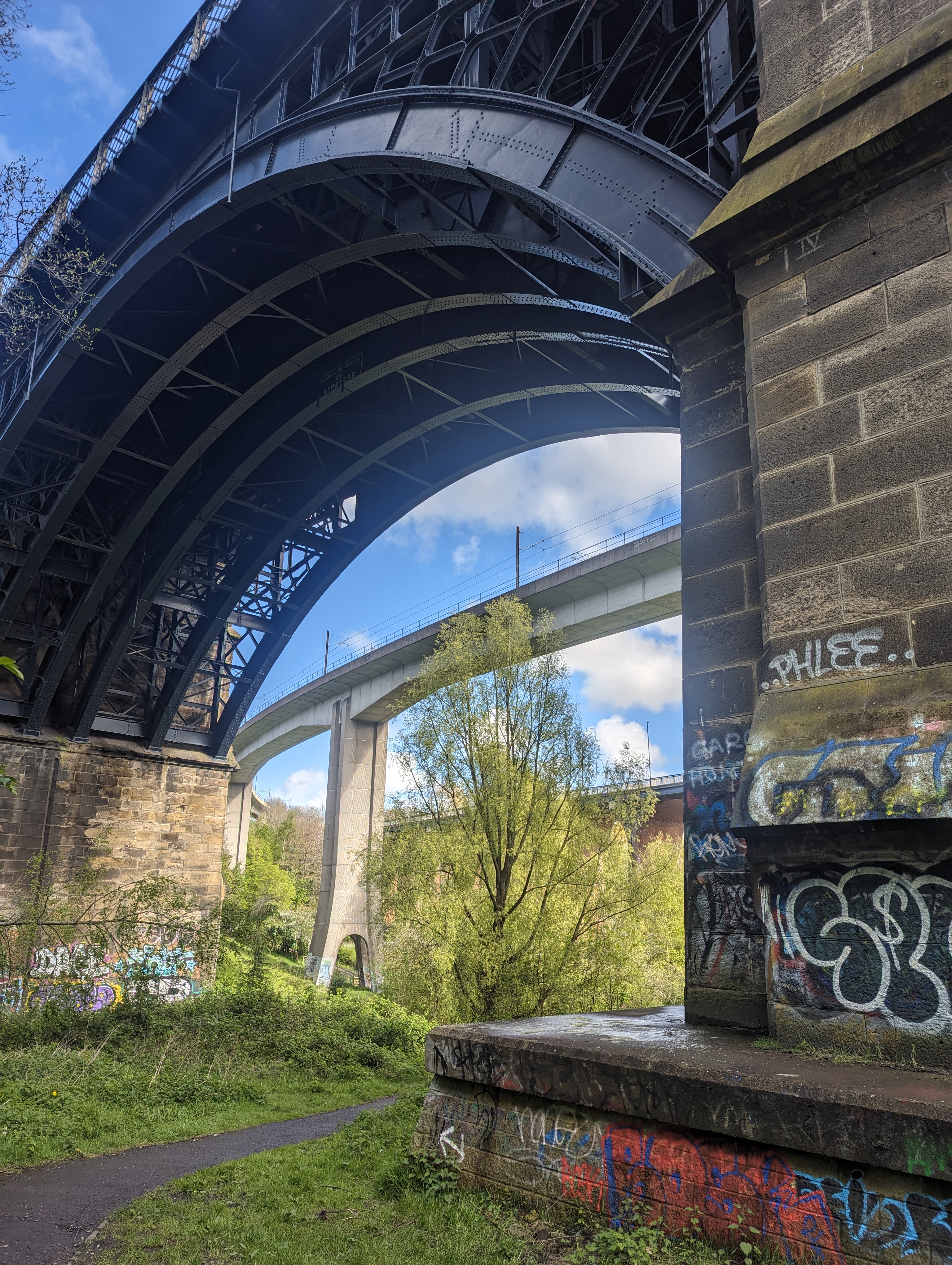
11.01 Northbound, the song of the rails And footie fans
Bright tongue-punch of tamarind – I’d go miles for pani puri
New builds on brownfields Fennel glades, teazels, finches Unhomed
Kestrel’s cliff scraped clean of roots Bloody cranesbill
Street food, not sawdust In the covered market; ghosts… Skinned hares, white tripes
Kittiwakes scream from the bridge No-one wants a terraced house
Everyone is fine Talking to thin air these days – Pods. Buds. Our blue teeth.
Shop fronts like cast shells Waiting for crabs
Guts hanging out Sliding doors wedged open Cataract windows
The Laing’s a drum, deaf with rain Paintings sign to each other
Bloodlust and faith Objects in oils and suspense Gilt-framed
Gulls after a lightning strike – The Age Concern social group
Do you paint? Used to. But the girl I showed them to Never loved me back.
Sap green Scorched earth
Where you see a storm I see a girl tucking in To a ham sandwich
Things, alone in their thingness But, a field of attention
Smashed rainbow The old snooker hall windows Be Gay, Do Crime
Three white clouds; the blossom trees Next to Manors car park
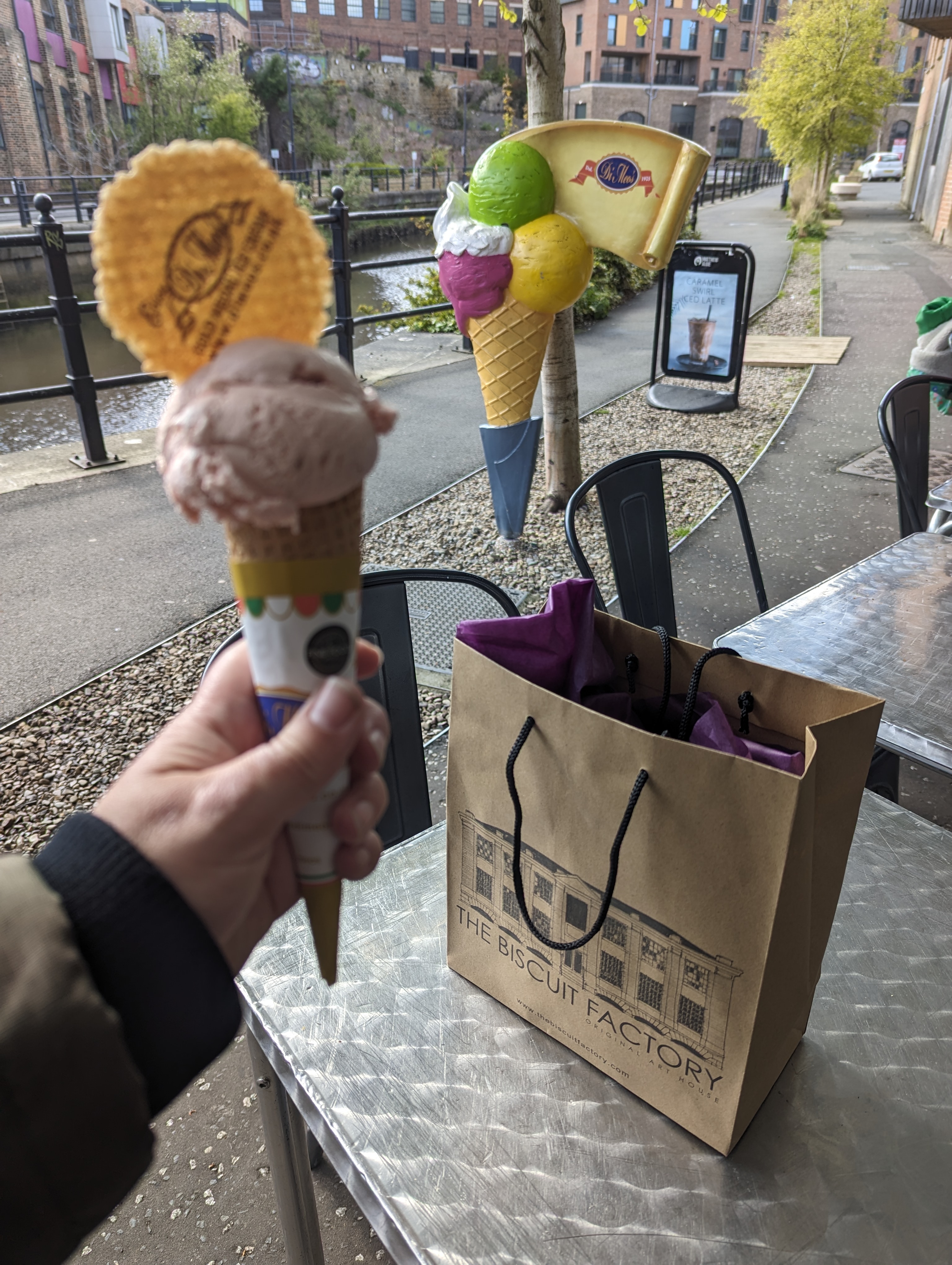
Tall cakes, short coffees In your head, they’re still fighting – This cafe has changed
The basic anatomy Of buildings eludes my pen
I am surprised By the skyline we worked for; Its absences
Ten years in the mirror That body is lost to me
The hotel shower – Skylight in a downpour Headful of pictures
Looks like she ate all the pies Exhibition in a bathtub
Close to shame Wouldn’t do that one (After grabbing)
Shit on the pigeon netting Echoes fall down Dog Leap Stairs
Cities are dreams People too are mostly dreams, New builds on goldfields
The waters of Tyne… They run between me and me
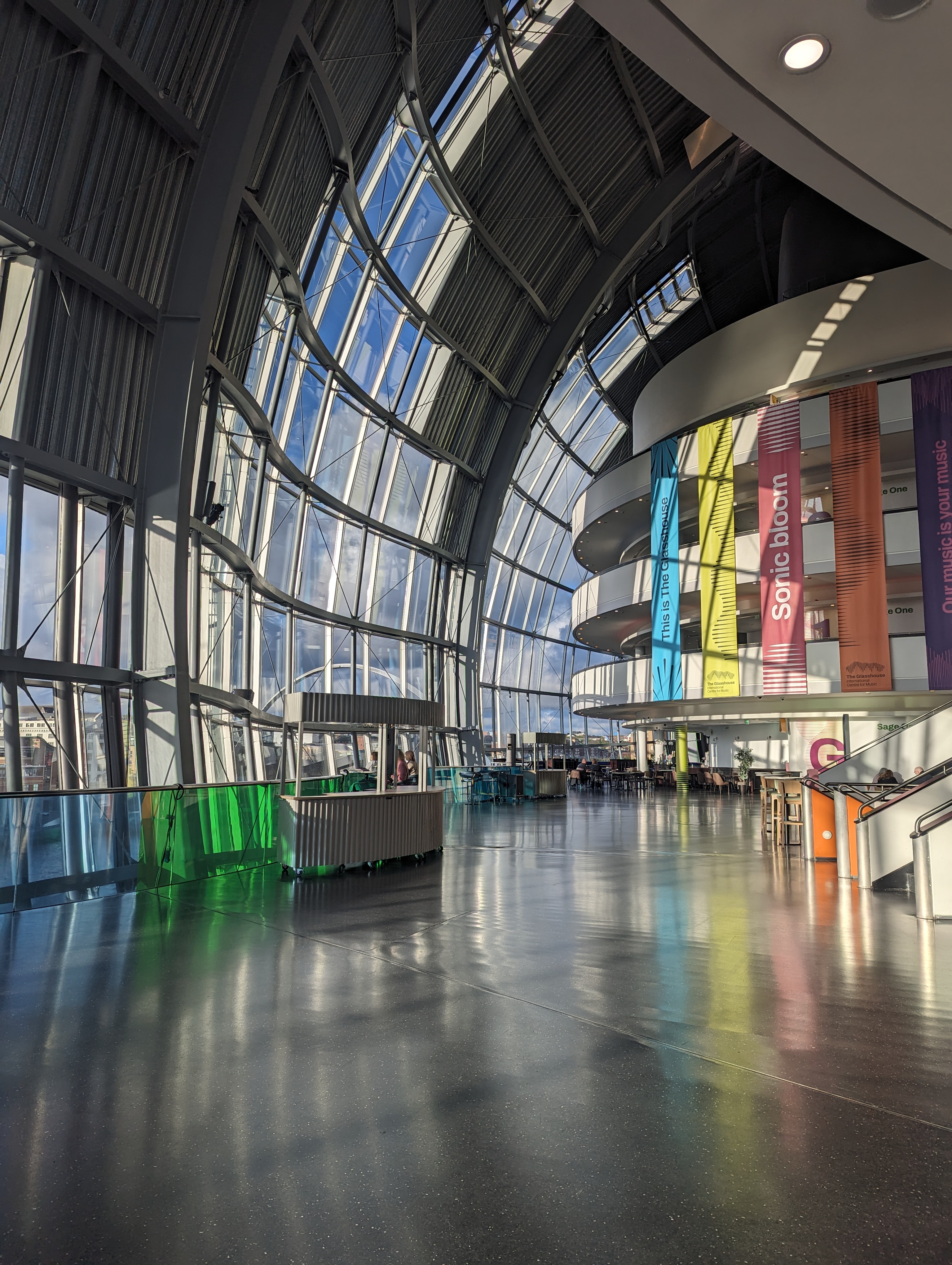
Continuing experiments with renga, though this doesn’t really count as not many people believe a single poet can write a renga – you need at least one other person with whom to collaborate. Let’s say this is me collaborating with the ghosts of former selves as I take a writing day around Newcastle, where I lived and worked for twelve years.
I’ve now lived in Hartlepool longer than I lived in Newcastle, but of course with it being just up the road it’s still very current for me, so the disconnect is not as strong as I might find going back to other old haunts in search of psychogeography. I filled half an old journal with sense impressions and random free writes over the day, then pulled these fragments out. Like emptying your pockets after a foraging walk.





















 Kirsten Luckins