Egg Fiction – for a bowl by Deirdre Burnett

Unbelievably, I didn’t take a decent photo of the third ceramic piece to become a poem in my Tees Women Poets @ MIMA residency, but here are some examples of Deirdre Burnett’s other work to give you a flavour. The one on the right is closest in colour and finish, but imagine it looking much more like an eggshell. The porcelain is also eggshell-thin, and quite small (ostrich egg?)

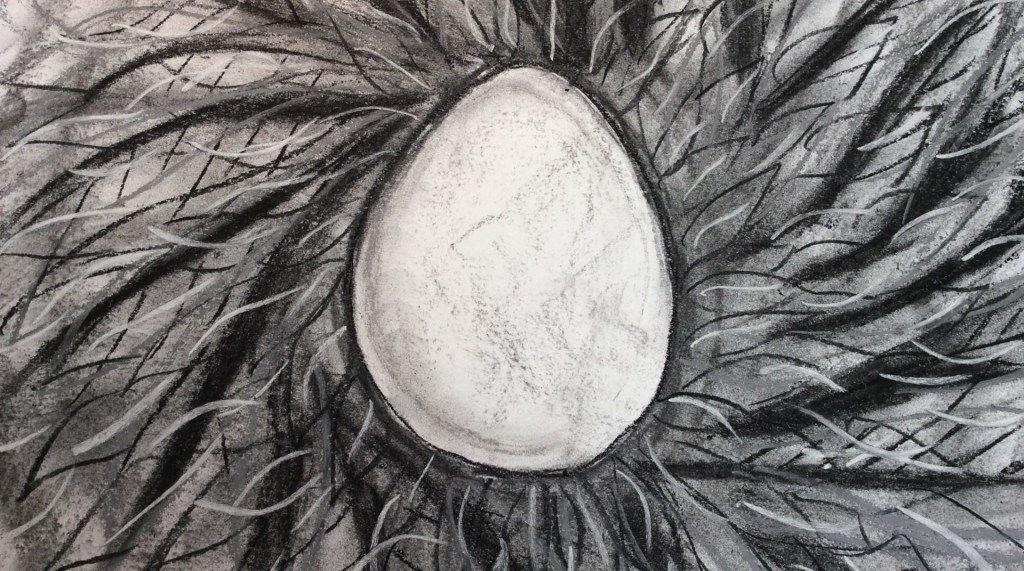
Egg Fiction draws on my own memories of collecting eggs and family folklore about witches’ boats. I learned charcoal animation for the resulting digital poem, and tried to keep a childlike feeling to the flow of images. I named the poem Egg Fiction because it is in no way an actual biography of Burnett’s route into ceramics.

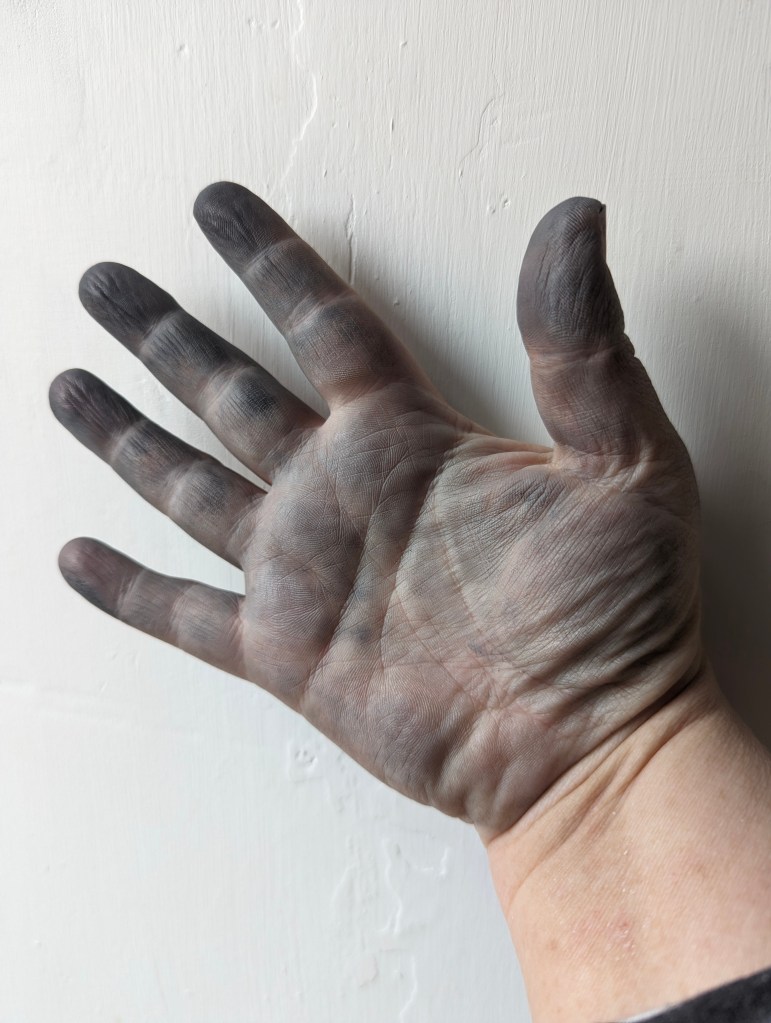
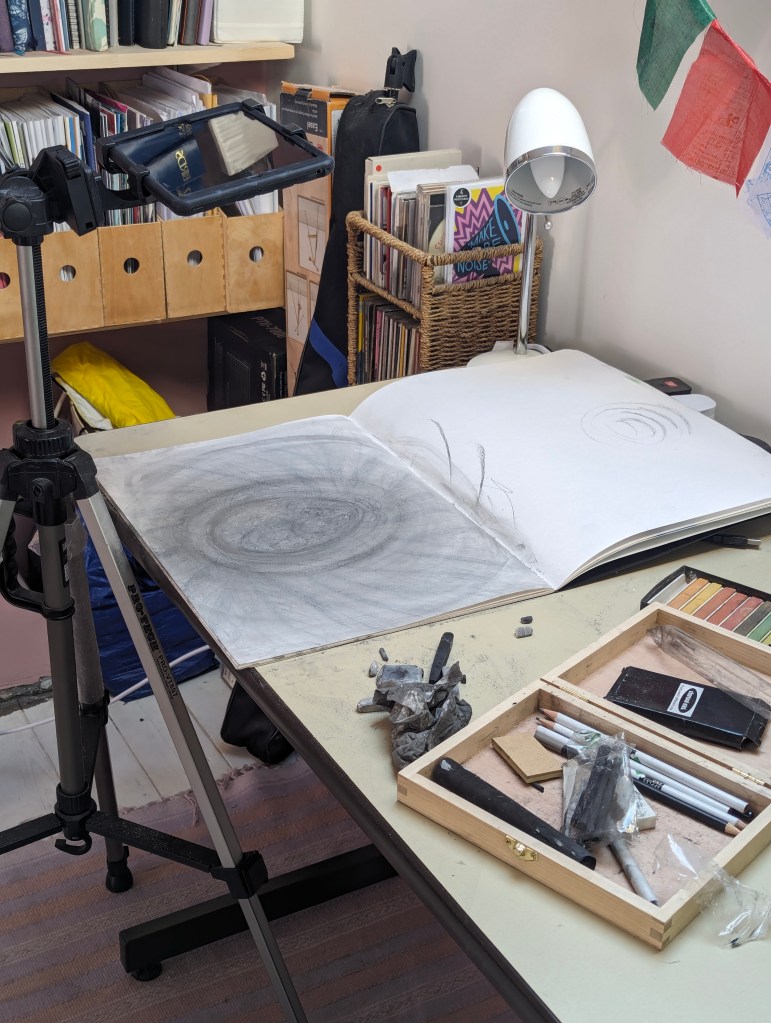
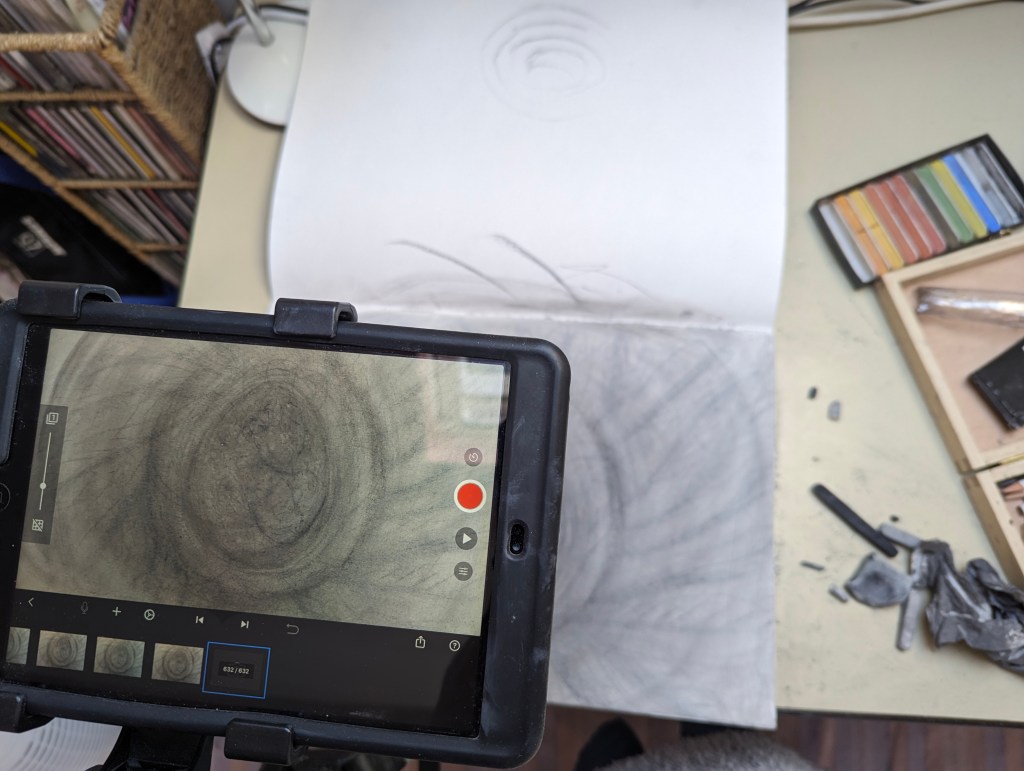
The animation was entirely unplanned and freeform. I used a central egg motif, and simply kept doodling in and around it using charcoal and chalk, taking 2 shots every couple of marks made, using the free app StopMotion on my ancient reconditioned iPad mini. I didn’t do separate drawings frame by frame, every frame was drawn on the same piece of paper. Rubbing in, sweeping off dust, erasing, chalking over, layer upon layer over a combined total of around 8 hours, until my desk was grey and grubby! Completely backbreaking, utterly obsessive…

1500 frames later, having made a whole 58 seconds of film, I recorded the voice track for the poem and was devastated to see it come in at nearly 3 minutes long! Nooooo!!!! Radical editing of words ensued, but I was still only half way with the visuals. Physically unable to continue with hand-drawn animation, I came up with an ingenious solution to triple the length of the film. Importing the original animation into iMovies, I duplicated and layered the sequence over itself, using the editing app’s greenscreen feature to set first the darkest parts and then the lightest parts of each frame as a greenscreen. In this way, the rapidly metamorphing egg began to ghost itself…

Here’s the text for this most challenging and enjoyable piece. When I show you all four finished films in my next blog, you’ll hear that the voiceover for this poem is not me speaking. In fact, I had my first foray into AI-generation by using a text-to-voice app. There were many accents to choose from, and male and female voices of different age profiles. When you read the poem below, what voice can you ‘hear’ in your head? What accent would you have chosen in my place?

Egg Fiction

nanna sent her to steal an egg
fresh from the straw
the darkness clucked

it was the end of the world
it was a rite of passage
don’t trip!
don’t smash it!

don’t smash it too soon
soft-boiled children must learn
the tap the crack the dip the scoop

now smash the empties!
scuttle the coracles
so witches can’t sail to sea
with their wicked, wicked storms

but that warm, smooth weight
had ordained her palm

it’s enough to make her grow up a potter
throwing porcelain
not to shatter, but
to release the paradox-
strength and fragility are twins
this is the earth whose yolk brews wings

this is the earth that knows fire
in the kiln it turns into a little sun
little pitchers become themselves
or smithereen…

look, this bowl has hatched a dragon!
half-shell with a scorched equator

and in the bottom
freckle-speckles
like the memory
of a hen’s egg

The Tees Women Poets are currently open to applications for their autumn residency at MIMA’s Towards New Worlds exhibition. If you’re a woman poet in Teesside, especially if you identify as disabled or neurodiverse, take a look at the info and apply here.
79 AD – for a Fuchs tazza

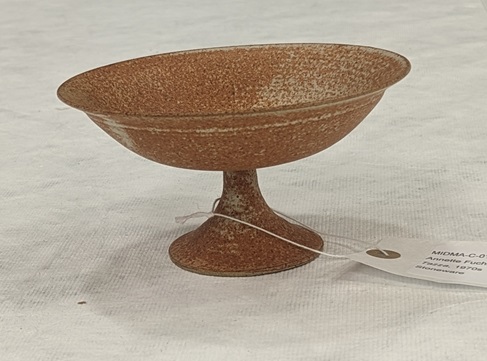
It’s small, about 18cm high maybe? Just looking at it, there is a classical, visual beauty in the proportions and the terracotta. But when you pick it up, the perfection of its balanced weight is breathtaking.

The second of my four digital poems for ceramic pieces in MIMA was written for a tazza, or serving dish on a pedestal and foot, wheel-turned out of earthenware by ceramicist Annette Fuchs. It made me imagine Roman society and murals, which in turn led me to think about Pompeii and Herculaneum. Pliny the Younger described the cloud of smoke that preceded the eruption of Vesuvius in 79AD as “a pine tree, for it shot up to a great height in the form of a very tall trunk, which spread itself out at the top”, a description which reminded me of the tazza shape. On this tazza, a pale razor-blade-shaped void has been left in the red surface, perhaps deliberately, as superstitious people will sometimes add a smudge to their make-up so the gods don’t get jealous…

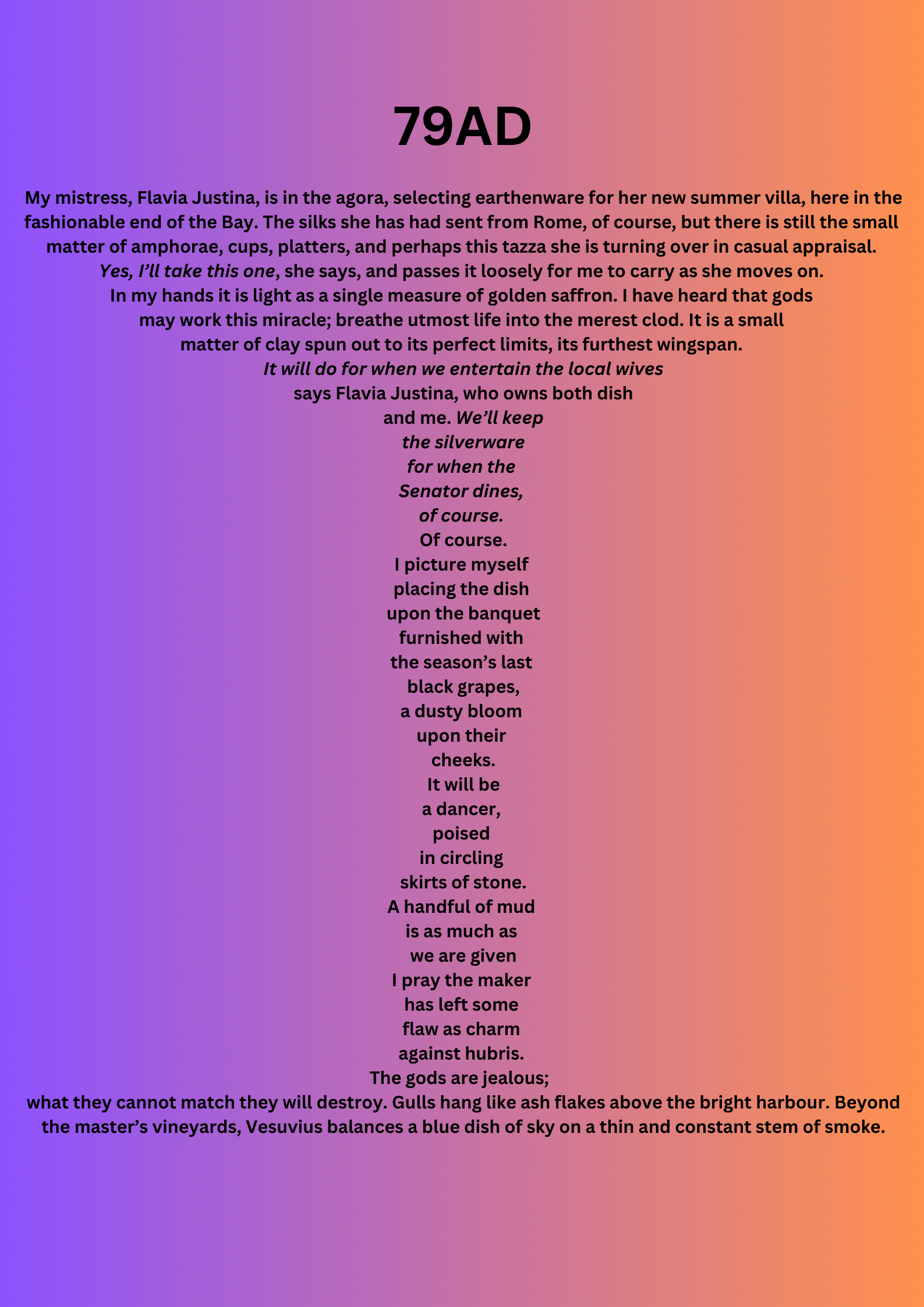
This poem has had a couple of concrete incarnations – the one above, which I made especially for this blog post, and the version in the micro-pamphlet handout produced by MIMA to accompany the exhibition, which had eight stanzas each shaped like a tazza. Can you guess where the stanza- and line-breaks came?

This extract from the visuals of the digital poem should give you a clue!

This is again made in Canva videos, using a textured background duplicated and flipped mirror-image along a vertical axis to enhance the tazza-shape of the stanzas. I then overlaid the texture with a free clip of a puff of smoke, to foreshadow the eruption of the volcano. The film clip was actually in a long, thin, landscape orientation. I have enlarged it, flipped it the portrait orientation, mirrored it along the same midline of the frame, and dialed down the transparency so it is a ghost of its former self…

What sounds would you choose to accompany this digital poem?

I’ll post all four completed pieces, with soundtracks, in my fourth blog. Watch this space for curved kinetic typography, charcoal animation, and weird adventures in Audacity and AI…

If you’re a woman, a poet, and you live in Teesside, then why not apply to be the next TWP poet-in-residence at MIMA’s Towards New Worlds exhibition this autumn? Information and application form here.

Origin Story – for a Betty Blandino vase

Now that my digital poems have finished their run at MIMA, I’m bringing you all four of them with some info on my process.

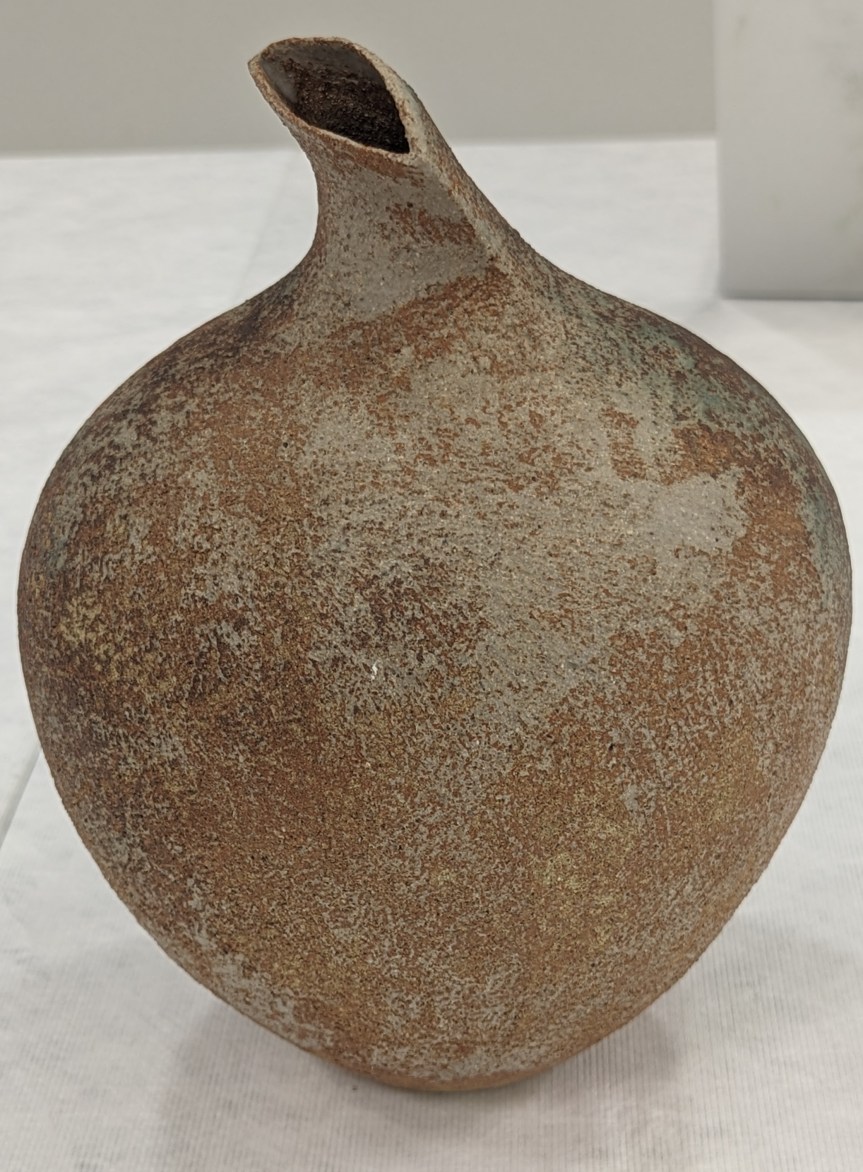
This first poem was written for a “leaning-neck vase” by Betty Blandino (1927-2011). As the poem states, the piece is made of coiled stoneware and is unexpectedly light when picked up – the rough finish makes it look like a natural stone, so the expectation of weight was there, and I did literally start talking to this pot when I held it.

My first step was to handle the pot, feel my responses, write notes, draw the vase to get its shape into my muscles…(and later use it for some gelli plate experiments, like you do)

Next step was to go away and write a poem from it. After a few edits, this poem then became a short film using a Canva video template (specifically, the Black White Minimalist the End template). I chose it because it features moving, soft focus lights with reddish-orange hues that made me think of the vase’s rusty-orange surface.

It also seemed to fit with an atmosphere of fairy stories/origin stories/when you were just a twinkle in my eye – the feelings of the poem, if not the specific details of the words. I changed the Canva template’s typefaces and text positioning, and played with how and where the text should arrive on each slide, changed the tempo to suit, and downloaded.

So far, everything I’ve used has been free and easily accessible. This was the result.

Now, that is not the final version of the digital poem – all four poems had soundtracks added before they were shown at MIMA, but you’ll have to wait because I’m going to talk about that, and show you the final looped installation, in a few blogs’ time! You could subscribe, if you like, then you won’t mis any of them?

But I will show you the last iteration of the poem right now, which is as a concrete poem. This was printed in the programme that accompanied the screening, with the following artist’s statement:

Origin Story was written for a coiled stoneware vase with a ‘leaning neck’ made by Betty Blandino (1927-2011). Handling this pot was a sensory overload for me, as it looks like a stone, feels like weathered rust, and is unexpectedly weightless. The shape is reminiscent of an amphora, a pot made specifically to store foodstuffs like wine or oil, but it is kept hollow, and sonorous.  I found myself speaking to it like a sentient creature, and continued that conversation into the poem, imagining myself telling the vase myths about itself like bedtime stories for a child. Little pitchers have big ears.

The observant among you may notice that there are some differences between the texts of the two versions, which just goes to show that poems are never quite finished.

Watch out for the next digital poem, which will be 79AD, written in response to an earthenware tazza by Annette Fuchs.

Soul to Newcastle

11.01
Northbound, the song of the rails
And footie fans

Bright tongue-punch of tamarind –
I’d go miles for pani puri

New builds on brownfields
Fennel glades, teazels, finches
Unhomed

Kestrel’s cliff scraped clean of roots
Bloody cranesbill

Street food, not sawdust
In the covered market; ghosts…
Skinned hares, white tripes

Kittiwakes scream from the bridge
No-one wants a terraced house

Everyone is fine
Talking to thin air these days –
Pods. Buds. Our blue teeth.

Shop fronts like cast shells
Waiting for crabs

Guts hanging out
Sliding doors wedged open
Cataract windows

The Laing’s a drum, deaf with rain
Paintings sign to each other

Bloodlust and faith
Objects in oils and suspense
Gilt-framed

Gulls after a lightning strike –
The Age Concern social group

Do you paint? Used to.
But the girl I showed them to
Never loved me back.


Sap green
Scorched earth

Where you see a storm
I see a girl tucking in
To a ham sandwich

Things, alone in their thingness
But, a field of attention

Smashed rainbow
The old snooker hall windows
Be Gay, Do Crime

Three white clouds; the blossom trees
Next to Manors car park

Tall cakes, short coffees
In your head, they’re still fighting –
This cafe has changed

The basic anatomy
Of buildings eludes my pen

I am surprised
By the skyline we worked for;
Its absences

Ten years in the mirror
That body is lost to me

The hotel shower –
Skylight in a downpour
Headful of pictures

Looks like she ate all the pies
Exhibition in a bathtub

Close to shame
Wouldn’t do that one
(After grabbing)

Shit on the pigeon netting
Echoes fall down Dog Leap Stairs

Cities are dreams
People too are mostly dreams,
New builds on goldfields

The waters of Tyne…
They run between me and me

Continuing experiments with renga, though this doesn’t really count as not many people believe a single poet can write a renga – you need at least one other person with whom to collaborate. Let’s say this is me collaborating with the ghosts of former selves as I take a writing day around Newcastle, where I lived and worked for twelve years.

I’ve now lived in Hartlepool longer than I lived in Newcastle, but of course with it being just up the road it’s still very current for me, so the disconnect is not as strong as I might find going back to other old haunts in search of psychogeography. I filled half an old journal with sense impressions and random free writes over the day, then pulled these fragments out. Like emptying your pockets after a foraging walk.

Reflections on Renga

Last month I led my first renga, or rather my first “quarter-renga”. We didn’t have the minimum five hours it takes to lead a group of poets through the collaborative creation of a linked chain of twenty haiku-alternating-with-couplets that is the shortest possible version of a traditional renga.

Now, I have a lot more learning to do about the intricacies of different renga patterns and how to lead people through them skillfully. They remind me of increasingly complex versions of card games – draw the Queen of Spades and pick up the discard, red sevens reverse the direction of play, mention the season once and you must mention it in the next 3 verses, only one verse about the moon per page.

The not-even-quarter renga we created in the sun-warmed vestry at 17nineteen in Sunderland (otherwise known as Holy Trinity church) cherry-picked some of the rules. We opened by establishing a sense of place, then deepened it in the next couplet. Then we allowed the moon to peek into a verse, before closing with a couplet open to any theme. As renga-master, those were the choices I made about the poem’s direction of flow. Four verses took just over an hour.

In keeping with the traditional method of renga, once the direction had been said for the verse in hand, everyone wrote, and everyone then read out the previous verse plus their new addition. As renga-master, I then chose the verse that would take us forward as a group. For the first two, I combined lines from two or more contributors; for the second two, the “correct” verse arrived fully-formed from a single source.

Eight poets took part, and although the final words only derive from five pens, all of us are considered to be co-authors of the resulting work, because it takes everyone’s energy, focus, and revealed words to weave the invisible field of connection in which the renga gestates.

It is a sacred space. It needs space.

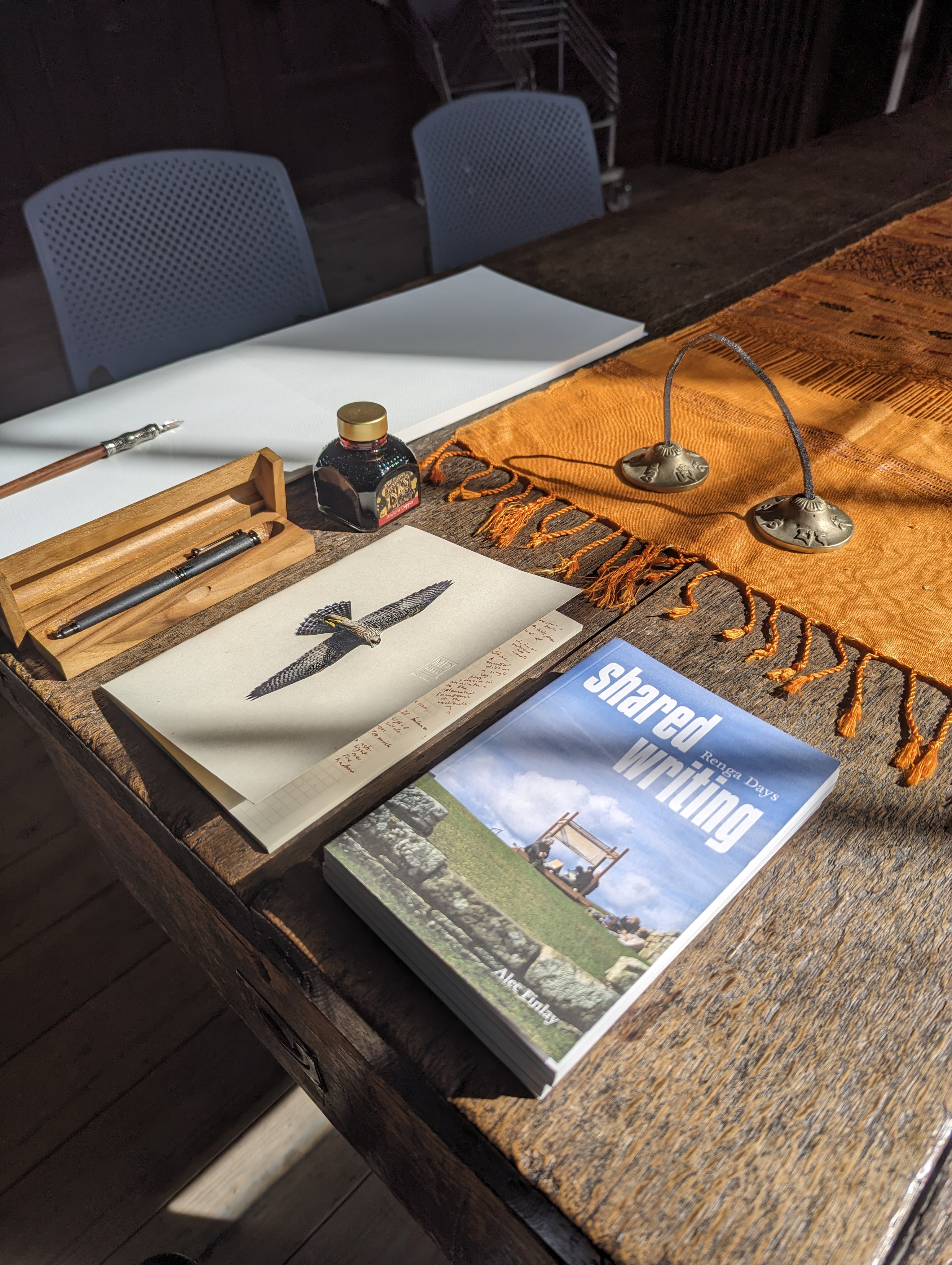
sunlight slants onto an old wood table, laid out beautifully with a deep yellow silk table runner, a fountain pen and ink bottle, a pair of Buddhist chimes, a notebook with a buzzard on the cover, and a copy of Shared Writing handbook of renga

With each circuit of the table, alternative poem-chains open out, fractal branching, seedlings of all possible poems grow ghostly, pale and eventually wither. Like my amateur gardening, I feel guilt and regret with every verse I thin out, death of so many. A smile when someone’s words are chosen, against their expectations. My inner wince away from too-clever, too-polished; my confused frustration when people get caught in syllables and don’t quite open the door to the poem – can you feel it? Like a birdcall, words at the right moment, and never too many. The unchoreographed sigh of recognition from everyone when the right lines arrive, when I choose correctly, when we are becoming the hivemind that spins together.

My approach to creating the conditions for the renga to arise was firstly to run two previous workshops about haiku, to provide renga participants with some insights and practice in the form. But several people turned up for the first time for the renga! So I also used Alec Finlay’s book Shared Writing and had us read out some 20-verse renga. I have two copies of the book, so we could do it in pairs, call and response, which was a beautiful way to hear how this way of writing unspools dreamlike dialogue resonant with association, echo and surprise.

A demarcated physical space really helps. Ours was a room, other projects have used a canopied platform. There is something qualitatively different about joint effort within a dedicated space, our combined attention builds an invisible structure that needs the trellis of a protective physical space up which to climb. I believe it would be possible to carry a mobile platform of stakes and flags, or meet in the wilds and create the space with foraged rocks or marks made in sand.

I also set up the energetic space for the renga by leading some brief meditation, and setting aside time for participants to move around the entire venue in silence in order to open their senses and minds to the latent poetry all around us. Even though the writing was done in the vestry, everyone brought with them details of everything from the wind in the trees outside to the halo lamps above the nave (white moons shining down).

In previous workshops I’d been able to do some basic qi gong with the poets, drawing on a previous life as a shiatsu/qi gong practitioner – it’s a useful, possibly essential preparation for poets who may be more used to starting with a focus on inner turmoil than on the observable world. Though makers in other disciplines would no doubt use the metaphors most related to their practices (haiku alternates with couplet, warp and weft, ones and zeroes) for me the rhythm of the chain felt very much like a walking qi gong where the weight must shift to the side before stepping forward. A quieter verse may make the better stepping stone. Not all can be Alpine grandeur, some must be saxifrage and gentian.

Here is what we wrote:

Three Gold Heads

Bright sunlight / Through high windows/ Inside, three gold heads

Water splashed on infants / Bless you, darling

On the dark side of the garden / A broken teacup saucer / In finger-nailed soil

The daffs need deadheading / Let’s leave them another week

And here are some favourite lines that didn’t make the cut – what would you have made with them?

Sun warms the wood / for centuries, this drawer / is it locked?

Sparrow chirp / ricochet on brick

Like the sky / my blue and white top / is colder than it looks

The lid of the poor box / is so heavy

Corinthian columns / the silver birches can’t quite touch / the window

Cholera corpses / standing room only

Lungs and moon full / I rub sleep from my eyes / another lonely night

The plural of haiku is haiku

Every so often, I get re-smitten by haiku.

They are simple, but not easy.

They are small, but contain vast spaces – like an atom.

They are a practice.

Last Saturday I led a workshop on writing them, in which we played with fridge magnet haikus to get that old 5-7-5 syllable counting thing off our chests before going out into the world for a walk to find our seasonal signifiers, our moments of subtle intersection with (urban) nature.

Here are some thoughts from that day…

  • Really do cut out words if they’re only there to make up the syllable count. Up to 17 syllables is fine – if you do this, you will find an expansive sense of ambiguity and open up the poem to reader interpretation. The space created when you cut an unnecessary ‘is’, ‘but’, or ‘that’ is much more haiku than finger-counting the dum-dum-dum.
  • Two things that don’t go together. Put them together. Do not try to build a bridge with words. Allow the reader to make the bridge for themselves, with resonance. Two things striking each other, like wind chimes. The poem is the note; the note is the white space.
  • Of all poetics, haiku care the least about what you mean. Stop meaning. Start looking and feeling simultaneously. In a glass building, having a complicated conversation, watching pigeons fly through their own reflection.
  • I say feeling, but this is not about getting it all out on paper. How Western! Stay still a little longer, the ivy may have something to say about that.

My next workshop on 13th April is going to be a mutual exploration space looking at how to bring haiku into film, using Reels. I’ve been trying and I have no firm conclusions!

This was my favourite out of the 5 haiku I wrote myself that day – why?

Complex birdsong
Simple flowers
I don’t know

“Common mistakes when writing poetry”

On Hallowe’en I dressed up as a Poetry Expert, and took my place on an international Zoom session organised by the ever-entrepreneurial Middlesbrough author Kudzai Pasirayi. I was asked to speak about common mistakes when writing poetry, which felt/feels like massive hubris!! What follows is a rough summary of what seemed to be the most helpful points, judging by the questions and conversations that ensued with some of the young writers tuning in from Zimbabwe.

Common mistakes that poets make:

  1. Thinking you can make a living just from selling poetry books

Yeah, not a reality for 99% of us, even the acclaimed or famous ones. I’ve published two books, and have a third collection coming out in February, but I make my money by teaching, and setting up funded community arts projects that have poetry somewhere in them. For example, I’ve just been writer-in-residence at a local festival, where their usual public parade has been replaced by a COVID-safe self-guided trail of art in people’s house windows. I wrote A Glossary of Lights – haikus that appeared as cut-out paper panels illuminated by people’s lamps. About one-tenth of my time has been spent writing poems – the rest is all about talking to people, cutting out the paper panels and installing them. But actually, poetry for most people is still very much what it’s always been – something to do in the time they have outside their day job. This includes many, many poets with a good public profile for their work.

The glamourous life of a poet – cutting out haiku panels on the kitchen floor

2. Thinking getting published by a press is automatically ‘better’ somehow than self-publishing

Hmm, yes and no. There is a definite advantage to being published by a recognised press, even a small one, if your aim is to build a reputation as a poet. A good publication track record can then lever in more work in the form of commissions, appearances, and teaching. If poetry is your career, its likely you’ll be aiming at a serious press sooner or later. But if you just want to make a beautiful book, then why not go for it? My first collection was published by an award-winning indie press, but I still had to buy my own copies at cost price and sell them myself at gigs – I barely broke even. My second book was ‘assisted’ self-published, meaning I bought the services of a proof editor and also bought my own copies to sell. It was a collection of illustrated poems that I’d already put out on my blog and I’d built an audience for the poems through social media posts. I crowdfunded the entire cost of publication through pre-sales and sales of bespoke illustrations, and every copy I sell now is clear profit (if you forget about the value of the time I’ve put in being my own marketing department). So which approach is mistaken?

Illustration from my self-published book, ‘Utterly Otterly’

3. Writing in a vacuum

You’ll hear this from absolutely every poet who has a halfway decent career – to write good poetry, you need to read good poetry. None of this ‘keeping my voice pure and untainted by influences’ bullshit. You won’t end up sounding original, you’ll end up sounding lazy, self-indulgent, old-fashioned or just plain mediocre. There, I said it. You can do almost anything with your poetry, but please have a reason for the choices you make – of words, of line breaks, of layout, of poetic form. Don’t rhyme for rhyme’s sake, especially if you have to twist your syntax to achieve it. Don’t go free verse without considering if a form would serve you better, either. White space on the page is not neutral, it should be ‘read’ as pause, beat, silence; and a good poet will position it in such a way as to draw the reader’s attention to an important word, or thought where they want you to pause. You can learn how to do this well by reading other poets and asking yourself – why did they make this poem in this particular shape?

4. Dispensing with editing

I think another possible mistake some poets make is to assume that their first or second draft of a poem is as good as it can get. I’m not saying you should agonise over something for years, or refuse and mistrust the gift of sudden inspiration, but really good poets tend to have a habit of close editing. They also tend to have a habit of seeking ways to get good critique, to push them to become better – attending masterclasses, or a really good writing group, or joining a collective, or investing in getting a mentor to read your work. It would be a mistake to think you can ever reach the point where there’s nothing left to learn; after all, you don’t want to become a pastiche of yourself.

Working with, and learning from, other poets will make us all better and happier poets!! Here are performance poets Don Jenkins, Steve Urwin, Sky Hawkins and Ellen Moran

5. Some pitfalls of publishing

Finally, a not-entirely serious word about publishing, and the hierarchy of prizes and publishers. England is inherently snobbish, even when we try not to be, so there definitely IS a hierarchy. A “perfect” career for a poet might go something like this:

  • Be discovered as a teenager, having attending one of the hothouse development programmes like Foyle Young Poets or the Roundhouse.
  • Win a Foyle Young Poet award.
  • Get multiple poems published in PAPER magazines, not just online ones – especially magazines with the word Poetry in their title (Poetry London, Poetry Birmingham, Poetry Wales, just Poetry) or magazines that have been around for a long time (Magma, The Rialto, The Stinging Fly, Frogmore Papers) or are produced by people who also publish poetry collections (Under The Radar by Nine Arches Press).
  • Write a pamphlet and have it either accepted by a reputable press during one of their free reading windows, or have it win a pamphlet competition. Slightly more kudos to just get accepted without all the grubby business of paying money to enter a competition.
  • Win an award with that pamphlet.
  • Write a collection, same procedure.
  • Win an award with that collection – if you’re young enough, make that an Eric Gregory Award. So if you’re already over 30, tough luck, or maybe try to win the Felix Dennis prize for best first collection. Whatever you do, MAKE YOUR FIRST COLLECTION AS INCREDIBLE AS POSSIBLE.
  • Get taken up permanently by one of the Big Presses – Faber, Carcanet, Cape, Bloodaxe, Nine Arches.
  • Write several more acclaimed collections, end up winning the Forward Prize and the TS Eliot Prize and as many others as you can manage.
  • Still have virtually no money.

Ok, so of course I’m joking! For everyone else, you and me and the many, many poets I know, this kind of poetry journey is neither possible nor relevant, and your greatest mistake would be thinking that it’s the only way to go, or the only measure of whether or not your work has value. Your work always has value. You might find it inspirational to read some interviews with the very compassionate and non-competitive poet Ocean Vuong. And to quote Miles Davies “It takes a long time to sound like yourself”. There are LOADS of poetry festivals, readings, open mics and supportive online communities out there who are waiting for YOUR words. So really, your biggest mistake would be giving up. But you’re not going to do that, are you?

Some resources and links to get you started, but just look for #poetry related hashtags on your socials and you’ll soon get a sense of what’s out there for you.

Nymphs & Thugs online poetry events

Bad Betty Press online poetry events

Say Owt poetry events

Apples and Snakes online poetry

Jo Bell writing prompts Try To Praise This Mutilated World

Magazines and competitions to enter

Poetry courses online – The Poetry School

It’s In The Cards – filmpoem week 10

We’re nearing the end of this little project, but there are still a few surprises to come as our collaborative film-poem twists from verse to verse. The latest clip is from Diane Cockburn, who picks up the “four years” of the poem by placing down the four of each playing card suit. Her deliberate movements are reminiscent of a Tarot reading, where there may well be “a reckoning”. See also how the colours of the table cloth echo and continue the colours of last week’s crochet footage.

So now we move to the final prompt! Can you find a way to illustrate this last verse?

in the pocket of the night I find you, let myself be found

As ever, please see these previous blog posts for

How and where to submit

How to think up a good image

Common mistakes to avoid

Domestic alchemy – filmpoem 9

As with a traditional renga, anyone from the group of participating artists can offer contributions as often as they like – which is how we welcome back Alison Raybould, who gave us our very first images. It just goes to show, try try again! Sometimes it takes a few attempts to get a bit of film that works the way you want it to.

Poet and renga-master Jo Colley has selected this clip of hands crocheting vintage wool for a number of reasons. One is that she enjoyed how it continues an overall mood of domesticity that is appropriate to the atmosphere of the poem it illustrates. She also liked seeing an action that is different from the pickling described in the verse, yet is also a kind of magic transformation of one substance into another thing entirely. And finally, she has fond memories of the wool shop featured on the wrappers in the film – if you’re from Darlington, maybe you do too?

Cherophobia: An Autumn Journal from Joanna on Vimeo.


So now here is the penultimate prompt for you! Can you come up with a 20 second clip of film to illustrate the meaning and mood of this verse?

this is the fourth year, abacus of elderberries, an accounting of sorts

Remember to look here for all the submission guidelines, and also check out previous blogs for advice on how to come up with compelling imagery and avoid common mistakes that could undermine the brilliance of your vision!

The arrival of the abstract – filmpoem week 8

A fascinating turn in the imagery this week, as new contributor Anathema McKenna picks up on the cut paper strips of week 7 and turns them into an abstraction. The choppy rhythm and ‘prison bar’ effect of the collaged lines is unexpected yet effective in conveying the actions and atmosphere of the verse, without ever becoming a direct illustration of the words.

We’d love to see your ideas for what might come next in this multi-authored film!

The verse you have to respond to is this:

alchemy: to transform berries and spice to dark distillation ready for winter

To help you get started, please do read this earlier blog about how to generate ideas for imagery, and this one about common mistakes to avoid.

Send your films to sleeperpoems@gmail.com by 5pm on Friday 29th May – thank you!