For Holocaust Memorial Day

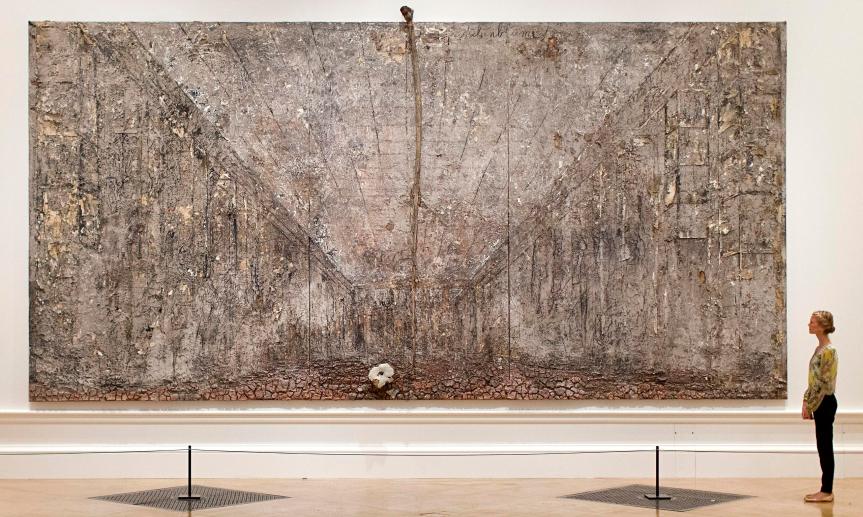
anselm-kiefer-ash-flower-1983-97.jpg

Ash Flower  (after Anselm Keifer)

The dead, who are thinner than gas,
might fit comfortably in their millions
in a simple cardboard box.

So why this desolate hangar?
Ankle-deep in guano and plaster-dust,
quiet as a sick forest –

(was Buchenwald once really a forest?)
Trees, acid-stripped and skeletal,
grow down out of a broken pane of sky.

Why has he painted such a mighty space?
Must we fit in there with them?
The millions whose last words

were a scrabbled cunieform on the inside
of the heavy chamber doors,
thickest where the handle should have been?


Workshops – during and after

Hello! This is for anyone who would like to know what kind of stuff happened in my recent creative writing workshops for The Forge in Stanley. It’s also a bit about how poems might develop after such a workshop. If that’s not for you, then no worries, see you later xx

justforwomen_4

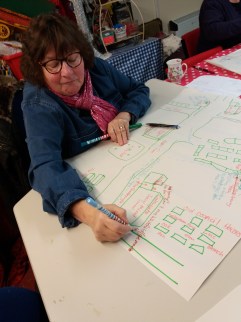
I recently ran two versions of the same workshop, one as an open public 3-hour workshop for Northern Writes Festival, and a shorter 2-hour version this morning for the Just For Women group. The basic structure was the same, but with 3 writing exercises in the longer version, 2 in the shorter session. In both, we start by drawing a map of somewhere we knew well as children. Over 30-45 minutes, we add on layers of details – street names and nicknames; people, animals, significant trees; places where stories happened to us and to others; urban legends; colours, sounds, textures and smells. It’s incredible how much detail you can recall using the technique of mapping.

Then we read a couple of example poems. I think of this bit as a choice between ‘landscape’ and ‘portrait’. The poems I’ve been using have been The Bight by Elizabeth Bishop, and Jean by my friend Jane Burn. We talk for a while about images, how to make them vivid, how to make verbs work hard for you. (Jean’s hair doesn’t curl, it ‘fizzes’, for example). Then we free write a landscape or portrait of our own, using the maps and their memories as our inspiration.

In the longer workshop I also ask people to try a short prose-poem or piece of flash fiction telling a real or imagined anecdote, and hand people some examples of ludicrous but real headlines to get them going. (One person in Stanley used this one – Ghost Hunters Stumble On Graveyard Porn Shoot). At some point we have tea. At the end we give our pieces a bit of spit-and-polish, talk about what editing we might do at home, share the bits we like so far. And then…

Well this is what happened to mine – huge frustration, followed by a couple of edits that got me quite close to a finished poem. It may not be brilliant, but it’s more interesting than versions 1 or 2. In my opinion.

Blackbirds

Sleek among the rotten

leaves are blackbirds

dandily stabbing

swallowing small things

whole; should a brother

wear a white patch

volleying pecks at him

(naturally to death)

other as he is to the Race

and Nation of Blackbird,

that reaches in the dark

to the outermost edges

of the next bird’s song.

One More Drop Of Kindness

img_1116I lied! There is one more showing of The Trouble With Compassion to come this year, because the fine folk of Stanley have booked me for the Northern Writes Festival next week. So if you’re in the vicinity at 4pm next Wednesday 7th December, please bob along to the Forge for some fun, film, poetry, music, musings, sketching, chocolates and clementines. All the details here.

Even more excitingly, it doesn’t stop there! I am also running a full-day workshop for the festival on Saturday 10th December, which will feature map-making and truly ridonkulous news headlines. More details here.

Human/Otter Dictionary

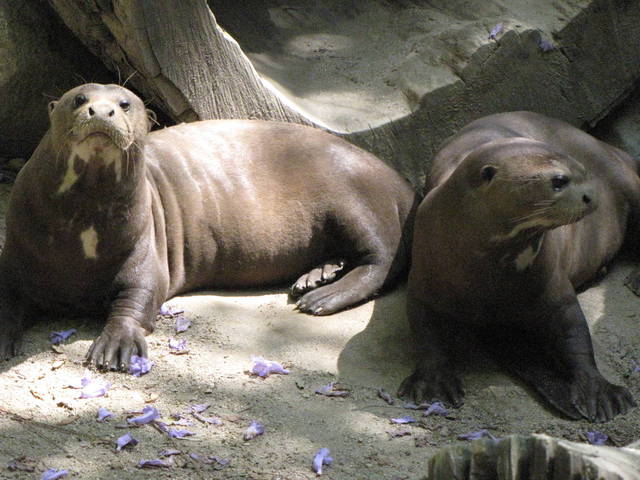
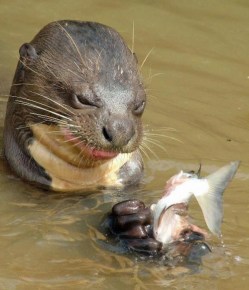
Final NaPoWriMo prompt! And it is to translate a poem, but unfortunately there is no otter literature, so I have had to listen to the varied vocalisations of the giant otter and then make up some complete nonsense again. Giant otters have twenty-two distinct sounds, probably because they live in the largest and most complex social groups. They are also very stressed out by being in close proximity with humans.

img_4576-99747


I may not have lived among giant otters, but I have shared flats

with people I can barely tolerate. Their hastily-chosen, temporary

sexmates, on catching sight in a doorcrack of my solitary moshing,

have given just that strangled yip of laughter that would garner

a small dead fish from an alpha otter momma.


I have beaten wearily at floors and ceilings in the incoherent Morse

of the diurnal trapped among nocturnal experimental loop-pedallers,

whose weeeekrrrikkering dial-flip zzewstatic WAH interferenzzzzeee

resounded loud enough to alter the direction of hunting otter packs

as far afield as Lake Salvador.


I have nursed beers on window seats whilst macaw-hoarse flirters

make throat-back grokkle sounds in the crowded kitchen, tsip-tsip

their own drinks and then exit the yikkering, yipchuckling hodgepodge

to find a place to ‘be alone’. Through my wall I heard them,

little snouty buzzings, universal language of purr.


And yes, I have felt that wavering scream of isolation threaten

to come sailing out like a violin bow dragged ragged on a saw-edge,

though  I have been habitually considerate and kept the noise down,

at most emitted a pup-squeak like a balloon-dog having its neck rung,

but no otter ever answered.


In Memoriam James Williams MBE


I was dimly aware of the nam96ab3c04c81b8ef05bea62d1b24dcd7ae James Williams because during this month of research various ads for his books on otters have popped up in my peripheral vision, but I had no idea he had been awarded an MBE for his conservation work, “for services to otters”.

I am slightly twisting today’s prompt, turning it from an ‘I remember’ poem to an ‘I don’t remember’ poem about James, inspired by the wonderful contributions on his memorial page at the Somerset Otter Group. What a man, how I wish I had known him.

I don’t remember James, with his cap and stick, and his little laugh.

I don’t remember him pushing down the barbed wire and legging over,

trotting back-heeled down the bank to check a turd – dog or otter?

I never ran into him under bridges, peering at dubious dark blobs

on known sprainting rocks, those infamous otter-loos he patrolled.

I don’t remember the anatomy of paw-prints he never taught me,

don’t think of eels because of him, still have no way to catch crayfish.

When I look at a riverbank, I see only the stones that are visible,

I don’t remember to follow my nose along the breeze, across the bend,

I don’t remember to see the land like a musk-talker, a scent-dweller.

Never have I bowed at his delicate request to sniff what otters leave –

“a sweet, wild, musky scent of pebbles and water weed and fish

and of the eternal untameable current”. But how I wish I had.


Otter fishing in the Sundarbans

article-2585932-1C75383E00000578-692_964x642

Off prompt today, sorry NaPoWriMo! Didn’t fancy writing a backwards story because I’ve been thrilled by accounts of otter fishing, still a living practise in the mangroves of Bangladesh, where generations of fishermen raise domesticated otters to herd fish into their nets, pups learning from their parents. I’ve taken inspiration, images and some entire phrases from this great eye witness account  and also from this deliciously atmospheric website celebrating the Sundarbans.

You can watch footage of otter fishing here and here.

Otter fishing in the Sundarbans

damp-mouthed

the beautiful forest receives

the falling night

smears it kohl-black

along its starless, brackish

watervoids


where fish trace cursive

drowned comets

tinysilvertremblers

elders swung on a chain

of tailflicks like

heavy-flanked censers


in a bamboo box

a writhing otterknot

cacophonous yipping

piercing the slats

their whiskers and stench

of fermented mud


treacherous

the estuaries breath the tide

into their bronchioles

new islands breach

spines of giant crocodiles

midstream, middream


the mud shifts

whispers under

the paws of maneaters

the striped jungle

conceals its secret hives

its weapons


fisherman, release them

longleashed from the narrow boat

dogfaced snouting

fish from crannies

playful, frisking

fish from gullies


in swamps where

translucent women wade

neck deep dragging

nets through shrimp-seethe

and are eaten tiger-silent

down to their screams


this is the only joyful hunt


Loving The Longest Otter

sappho-eats-600x700-500x583It’s been a long day, folks, and we were challenged by NaPoWriMo to write a poem with long lines – seventeen syllables long, to be exact. To my mind, this calls for a particularly long otter, so I’ve taken a look at the Giant Otter of the Amazon. Which, of course, is a particularly long river.

There are a lot of fabulously interesting facts about Giant Otters – for example, if they stood up they’d be as tall as my mum. There are some distressing facts about Giant Otters – for example, just the noise of human activity in their vicinity can stress them out so much they kill their own pups. None of this is in the poem, but you should totally check them out here.


The path of the Amazon is

a dilly-dallying belly-dancer, juggling half-moons hip to hip

a slipshod silt-filled seam, stray-dog yellow, stupefied vein of sunlight

an unravelled fingerprint, a concertina folded from jaguar tongues

a velvet ghost road four hundred and eleven thousand otters long


Sea Otter Prayer

The designated call-and-response for today has allowed me to combine some research lists, that of shark species and Ocean goddesses. Now, the competent marine biologists among you will no doubt be able to tell me exactly which of the following sharks have no interest in eating sea otters, but for now let’s just go with the flow, alright?

72ed095cd93f9ef9df178f6d0d3259e8

Sea Otter Prayer

Sedna, mother of storms,

From Blacktips save us

From Silvertips, Silkys,

Duskys, Coppers, Blues.

Deliver us safe from their mouths


Nerrivik, lady of the deep places,

From Tigers keep us

From Leopards, and Smoothhounds

Sharptoothed, Grey and Brown.

Delivers us safe from their mouths.


Arnakuagsak, daughter of the creator,

Protect us from Hammerheads,

Malletheads, Bonnetheads,

Bulls, Swells and Sicklefins.

Deliver us safe from their hunger.


Arnapkapfaaluk, Big Bad Woman

Let us not fall into the Megamouth,

Keep far from us your Goblins,

Horns, Nurses, Pacific Angels.

Deliver us safe from their hunger.


We are the smallest of your fingers

Cut from you and fallen in the bitter sea.

Gather us away from Great Whites.

Sedna, deliver us.


Otter Gibberish

0e5bac450eaadf8fe1ab7904bf6fd918Our prompt today was to start with a line from an existing poem that we could remember without looking it up, and then to write our own poem onwards from there. Many people immediately reached for beautiful, flowing phrases, lines that have remained with them as inspiration and guide…. My immediate thought was ‘Can a parrot eat a carrot standing on his head?’. Spike Milligan. Gotta love him.

Can a parrot eat a carrot standing on his head?

Would a possum scatter blossom on his lover’s bed?

Could a peacock dance to bebop if he’s in the mood?

Would an otter race a stock car, or would he just get booed?


Can a raven go clean-shaven to evade the law?

Could an emu change a brake shoe on a four by four?

Can a lobster be a mobster if he has a gun?

Should an otter be a yachter just to have some fun?


Can an ostrich free the hostage from the terrorists?

Is a weasel on a Nepalese hill scaling Everest?

Could a pigeon get religion if it were brain-washed?

Would an otter tell a whopper, or the truth at any cost?


Can a beaver get Dengue fever sitting in his dam?

A spider in the Hadron collider – does the world go bang?

Would a dolphin and Alec Baldwin have screen chemistry?

Are some otters total tossers, or is that only me?


Can a jackal use block and tackle to raise up a wreck?

Does a donkey wear diamante to the discotheque?

Can a panther be a Morris dancer if he has no rhythm?

If an otter flies a helicopter, must I get in with him?


Best Headline Ever

Oh how I’ve been looking forward to writing inspired by this great 2011 headline from the Irish Sun!

The NaPoWriMo prompt was to mix two registers of language in the same poem, so I’ve done one with some long, fancy, formal words and a bit of low vocab as well. I’ve given you the link for today’s prompt, but mostly because I’m their featured artist with my sonnet from yesterday! So chuffed, really unexpected 🙂

Anyhoo, here’s the ludicrous doggerel for today…

83796e2b-e8c7-4d96-b3a6-acff19cec43a

“Farmer Attacked By Furbag”

A headline the like of which has never since ran,

A shock that that shook us from Spokane to Kazakhstan,

A calumny befallen a numpty of a man –

“Devil Otter Ate My Minivan”


It seems that a farmer by the name Joe Burke

Whilst going about his bucolic work,

Came upon and straight away cornered the creature

Slandered as ‘Devil’ in the Sun’s lead feature.


(This appellation surely was intended to mislead

And manipulate the masses to cough up cash to read,

For otters are peaceable and piscophageous,

To impute Satanic provenance is otterly outrageous.)


Yes, he asserted that he’d sustained a bite,

But we weren’t witness, so who knows who is right?

He could be talking out of his welly boots,

Without otter testimony the point is moot.


At the very least he showed poverty of judgement,

Made himself a target for otterish assailment,

For if a man grabbed your scruff and stuffed you in a sack,

Would you not make petulcous* attempts to nut him back?


Having gnawed its way out of one container,

To persist in its escape was a simple no-brainer.

It was the only logical game plan,

To eat its way out of the minivan.


So if you catch an otter, don’t hold it hostage,

It’ll munch through your chassis like a Scot through porridge,

And definitely don’t be like that Burke with his van –

Never plug a wild otter’s gobhole with your hand.


A headline the like of which has never since ran,

A shock that that shook us from Spokane to Kazakhstan,

A calumny befallen a numpty of a man –

“Devil Otter Ate My Minivan”


*meaning ‘likely to butt with its head’, archaic/literary