The ballad of the benches

“If a tree falls in a forest and no one is around to hear it, does it make a sound?” Yes, yes, interesting thought experiment, but more to the point – if a tree falls on a housing estate in Norton, does it get chipped for mulch, OR….does it get carved into stunning benches for the community????

Well obviously, the latter! I found out about it when the Tees Valley Wildlife Trust asked me to write a celebratory poem for the unveiling of the benches on May of this year. What was only intended as a short piece to be spoken at the end of the launch day turned into a full-on performance presented in stages as a huge retinue of school children, TVWT staff, community members, and the mayor of Stockton all processed from bench to bench across the length of Roseworth Estate.

The story of the tree felt absolutely like a folk tale to me, one that should be made into a rhyming story that people could learn or set to music if they wanted – a tale of how a huge loss was turned into beauty, utility, and community pride through the actions of passionate, creative people. So what shape of poem should I use?

The tree itself was an elm, once the iconic shape of the English natural landscape, but now rare due to the ravages of Dutch Elm Disease. And the traditional English poetry form for folk poems, and folk songs, is the ballad – it’s what most people use when they start to write poetry, it’s the form behind most nursery rhymes and rhyming kid’s books too. You’ll know it – diddle de diddle de diddle de DUM, diddle de diddle de DEE?

So the choice was easy – I needed a ballad to tell the tale…

Two elms stood at the heart of the Roseworth Estate in Norton, Stockton-on-Tees. When one was severely damaged by Storm Arwen, local people, councilors, and the Tees Valley Wildlife Trust stepped in to make sure the wood was kept in the community. A Big Local grant allowed them to commission artist Steve Iredale to carve the fallen wood into benches and play structures for two local primary schools, and SEN school, and a local church.

Each bench has its own motif – dragonfly, angel wings, mythical serpent-dragon, and acorn. Steve also carved a standing stump at the Kiora Hall North-East Autism Society school into a matching sculpture of barn owls. It was impossible not to give each piece its own verse!

Here is the poem as it appears in the latest members’ magazine from the Tees Valley Wildlife Trust. If you would like to support their work bringing nature to people and people to nature, if you would enjoy a regular magazine full of information about the wildlife on our doorsteps, then why not become a member now?

AI and poetry – a weird flirtation

Over at the Tees Women Poets, there have been some fascinating recent experiments with the relationship between AI, poetry, and ways to describe women. I’d like to share one of my experiments here.

The following poem is one I wrote for a TWP performance at Drake the Bookshop, for Feminist Book Fortnight. It is inspired by the non-fiction book Going with the Boys by Judith Mackrell, an account of six of the very first official female war correspondents, many of them from privileged yet problematic backgrounds, some of them trading on personal and sexual relationships (e.g. with Hemingway) to get their big breaks, and at least one of them ending up spying and smuggling people out of Nazi-held territories. All of them using femininity as a tool and a disguise, to divert danger and obtain information.

How To Get Ahead As A Female War Correspondent, 1930

So, daddy left mommy?
Daddy beat mommy?
Daddy didn’t love you?
Daddy loved you too much? – whatever,
Heiress, It Girl, bluestocking, black sheep,
Hitch your long legs around a brand new Daddy and make the wild leap.
You’re a bright girl, and you’re restless, so choose your ride judiciously –
Aristocrat? Diplomat? Editor? Author?
Who do you have to screw around here for the chance to prove
you are more than a gossip reporter?

Outrage them.
Hook Hemingway in Florida, and before you can say ‘exclusive’
you could be reporting the war in Spain, dancing
around the rubble and each morning’s wet and sudden stains,
your gold bangles clinking and your fox-fur neat.
Ignore the hacks and hounds who scoff no matter what
you wear on your pretty little feet.

Outdrink them, and outcharm them
in beleaguered Barcelona, in Berlin’s cellar bars,
at country house shoots and by candlelight
in Libya, Moscow, Bechtesgarten; play nice
with generalissimos of every stripe -
Hitler, Stalin, William Randolph Hearst,
some men are all the same, hungry for the bloodbath
that will make their name.

Feed their vainglory. Smile, darling, and they won’t refuse -
You’d look great if you made a little effort!
You gotta schmooze to get the news!
just don’t mention that your relatives are Jews –
that’s when the shadow men slide after you in their quiet cars
that’s when you feel your nape prick at the telephone’s flat click -

Outwit them.
They underestimate your brains, your bravery –
Pretty little polyglot
Cub reporter, trot, trot, trot
In the embassy limo, finesse your way through border lines
Bat your eyes, a shopping trip, too blonde for spies,
Just can’t get Schiaparelli in a city prepped for siege,
Just happen to glimpse the Panzer ranks, the massed Blitzkrieg,
Stash that in your boutique bags, quick
Glitz and ditz your way back ‘home’ to the last hotel open,
the one international phone, and –

Scoop! Outwrite them!
When they say you’re getting reckless, threaten to quit.
Forge exit visas for thousands, hold your nerve, get away with it,
You could not have covered society pages for one more minute!

So
When adrenalin gets you pumping,
When your mean heart’s bomb-blast-thumping,
When ambition gets you jumping to catastrophe’s rhythm, say
you don’t know where the boys are going
but by god you’re going with them.

I fed the poem into craiyon.com with the prompt “Create a photo based on this poem”. I tried the entire piece, and then experimented with using it in sections. Our hypothesis was that the first words were likely to influence the overall composition, like an ingredient list on a food packet showing you the highest percentage ingredient first.

What do you think of these images?

I wondered where some of the people of colour have come from, was the mention of Libya enough to get some of the North African vibes in the first slide? It’s much more than I expected. Why is the AI weighted in that direction? Where is Moscow, or Florida?

I was unsurprised to see that the bot is a leg man and a foot fetishist!

I was most irritated that I didn’t know to save screenshots, so was clicking the Save To Collection button only to lose everything several times. The very first results were incredible in their Paula Rego-esque looming dark surrealism, I felt like they absolutely captured the atmosphere of threat and danger I tried to portray in the poem. Each subsequent attempt got weaker results. Alas, you will have to take my word for it – that the long legs were flung higher and stranger, and there were orphanage-camps full of sheep-headed babies and women with slits in their feet…

My conclusions?

Still pending, but I know I’m not interested in generating sweet, neat, pretty and complete images, therefore I’m actually quite taken with these. I am still haunted by the images lost (the literally upholstered society lady, her eight hands caressing the limousine door, the slutty nurse with the several legs). What if I tried now to draw these images and the ones I remember, using charcoal perhaps? Is this essentially a good way of making preparatory sketches?

One thing I have learned – with the image-stream of AI, you really never can step into the same river twice.

Playing With Rose’s Bodies

When I mentor performance poets, I watch their bodies. Are they – static, rigid, fidgety, slumped, blocked? Are they all up in their head, or is their personality coming out to meet me? I imagine I can actually see the movement, quality, even colour of their ‘energetic body’.

Then I get them to build new bodies.

Ones that better express their words. Ones where the non-verbal communication amplifies the verbal.

Rose Condo makes solo theatre shows, full of poems and warmth and humanity. She’s a very good writer, and Very Good People. But, she does have this habit of always keeping calm and still when she performs. So when she commissioned me to be performance mentor on her new show, The Empathy Experiment, I was itching to get her body moving. Fortunately, that’s exactly what she wanted too…

Here are the bodies I created with Rose:

  • The Donald &The Magic Mirror
  • Red Hot Chilli Rose
  • Hopelessly Devoted To Facebook
  • The Memory Arcade
  • Trying Her Best & The Scientist
  • Rose Under Pressure

The Donald & The Magic Mirror

In one poem, Rose plays both sides of a conversation between Trump and a magic mirror. We made sure the mirror showed polite horror through a rigid ‘backing off’ shape. For The Donald, Rose had some good expressions and gestures, but it really came alive when I got her to imagine projecting a huge ‘psychopathic hook’ out of the top of her head.

Red Hot Chilli Rose

“Put it away, put it away, put it away now” – the poem mimicked the classic Red Hot Chilli Peppers track ‘Give It Away’, but we needed the body as well. Using the video as inspiration, I forced poor Rose to flail about in full rock star mode!

Hopelessly Devoted To Facebook

For this break-up love-letter to social media, I wanted to channel Olivia Newton-John in ‘Grease’, but the wistful gazing into space didn’t quite nail it. Once we included a prop for Rose to look at, I could provoke a waltzing motion that was both romantic and confrontational.

The Memory Arcade

Memory Arcade

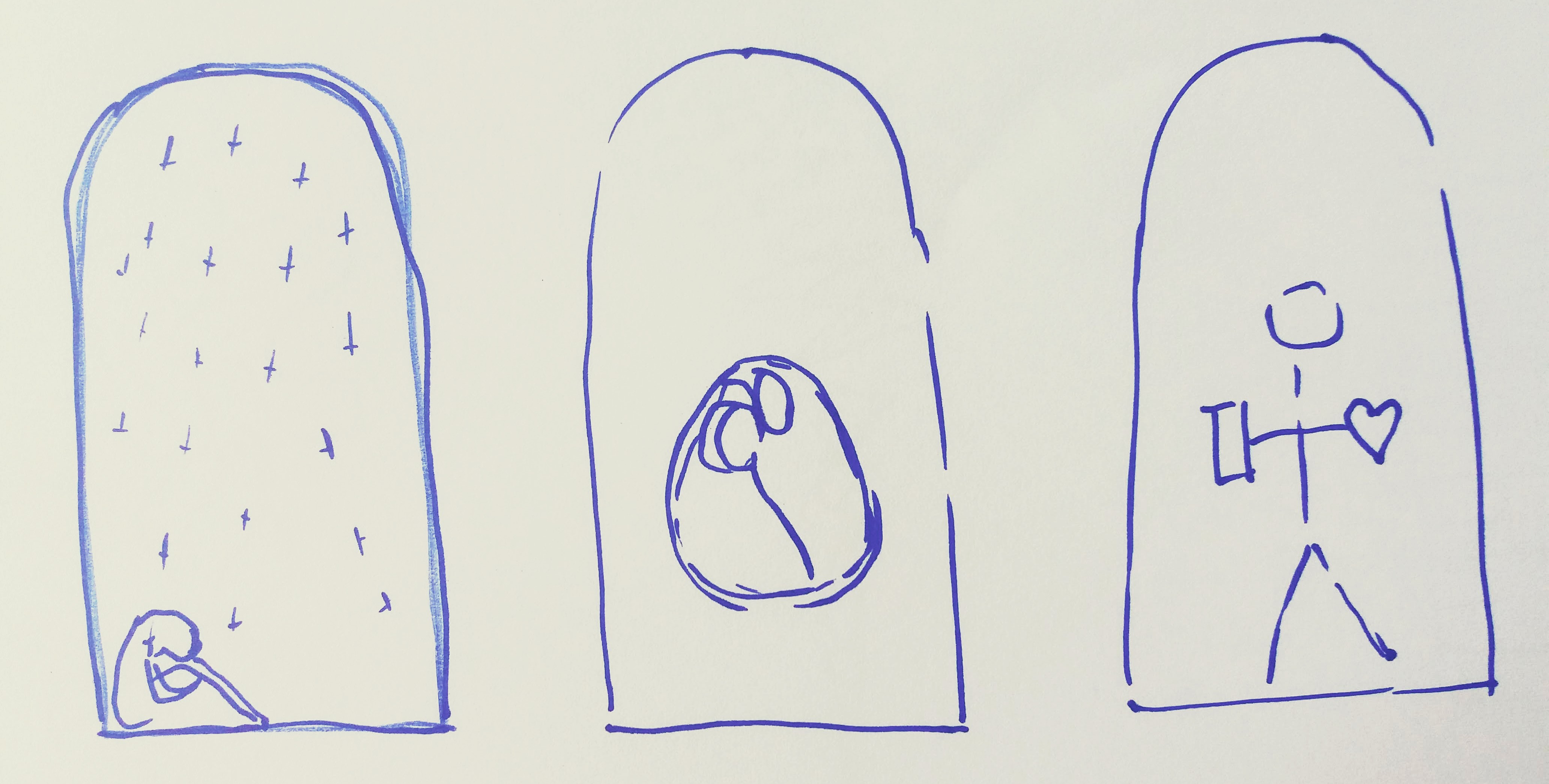
Three memories form the three stanzas of this poem. For each one, I asked Rose to visualise a tableau and stand within it, creating the scene in her mind as she spoke. Much more effective than you might expect from an invisible technique, and we spent some times drawing the tableaux to fix them in her mind.

Trying Her Best & The Scientist

Real Rose vs Science Rose

These two are the narrative glue, the personas that do all the explanation. They are both Rose, but one of her is less confident, which shows in her looser posture and looping, wandering movements around the stage. The other Rose is more structured and certain, so she stays by her whiteboard and keeps herself straight and ‘plugged in’ to her head.

Rose Under Pressure

This body contains the heart of the show, and when we found it there was a very emotional, precious moment. I’m not going to talk about it too much. Perhaps you can understand it from the pictures?

Stay tuned for more, including a Q&A with Rose herself, plus I reveal how shiatsu training can make you a better performance poet…