Voyager -for a ‘poem bowl’ by Rupert Spira – and all four digital poems!

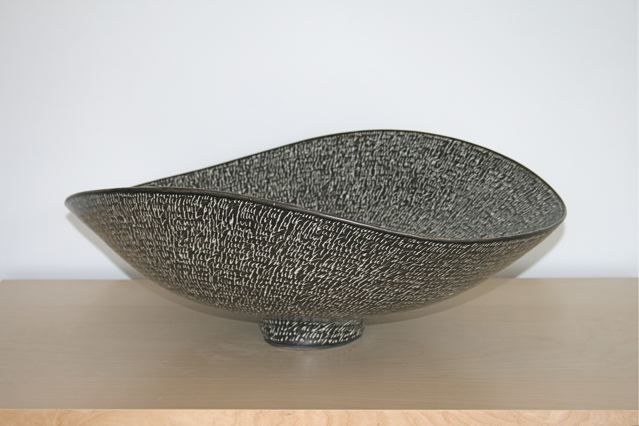
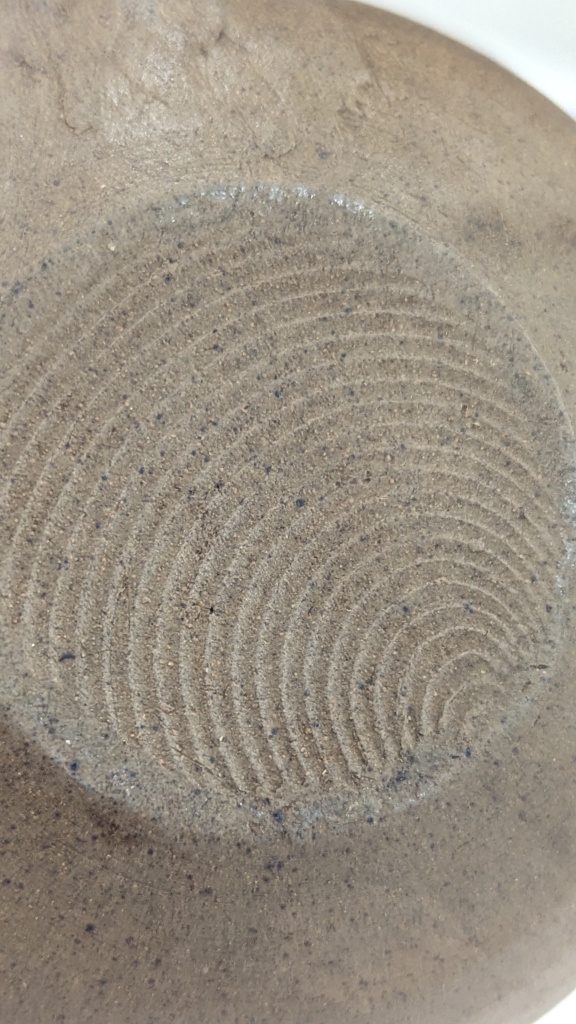
The fourth and final digital poem I made for my MIMA/Tees Women Poets residency was Voyager, written for Poem Bowl by potter, writer and philosopher Rupert Spira (b.1960). A vast black dish, it is decorated inside and out with a mostly illegible hand-written text that has been incised through the black glaze. Certain words can be made out, and these have been incorporated into the poem.

My inspirations for the imagery in the poem comes from the way the dish reminded me of both a warped vinyl record and a radio dish. Combined with the only partial legibility of the decoration, it led me to play with ideas of decaying signals and transmissions through space. The audio accompanying the digital poem features a short sample from “I’ll Be Seeing You” by Billie Holliday, which was the last message sent by NASA to the Mars Rover Opportunity before it ‘died’ in 2019.

The sound track for this poem was the most complicated, featuring free samples of for example vinyl record clicks and Cold War numbers stations alongside my own voice pushed through echo and distortion effects, and the poem text run through AI voice generators. All of this was put together using free Audacity software, which also allows you to create blocks of static interference.

The digital poem was also the most complex in terms of the kinetic typography, even though it was made in Canva in exactly the same way at 79AD and Origin Story. Drawing on the circular nature of the bowl, and all the images of records, radio dishes etc that are in the poem, I made the typography follow arcing pathways. The sections of text overlap and ‘degrade’, just like the audio. To make the effect of degradation I reduced the transparency of the text by degrees, sometimes in arcs that were offset so the faded echoes can still be read; and once in a fully-aligned circle with text blacked out except for certain selected letters.

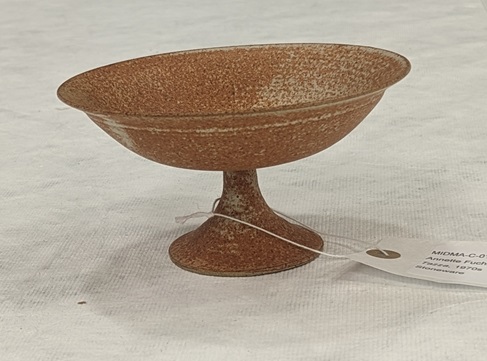
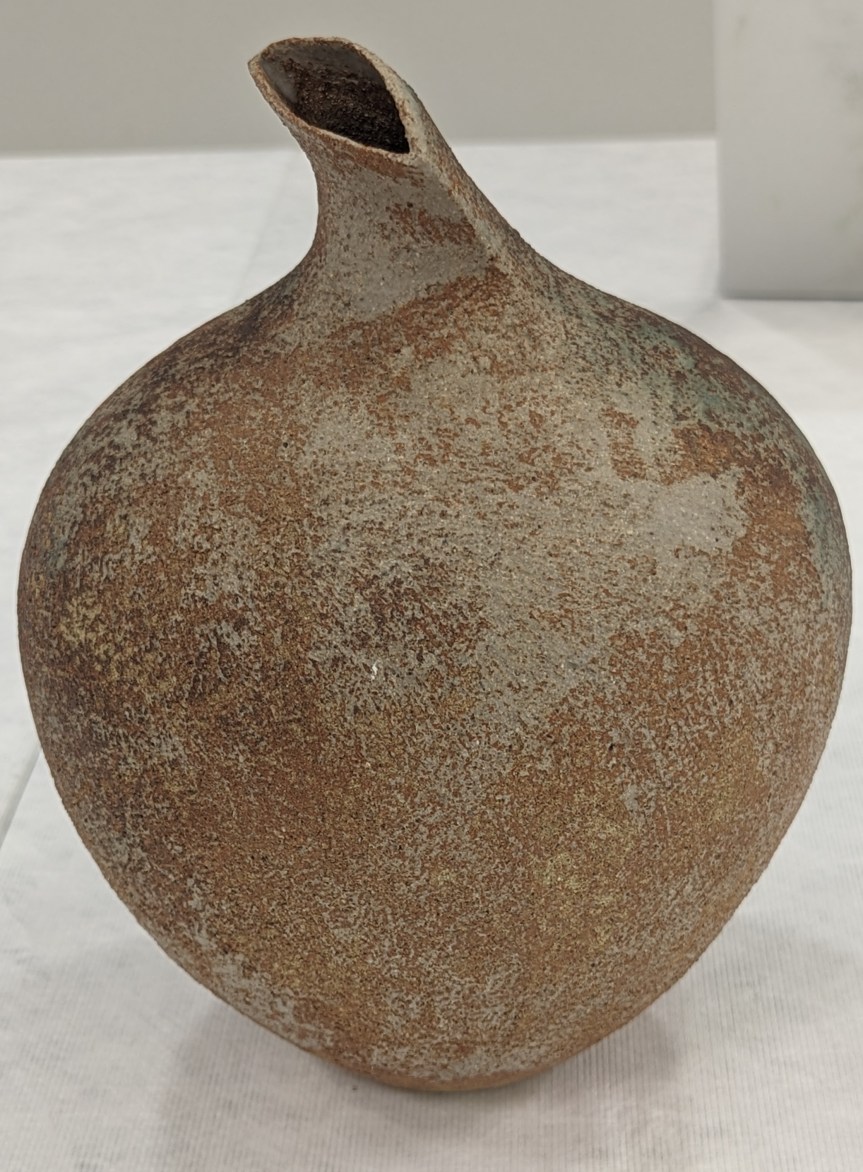
I’m really proud of these digital poems! Here’s a reminder of the ceramics that inspired them – a leaning neck vase by Betty Blandino (Origin Story); a tazza by Annette Fuchs (79AD); a bowl by Deirdre Burnett (Egg Fiction); and a poem bowl by Rupert Spira (Voyager).

  • A rough and rusty-looking vase with a neck that is bent to the left.

And here are the finished digital poems in the loop as it appeared at MIMA. Headphones on!

For those that are interested in the sounds, here’s a list of all the sound clips I used – see if you can tell which poems they appeared in!

  • Volcano lava
  • Dripping cave
  • Message 4
  • Chickens
  • Seagull flock
  • Vinyl scratch skip loop
  • Cave music
  • Chucks Egg classic arcade game
  • Little chicken
  • Needle drop
  • Numbers station 332241
  • Seagull short
  • Vinyl scraped
  • Vinyl crackle 33rpm
Egg Fiction – for a bowl by Deirdre Burnett

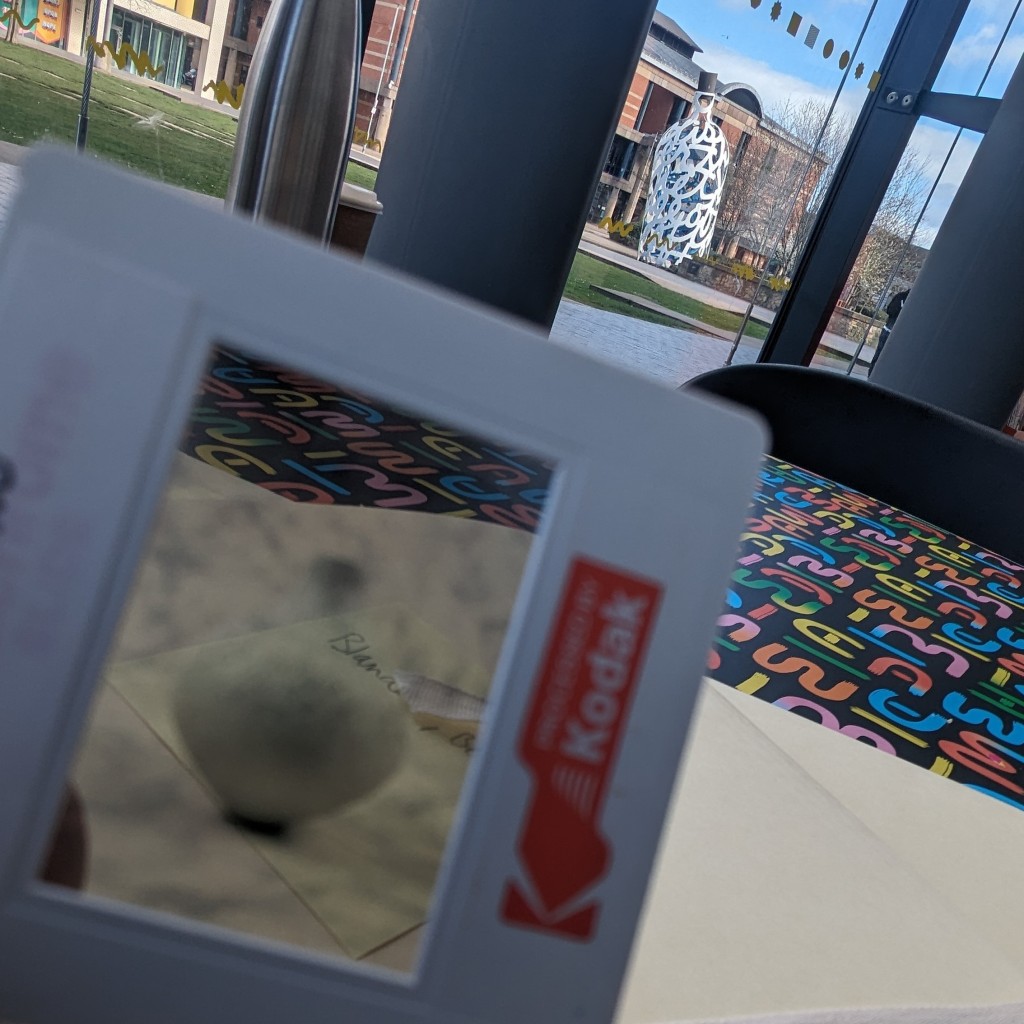
Unbelievably, I didn’t take a decent photo of the third ceramic piece to become a poem in my Tees Women Poets @ MIMA residency, but here are some examples of Deirdre Burnett’s other work to give you a flavour. The one on the right is closest in colour and finish, but imagine it looking much more like an eggshell. The porcelain is also eggshell-thin, and quite small (ostrich egg?)

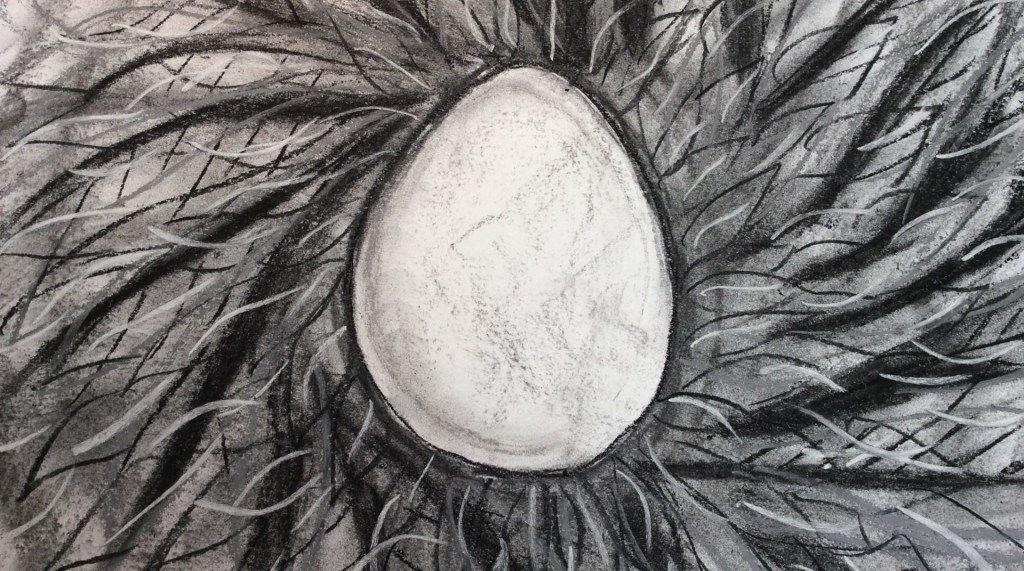
Egg Fiction draws on my own memories of collecting eggs and family folklore about witches’ boats. I learned charcoal animation for the resulting digital poem, and tried to keep a childlike feeling to the flow of images. I named the poem Egg Fiction because it is in no way an actual biography of Burnett’s route into ceramics.

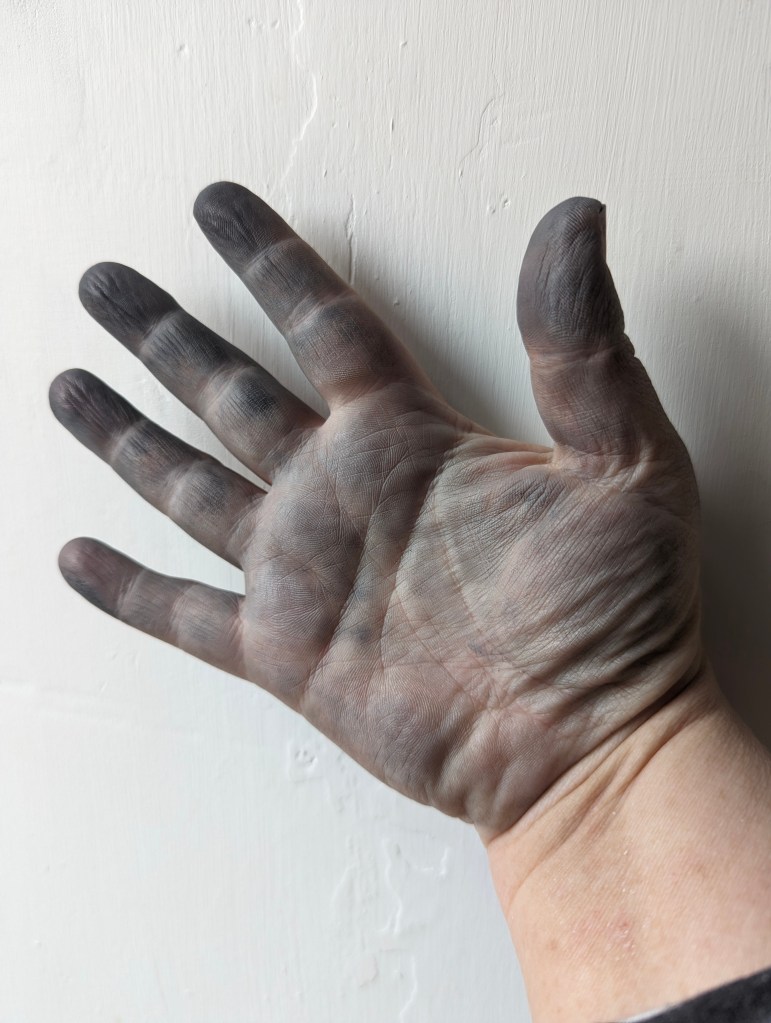
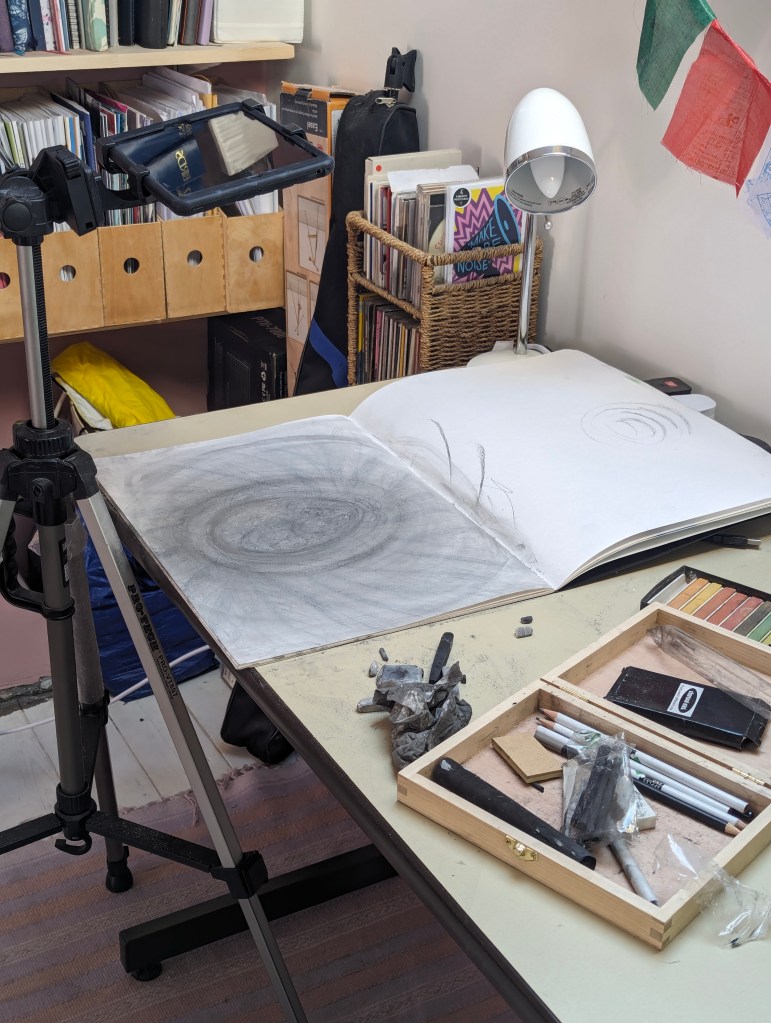
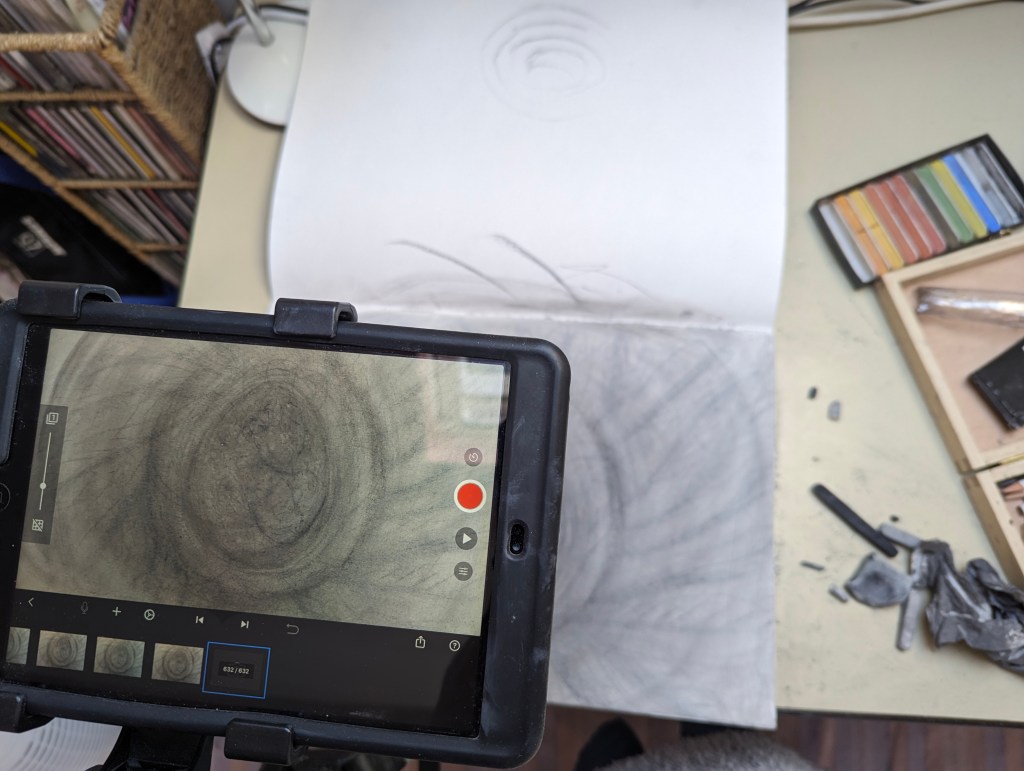
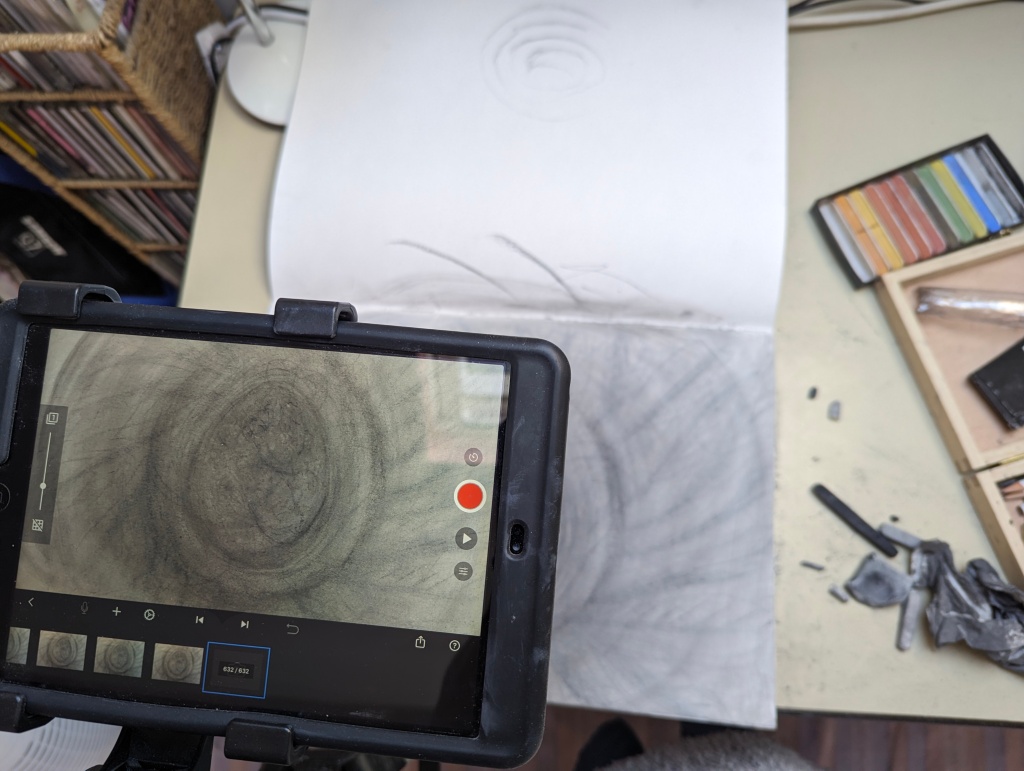
The animation was entirely unplanned and freeform. I used a central egg motif, and simply kept doodling in and around it using charcoal and chalk, taking 2 shots every couple of marks made, using the free app StopMotion on my ancient reconditioned iPad mini. I didn’t do separate drawings frame by frame, every frame was drawn on the same piece of paper. Rubbing in, sweeping off dust, erasing, chalking over, layer upon layer over a combined total of around 8 hours, until my desk was grey and grubby! Completely backbreaking, utterly obsessive…

1500 frames later, having made a whole 58 seconds of film, I recorded the voice track for the poem and was devastated to see it come in at nearly 3 minutes long! Nooooo!!!! Radical editing of words ensued, but I was still only half way with the visuals. Physically unable to continue with hand-drawn animation, I came up with an ingenious solution to triple the length of the film. Importing the original animation into iMovies, I duplicated and layered the sequence over itself, using the editing app’s greenscreen feature to set first the darkest parts and then the lightest parts of each frame as a greenscreen. In this way, the rapidly metamorphing egg began to ghost itself…

Here’s the text for this most challenging and enjoyable piece. When I show you all four finished films in my next blog, you’ll hear that the voiceover for this poem is not me speaking. In fact, I had my first foray into AI-generation by using a text-to-voice app. There were many accents to choose from, and male and female voices of different age profiles. When you read the poem below, what voice can you ‘hear’ in your head? What accent would you have chosen in my place?

Egg Fiction

nanna sent her to steal an egg
fresh from the straw
the darkness clucked

it was the end of the world
it was a rite of passage
don’t trip!
don’t smash it!

don’t smash it too soon
soft-boiled children must learn
the tap the crack the dip the scoop

now smash the empties!
scuttle the coracles
so witches can’t sail to sea
with their wicked, wicked storms

but that warm, smooth weight
had ordained her palm

it’s enough to make her grow up a potter
throwing porcelain
not to shatter, but
to release the paradox-
strength and fragility are twins
this is the earth whose yolk brews wings

this is the earth that knows fire
in the kiln it turns into a little sun
little pitchers become themselves
or smithereen…

look, this bowl has hatched a dragon!
half-shell with a scorched equator

and in the bottom
freckle-speckles
like the memory
of a hen’s egg

The Tees Women Poets are currently open to applications for their autumn residency at MIMA’s Towards New Worlds exhibition. If you’re a woman poet in Teesside, especially if you identify as disabled or neurodiverse, take a look at the info and apply here.

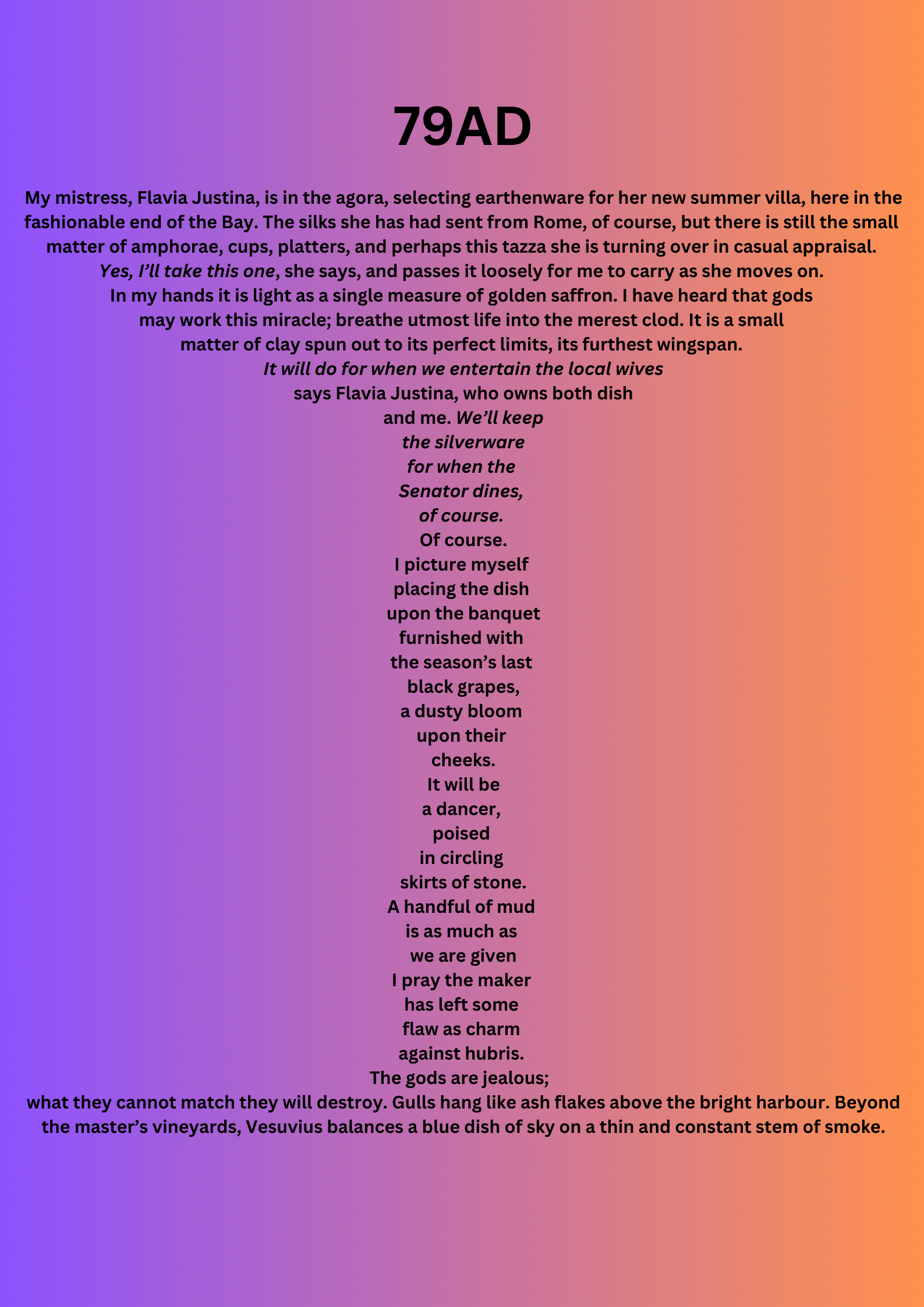
79 AD – for a Fuchs tazza

It’s small, about 18cm high maybe? Just looking at it, there is a classical, visual beauty in the proportions and the terracotta. But when you pick it up, the perfection of its balanced weight is breathtaking.

The second of my four digital poems for ceramic pieces in MIMA was written for a tazza, or serving dish on a pedestal and foot, wheel-turned out of earthenware by ceramicist Annette Fuchs. It made me imagine Roman society and murals, which in turn led me to think about Pompeii and Herculaneum. Pliny the Younger described the cloud of smoke that preceded the eruption of Vesuvius in 79AD as “a pine tree, for it shot up to a great height in the form of a very tall trunk, which spread itself out at the top”, a description which reminded me of the tazza shape. On this tazza, a pale razor-blade-shaped void has been left in the red surface, perhaps deliberately, as superstitious people will sometimes add a smudge to their make-up so the gods don’t get jealous…

This poem has had a couple of concrete incarnations – the one above, which I made especially for this blog post, and the version in the micro-pamphlet handout produced by MIMA to accompany the exhibition, which had eight stanzas each shaped like a tazza. Can you guess where the stanza- and line-breaks came?

This extract from the visuals of the digital poem should give you a clue!

This is again made in Canva videos, using a textured background duplicated and flipped mirror-image along a vertical axis to enhance the tazza-shape of the stanzas. I then overlaid the texture with a free clip of a puff of smoke, to foreshadow the eruption of the volcano. The film clip was actually in a long, thin, landscape orientation. I have enlarged it, flipped it the portrait orientation, mirrored it along the same midline of the frame, and dialed down the transparency so it is a ghost of its former self…

What sounds would you choose to accompany this digital poem?

I’ll post all four completed pieces, with soundtracks, in my fourth blog. Watch this space for curved kinetic typography, charcoal animation, and weird adventures in Audacity and AI…

If you’re a woman, a poet, and you live in Teesside, then why not apply to be the next TWP poet-in-residence at MIMA’s Towards New Worlds exhibition this autumn? Information and application form here.

Origin Story – for a Betty Blandino vase

Now that my digital poems have finished their run at MIMA, I’m bringing you all four of them with some info on my process.

This first poem was written for a “leaning-neck vase” by Betty Blandino (1927-2011). As the poem states, the piece is made of coiled stoneware and is unexpectedly light when picked up – the rough finish makes it look like a natural stone, so the expectation of weight was there, and I did literally start talking to this pot when I held it.

My first step was to handle the pot, feel my responses, write notes, draw the vase to get its shape into my muscles…(and later use it for some gelli plate experiments, like you do)

Next step was to go away and write a poem from it. After a few edits, this poem then became a short film using a Canva video template (specifically, the Black White Minimalist the End template). I chose it because it features moving, soft focus lights with reddish-orange hues that made me think of the vase’s rusty-orange surface.

It also seemed to fit with an atmosphere of fairy stories/origin stories/when you were just a twinkle in my eye – the feelings of the poem, if not the specific details of the words. I changed the Canva template’s typefaces and text positioning, and played with how and where the text should arrive on each slide, changed the tempo to suit, and downloaded.

So far, everything I’ve used has been free and easily accessible. This was the result.

Now, that is not the final version of the digital poem – all four poems had soundtracks added before they were shown at MIMA, but you’ll have to wait because I’m going to talk about that, and show you the final looped installation, in a few blogs’ time! You could subscribe, if you like, then you won’t mis any of them?

But I will show you the last iteration of the poem right now, which is as a concrete poem. This was printed in the programme that accompanied the screening, with the following artist’s statement:

Origin Story was written for a coiled stoneware vase with a ‘leaning neck’ made by Betty Blandino (1927-2011). Handling this pot was a sensory overload for me, as it looks like a stone, feels like weathered rust, and is unexpectedly weightless. The shape is reminiscent of an amphora, a pot made specifically to store foodstuffs like wine or oil, but it is kept hollow, and sonorous.  I found myself speaking to it like a sentient creature, and continued that conversation into the poem, imagining myself telling the vase myths about itself like bedtime stories for a child. Little pitchers have big ears.

The observant among you may notice that there are some differences between the texts of the two versions, which just goes to show that poems are never quite finished.

Watch out for the next digital poem, which will be 79AD, written in response to an earthenware tazza by Annette Fuchs.

What exactly does a poet-in-residence do?

How long is a piece of string?!

Residencies for poets are few and far between. At one end of the scale, a residency offers time and often a dedicated space away from home life, in which to explore your craft and make progress on new work. Most of these will be a commercial proposition where the poet is the one that pays. Sometimes it’s subsidised, and with hen’s-teeth rarity the poet is paid just to be a poet – living the dream!!

On the other end of the scale, you are paid but the emphasis is firmly on delivering a set of outcomes for the venue who is hiring you, whether that be an agreed number of poems in a prescribed format, and/or a set number of participatory activities for groups of people important to the venue. The more participatory the brief, the more likely it is that you’ll be working with children, families, and possibly with groups that have specific access needs of various kinds. For this kind of residency to be a residency rather than a short-term hire or a commission, there should be some wiggle room to make new work on your own terms, but there is a real need to align your professional ambitions with the needs of the host – and the host is probably thinking in terms of foot-fall and engagement.

An ideal residency should have elements of both valuable outputs and independent creative experimentation, and an expectation that the exact methods of delivery might be decided through co-creation and negotiation between artist and staff teams. You still need to pitch a good idea, though, and that can feel a bit like having to be telepathic, guessing at what the venue might really need or having some experiential knowledge of how commissioning organisations operate on a day-to-day basis. For example, is their staff team small and overwhelmed, might you need to foreground your ability to self-manage or include social media activity in your pitch?

My current residency at MIMA for Tees Women Poets has been a real joy. The expectations of the host venue were clear – create digital poems in response to the Contemporary Ceramics collection in a format that could be used on a flat screen within the gallery, within a very specific timescale. Be able to self-organise and meet deadlines to present the work at MIMA Art Social #17 on 20th June. Offer two workshops to ensure the public and the TWP are getting developmental benefit, but also develop my own creative practice by learning new skills.

What does that look like in terms of my activity? It’s involved

  • an in-person pottery handling session with the curatorial team
  • my attendance at a workshop about de-colonializing ceramics curation, again with the staff team (see the slideshow above)
  • several days of writing and editing poems in response to handling pots
  • delivering a creative writing workshop with exercises inspired by the ceramics
  • making film-poems from participants’ work in Reels
  • delivering a round-table discussion about residencies for TWP members who would like to apply for future opportunities
  • learning how to make kinetic typography digital poems in Canva
  • learning how to make charcoal animations
  • experimenting with AI-generated voice-overs
  • learning how to create soundtracks in Audacity
  • the creation of four digital poems ready to reveal in June.

To find out more about my process and poems, please come to MIMA Art Social #17 on Thursday 20th June, 5.30-8pm at MIMA, and I’ll reveal all!!

Cherophobia by Jo Colley – a final cut

I’m delighted to bring you the final cut of the experimental, collaborative film-poem myself and poet Jo Colley have been making over the last 2 months. I say final cut, but in fact there are more sections to the poem, so consider this the final version of a pilot edition. Jo has edited together footage donated by several people, most of who are excellent poets in their own right – please watch through to the end for the credits.

We’re very grateful to those who sent in clips, whether they were eventually used or not. One thing we’ve learned from this process is that it’s harder than you think to capture even 20 seconds of compelling video! Writing poetry and making film-poetry are most definitely two linked but separate disciplines. Where do their skill sets diverge, and where do they overlap? I’m going to think and research more in order to answer that question in future blogs, and in my own film-poems. My gut tells me the overlap lies in attention to detail, and the creation of metaphor. What do you think?


It’s In The Cards – filmpoem week 10

We’re nearing the end of this little project, but there are still a few surprises to come as our collaborative film-poem twists from verse to verse. The latest clip is from Diane Cockburn, who picks up the “four years” of the poem by placing down the four of each playing card suit. Her deliberate movements are reminiscent of a Tarot reading, where there may well be “a reckoning”. See also how the colours of the table cloth echo and continue the colours of last week’s crochet footage.

So now we move to the final prompt! Can you find a way to illustrate this last verse?

in the pocket of the night I find you, let myself be found

As ever, please see these previous blog posts for

How and where to submit

How to think up a good image

Common mistakes to avoid

Domestic alchemy – filmpoem 9

As with a traditional renga, anyone from the group of participating artists can offer contributions as often as they like – which is how we welcome back Alison Raybould, who gave us our very first images. It just goes to show, try try again! Sometimes it takes a few attempts to get a bit of film that works the way you want it to.

Poet and renga-master Jo Colley has selected this clip of hands crocheting vintage wool for a number of reasons. One is that she enjoyed how it continues an overall mood of domesticity that is appropriate to the atmosphere of the poem it illustrates. She also liked seeing an action that is different from the pickling described in the verse, yet is also a kind of magic transformation of one substance into another thing entirely. And finally, she has fond memories of the wool shop featured on the wrappers in the film – if you’re from Darlington, maybe you do too?

Cherophobia: An Autumn Journal from Joanna on Vimeo.


So now here is the penultimate prompt for you! Can you come up with a 20 second clip of film to illustrate the meaning and mood of this verse?

this is the fourth year, abacus of elderberries, an accounting of sorts

Remember to look here for all the submission guidelines, and also check out previous blogs for advice on how to come up with compelling imagery and avoid common mistakes that could undermine the brilliance of your vision!

The arrival of the abstract – filmpoem week 8

A fascinating turn in the imagery this week, as new contributor Anathema McKenna picks up on the cut paper strips of week 7 and turns them into an abstraction. The choppy rhythm and ‘prison bar’ effect of the collaged lines is unexpected yet effective in conveying the actions and atmosphere of the verse, without ever becoming a direct illustration of the words.

We’d love to see your ideas for what might come next in this multi-authored film!

The verse you have to respond to is this:

alchemy: to transform berries and spice to dark distillation ready for winter

To help you get started, please do read this earlier blog about how to generate ideas for imagery, and this one about common mistakes to avoid.

Send your films to sleeperpoems@gmail.com by 5pm on Friday 29th May – thank you!

What to avoid when filming – filmpoem week 7

Hey hey, thanks for sticking with me on this one – week 7 of 11, and the contributor this week is…… me.

There’s a couple of reasons why it’s me. One is that I really wanted to create the ‘choking on strips of the Bible’ image idea I came up with in last week’s blog. Although when it came to it, I used newspapers to evoke the word ‘truth’ that is in the verse I’m illustrating.

The second reason is one of film quality-control. We received a couple of very intriguing concepts for imagery as a result of last week’s How-To guide, but unfortunately the execution did not do justice to the ideas. Common problems are:

Off-centre framing, or shots set up so that there is unwanted background detail

It can seem super-hard to get the framing right on a shot, but it’s worth playing around to get the perfect angle. It seems like most people would benefit from simply taking the camera closer in towards the objects and actions they’re filming. If you have a central action, you need to move the camera until the action or objects appears at the centre of the frame. This might take a fair amount of fiddling on! I’m lucky that I have a tripod, and a special attachment that allows me to put my iPad in any position I want. It wasn’t an expensive bit of kit, less than a tenner I think, and it makes a HUGE difference. It also completely eliminates the next biggest problem –

Shaky-cam and loss of focus

If you don’t have a tripod, then I really recommend you improvise some other ways to keep your device still, like propping it up on piles of books. It’s amazing how eliminating hand-held shake immediately makes your film look more engaging. And finally (for now) the other thing worth trying to resolve is –

Bad lighting

Of course we don’t have all the fancy-schmancy lights and reflectors that a serious film-maker has (although you can actually pick them up relatively cheaply). Nevertheless, you can make the most of the light you have and you absolutely should do so, because it makes everything look better. Arrange your cinematic composition so that it catches full sunlight, and add in more light using as many reading lamps as you can lay your sticky hands on.

So here is the latest version of Cherophobia – an Autumn Journal, with my 20 seconds added in. You’ll see that I’ve been a bit of a smart arse and have edited together a few different sections of film to make my 20 second clip. Notice how close in I’ve got the camera in order to get the effects I wanted – cropped right in on my hands, and then on my mouth and neck. Keeping the camera further away just wouldn’t have worked – the closer I am, the more intense the effect of the imagery.

And now it’s back over to you!

Below is the verse for week 8, for you to brainstorm into an eye-catching film snippet. Please send us your clips to sleeperpoems@gmail.com by 5pm this Friday 22nd May. And remember –

  • Illustrate/respond to the words and atmosphere of the poem – can you do this without filming someone chopping shallots??
  • Shoot in landscape orientation
  • Experiment until you have the shot framed right – come in closer, get things centred or in the right place, make sure unwanted details are kept out of frame
  • Keep the camera steady
  • Use as much light as you can

I slice shallots because this makes you cry. Juice spills all over the kitchen.