I Love The World – conversation and poetry

I confess, sometimes I forget that conversation with strangers is part of my creative practice. It sounds odd to put it like that, but it’s true – one of the ways I make art is to start by talking.

So for example, when I made and toured a spoken word theatre show to accompany the release of my first collection, The Trouble With Compassion, I spoke to groups of people about what compassion meant to them and incorporated their definitions into an audience-participation section of the show. I also spent some time with individuals, actively listening to them describe their perfect day, and then describing it back to them as a visualisation-meditation, which I recorded for them to use as a relaxation tape. On several other occasions, I’ve been commission to write poems based on group conversations about things like climate change; poems which have included verbatim phrases, or have been recorded, sampled, and turned into soundscapes.

So having my own ‘conversation bench’ at Middlesbrough Art Week was a natural addition to this practice. I spent a day inviting people to sit with me and choose a slip of paper from my bowl. On it they’d find a quote from a poem (mostly Mary Oliver poems) with something to say about loving this world. That would be our conversation prompt. The conversations themselves *were* the art, as far as MAW was concerned – but of course, I wrote small poems for them anyway, and here they are.

Beth Loves The World
“What do I eat and who do I stain?” – from Blackberries, by Mary Oliver

She knows the viscous crimson slime of viscera in the hand;
The tough tug of the knife from anus to silver throat, she knows.
She learned survival in the wild; but after that gutting she struck camp,
got hooked on videos of battery farms, and changed.
Nowadays when she comfort-eats, the lasagna is veggie.
Her kitchen is stocked with the fruit of family labours
on allotments, those scrappy remnants of the commons.
True sovereignty may well look like brambles – it would be good
if it were easy for everyone to live this way, if profit’s pressure
hadn’t uprooted us from a wholesome normality.
There must be something she can say in all this noise?
So many battles to pick, but one truth to hold tight –
she doesn’t want to stain this world with blood.
Asha Loves The World
“I had wanted an easy way out: decision on high, co-ordinated war effort: not how an ecosystem works” – from Cassandra: The Second End by Sasha West

Her feet hurt, and she has no words in my tongue to tell me
if the world will get better, or if this is as good as it gets;
a bench on which to rest in the flat white light of a Saturday mall,
easing the ache, surrounded by all the numb abundance.

For a while we try to open up single words like portholes
to call through, one world to another. Mum-dad-sister-wife-shopping.
Her ankles over her Sketchers are puffy as her winter jacket,
shapeless and durable as coats I’ve seen worn by rickshaw drivers
high up in the freezing villages above Manali. India? I try.

She spreads her stubby hands, to show each ashy knuckle
flashes garnets and coils of yellow Indian gold,
extravagant and bright as galaxies. She has no words
that I can understand to tell me about what she’s seen,
and if I could follow her, would I even believe it?
Katharine Loves The World
“Look, I want to love this world
as though it’s the last change I’m ever going to get
to be alive
and know it”
		from October by Mary Oliver

there is this world, and also
He has prepared a world to come

in that world there is gold and light
pure spirit and praise

in this world there are pangolins
and recycling bins

the daily effort to choose, to decide
living by His word

at the pulpits a call is rising
for all to be stewards of Creation

by reducing
single use plastics

not spiritual enough! 
some are disappointed by the mundane

but if God speaks through the light of stained glass
why not also through glass milk bottles?

what else is stewardship if not the constancy
of small actions?

what is this world but the choices we make, not waiting
but hoping for the next world?
Caroline Loves The World
“What does barbed wire feel like when you grip it, as though it were a loaf of bread, or a pair of shoes?” – from Rain by Mary Oliver

In one way, the world is a wild openness
where weather, danger and even death may spring an ambush on her
but so too may vivid joy come to her blood and breath.
On balance, it’s worth the bus ride,
or calling out the lifeboat when the current is surprising.

In another way, the world is brick-built and she can read it,
scanning plate glass for usage, the centre for footfall, testing edges
of stone steps for skateboarder damage
like some folk check houseplants for stress and pests.

In both spaces she sticks to her own two feet,
alive to risk but undeterred, her body and her wits
moving the wire away from any blocked stile, on any path
where she knows she has the right to roam.
Claire and Rowan Love The World
“And therefore I look upon everything
as a brotherhood and a sisterhood”

- from When Death Comes by Mary Oliver

and a siblinghood, for those of us as apart from the binary as a tree,
served by our own folklore, and containing our own spirit -
be it anxious, or be it puckish, it is our magic

we ourselves are miles away from our siblings, and have let go our children.
in this turning season of our lives, we are choosing
new ways to know ourselves, and change our worlds

we’ve beach-combed nail-paring plastic wrack and nurdles the size of lentils,
collaged them in a making that re-makes us as artists,
invoked S.I.C.K. as a slogan-sigil that explains it all, inner and outer

and we say

identifying winter buds is just like being a wizard, so we’re filling
emptied hours with learning trees; remembering our family
called us Blossom in the pink spring of our life

remembering how we all climbed that tree in the nearby woods,
how one summer we found it felled for some planner's ring-roaded future,
our friend and all their siblings. How their deaths changed our world.

Egg Fiction – for a bowl by Deirdre Burnett

Unbelievably, I didn’t take a decent photo of the third ceramic piece to become a poem in my Tees Women Poets @ MIMA residency, but here are some examples of Deirdre Burnett’s other work to give you a flavour. The one on the right is closest in colour and finish, but imagine it looking much more like an eggshell. The porcelain is also eggshell-thin, and quite small (ostrich egg?)

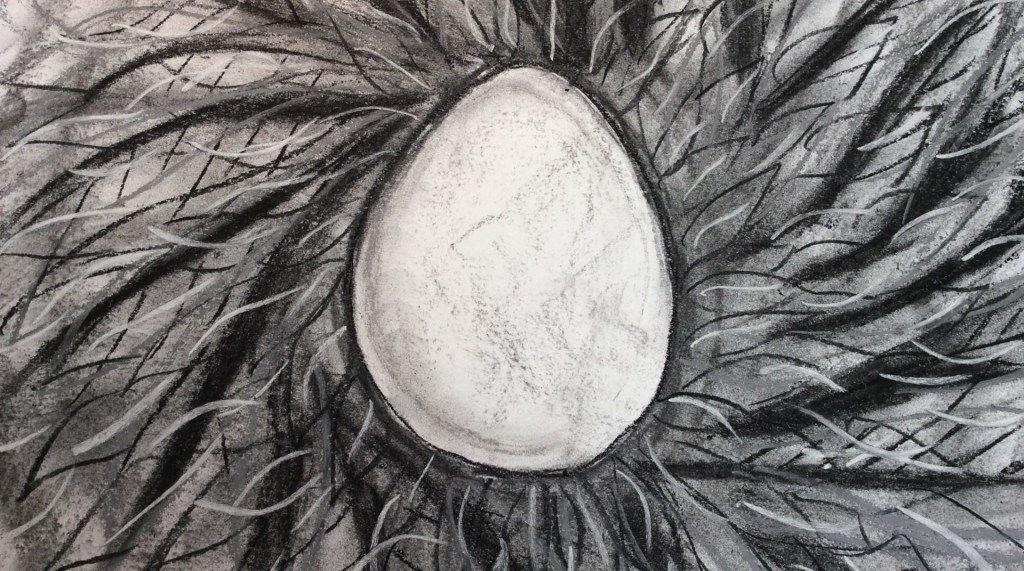
Egg Fiction draws on my own memories of collecting eggs and family folklore about witches’ boats. I learned charcoal animation for the resulting digital poem, and tried to keep a childlike feeling to the flow of images. I named the poem Egg Fiction because it is in no way an actual biography of Burnett’s route into ceramics.

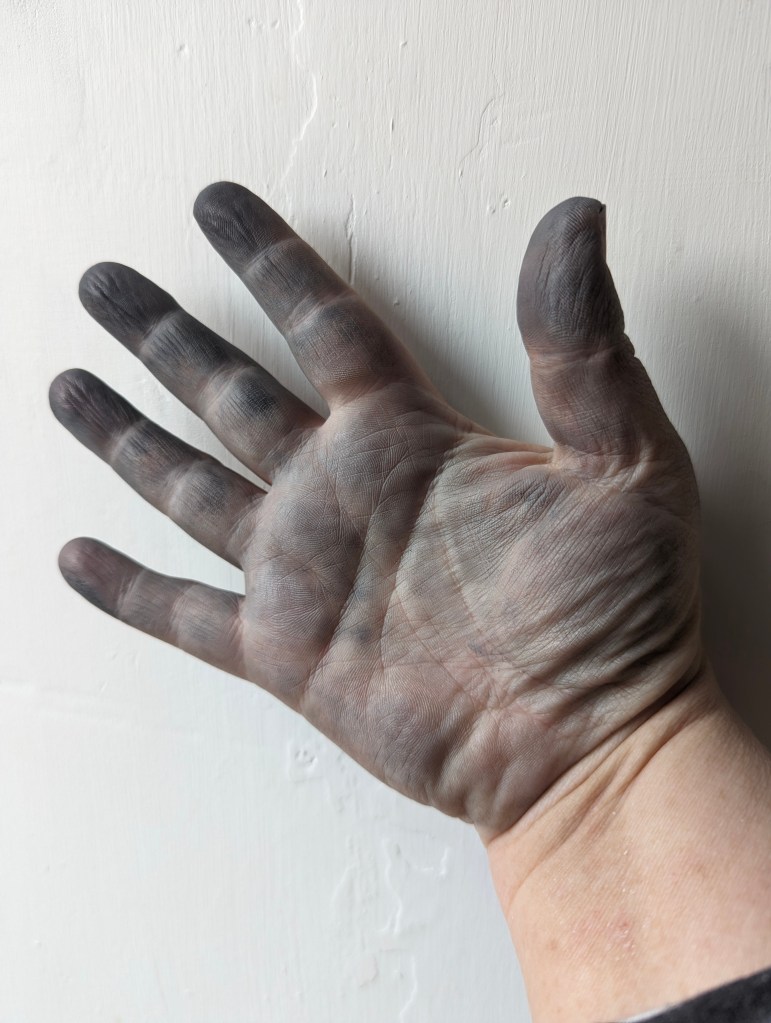
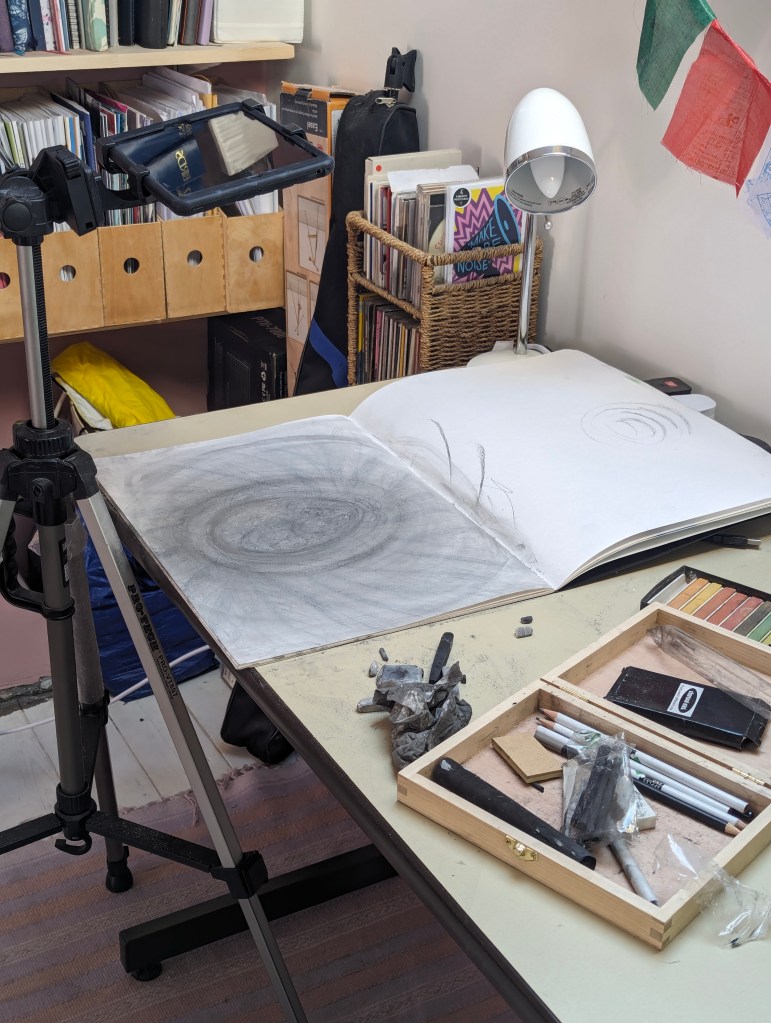
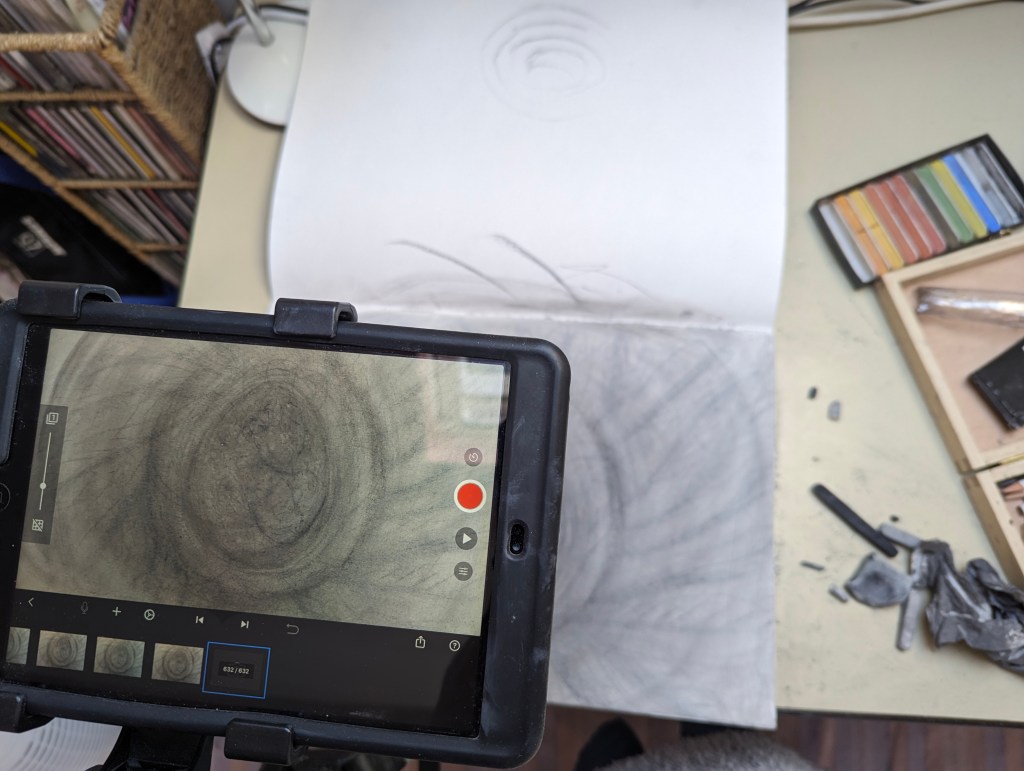
The animation was entirely unplanned and freeform. I used a central egg motif, and simply kept doodling in and around it using charcoal and chalk, taking 2 shots every couple of marks made, using the free app StopMotion on my ancient reconditioned iPad mini. I didn’t do separate drawings frame by frame, every frame was drawn on the same piece of paper. Rubbing in, sweeping off dust, erasing, chalking over, layer upon layer over a combined total of around 8 hours, until my desk was grey and grubby! Completely backbreaking, utterly obsessive…

1500 frames later, having made a whole 58 seconds of film, I recorded the voice track for the poem and was devastated to see it come in at nearly 3 minutes long! Nooooo!!!! Radical editing of words ensued, but I was still only half way with the visuals. Physically unable to continue with hand-drawn animation, I came up with an ingenious solution to triple the length of the film. Importing the original animation into iMovies, I duplicated and layered the sequence over itself, using the editing app’s greenscreen feature to set first the darkest parts and then the lightest parts of each frame as a greenscreen. In this way, the rapidly metamorphing egg began to ghost itself…

Here’s the text for this most challenging and enjoyable piece. When I show you all four finished films in my next blog, you’ll hear that the voiceover for this poem is not me speaking. In fact, I had my first foray into AI-generation by using a text-to-voice app. There were many accents to choose from, and male and female voices of different age profiles. When you read the poem below, what voice can you ‘hear’ in your head? What accent would you have chosen in my place?

Egg Fiction

nanna sent her to steal an egg
fresh from the straw
the darkness clucked

it was the end of the world
it was a rite of passage
don’t trip!
don’t smash it!

don’t smash it too soon
soft-boiled children must learn
the tap the crack the dip the scoop

now smash the empties!
scuttle the coracles
so witches can’t sail to sea
with their wicked, wicked storms

but that warm, smooth weight
had ordained her palm

it’s enough to make her grow up a potter
throwing porcelain
not to shatter, but
to release the paradox-
strength and fragility are twins
this is the earth whose yolk brews wings

this is the earth that knows fire
in the kiln it turns into a little sun
little pitchers become themselves
or smithereen…

look, this bowl has hatched a dragon!
half-shell with a scorched equator

and in the bottom
freckle-speckles
like the memory
of a hen’s egg

The Tees Women Poets are currently open to applications for their autumn residency at MIMA’s Towards New Worlds exhibition. If you’re a woman poet in Teesside, especially if you identify as disabled or neurodiverse, take a look at the info and apply here.

Lubaina Himid’s Sexy Slapdash Squares

I’m in the second-floor gallery at mima. I’m surrounded by an amazing array of art. I need to choose maybe half a dozen artworks as my focus. I’m a writer-in-residence. I’m going to use their archived records as source texts for erasure poems, but I have no idea what kind of documents are kept on file. What do I choose?

My first choice, without a moment’s hesitation, is Toussaint L’Ouverture by Lubaina Himid. It’s huge, bold, and contains loads of brilliant collage elements. I know that I want to use collage as an erasure technique in my found poems. Himid is definitely a good choice.

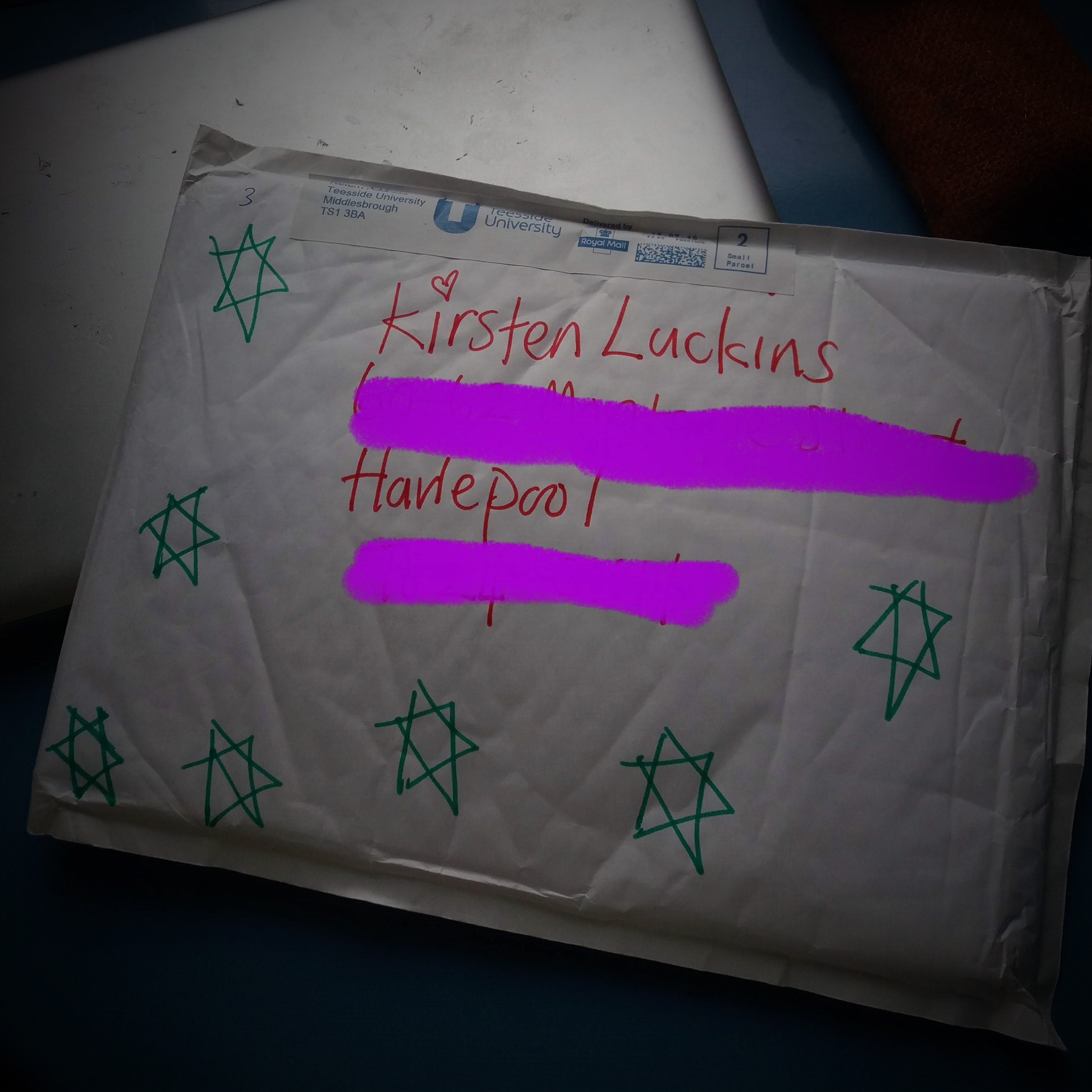
mima envelopeSkip forward a few weeks, and I’m at home when an enormous padded envelope arrives from the mima team. Inside is a ream of photocopied archive documents, including several about Himid’s work. There is an extensive biography, an acquisition statement, and a detailed condition report from a conservator. This last document includes a thorough treatment proposal, full of technical suggestions on how to repair and maintain the painting.

I start from waaaay inside my comfort zone – a tiny found poem spied in the condition report, simple and quite abstract. It’s all about colour, but not about race. I know I’ll have to work out how to respond to Himid with some shred of socio-political consciousness, but I haven’t thought it through yet. I just want to do some erasure using collage squares that are as exuberant as the ones that Himid has used to make the floor under Toussaint’s boots.

Himid collage squares

I ransack my stack of magazines for images featuring gold and yellow, cut them into rough squares, and set about it with a Pritt stick. Bliss.

“Gold has yellowed….yellowed…yellows”

Gold Yellows collage after Himid

Is this developing my creative practice? It’s not so far away from work I’ve made in the past, although I’ve never made a process video before. I love time lapse! OK, I will try to do more of these videos, and framed better, without so much of my belly-bulge showing. But first I have a hankering to do some stop-motion.

Tune in next week to find out what I manage to squeeze from a treatment proposal, and why I start regretting the whole endeavour…

What to do with a blank page, and why?

Creativity is always a leap of faith. You’re faced with a blank page, blank easel, or empty stage. – Julia Cameron, author of The Artist’s Way

I’m currently a writer-in-residence at mima, Middlesbrough’s Institute of Modern Art. Well, so what? I hear you say. Congrats and custard to you, I bet you’re very happy with yourself. But, BUT, friends – there are no terms to this residency! I have to decide for myself what to do and when to do it by. This is quite different from when I was poet-in-residence at Hartlepool History Then And Now, gathering and re-telling WW1 maritime tales. This is a teensy bit terrifying. What on earth am I going to do?

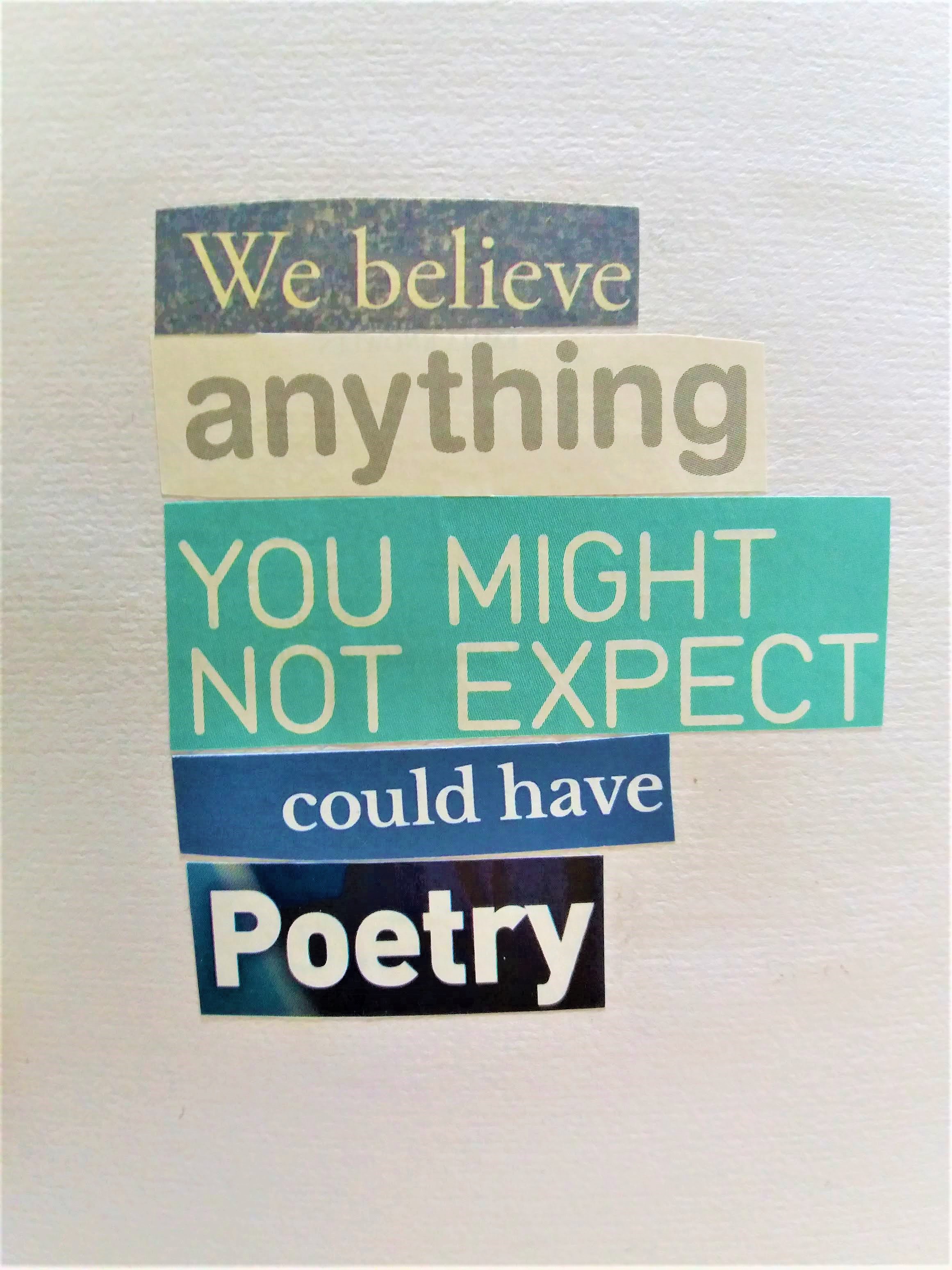
WeBelieveAnything

Some background? Ok. Last year I was accepted on to the Writers Block North East novel-writing bootcamp, a year-long programme during which, if participants so choose, they may supplement their frantic novel-writing with a self-generated side hustle at mima. My side hustle is this –

I will use archive documents relating to artworks in the Middlesbrough collection as source material to inspire blackout, erasure and found poetry, plus a load of other digital and multimedia approaches like stop-motion films and collage.

If you follow my Insta, you’ll know that these are all things I do for fun. They’re not my ‘real’ writing. (Whatever that means, imposter-critic-head-voice) I mean, writing is writing and I’m a writer, right? (WHATEVER THAT MEANS, IMPOSTER-CRITIC-HEAD-VOICE!) So why do I do them in the first place? And why choose to do them more?

I do them
1. To keep myself creatively active through times of block and mental exhaustion
2. To retain playfulness as a creative principle
3. To get some wiggle-room into the idea of ‘writing’ by crossing disciplines and media
4. To activate my subconscious and surprise myself
5. To activate my subconscious and recognize patterns of thought, association, values

So, by making techniques the focus of this residency, I hope to
1. Make work on a broad and unexpected range of subjects
2. Make work whose forms and materials are influenced by both the source texts and the artworks to which they refer
3. Experiment with a really wide range of techniques, and fail as interestingly as possible
4. Learn to use new equipment and digital methods
5. Say hi to a new bunch of people via the mima Insta account

PoemsHelpDriverlessVehiclesBut YOU lovely lot are going to get more than just an Insta post. I’m going to take you with me while I work out what the heckitty-heck to do, and if you have had any similar experiences of setting up your own residency in any artform at all, you’d better believe I’d LOVE to hear about it. Have you blogged about it? Send me links! I’ll quote you! What’s your process, your practise, your advice?
Tune in next week-ish for some Gold/Yellow collage, a process video in which my belly features far too prominently, and me fangirling somewhat about Lubaina Himid. And follow @mimauseful on Insta, please and thank you.

Otters, gigs, pamphlets, gigs, projects

Hi all – quick round-up of what’s been keeping me away from blogging here – blogging HERE! Celebrating Change is a new Arts Council-funded project from me and my colleague Laura Degnan. We’re combining my writing experience with her filmmaking skills in order to run a year-long digital storytelling project for Middlesbrough residents. I’m also in charge of running the blog as a poetry/film/flash fiction online magazine, so please do check out the many poems I’ve been posting over the last few weeks.

Otters are through the first edit and getting their covers sorted, on track for publication in early October – you can still pre-order your copy, and even buy a print of my ‘Otters In A Bathtub’ illustration, or instruct me to draw an otter of your very own! You have until 10th October to get in on the deal, so do get clicking!

And finally, I will be one half of a brand-new pamphlet coming out in the Black Light Engine Room series. These are gorgeous little pocket-sized poetry gems, with a classy yellow cover, and only cost £4 a pop. I will be reading at the pamphlet launch at Python Gallery in Middlesbrough on Saturday 28th October, hope to see you there.

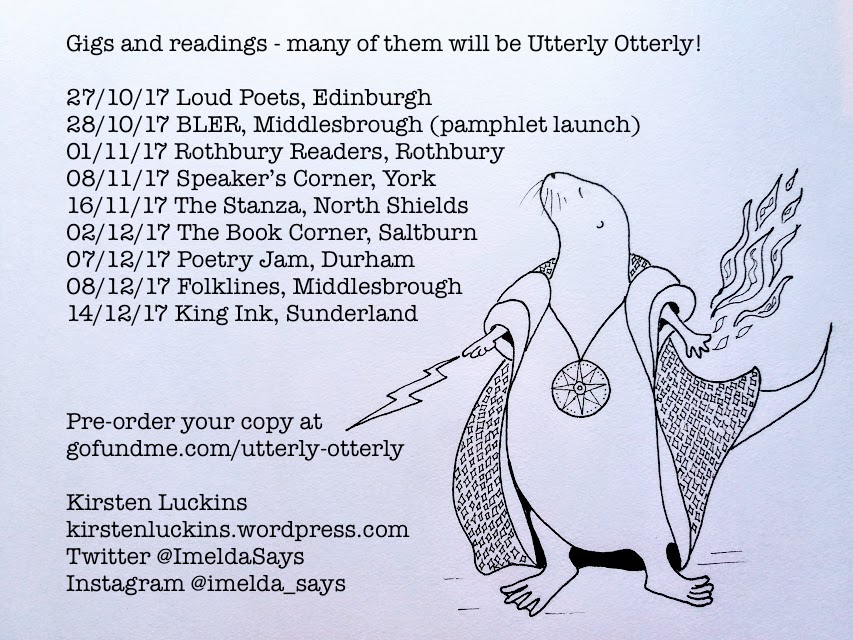
Lots of other gigs and readings lined up for autumn:

Autumn Gigs updated