
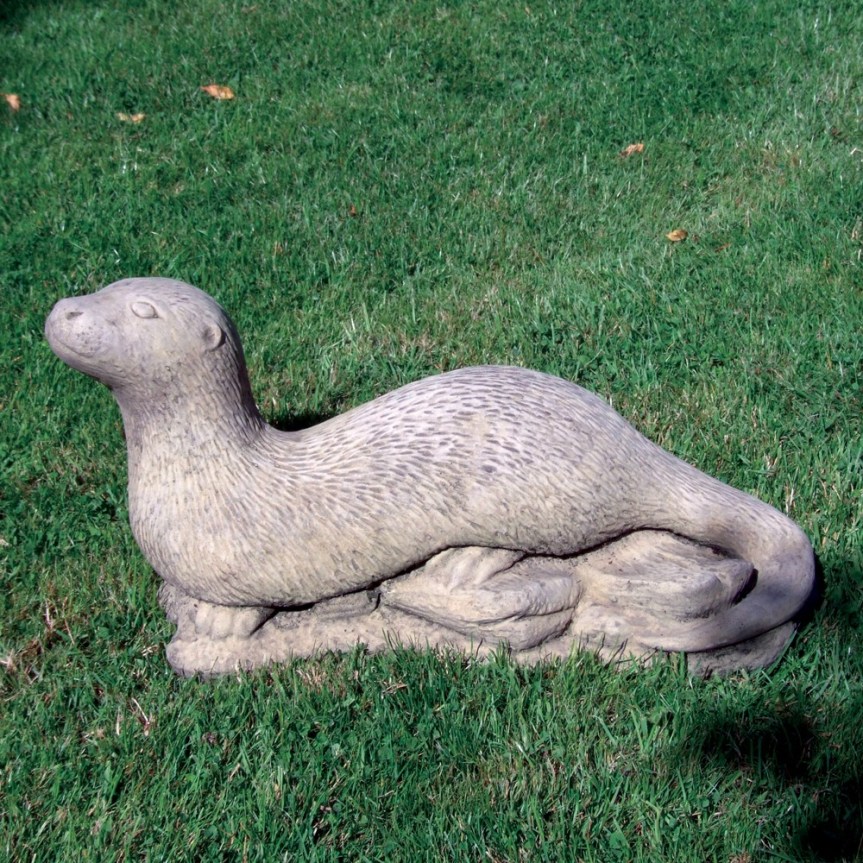
Today we are asked to describe a place, then top off our description with a philiosphical bon mot or two. Fab. Of course, I immediately rifled my memories for sunlit riverbanks, demanded my imagination populate the scene with otters. But then I remembered a place I had already promised myself I would write about this month, a garden I pass every day, a garden blessed with… an ornamental otter!!!!!!!
This simple bench, its back against
the pebble dash, is a trap for sun
on which I sit, patient as bait.
In the eaves a host of starlings
whirr, click and chuff, discordant
choristers for a strange faith.
A road may be inferred beyond
the horizon of the garden wall,
from the odd passages of cars.
In their wake a sucking, slapping
almost entirely irregular boom.
I believe it is high tide. Yes, yes,
the bells of St Hilda’s nod agreement,
A stray beam of April illuminates
the pocket lawn, a square-cut emerald,
whose margins are as dense with foliage
and critters as a mediaeval Gospel.
Gargoyles and dwarves wink plastic eyes
under fancifully unscrolling hosters.
Amid bluebells, a goose gawps upwards,
its white throat a column of greed,
twice the height of the flamingo.
And at my feet, resplendent,
scampers the piece de resistance –
the moulded-resin, stone-effect,
not-quite-life-sized otter, apogee
of all that is good and pleasing.
It is not to have what you want,
but to want what you have,
that is true happiness.


 The Song Of The Feeding Sea Otter

 In this quote, Boris demonstrates two things. Firstly, a certain deftness with sentence construction, a breadth of vocabulary and an almost proprietorial familiarity with fine art history that is entirely fitting in one who has received so staggeringly privileged and expensive an education. Secondly, a terrifying ignorance of the tendency of otters, according to Japanese folklore, to shapeshift into beautiful women with the express purpose of seducing, killing and eating unwary men.
 Many people say to me, Kirsten, we know that otters love jazz, but what of otter politics? I reply that I am convinced most British otters would vote Corbyn, where the Californian Sea Otter community has come out strongly for Bernie Sanders. (Many have donated a few clams to his campaign fund).
 Kirsten Luckins