11.01 Northbound, the song of the rails And footie fans
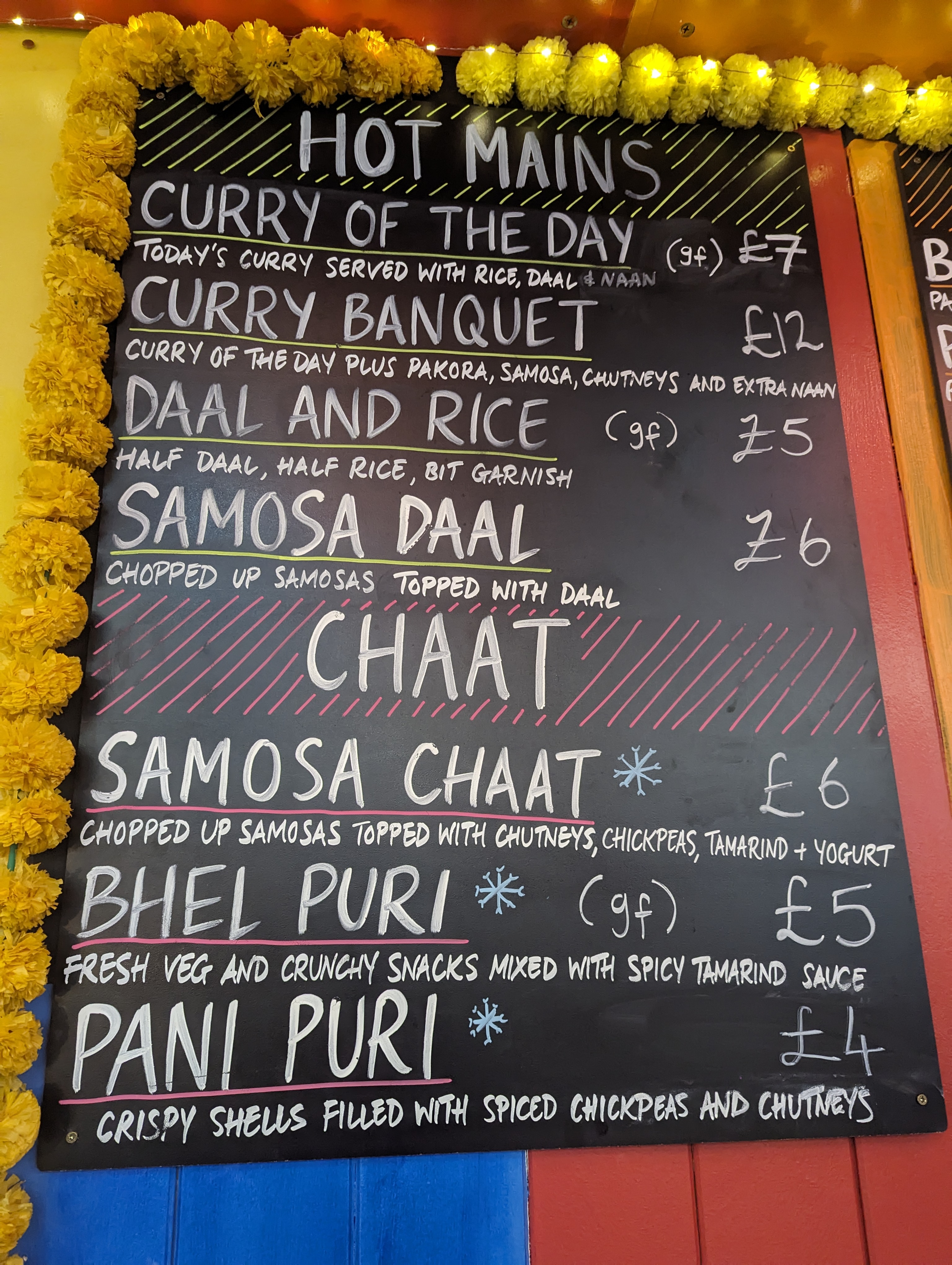
Bright tongue-punch of tamarind – I’d go miles for pani puri
New builds on brownfields Fennel glades, teazels, finches Unhomed
Kestrel’s cliff scraped clean of roots Bloody cranesbill
Street food, not sawdust In the covered market; ghosts… Skinned hares, white tripes
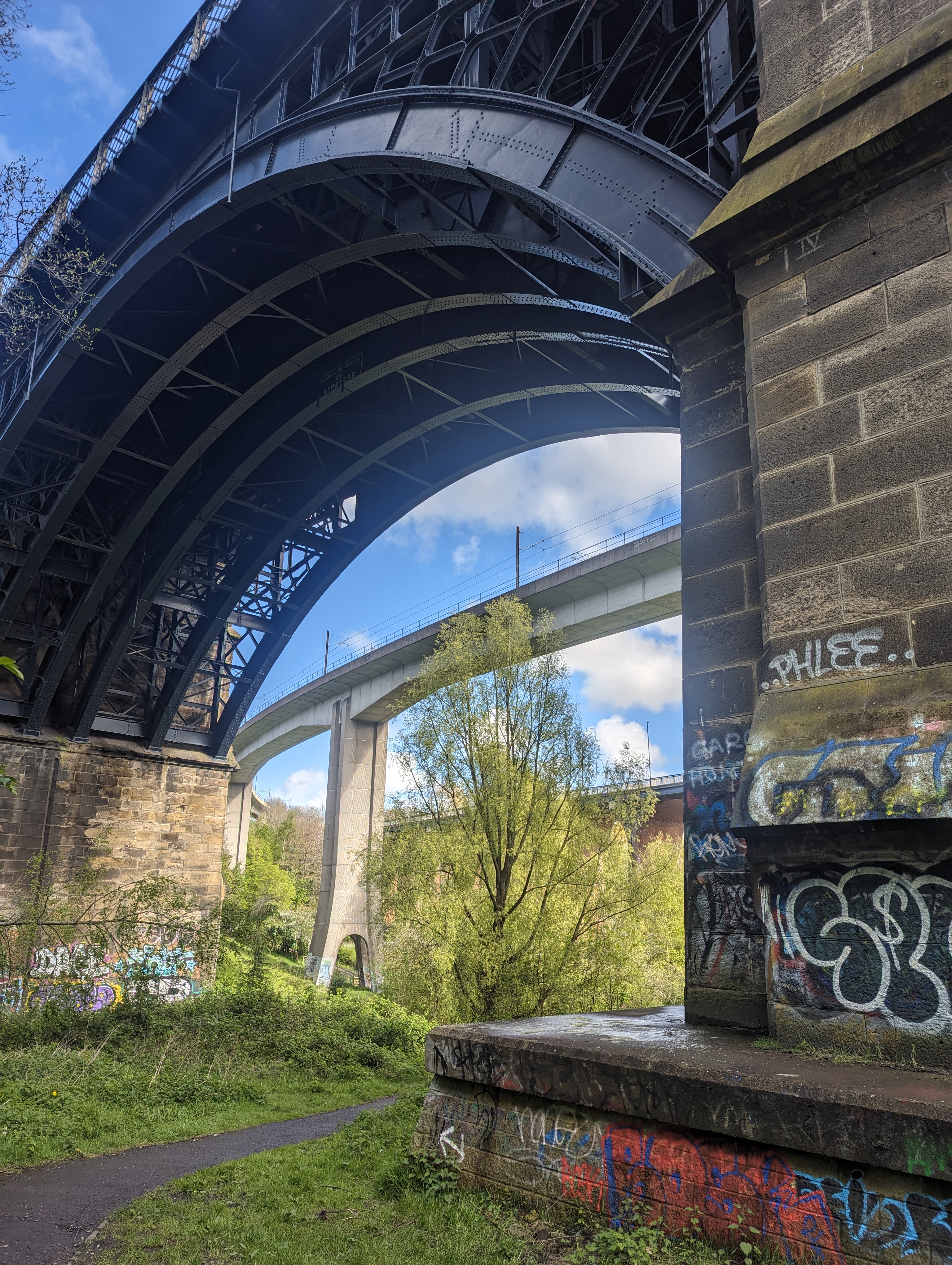
Kittiwakes scream from the bridge No-one wants a terraced house
Everyone is fine Talking to thin air these days – Pods. Buds. Our blue teeth.
Shop fronts like cast shells Waiting for crabs
Guts hanging out Sliding doors wedged open Cataract windows
The Laing’s a drum, deaf with rain Paintings sign to each other
Bloodlust and faith Objects in oils and suspense Gilt-framed
Gulls after a lightning strike – The Age Concern social group
Do you paint? Used to. But the girl I showed them to Never loved me back.
Sap green Scorched earth
Where you see a storm I see a girl tucking in To a ham sandwich
Things, alone in their thingness But, a field of attention
Smashed rainbow The old snooker hall windows Be Gay, Do Crime
Three white clouds; the blossom trees Next to Manors car park
Tall cakes, short coffees In your head, they’re still fighting – This cafe has changed
The basic anatomy Of buildings eludes my pen
I am surprised By the skyline we worked for; Its absences
Ten years in the mirror That body is lost to me
The hotel shower – Skylight in a downpour Headful of pictures
Looks like she ate all the pies Exhibition in a bathtub
Close to shame Wouldn’t do that one (After grabbing)
Shit on the pigeon netting Echoes fall down Dog Leap Stairs
Cities are dreams People too are mostly dreams, New builds on goldfields
The waters of Tyne… They run between me and me
Continuing experiments with renga, though this doesn’t really count as not many people believe a single poet can write a renga – you need at least one other person with whom to collaborate. Let’s say this is me collaborating with the ghosts of former selves as I take a writing day around Newcastle, where I lived and worked for twelve years.
I’ve now lived in Hartlepool longer than I lived in Newcastle, but of course with it being just up the road it’s still very current for me, so the disconnect is not as strong as I might find going back to other old haunts in search of psychogeography. I filled half an old journal with sense impressions and random free writes over the day, then pulled these fragments out. Like emptying your pockets after a foraging walk.
Last month I led my first renga, or rather my first “quarter-renga”. We didn’t have the minimum five hours it takes to lead a group of poets through the collaborative creation of a linked chain of twenty haiku-alternating-with-couplets that is the shortest possible version of a traditional renga.
Now, I have a lot more learning to do about the intricacies of different renga patterns and how to lead people through them skillfully. They remind me of increasingly complex versions of card games – draw the Queen of Spades and pick up the discard, red sevens reverse the direction of play, mention the season once and you must mention it in the next 3 verses, only one verse about the moon per page.
The not-even-quarter renga we created in the sun-warmed vestry at 17nineteen in Sunderland (otherwise known as Holy Trinity church) cherry-picked some of the rules. We opened by establishing a sense of place, then deepened it in the next couplet. Then we allowed the moon to peek into a verse, before closing with a couplet open to any theme. As renga-master, those were the choices I made about the poem’s direction of flow. Four verses took just over an hour.
In keeping with the traditional method of renga, once the direction had been said for the verse in hand, everyone wrote, and everyone then read out the previous verse plus their new addition. As renga-master, I then chose the verse that would take us forward as a group. For the first two, I combined lines from two or more contributors; for the second two, the “correct” verse arrived fully-formed from a single source.
Eight poets took part, and although the final words only derive from five pens, all of us are considered to be co-authors of the resulting work, because it takes everyone’s energy, focus, and revealed words to weave the invisible field of connection in which the renga gestates.
It is a sacred space. It needs space.
With each circuit of the table, alternative poem-chains open out, fractal branching, seedlings of all possible poems grow ghostly, pale and eventually wither. Like my amateur gardening, I feel guilt and regret with every verse I thin out, death of so many. A smile when someone’s words are chosen, against their expectations. My inner wince away from too-clever, too-polished; my confused frustration when people get caught in syllables and don’t quite open the door to the poem – can you feel it? Like a birdcall, words at the right moment, and never too many. The unchoreographed sigh of recognition from everyone when the right lines arrive, when I choose correctly, when we are becoming the hivemind that spins together.
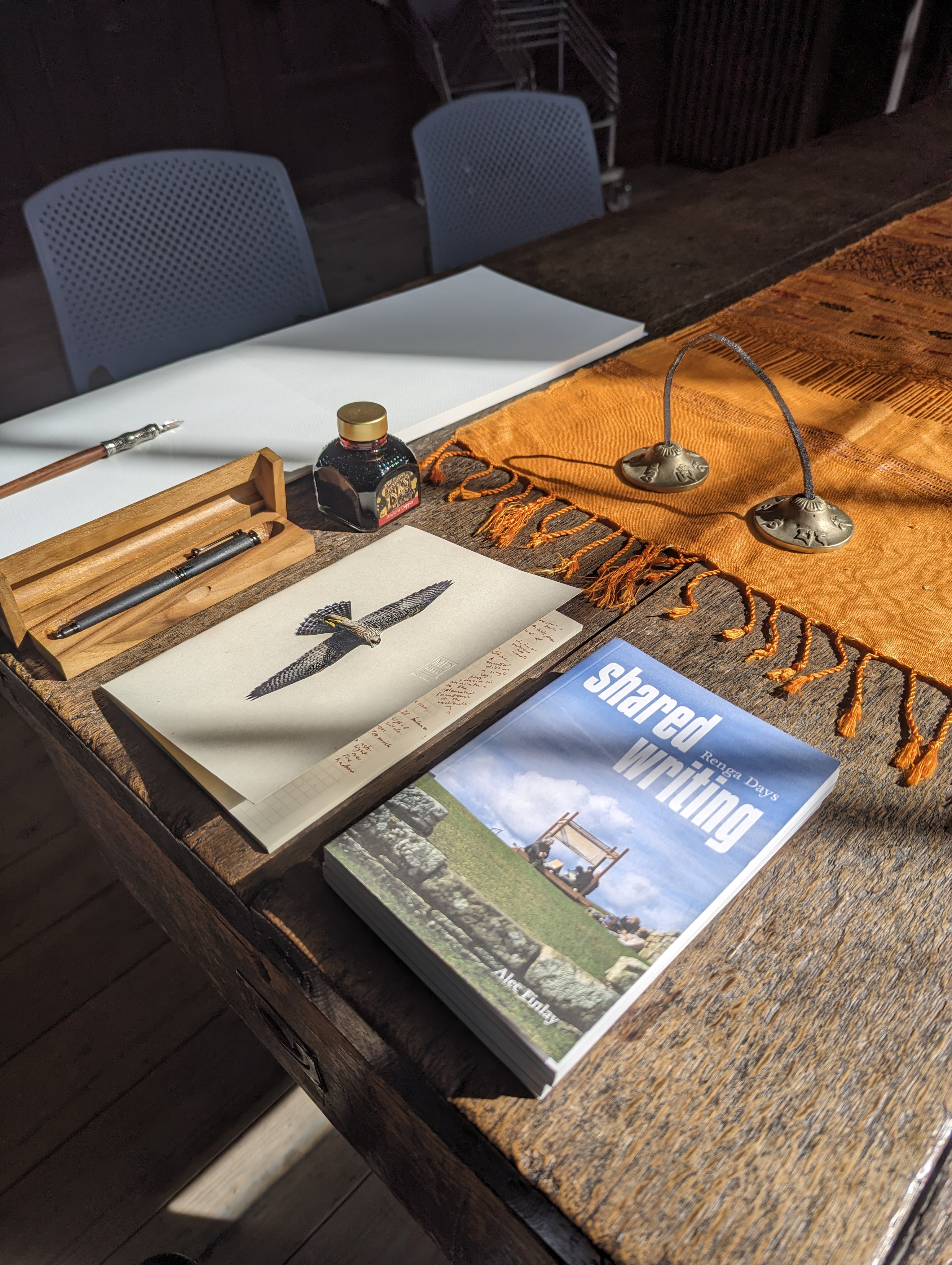
My approach to creating the conditions for the renga to arise was firstly to run two previous workshops about haiku, to provide renga participants with some insights and practice in the form. But several people turned up for the first time for the renga! So I also used Alec Finlay’s book Shared Writing and had us read out some 20-verse renga. I have two copies of the book, so we could do it in pairs, call and response, which was a beautiful way to hear how this way of writing unspools dreamlike dialogue resonant with association, echo and surprise.
A demarcated physical space really helps. Ours was a room, other projects have used a canopied platform. There is something qualitatively different about joint effort within a dedicated space, our combined attention builds an invisible structure that needs the trellis of a protective physical space up which to climb. I believe it would be possible to carry a mobile platform of stakes and flags, or meet in the wilds and create the space with foraged rocks or marks made in sand.
I also set up the energetic space for the renga by leading some brief meditation, and setting aside time for participants to move around the entire venue in silence in order to open their senses and minds to the latent poetry all around us. Even though the writing was done in the vestry, everyone brought with them details of everything from the wind in the trees outside to the halo lamps above the nave (white moons shining down).
In previous workshops I’d been able to do some basic qi gong with the poets, drawing on a previous life as a shiatsu/qi gong practitioner – it’s a useful, possibly essential preparation for poets who may be more used to starting with a focus on inner turmoil than on the observable world. Though makers in other disciplines would no doubt use the metaphors most related to their practices (haiku alternates with couplet, warp and weft, ones and zeroes) for me the rhythm of the chain felt very much like a walking qi gong where the weight must shift to the side before stepping forward. A quieter verse may make the better stepping stone. Not all can be Alpine grandeur, some must be saxifrage and gentian.
Here is what we wrote:
Three Gold Heads
Bright sunlight / Through high windows/ Inside, three gold heads
Water splashed on infants / Bless you, darling
On the dark side of the garden / A broken teacup saucer / In finger-nailed soil
The daffs need deadheading / Let’s leave them another week
And here are some favourite lines that didn’t make the cut – what would you have made with them?
Sun warms the wood / for centuries, this drawer / is it locked?
Sparrow chirp / ricochet on brick
Like the sky / my blue and white top / is colder than it looks
The lid of the poor box / is so heavy
Corinthian columns / the silver birches can’t quite touch / the window
Cholera corpses / standing room only
Lungs and moon full / I rub sleep from my eyes / another lonely night
We’re nearing the end of this little project, but there are still a few surprises to come as our collaborative film-poem twists from verse to verse. The latest clip is from Diane Cockburn, who picks up the “four years” of the poem by placing down the four of each playing card suit. Her deliberate movements are reminiscent of a Tarot reading, where there may well be “a reckoning”. See also how the colours of the table cloth echo and continue the colours of last week’s crochet footage.
So now we move to the final prompt! Can you find a way to illustrate this last verse?
As with a traditional renga, anyone from the group of participating artists can offer contributions as often as they like – which is how we welcome back Alison Raybould, who gave us our very first images. It just goes to show, try try again! Sometimes it takes a few attempts to get a bit of film that works the way you want it to.
Poet and renga-master Jo Colley has selected this clip of hands crocheting vintage wool for a number of reasons. One is that she enjoyed how it continues an overall mood of domesticity that is appropriate to the atmosphere of the poem it illustrates. She also liked seeing an action that is different from the pickling described in the verse, yet is also a kind of magic transformation of one substance into another thing entirely. And finally, she has fond memories of the wool shop featured on the wrappers in the film – if you’re from Darlington, maybe you do too?
A fascinating turn in the imagery this week, as new contributor Anathema McKenna picks up on the cut paper strips of week 7 and turns them into an abstraction. The choppy rhythm and ‘prison bar’ effect of the collaged lines is unexpected yet effective in conveying the actions and atmosphere of the verse, without ever becoming a direct illustration of the words.
We’d love to see your ideas for what might come next in this multi-authored film!
Hey hey, thanks for sticking with me on this one – week 7 of 11, and the contributor this week is…… me.
There’s a couple of reasons why it’s me. One is that I really wanted to create the ‘choking on strips of the Bible’ image idea I came up with in last week’s blog. Although when it came to it, I used newspapers to evoke the word ‘truth’ that is in the verse I’m illustrating.
The second reason is one of film quality-control. We received a couple of very intriguing concepts for imagery as a result of last week’s How-To guide, but unfortunately the execution did not do justice to the ideas. Common problems are:
Off-centre framing, or shots set up so that there is unwanted background detail
It can seem super-hard to get the framing right on a shot, but it’s worth playing around to get the perfect angle. It seems like most people would benefit from simply taking the camera closer in towards the objects and actions they’re filming. If you have a central action, you need to move the camera until the action or objects appears at the centre of the frame. This might take a fair amount of fiddling on! I’m lucky that I have a tripod, and a special attachment that allows me to put my iPad in any position I want. It wasn’t an expensive bit of kit, less than a tenner I think, and it makes a HUGE difference. It also completely eliminates the next biggest problem –
Shaky-cam and loss of focus
If you don’t have a tripod, then I really recommend you improvise some other ways to keep your device still, like propping it up on piles of books. It’s amazing how eliminating hand-held shake immediately makes your film look more engaging. And finally (for now) the other thing worth trying to resolve is –
Bad lighting
Of course we don’t have all the fancy-schmancy lights and reflectors that a serious film-maker has (although you can actually pick them up relatively cheaply). Nevertheless, you can make the most of the light you have and you absolutely should do so, because it makes everything look better. Arrange your cinematic composition so that it catches full sunlight, and add in more light using as many reading lamps as you can lay your sticky hands on.
So here is the latest version of Cherophobia – an Autumn Journal, with my 20 seconds added in. You’ll see that I’ve been a bit of a smart arse and have edited together a few different sections of film to make my 20 second clip. Notice how close in I’ve got the camera in order to get the effects I wanted – cropped right in on my hands, and then on my mouth and neck. Keeping the camera further away just wouldn’t have worked – the closer I am, the more intense the effect of the imagery.
And now it’s back over to you!
Below is the verse for week 8, for you to brainstorm into an eye-catching film snippet. Please send us your clips to sleeperpoems@gmail.com by 5pm this Friday 22nd May. And remember –
Illustrate/respond to the words and atmosphere of the poem – can you do this without filming someone chopping shallots??
Shoot in landscape orientation
Experiment until you have the shot framed right – come in closer, get things centred or in the right place, make sure unwanted details are kept out of frame
Welcome to week 6, the mid-point of this experimental project based on a poem by Jo Colley from her latest collection, Sleeper. The footage for this verse uses a combination of old photos featuring marbles, and video of raindrops falling on a dark puddle.
Every week we ask for contributions of film clips that might in some way illustrate or respond to the words, imagery, and above all the emotional tone of the poem. This last week we received several pieces of film, some very beautiful, but few seemed to really be in dialogue with the words of the prompt.
It can be hard to put images to words, but for this to work there must be some sense of connection. Here, the roundness and clustering of the marbles are a visual echo of the berries in the poem, described as “beads”. The rain on water stands in for the “cider vinegar”, and the sinister hints of the word “drowning” are suggested by both the darkness of the water and the earlier glimpse of a doll positioned face-down in a disturbing posture. Take a look, and see if you can catch what I mean.
So, here’s a hint for how to approach making a film clip for this week’s verse, because there are very few visual references in it!
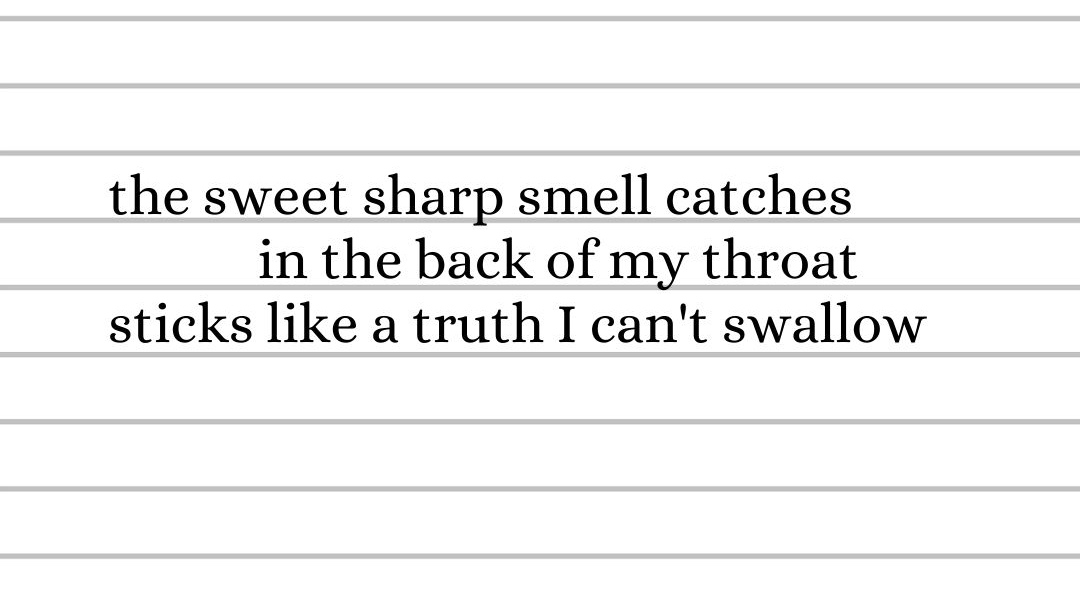
Take three or four of the words that seem to you to be most important for the atmosphere of the verse. For example, you might choose ‘sharp’, ‘catches’, ‘throat’ and ‘truth’.
Write them in a random way on a piece of paper, and then start to make a spider-web of associated words, images, objects, colours even. It might look like this:
Now try connecting two or three of your associated images together (ideally three), to create a possible moment of footage. For example:
Connecting ‘knife’ (sharp) with ‘stroking neck’ (throat) gives a strong image. Too strong?
Connecting ‘drop something’ (catches) with ‘broken glass’ and ‘plasters on fingers’ (sharp) suggests a scene of letting something drop and shatter, perhaps filmed from above; or a scene of injured fingers picking up shards.
Connecting ‘twitter feed’ (truth) with ‘broken glass’ (sharp) makes me imagine swiping a broken phone screen – perhaps the images on the phone could be staged to be relevant to the poem’s atmosphere of a relationship in trouble – photos of the couple in happier times?
Connecting ‘tear’ (catches) to ‘Bible’ (truth) to ‘mouth’ (throat) gets us perhaps the most art-house image, of someone ripping up and chewing the pages of a Bible.
Have a go yourself, and see where your associations take you – and remember, ALWAYS film in landscape orientation, and send us your clip to sleeperpoems@gmail.com by 5pm this Friday! Here is the full verse of poetry to inspire you:
This week a contribution from Bernie McAloon takes us back towards imagery of nature, but purple and grainy with age. The road up through trees is the ‘Bank’ and perhaps the ‘challenge’ mentioned in the verse, the tint of the film stock is the stain of the burst berries.
Next week is our midpoint, verse 6, and we would love you to contribute a 20-second clip of video that responds to the following text:
Here is your challenge – can you send us something that shows neither forks, nor pots, not vinegar, but still illustrates the mood of the poetry. Repetitive action, the suggestion of unspoken hostilities in the word ‘drown’?
Send your landscape-oriented footage to sleeperpoems@gmail.com by 5pm Friday 8 May!
Our film-poem takes a new turn this week, as archive footage contributed by Wilf Wilson is spliced into the mix. When imagery of war appears inside the confines of what has so far been a domestic setting, what is the psychological impact? Where is this story going? Take a look at the film so far, and then read the verse for week five. We want your 20 second film clip to take us forwards!
We need 20 seconds of footage that reacts to this verse, but it doesn’t have to be a direct illustration of it. Bring us something that speaks of challenge, or bursting? Remember to film it in landscape orientation, and email it to sleeperpoems@gmail.com by 5pm on Friday 1st May.
This week’s clip is provided by Lilly Flypchuk, whose daily lockdown walk takes her along the banks of the upper Tyne.
Looking at how the film is progressing, it’s really interesting to notice how the mind forges links between the words of the text and images that may seem quite unconnected. In week one, there was a clear link between Ali’s film (light shining through a glass tumbler) and Jo’s words “dim light on a glass of brandy”, but also the way the light twisted and turned seemed to fit well with the text “incoherent babble”.
Natalie’s footage used spoons, which weren’t mentioned in Jo’s poem at all, but their silver shininess chimed with “kept for best”, the domestic nature of the object matched with “cupboarded”, and of course their Hall of Mirrors reflections gave us the “face…but folded”.
This week we see a river whilst reading “pond reeds” and our mind puts the sense impressions together. When the text gets to “fresh out of the cellophane” the transparent glisten of the water becomes the plastic wrapping – or it at least it did in my mind!
Have a look for yourself, and then please do spend 20 seconds this week recording a clip for verse 4, using these guidelines.









 Kirsten Luckins