AI and poetry – a weird flirtation

Over at the Tees Women Poets, there have been some fascinating recent experiments with the relationship between AI, poetry, and ways to describe women. I’d like to share one of my experiments here.

The following poem is one I wrote for a TWP performance at Drake the Bookshop, for Feminist Book Fortnight. It is inspired by the non-fiction book Going with the Boys by Judith Mackrell, an account of six of the very first official female war correspondents, many of them from privileged yet problematic backgrounds, some of them trading on personal and sexual relationships (e.g. with Hemingway) to get their big breaks, and at least one of them ending up spying and smuggling people out of Nazi-held territories. All of them using femininity as a tool and a disguise, to divert danger and obtain information.

How To Get Ahead As A Female War Correspondent, 1930

So, daddy left mommy?
Daddy beat mommy?
Daddy didn’t love you?
Daddy loved you too much? – whatever,
Heiress, It Girl, bluestocking, black sheep,
Hitch your long legs around a brand new Daddy and make the wild leap.
You’re a bright girl, and you’re restless, so choose your ride judiciously –
Aristocrat? Diplomat? Editor? Author?
Who do you have to screw around here for the chance to prove
you are more than a gossip reporter?

Outrage them.
Hook Hemingway in Florida, and before you can say ‘exclusive’
you could be reporting the war in Spain, dancing
around the rubble and each morning’s wet and sudden stains,
your gold bangles clinking and your fox-fur neat.
Ignore the hacks and hounds who scoff no matter what
you wear on your pretty little feet.

Outdrink them, and outcharm them
in beleaguered Barcelona, in Berlin’s cellar bars,
at country house shoots and by candlelight
in Libya, Moscow, Bechtesgarten; play nice
with generalissimos of every stripe -
Hitler, Stalin, William Randolph Hearst,
some men are all the same, hungry for the bloodbath
that will make their name.

Feed their vainglory. Smile, darling, and they won’t refuse -
You’d look great if you made a little effort!
You gotta schmooze to get the news!
just don’t mention that your relatives are Jews –
that’s when the shadow men slide after you in their quiet cars
that’s when you feel your nape prick at the telephone’s flat click -

Outwit them.
They underestimate your brains, your bravery –
Pretty little polyglot
Cub reporter, trot, trot, trot
In the embassy limo, finesse your way through border lines
Bat your eyes, a shopping trip, too blonde for spies,
Just can’t get Schiaparelli in a city prepped for siege,
Just happen to glimpse the Panzer ranks, the massed Blitzkrieg,
Stash that in your boutique bags, quick
Glitz and ditz your way back ‘home’ to the last hotel open,
the one international phone, and –

Scoop! Outwrite them!
When they say you’re getting reckless, threaten to quit.
Forge exit visas for thousands, hold your nerve, get away with it,
You could not have covered society pages for one more minute!

So
When adrenalin gets you pumping,
When your mean heart’s bomb-blast-thumping,
When ambition gets you jumping to catastrophe’s rhythm, say
you don’t know where the boys are going
but by god you’re going with them.

I fed the poem into craiyon.com with the prompt “Create a photo based on this poem”. I tried the entire piece, and then experimented with using it in sections. Our hypothesis was that the first words were likely to influence the overall composition, like an ingredient list on a food packet showing you the highest percentage ingredient first.

What do you think of these images?

I wondered where some of the people of colour have come from, was the mention of Libya enough to get some of the North African vibes in the first slide? It’s much more than I expected. Why is the AI weighted in that direction? Where is Moscow, or Florida?

I was unsurprised to see that the bot is a leg man and a foot fetishist!

I was most irritated that I didn’t know to save screenshots, so was clicking the Save To Collection button only to lose everything several times. The very first results were incredible in their Paula Rego-esque looming dark surrealism, I felt like they absolutely captured the atmosphere of threat and danger I tried to portray in the poem. Each subsequent attempt got weaker results. Alas, you will have to take my word for it – that the long legs were flung higher and stranger, and there were orphanage-camps full of sheep-headed babies and women with slits in their feet…

My conclusions?

Still pending, but I know I’m not interested in generating sweet, neat, pretty and complete images, therefore I’m actually quite taken with these. I am still haunted by the images lost (the literally upholstered society lady, her eight hands caressing the limousine door, the slutty nurse with the several legs). What if I tried now to draw these images and the ones I remember, using charcoal perhaps? Is this essentially a good way of making preparatory sketches?

One thing I have learned – with the image-stream of AI, you really never can step into the same river twice.

Voyager -for a ‘poem bowl’ by Rupert Spira – and all four digital poems!

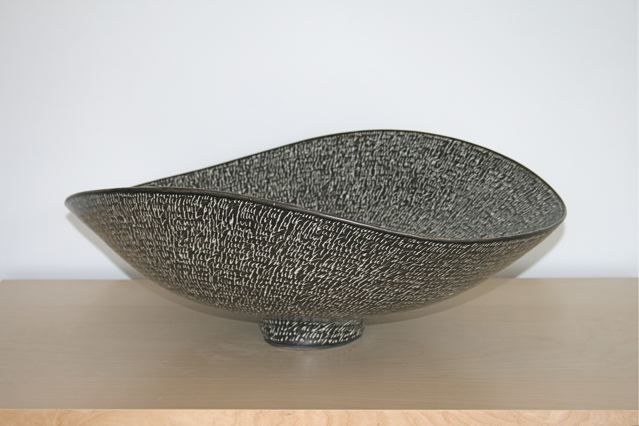
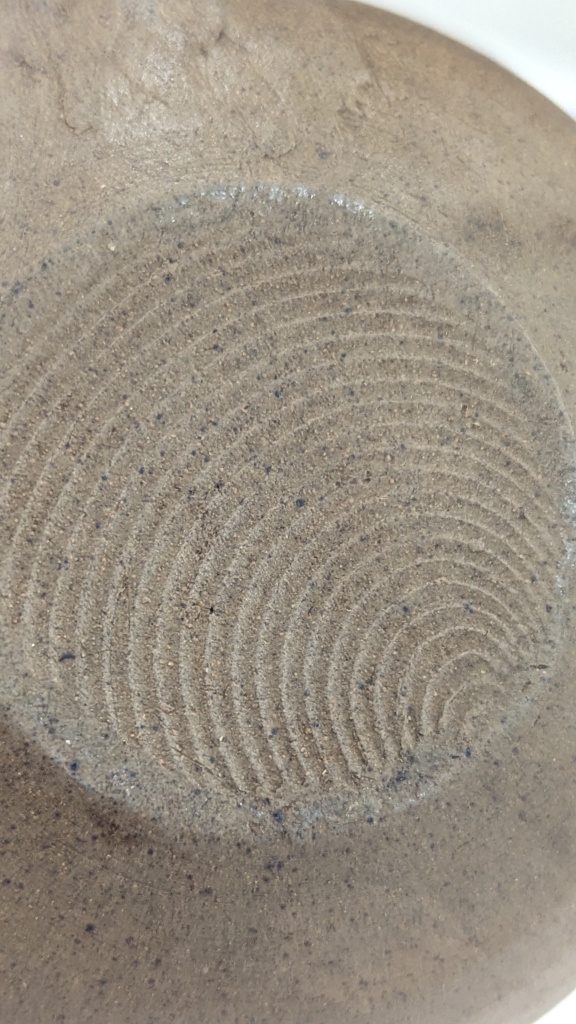
The fourth and final digital poem I made for my MIMA/Tees Women Poets residency was Voyager, written for Poem Bowl by potter, writer and philosopher Rupert Spira (b.1960). A vast black dish, it is decorated inside and out with a mostly illegible hand-written text that has been incised through the black glaze. Certain words can be made out, and these have been incorporated into the poem.

My inspirations for the imagery in the poem comes from the way the dish reminded me of both a warped vinyl record and a radio dish. Combined with the only partial legibility of the decoration, it led me to play with ideas of decaying signals and transmissions through space. The audio accompanying the digital poem features a short sample from “I’ll Be Seeing You” by Billie Holliday, which was the last message sent by NASA to the Mars Rover Opportunity before it ‘died’ in 2019.

The sound track for this poem was the most complicated, featuring free samples of for example vinyl record clicks and Cold War numbers stations alongside my own voice pushed through echo and distortion effects, and the poem text run through AI voice generators. All of this was put together using free Audacity software, which also allows you to create blocks of static interference.

The digital poem was also the most complex in terms of the kinetic typography, even though it was made in Canva in exactly the same way at 79AD and Origin Story. Drawing on the circular nature of the bowl, and all the images of records, radio dishes etc that are in the poem, I made the typography follow arcing pathways. The sections of text overlap and ‘degrade’, just like the audio. To make the effect of degradation I reduced the transparency of the text by degrees, sometimes in arcs that were offset so the faded echoes can still be read; and once in a fully-aligned circle with text blacked out except for certain selected letters.

I’m really proud of these digital poems! Here’s a reminder of the ceramics that inspired them – a leaning neck vase by Betty Blandino (Origin Story); a tazza by Annette Fuchs (79AD); a bowl by Deirdre Burnett (Egg Fiction); and a poem bowl by Rupert Spira (Voyager).

  • A rough and rusty-looking vase with a neck that is bent to the left.

And here are the finished digital poems in the loop as it appeared at MIMA. Headphones on!

For those that are interested in the sounds, here’s a list of all the sound clips I used – see if you can tell which poems they appeared in!

  • Volcano lava
  • Dripping cave
  • Message 4
  • Chickens
  • Seagull flock
  • Vinyl scratch skip loop
  • Cave music
  • Chucks Egg classic arcade game
  • Little chicken
  • Needle drop
  • Numbers station 332241
  • Seagull short
  • Vinyl scraped
  • Vinyl crackle 33rpm

Egg Fiction – for a bowl by Deirdre Burnett

Unbelievably, I didn’t take a decent photo of the third ceramic piece to become a poem in my Tees Women Poets @ MIMA residency, but here are some examples of Deirdre Burnett’s other work to give you a flavour. The one on the right is closest in colour and finish, but imagine it looking much more like an eggshell. The porcelain is also eggshell-thin, and quite small (ostrich egg?)

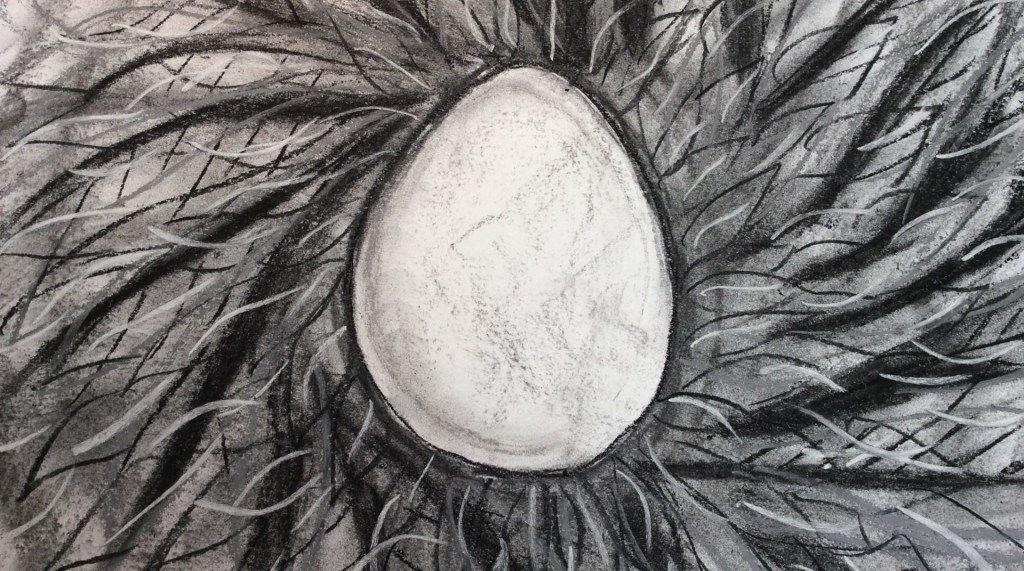
Egg Fiction draws on my own memories of collecting eggs and family folklore about witches’ boats. I learned charcoal animation for the resulting digital poem, and tried to keep a childlike feeling to the flow of images. I named the poem Egg Fiction because it is in no way an actual biography of Burnett’s route into ceramics.

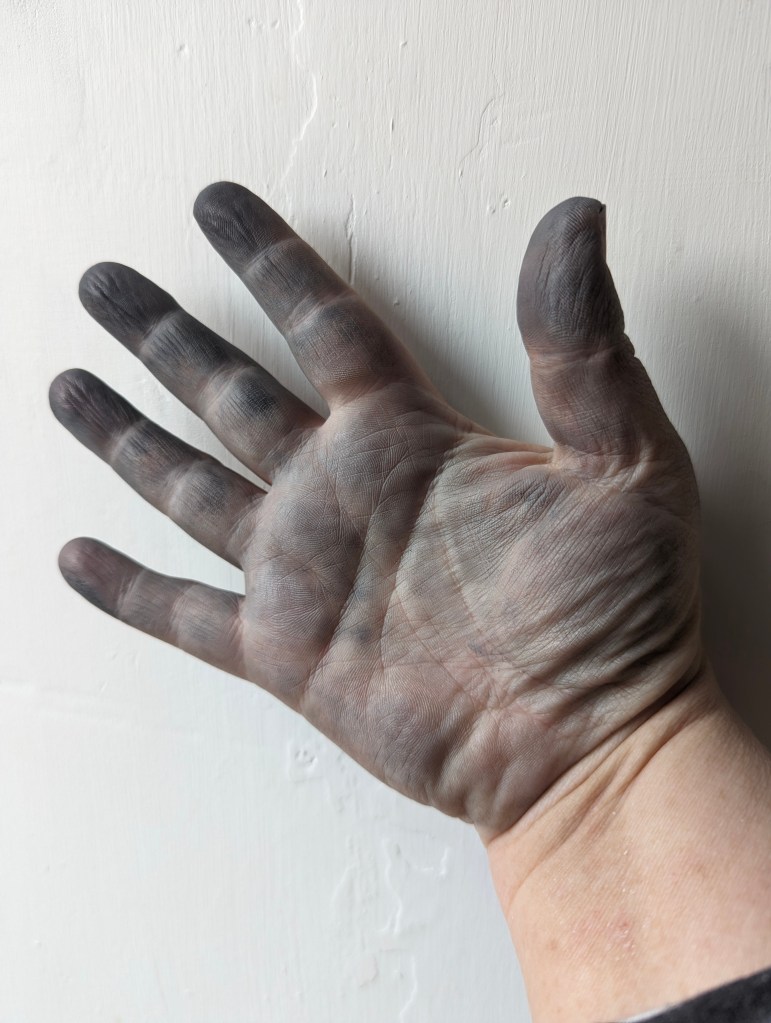
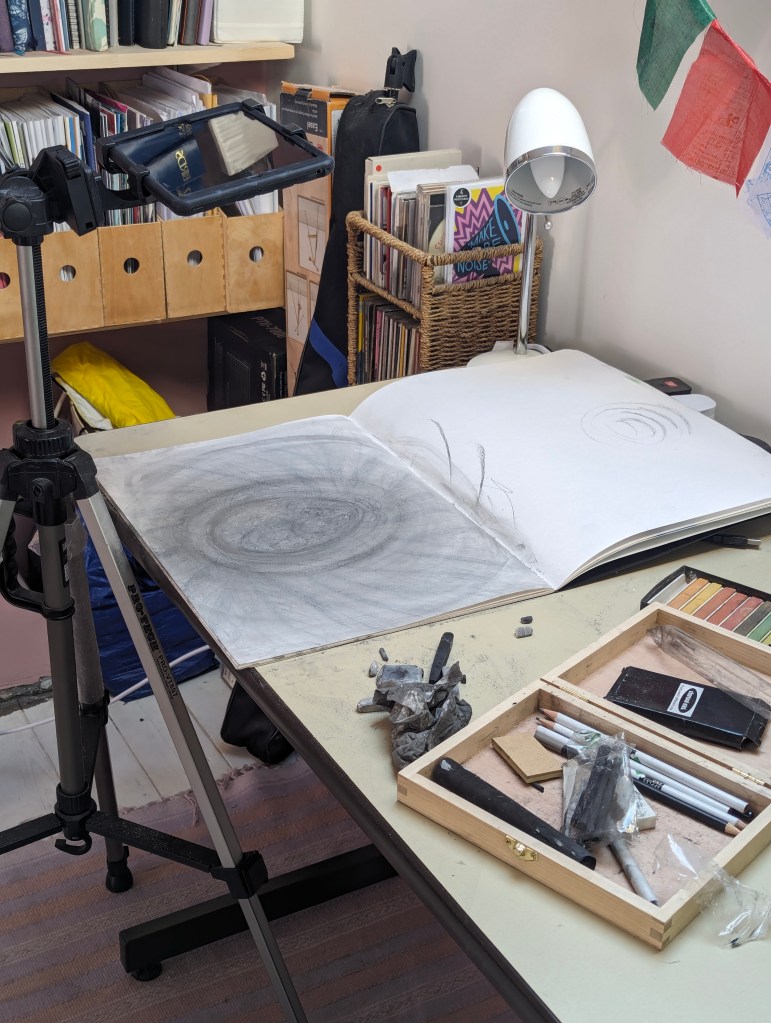
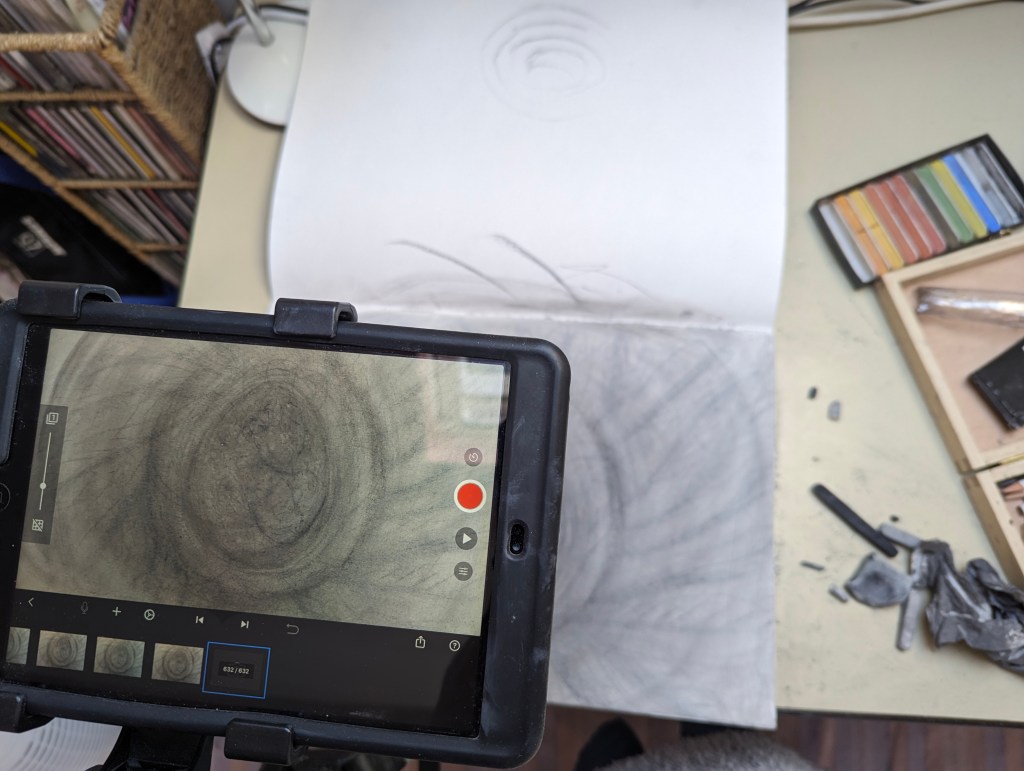
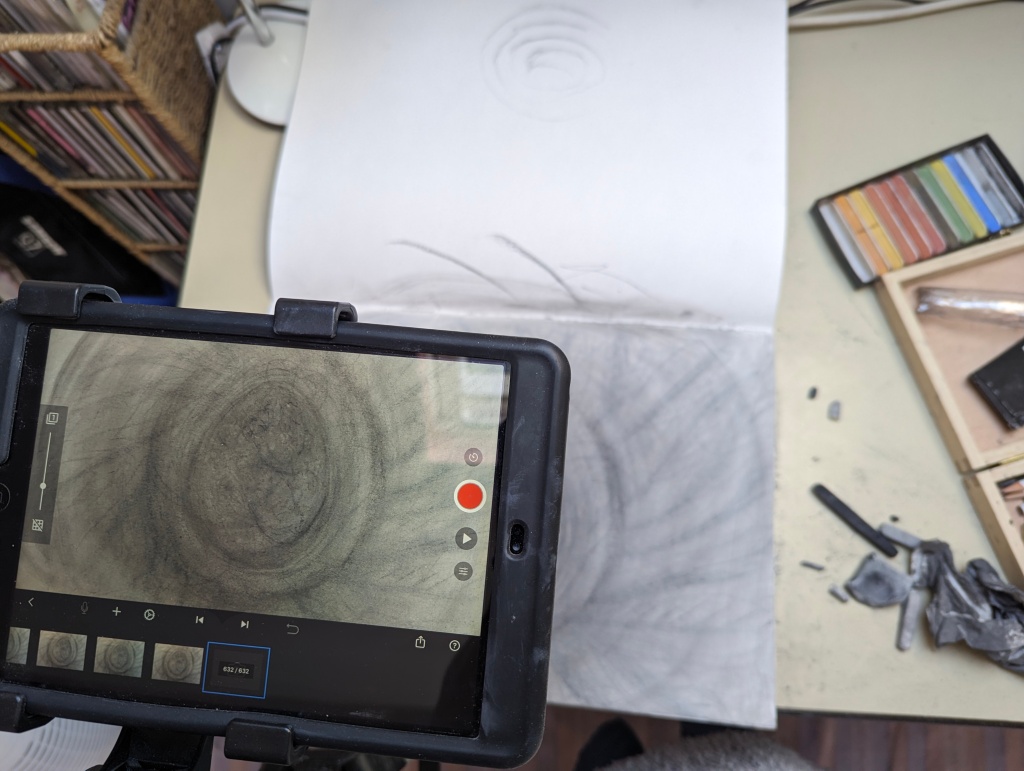
The animation was entirely unplanned and freeform. I used a central egg motif, and simply kept doodling in and around it using charcoal and chalk, taking 2 shots every couple of marks made, using the free app StopMotion on my ancient reconditioned iPad mini. I didn’t do separate drawings frame by frame, every frame was drawn on the same piece of paper. Rubbing in, sweeping off dust, erasing, chalking over, layer upon layer over a combined total of around 8 hours, until my desk was grey and grubby! Completely backbreaking, utterly obsessive…

1500 frames later, having made a whole 58 seconds of film, I recorded the voice track for the poem and was devastated to see it come in at nearly 3 minutes long! Nooooo!!!! Radical editing of words ensued, but I was still only half way with the visuals. Physically unable to continue with hand-drawn animation, I came up with an ingenious solution to triple the length of the film. Importing the original animation into iMovies, I duplicated and layered the sequence over itself, using the editing app’s greenscreen feature to set first the darkest parts and then the lightest parts of each frame as a greenscreen. In this way, the rapidly metamorphing egg began to ghost itself…

Here’s the text for this most challenging and enjoyable piece. When I show you all four finished films in my next blog, you’ll hear that the voiceover for this poem is not me speaking. In fact, I had my first foray into AI-generation by using a text-to-voice app. There were many accents to choose from, and male and female voices of different age profiles. When you read the poem below, what voice can you ‘hear’ in your head? What accent would you have chosen in my place?

Egg Fiction

nanna sent her to steal an egg
fresh from the straw
the darkness clucked

it was the end of the world
it was a rite of passage
don’t trip!
don’t smash it!

don’t smash it too soon
soft-boiled children must learn
the tap the crack the dip the scoop

now smash the empties!
scuttle the coracles
so witches can’t sail to sea
with their wicked, wicked storms

but that warm, smooth weight
had ordained her palm

it’s enough to make her grow up a potter
throwing porcelain
not to shatter, but
to release the paradox-
strength and fragility are twins
this is the earth whose yolk brews wings

this is the earth that knows fire
in the kiln it turns into a little sun
little pitchers become themselves
or smithereen…

look, this bowl has hatched a dragon!
half-shell with a scorched equator

and in the bottom
freckle-speckles
like the memory
of a hen’s egg

The Tees Women Poets are currently open to applications for their autumn residency at MIMA’s Towards New Worlds exhibition. If you’re a woman poet in Teesside, especially if you identify as disabled or neurodiverse, take a look at the info and apply here.

What exactly does a poet-in-residence do?

How long is a piece of string?!

Residencies for poets are few and far between. At one end of the scale, a residency offers time and often a dedicated space away from home life, in which to explore your craft and make progress on new work. Most of these will be a commercial proposition where the poet is the one that pays. Sometimes it’s subsidised, and with hen’s-teeth rarity the poet is paid just to be a poet – living the dream!!

On the other end of the scale, you are paid but the emphasis is firmly on delivering a set of outcomes for the venue who is hiring you, whether that be an agreed number of poems in a prescribed format, and/or a set number of participatory activities for groups of people important to the venue. The more participatory the brief, the more likely it is that you’ll be working with children, families, and possibly with groups that have specific access needs of various kinds. For this kind of residency to be a residency rather than a short-term hire or a commission, there should be some wiggle room to make new work on your own terms, but there is a real need to align your professional ambitions with the needs of the host – and the host is probably thinking in terms of foot-fall and engagement.

An ideal residency should have elements of both valuable outputs and independent creative experimentation, and an expectation that the exact methods of delivery might be decided through co-creation and negotiation between artist and staff teams. You still need to pitch a good idea, though, and that can feel a bit like having to be telepathic, guessing at what the venue might really need or having some experiential knowledge of how commissioning organisations operate on a day-to-day basis. For example, is their staff team small and overwhelmed, might you need to foreground your ability to self-manage or include social media activity in your pitch?

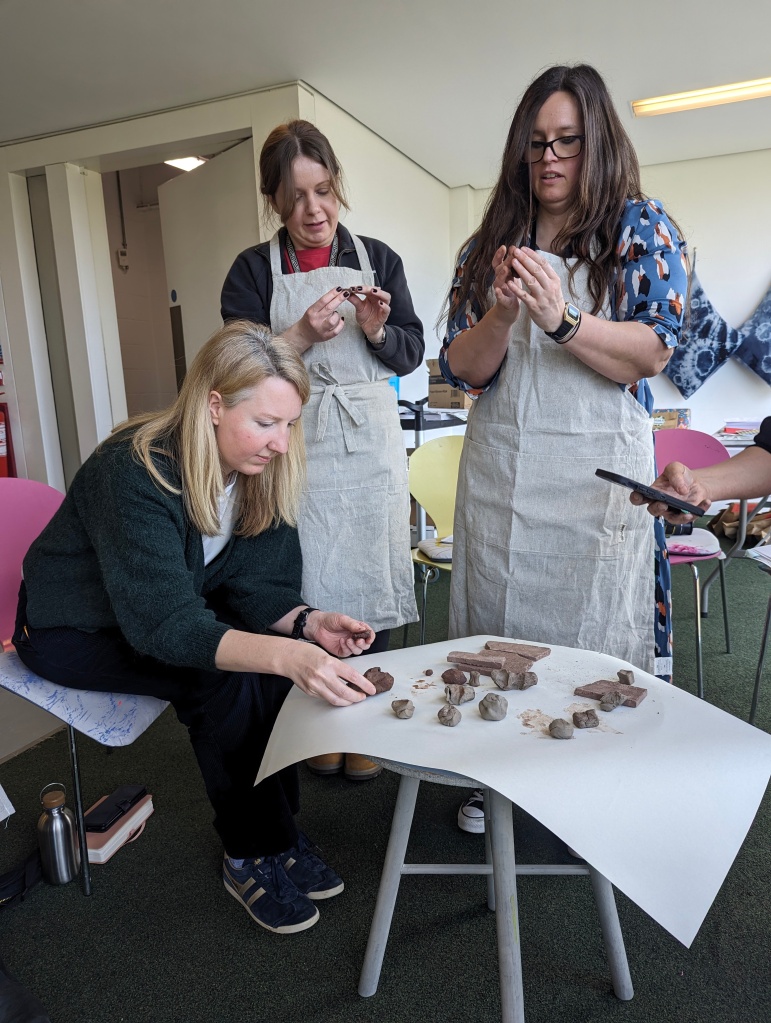
My current residency at MIMA for Tees Women Poets has been a real joy. The expectations of the host venue were clear – create digital poems in response to the Contemporary Ceramics collection in a format that could be used on a flat screen within the gallery, within a very specific timescale. Be able to self-organise and meet deadlines to present the work at MIMA Art Social #17 on 20th June. Offer two workshops to ensure the public and the TWP are getting developmental benefit, but also develop my own creative practice by learning new skills.

What does that look like in terms of my activity? It’s involved

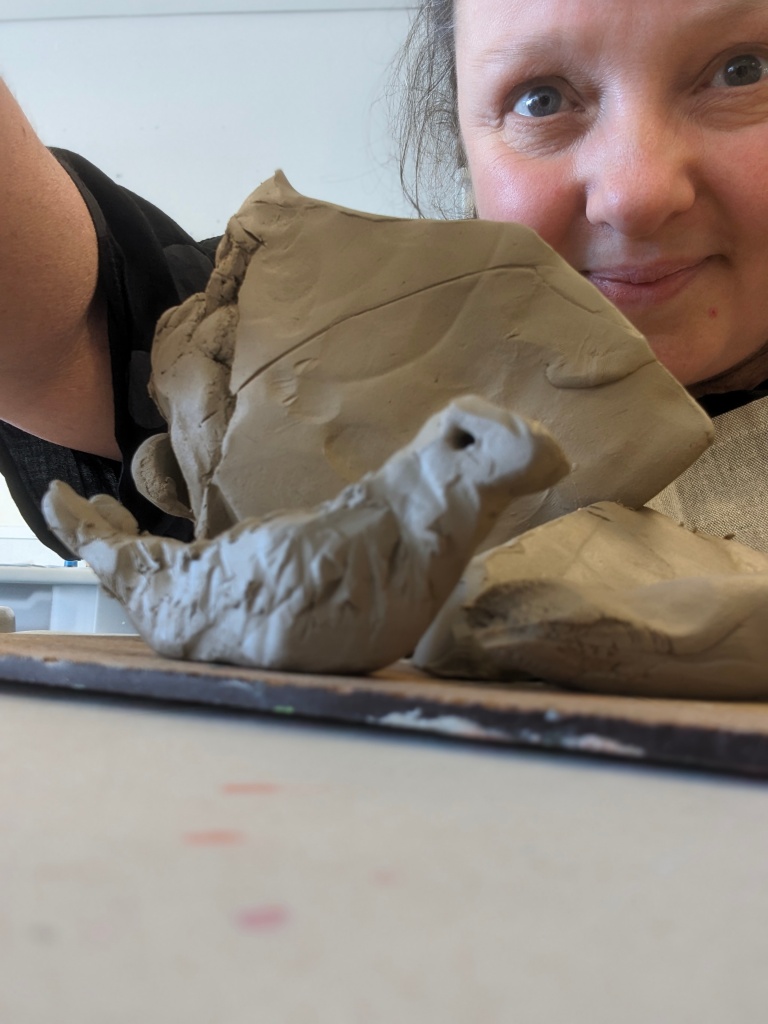
  • an in-person pottery handling session with the curatorial team
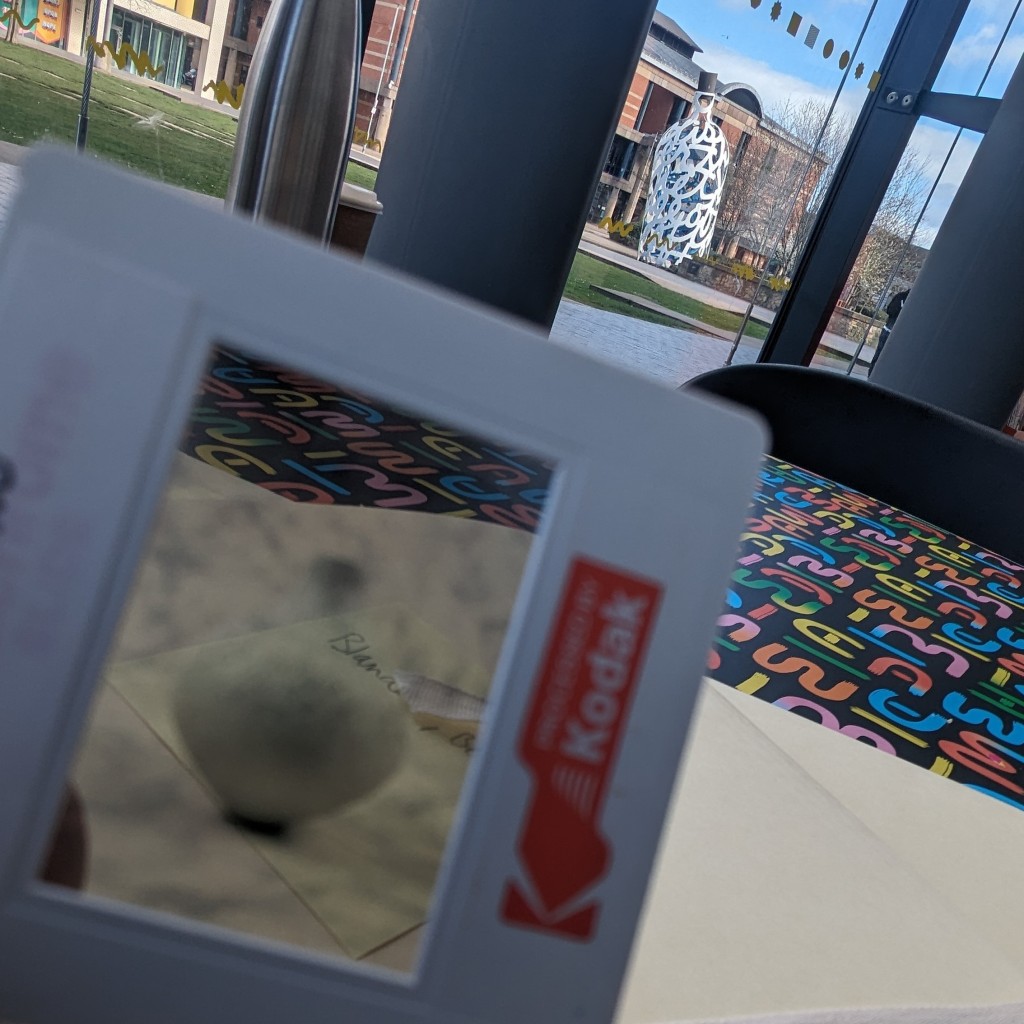
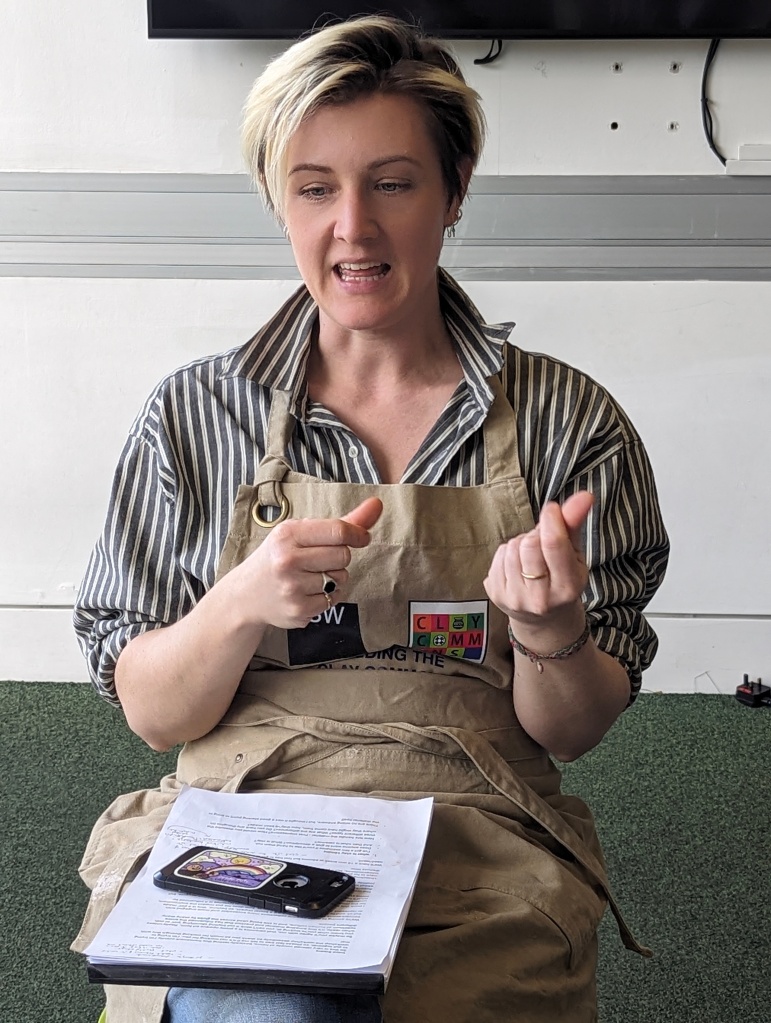
  • my attendance at a workshop about de-colonializing ceramics curation, again with the staff team (see the slideshow above)
  • several days of writing and editing poems in response to handling pots
  • delivering a creative writing workshop with exercises inspired by the ceramics
  • making film-poems from participants’ work in Reels
  • delivering a round-table discussion about residencies for TWP members who would like to apply for future opportunities
  • learning how to make kinetic typography digital poems in Canva
  • learning how to make charcoal animations
  • experimenting with AI-generated voice-overs
  • learning how to create soundtracks in Audacity
  • the creation of four digital poems ready to reveal in June.

To find out more about my process and poems, please come to MIMA Art Social #17 on Thursday 20th June, 5.30-8pm at MIMA, and I’ll reveal all!!