AI and poetry – a weird flirtation

Over at the Tees Women Poets, there have been some fascinating recent experiments with the relationship between AI, poetry, and ways to describe women. I’d like to share one of my experiments here.

The following poem is one I wrote for a TWP performance at Drake the Bookshop, for Feminist Book Fortnight. It is inspired by the non-fiction book Going with the Boys by Judith Mackrell, an account of six of the very first official female war correspondents, many of them from privileged yet problematic backgrounds, some of them trading on personal and sexual relationships (e.g. with Hemingway) to get their big breaks, and at least one of them ending up spying and smuggling people out of Nazi-held territories. All of them using femininity as a tool and a disguise, to divert danger and obtain information.

How To Get Ahead As A Female War Correspondent, 1930

So, daddy left mommy?
Daddy beat mommy?
Daddy didn’t love you?
Daddy loved you too much? – whatever,
Heiress, It Girl, bluestocking, black sheep,
Hitch your long legs around a brand new Daddy and make the wild leap.
You’re a bright girl, and you’re restless, so choose your ride judiciously –
Aristocrat? Diplomat? Editor? Author?
Who do you have to screw around here for the chance to prove
you are more than a gossip reporter?

Outrage them.
Hook Hemingway in Florida, and before you can say ‘exclusive’
you could be reporting the war in Spain, dancing
around the rubble and each morning’s wet and sudden stains,
your gold bangles clinking and your fox-fur neat.
Ignore the hacks and hounds who scoff no matter what
you wear on your pretty little feet.

Outdrink them, and outcharm them
in beleaguered Barcelona, in Berlin’s cellar bars,
at country house shoots and by candlelight
in Libya, Moscow, Bechtesgarten; play nice
with generalissimos of every stripe -
Hitler, Stalin, William Randolph Hearst,
some men are all the same, hungry for the bloodbath
that will make their name.

Feed their vainglory. Smile, darling, and they won’t refuse -
You’d look great if you made a little effort!
You gotta schmooze to get the news!
just don’t mention that your relatives are Jews –
that’s when the shadow men slide after you in their quiet cars
that’s when you feel your nape prick at the telephone’s flat click -

Outwit them.
They underestimate your brains, your bravery –
Pretty little polyglot
Cub reporter, trot, trot, trot
In the embassy limo, finesse your way through border lines
Bat your eyes, a shopping trip, too blonde for spies,
Just can’t get Schiaparelli in a city prepped for siege,
Just happen to glimpse the Panzer ranks, the massed Blitzkrieg,
Stash that in your boutique bags, quick
Glitz and ditz your way back ‘home’ to the last hotel open,
the one international phone, and –

Scoop! Outwrite them!
When they say you’re getting reckless, threaten to quit.
Forge exit visas for thousands, hold your nerve, get away with it,
You could not have covered society pages for one more minute!

So
When adrenalin gets you pumping,
When your mean heart’s bomb-blast-thumping,
When ambition gets you jumping to catastrophe’s rhythm, say
you don’t know where the boys are going
but by god you’re going with them.

I fed the poem into craiyon.com with the prompt “Create a photo based on this poem”. I tried the entire piece, and then experimented with using it in sections. Our hypothesis was that the first words were likely to influence the overall composition, like an ingredient list on a food packet showing you the highest percentage ingredient first.

What do you think of these images?

I wondered where some of the people of colour have come from, was the mention of Libya enough to get some of the North African vibes in the first slide? It’s much more than I expected. Why is the AI weighted in that direction? Where is Moscow, or Florida?

I was unsurprised to see that the bot is a leg man and a foot fetishist!

I was most irritated that I didn’t know to save screenshots, so was clicking the Save To Collection button only to lose everything several times. The very first results were incredible in their Paula Rego-esque looming dark surrealism, I felt like they absolutely captured the atmosphere of threat and danger I tried to portray in the poem. Each subsequent attempt got weaker results. Alas, you will have to take my word for it – that the long legs were flung higher and stranger, and there were orphanage-camps full of sheep-headed babies and women with slits in their feet…

My conclusions?

Still pending, but I know I’m not interested in generating sweet, neat, pretty and complete images, therefore I’m actually quite taken with these. I am still haunted by the images lost (the literally upholstered society lady, her eight hands caressing the limousine door, the slutty nurse with the several legs). What if I tried now to draw these images and the ones I remember, using charcoal perhaps? Is this essentially a good way of making preparatory sketches?

One thing I have learned – with the image-stream of AI, you really never can step into the same river twice.
5 Things I Learned From A Book Launch (Number 6 Will Amaze You!)

God loves an independent bookshop, yes she does, especially the self-help section. Independent bookshops are places of love and beauty, so small that thirty people assembled for an author talk is as good as a stadium crowd. (The best ones, like mine, also have a coffee machine.)

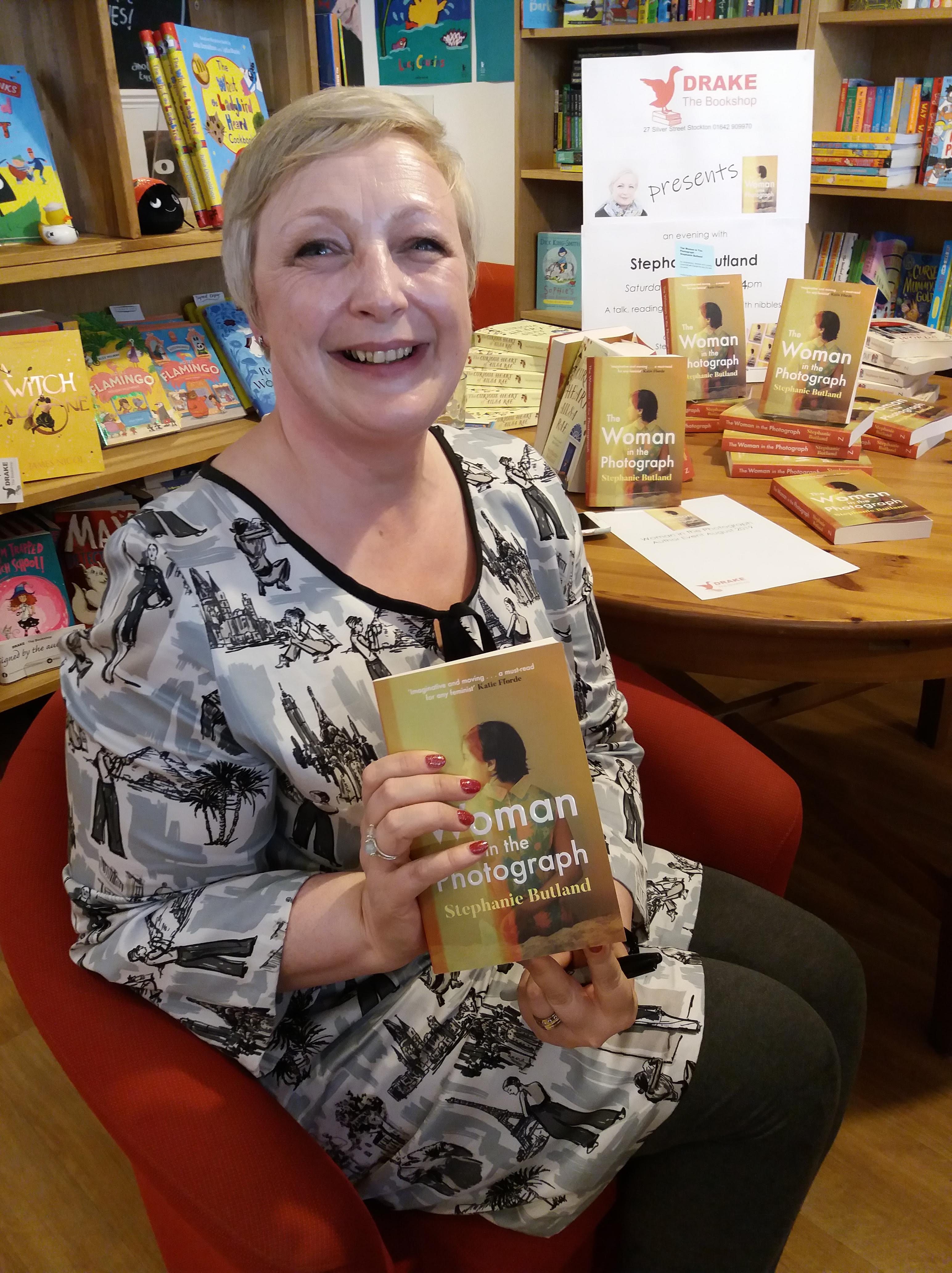
My local independent bookshop is Drake in Stockton, where I went to hear Stephanie Butland read from, and talk about, her sixth novel ‘The Woman In The Photograph‘ *

I loved the extract she read (enough to buy the book), but it was the Q&A session that delivered treasure – because, dear Reader, I am that unhappiest of creatures, a First-Time Aspiring Novelist.

20190803_165202
Stephanie Butland at Drake Bookshop

Here are the marvellous titbits of inspiration I took from Steph’s talk, all of which I will immediately try to apply to my writing life:

1. There are no RULES for the writer’s working day, only PREFERENCES 

Oh joy, you mean I’m not failing if I haven’t written 1000 words by 8am? No! Steph works when she feels most able to sit down and focus on the work. As it happens, for her that is first thing. A 2-hour morning might yield 1000 words that would take twice as long to squeeze out if she started in the afternoon. BUT – if the morning is taken up with other, unavoidable things, then a long afternoon of writing will happen. The woman has professional persistence.

2. 1000 words a day for 3 months = “a bad first draft”

I love that “bad”. If I could fixate on completion at the expense of perfection, I might be in with a shot of writing this damn thing!

3. Novels will bring their own ways of being written

Now, I’m working with a formulaic genre (cosy crime), which Steph is not, but I still found it inspiring to hear how each time she writes a novel she comes up with a different way of ‘how to write a novel’. This current book was meticulously planned using a spreadsheet. Her previous book, ‘The Curious Heart Of Ailsa Rae‘, was written in a huge outpouring and then sculpted into shape. It’s OK for me to not know exactly how to write this first book of mine. Even better, it will be OK for me not to quite know how to write the next one, and the next – better to be interested in the process than the product!

4. Don’t read inside your own genre while you’re writing

I’ve been a reading a lot of my genre, because as a first-time writer I need to spend a bit of time working out how it’s done. But now that I’m into the actual writing, I can see the sense of giving my brain some space. Should probably lay off the cosy crime TV dramas, too! Steph reads Young Adult fiction, and dystopian fiction, so this could be a great excuse for me to widen my reading landscape.

5. Editing is great, but after a while you’re not making the book better, you’re making it a different book.

I haven’t reached this stage yet, but I’m going to bear it in mind when I do…

And the bonus bit of info is this:

6. The presenter for uber-macho TV show Top Gear was actually Angela Rippon!

Proof! 

*’The Woman In The Photograph’ is a story about feminism and fierce friendship. It is out now from Zaffre Books and if you buy it online via Hive then you can nominate a local bookshop to collect it from. The bookshop receives a small fee. This is massively better for authors and booksellers than going to Amazon, but doesn’t make it any more expensive for you – please make Hive a habit! 

I Think Of All The Young Women To Come

Me at my lovely hotel

One of the first things that happened to me when I went to boarding school, aged sixteen, was a mysterious summons to interview by the boys of the Upper Sixth. One by one, the new girls like me were taken to some common room or other, and were solemnly quizzed by complete strangers on such arcane matters as whether we preferred ‘pork’ or ‘beef’, and how short we kept our fingernails. There was an atmosphere of barely suppressed sniggering, a definite sense that we were being judged on the basis of our sexual orientation and availability, but in a code to which we had no access. None of us refused to go. None, that I know of, refused to answer the questions. We swapped notes once we were back in our own boarding house, all of us admitting to bewilderment, but none of us sharing the lingering sense of shame, that we had been subtley violated, made to perform for male amusement, manipulated into trying to ‘get it right’ in a game where we could never know or change the rules.

Welcome to patriarchy.

Nearly thirty years later, I find myself by some random chance hired by a private school several orders of magnitude more expensive, prestigious and intimidating than the one I attended. My job is to perform my show, The Moon Cannot Be Stolen, to their sixth form , and to have a convivial dinner with the students of the Lit Soc beforehand. I speak to intelligent girls, one a scholarship student who like me was state educated until receiving a bursary to attend this vast Palladian edifice. She feels a teensy bit stunned into submission – I sympathise. I speak to a quiet, thoughtful girl who would like to write about gender politics, but is too afraid to put herself and her thoughts out there for the trolls to piss on. When I ask her if there are feminist issues to be explored at her school, she replies that the opinions of female students ‘aren’t really taken seriously’.

Hello patriarchy, you again.

I start to perform my show, amid the impeccable acoustics of the rococo Music Room, but I am distracted by the (impeccably amplified) snickering of three boys in the front row. (The front row is pretty much all boys, I have watched the girls filter in and take their seats further back.) I try to ignore them, and the rising sense of inadequacy, self-conciousness and failure that their reaction is provoking in me. It can’t be done. In an instant flash of anger so strong it is virtually an out-of-body experience, I halt mid-sentence, spin on my heel and advance forcefully on them, tell them exactly what I think of being disrespected in this way, then seamlessly return to my performance. From the mulish shock on their faces, I imagine that perhaps women don’t generally speak to them like that.

Oh patriarchy, you don’t get it, do you?

The heart of the show talks about young women and their vulnerability to attack, rape, manipulation. Usually I end the short segment by saying “and I think of all the young women to come”. This time, for the first time, I get to say “and I think of you”, looking directly at these young, bright, well-bred young women, who are in receipt of such a privileged education, but whose native fierceness has been, and is being, trained out of them. A few of them are looking at me with faces close to rapture, eyes shining, listening to my one little story about finding myself. At the end, I am surrounded by girls wanting to ask questions, and I have never felt so useful and proud in my life. May they one day rule the world.

Ekphrastic project – Conflict and Conscience

The second of my poems for art crit magazine Corridor 8 went live a couple of weeks ago, but I’d like to bring it back to your attention now. Why? Because it’s a response to the exhibition ‘Conflict and Conscience : British Artists and the Spanish Civil War‘, running at the Laing Gallery until 7th June, and May Day weekend seems an appropriate time to nod in the direction of socialist struggles past and present.

I’d really just like to encourage you to see the exhibition if you can. Not only are there some really strong works, including Picasso’s ‘Weeping Woman’, but it is full of inspirational women. Women artists who fought and died, women who served the rebel camps and fed the insurgents, women who were passionate political and military leaders, women who sewed vast celebratory tapestries in remembrance of their comrades, women who made the heart-wrenching posters that ensured aid went to the victims of the conflict, women who got off their arses and started charitable foundations to secure the safety of orphans when our pathetic government of men refused to take in refugees, women who learned how to run ambulance services in blitzed cities, women, women, women…

Atlas was a woman…