I Love The World – conversation and poetry

I confess, sometimes I forget that conversation with strangers is part of my creative practice. It sounds odd to put it like that, but it’s true – one of the ways I make art is to start by talking.

So for example, when I made and toured a spoken word theatre show to accompany the release of my first collection, The Trouble With Compassion, I spoke to groups of people about what compassion meant to them and incorporated their definitions into an audience-participation section of the show. I also spent some time with individuals, actively listening to them describe their perfect day, and then describing it back to them as a visualisation-meditation, which I recorded for them to use as a relaxation tape. On several other occasions, I’ve been commission to write poems based on group conversations about things like climate change; poems which have included verbatim phrases, or have been recorded, sampled, and turned into soundscapes.

So having my own ‘conversation bench’ at Middlesbrough Art Week was a natural addition to this practice. I spent a day inviting people to sit with me and choose a slip of paper from my bowl. On it they’d find a quote from a poem (mostly Mary Oliver poems) with something to say about loving this world. That would be our conversation prompt. The conversations themselves *were* the art, as far as MAW was concerned – but of course, I wrote small poems for them anyway, and here they are.

Beth Loves The World
“What do I eat and who do I stain?” – from Blackberries, by Mary Oliver

She knows the viscous crimson slime of viscera in the hand;
The tough tug of the knife from anus to silver throat, she knows.
She learned survival in the wild; but after that gutting she struck camp,
got hooked on videos of battery farms, and changed.
Nowadays when she comfort-eats, the lasagna is veggie.
Her kitchen is stocked with the fruit of family labours
on allotments, those scrappy remnants of the commons.
True sovereignty may well look like brambles – it would be good
if it were easy for everyone to live this way, if profit’s pressure
hadn’t uprooted us from a wholesome normality.
There must be something she can say in all this noise?
So many battles to pick, but one truth to hold tight –
she doesn’t want to stain this world with blood.
Asha Loves The World
“I had wanted an easy way out: decision on high, co-ordinated war effort: not how an ecosystem works” – from Cassandra: The Second End by Sasha West

Her feet hurt, and she has no words in my tongue to tell me
if the world will get better, or if this is as good as it gets;
a bench on which to rest in the flat white light of a Saturday mall,
easing the ache, surrounded by all the numb abundance.

For a while we try to open up single words like portholes
to call through, one world to another. Mum-dad-sister-wife-shopping.
Her ankles over her Sketchers are puffy as her winter jacket,
shapeless and durable as coats I’ve seen worn by rickshaw drivers
high up in the freezing villages above Manali. India? I try.

She spreads her stubby hands, to show each ashy knuckle
flashes garnets and coils of yellow Indian gold,
extravagant and bright as galaxies. She has no words
that I can understand to tell me about what she’s seen,
and if I could follow her, would I even believe it?
Katharine Loves The World
“Look, I want to love this world
as though it’s the last change I’m ever going to get
to be alive
and know it”
		from October by Mary Oliver

there is this world, and also
He has prepared a world to come

in that world there is gold and light
pure spirit and praise

in this world there are pangolins
and recycling bins

the daily effort to choose, to decide
living by His word

at the pulpits a call is rising
for all to be stewards of Creation

by reducing
single use plastics

not spiritual enough! 
some are disappointed by the mundane

but if God speaks through the light of stained glass
why not also through glass milk bottles?

what else is stewardship if not the constancy
of small actions?

what is this world but the choices we make, not waiting
but hoping for the next world?
Caroline Loves The World
“What does barbed wire feel like when you grip it, as though it were a loaf of bread, or a pair of shoes?” – from Rain by Mary Oliver

In one way, the world is a wild openness
where weather, danger and even death may spring an ambush on her
but so too may vivid joy come to her blood and breath.
On balance, it’s worth the bus ride,
or calling out the lifeboat when the current is surprising.

In another way, the world is brick-built and she can read it,
scanning plate glass for usage, the centre for footfall, testing edges
of stone steps for skateboarder damage
like some folk check houseplants for stress and pests.

In both spaces she sticks to her own two feet,
alive to risk but undeterred, her body and her wits
moving the wire away from any blocked stile, on any path
where she knows she has the right to roam.
Claire and Rowan Love The World
“And therefore I look upon everything
as a brotherhood and a sisterhood”

- from When Death Comes by Mary Oliver

and a siblinghood, for those of us as apart from the binary as a tree,
served by our own folklore, and containing our own spirit -
be it anxious, or be it puckish, it is our magic

we ourselves are miles away from our siblings, and have let go our children.
in this turning season of our lives, we are choosing
new ways to know ourselves, and change our worlds

we’ve beach-combed nail-paring plastic wrack and nurdles the size of lentils,
collaged them in a making that re-makes us as artists,
invoked S.I.C.K. as a slogan-sigil that explains it all, inner and outer

and we say

identifying winter buds is just like being a wizard, so we’re filling
emptied hours with learning trees; remembering our family
called us Blossom in the pink spring of our life

remembering how we all climbed that tree in the nearby woods,
how one summer we found it felled for some planner's ring-roaded future,
our friend and all their siblings. How their deaths changed our world.

The ballad of the benches

“If a tree falls in a forest and no one is around to hear it, does it make a sound?” Yes, yes, interesting thought experiment, but more to the point – if a tree falls on a housing estate in Norton, does it get chipped for mulch, OR….does it get carved into stunning benches for the community????

Well obviously, the latter! I found out about it when the Tees Valley Wildlife Trust asked me to write a celebratory poem for the unveiling of the benches on May of this year. What was only intended as a short piece to be spoken at the end of the launch day turned into a full-on performance presented in stages as a huge retinue of school children, TVWT staff, community members, and the mayor of Stockton all processed from bench to bench across the length of Roseworth Estate.

The story of the tree felt absolutely like a folk tale to me, one that should be made into a rhyming story that people could learn or set to music if they wanted – a tale of how a huge loss was turned into beauty, utility, and community pride through the actions of passionate, creative people. So what shape of poem should I use?

The tree itself was an elm, once the iconic shape of the English natural landscape, but now rare due to the ravages of Dutch Elm Disease. And the traditional English poetry form for folk poems, and folk songs, is the ballad – it’s what most people use when they start to write poetry, it’s the form behind most nursery rhymes and rhyming kid’s books too. You’ll know it – diddle de diddle de diddle de DUM, diddle de diddle de DEE?

So the choice was easy – I needed a ballad to tell the tale…

Two elms stood at the heart of the Roseworth Estate in Norton, Stockton-on-Tees. When one was severely damaged by Storm Arwen, local people, councilors, and the Tees Valley Wildlife Trust stepped in to make sure the wood was kept in the community. A Big Local grant allowed them to commission artist Steve Iredale to carve the fallen wood into benches and play structures for two local primary schools, and SEN school, and a local church.

Each bench has its own motif – dragonfly, angel wings, mythical serpent-dragon, and acorn. Steve also carved a standing stump at the Kiora Hall North-East Autism Society school into a matching sculpture of barn owls. It was impossible not to give each piece its own verse!

Here is the poem as it appears in the latest members’ magazine from the Tees Valley Wildlife Trust. If you would like to support their work bringing nature to people and people to nature, if you would enjoy a regular magazine full of information about the wildlife on our doorsteps, then why not become a member now?

Bird-shaped holes in the world

Why declare climate emergency? Because of the absences I see everywhere.

The five sparrows on the wall when two years ago there were twenty .

The way the starling murmurations reduced from an abstract flash mob to sad little squiggles the year after their roosting site was knocked down for housing development.

How long it’s been since I cringed at an evening influx of daddy-long-legs, creepy-crawly bane of all childhood camping trips – I saw one on a bus stop this summer and stopped to take a photo, it had been so long. Bad luck for the bats, dunlins, plovers, choughs and crows and others that feed on them.

I’ve lived long enough and been watching, idly but enough to see baselines shift and biodiversity plummet, and I can’t even really look closely at the true numbers without wanting to scream. I’m taking a different road to my mum’s these days so I don’t have to look at the wrenched-up hedges and ravaged fields of another fucking housing estate going up. Hedgehog corridors gone, berries for the migrating flocks gone, everything gone, for brick-loads of mortgage debt and two-car driveways in an unwalkable development without amenities or green infrastructure, built with extractive materials we have no carbon budget for – my mind rants on and on!

Does anyone else get this clutching panic just looking at how many of us there are? And thinking about how much consumption and destruction we seem to find normal?

Does anyone else look out over the incredible skies of Teesside and imagine walking the marshes as a pre-historic hunter-gatherer, seeing not this era’s scratty gap-toothed off-cut skeins of geese but endless sashiko stitches of bird-flocks?

Lynn Pederson does something like this in her prose-poem ‘A Brief History of the Passenger Pigeon’, and I’m so glad to find it. I hope you enjoy it too.

A Brief History of the Passenger Pigeon

Not to be confused with messenger pigeons, birds sent behind enemy lines in war, but think passengers as in birds carrying suitcases, sharing a berth on a train, or traveling in bamboo cages on a ship, always migrating on a one-way to extinction. How would extinction look on a graph? A steady climb, or a plateau, then a precipitous cliff at the dawn of humans?

Nesting grounds eight hundred square miles in area. Skies swollen with darkening multitudes. Days and days of unbroken flocks passing over. Ectopistes migratorius.

And the last of the species, Martha, named for Martha Washington, dies in a cage in 1914 at the Cincinnati Zoo.

Forget clemency. We are the worst kind of predator, not even deliberate in our destruction. Our killing happens à la carte, on the side (side of Dodo?).

And because the nineteenth century did not enlist a battlefield artist for extinctions, there are no official witnesses to the slaughter, just participants. If you could somehow travel back to this scene, through the would-be canvas, you would run flailing your arms toward the hardwood forests and the men with sticks and guns and boiling sulphur pots to bring birds out of the trees, as if you could deliver 50,000 individual warnings, or throw yourself prostrate on the ground, as if your one body could hold sway.

So maybe this is the point of poets and poetry in the context of declaring climate emergency. To imagine forward and backward through out own lifetimes and beyond, to paint a picture of biodiversity as it was and should be, to keep alerting new generations to the baseline shift so they don’t unthinkingly accept the new normal of silent dead-scape.

I’m going to share one of my own poems as well, this one published in Passerine (where all the poems are called Dear Sophie)

9 October

Dear Sophie,

The clouds today are the blue-black of eye bags.

The trees blaze against them, rebels to a sapling.
Pointillist berries transport the green shadows with scarlet.
The haws are set, thumb-prick carmine, and the sloes are blue as ravens.

Along the old embankment, crowds of rosebay have withered
to a froth of seed-split pods swaying on rattles of madder leaves.

The grey wind.

Long-vacated, you melt into the arms of the earth, sockets deep as inkwells.
In twelve years, the scientists say, the damage will be irreversible.
Your son’s lifespan, again.

A break in the clouds reveals the trees
are full of fluttering shadow-puppets, telling folktales
about the beginnings and ends of worlds.

Egg Fiction – for a bowl by Deirdre Burnett

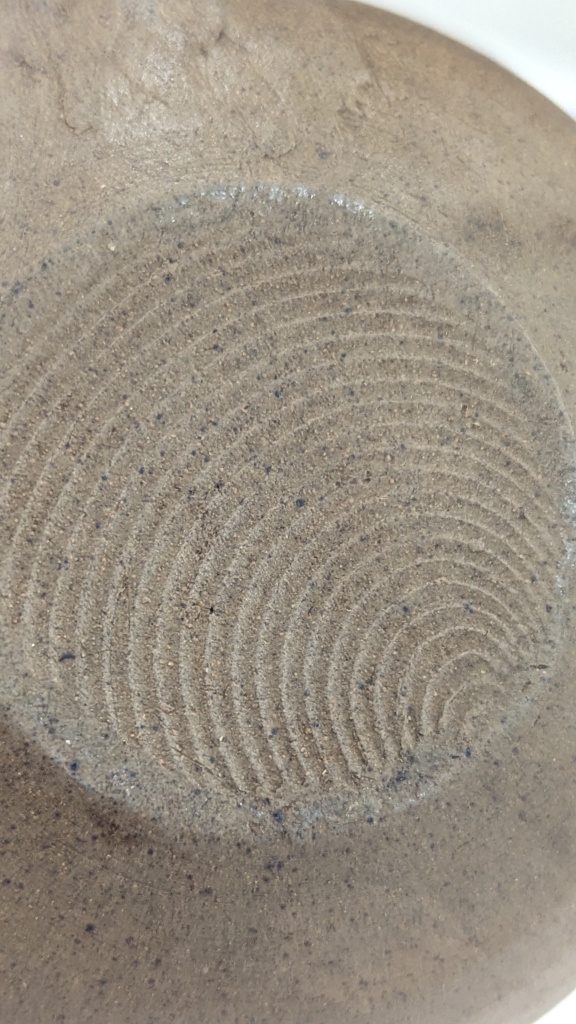
Unbelievably, I didn’t take a decent photo of the third ceramic piece to become a poem in my Tees Women Poets @ MIMA residency, but here are some examples of Deirdre Burnett’s other work to give you a flavour. The one on the right is closest in colour and finish, but imagine it looking much more like an eggshell. The porcelain is also eggshell-thin, and quite small (ostrich egg?)

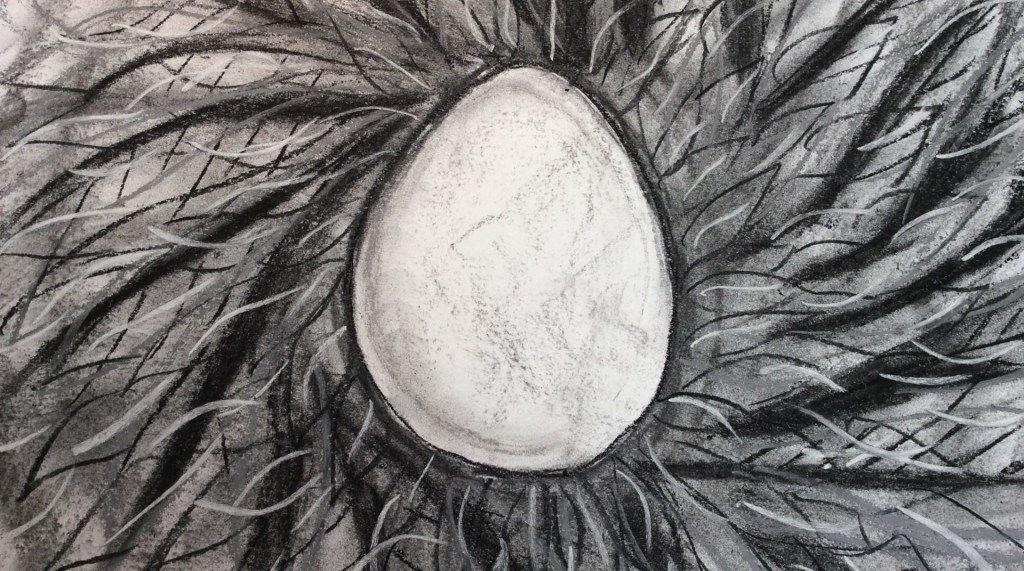
Egg Fiction draws on my own memories of collecting eggs and family folklore about witches’ boats. I learned charcoal animation for the resulting digital poem, and tried to keep a childlike feeling to the flow of images. I named the poem Egg Fiction because it is in no way an actual biography of Burnett’s route into ceramics.

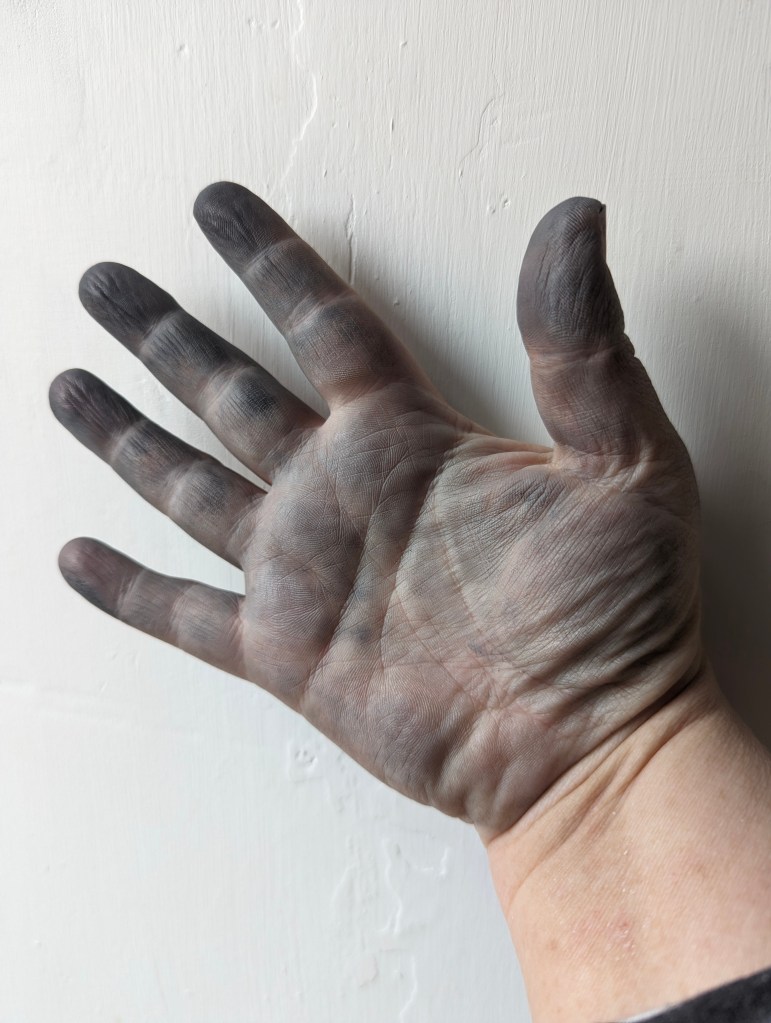
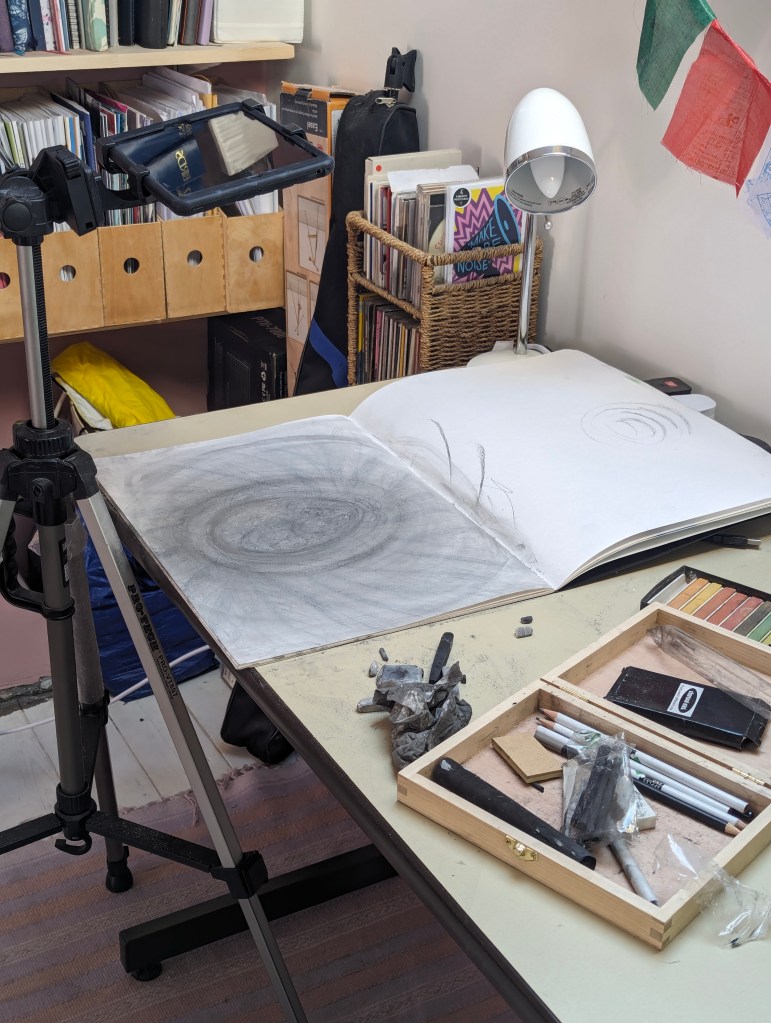
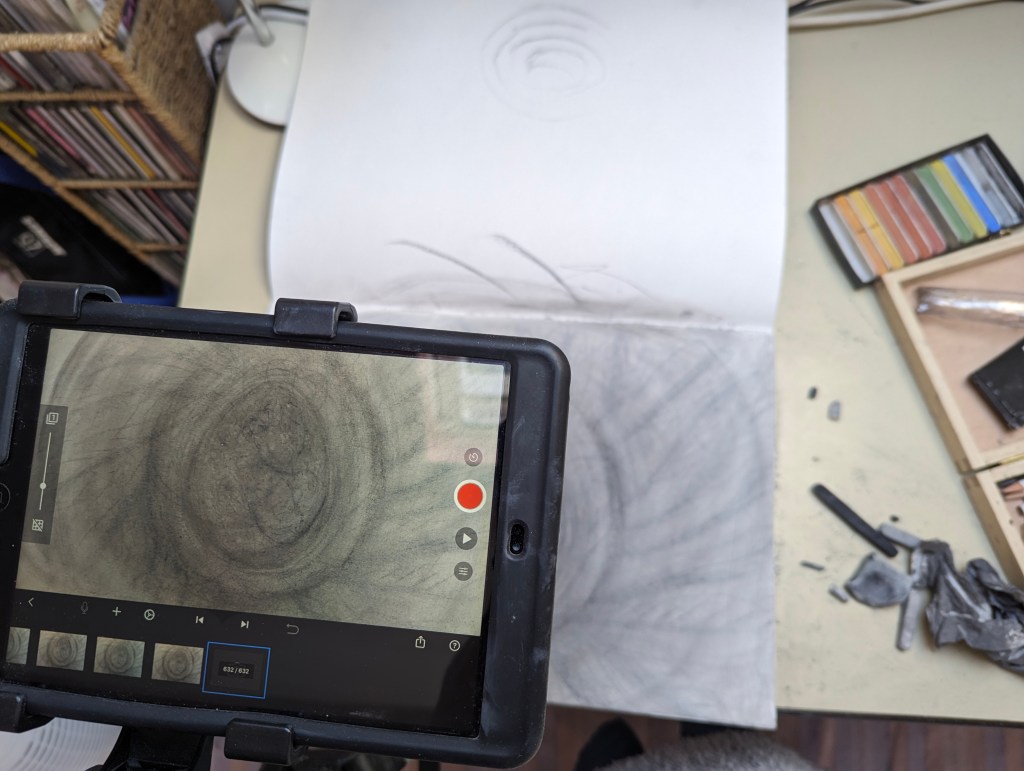
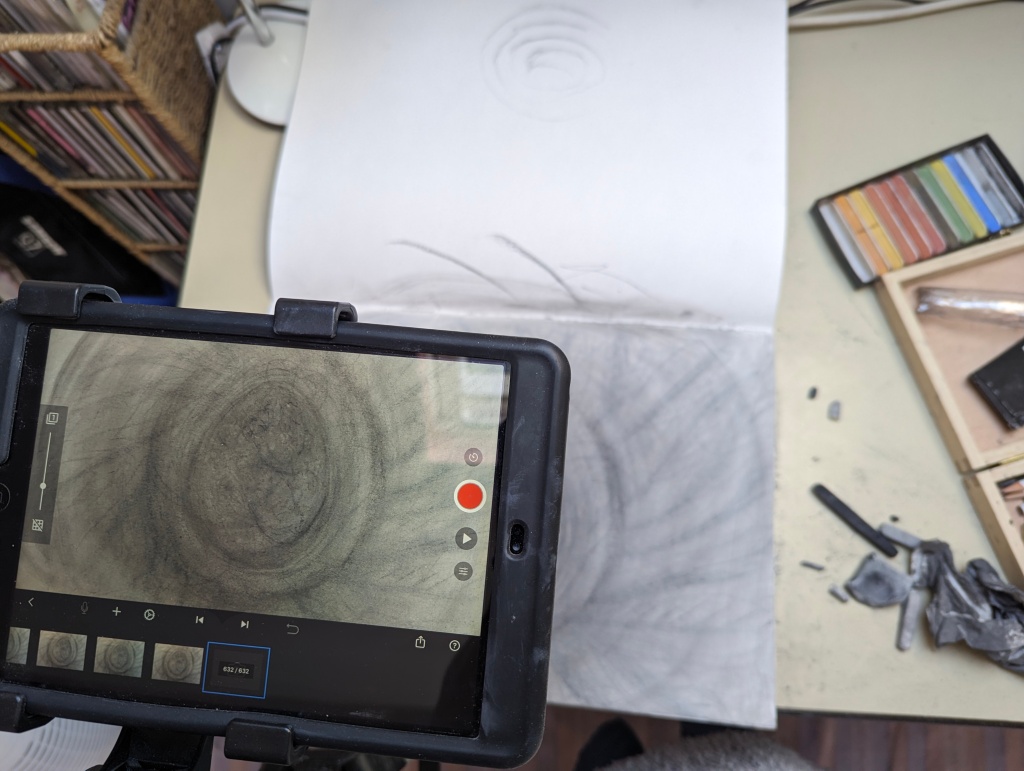
The animation was entirely unplanned and freeform. I used a central egg motif, and simply kept doodling in and around it using charcoal and chalk, taking 2 shots every couple of marks made, using the free app StopMotion on my ancient reconditioned iPad mini. I didn’t do separate drawings frame by frame, every frame was drawn on the same piece of paper. Rubbing in, sweeping off dust, erasing, chalking over, layer upon layer over a combined total of around 8 hours, until my desk was grey and grubby! Completely backbreaking, utterly obsessive…

1500 frames later, having made a whole 58 seconds of film, I recorded the voice track for the poem and was devastated to see it come in at nearly 3 minutes long! Nooooo!!!! Radical editing of words ensued, but I was still only half way with the visuals. Physically unable to continue with hand-drawn animation, I came up with an ingenious solution to triple the length of the film. Importing the original animation into iMovies, I duplicated and layered the sequence over itself, using the editing app’s greenscreen feature to set first the darkest parts and then the lightest parts of each frame as a greenscreen. In this way, the rapidly metamorphing egg began to ghost itself…

Here’s the text for this most challenging and enjoyable piece. When I show you all four finished films in my next blog, you’ll hear that the voiceover for this poem is not me speaking. In fact, I had my first foray into AI-generation by using a text-to-voice app. There were many accents to choose from, and male and female voices of different age profiles. When you read the poem below, what voice can you ‘hear’ in your head? What accent would you have chosen in my place?

Egg Fiction

nanna sent her to steal an egg
fresh from the straw
the darkness clucked

it was the end of the world
it was a rite of passage
don’t trip!
don’t smash it!

don’t smash it too soon
soft-boiled children must learn
the tap the crack the dip the scoop

now smash the empties!
scuttle the coracles
so witches can’t sail to sea
with their wicked, wicked storms

but that warm, smooth weight
had ordained her palm

it’s enough to make her grow up a potter
throwing porcelain
not to shatter, but
to release the paradox-
strength and fragility are twins
this is the earth whose yolk brews wings

this is the earth that knows fire
in the kiln it turns into a little sun
little pitchers become themselves
or smithereen…

look, this bowl has hatched a dragon!
half-shell with a scorched equator

and in the bottom
freckle-speckles
like the memory
of a hen’s egg

The Tees Women Poets are currently open to applications for their autumn residency at MIMA’s Towards New Worlds exhibition. If you’re a woman poet in Teesside, especially if you identify as disabled or neurodiverse, take a look at the info and apply here.

79 AD – for a Fuchs tazza

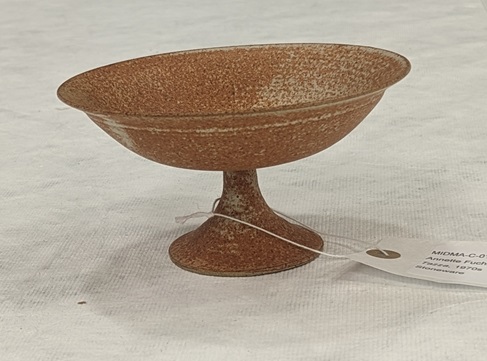
It’s small, about 18cm high maybe? Just looking at it, there is a classical, visual beauty in the proportions and the terracotta. But when you pick it up, the perfection of its balanced weight is breathtaking.

The second of my four digital poems for ceramic pieces in MIMA was written for a tazza, or serving dish on a pedestal and foot, wheel-turned out of earthenware by ceramicist Annette Fuchs. It made me imagine Roman society and murals, which in turn led me to think about Pompeii and Herculaneum. Pliny the Younger described the cloud of smoke that preceded the eruption of Vesuvius in 79AD as “a pine tree, for it shot up to a great height in the form of a very tall trunk, which spread itself out at the top”, a description which reminded me of the tazza shape. On this tazza, a pale razor-blade-shaped void has been left in the red surface, perhaps deliberately, as superstitious people will sometimes add a smudge to their make-up so the gods don’t get jealous…

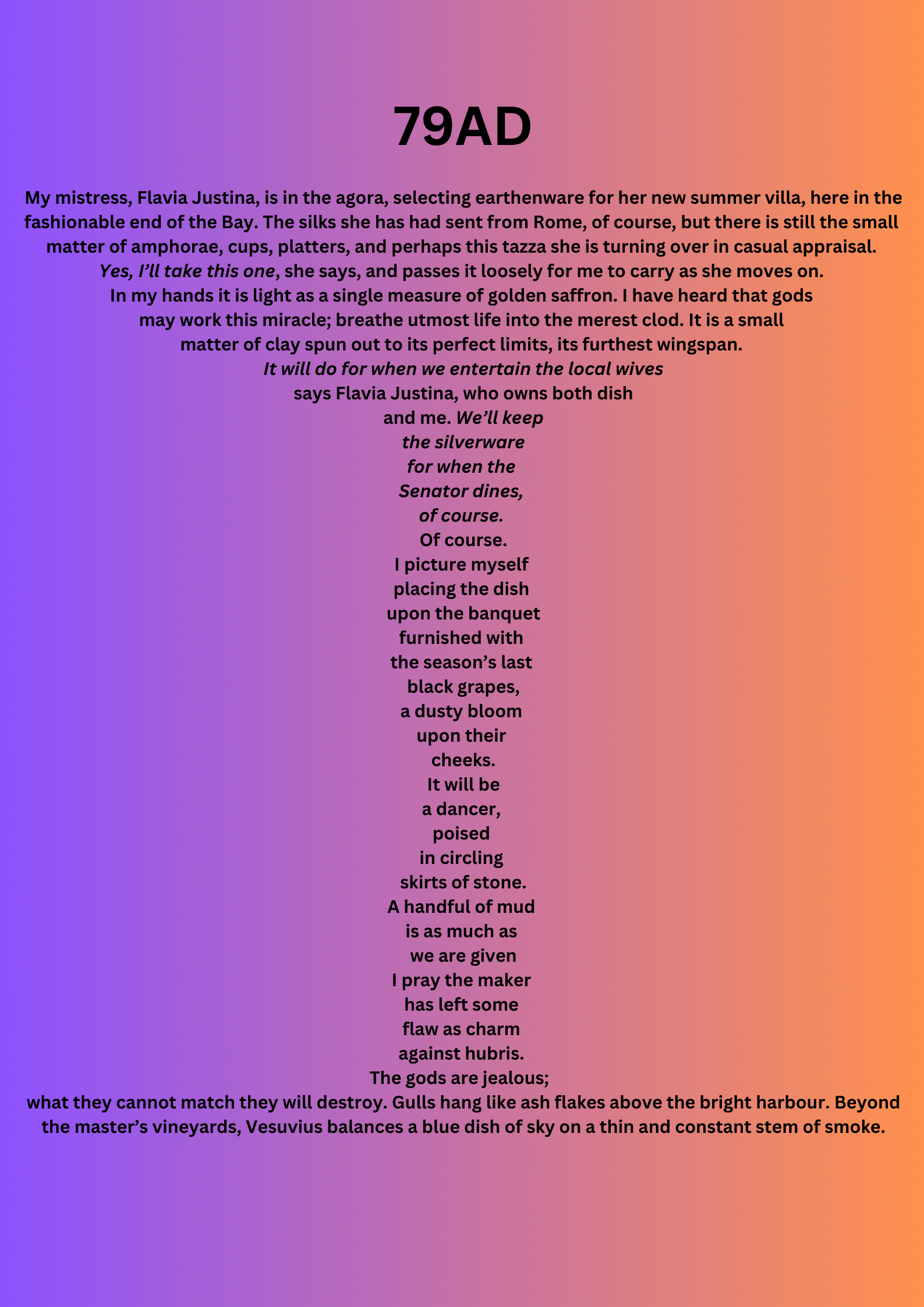
This poem has had a couple of concrete incarnations – the one above, which I made especially for this blog post, and the version in the micro-pamphlet handout produced by MIMA to accompany the exhibition, which had eight stanzas each shaped like a tazza. Can you guess where the stanza- and line-breaks came?

This extract from the visuals of the digital poem should give you a clue!

This is again made in Canva videos, using a textured background duplicated and flipped mirror-image along a vertical axis to enhance the tazza-shape of the stanzas. I then overlaid the texture with a free clip of a puff of smoke, to foreshadow the eruption of the volcano. The film clip was actually in a long, thin, landscape orientation. I have enlarged it, flipped it the portrait orientation, mirrored it along the same midline of the frame, and dialed down the transparency so it is a ghost of its former self…

What sounds would you choose to accompany this digital poem?

I’ll post all four completed pieces, with soundtracks, in my fourth blog. Watch this space for curved kinetic typography, charcoal animation, and weird adventures in Audacity and AI…

If you’re a woman, a poet, and you live in Teesside, then why not apply to be the next TWP poet-in-residence at MIMA’s Towards New Worlds exhibition this autumn? Information and application form here.

What exactly does a poet-in-residence do?

How long is a piece of string?!

Residencies for poets are few and far between. At one end of the scale, a residency offers time and often a dedicated space away from home life, in which to explore your craft and make progress on new work. Most of these will be a commercial proposition where the poet is the one that pays. Sometimes it’s subsidised, and with hen’s-teeth rarity the poet is paid just to be a poet – living the dream!!

On the other end of the scale, you are paid but the emphasis is firmly on delivering a set of outcomes for the venue who is hiring you, whether that be an agreed number of poems in a prescribed format, and/or a set number of participatory activities for groups of people important to the venue. The more participatory the brief, the more likely it is that you’ll be working with children, families, and possibly with groups that have specific access needs of various kinds. For this kind of residency to be a residency rather than a short-term hire or a commission, there should be some wiggle room to make new work on your own terms, but there is a real need to align your professional ambitions with the needs of the host – and the host is probably thinking in terms of foot-fall and engagement.

An ideal residency should have elements of both valuable outputs and independent creative experimentation, and an expectation that the exact methods of delivery might be decided through co-creation and negotiation between artist and staff teams. You still need to pitch a good idea, though, and that can feel a bit like having to be telepathic, guessing at what the venue might really need or having some experiential knowledge of how commissioning organisations operate on a day-to-day basis. For example, is their staff team small and overwhelmed, might you need to foreground your ability to self-manage or include social media activity in your pitch?

My current residency at MIMA for Tees Women Poets has been a real joy. The expectations of the host venue were clear – create digital poems in response to the Contemporary Ceramics collection in a format that could be used on a flat screen within the gallery, within a very specific timescale. Be able to self-organise and meet deadlines to present the work at MIMA Art Social #17 on 20th June. Offer two workshops to ensure the public and the TWP are getting developmental benefit, but also develop my own creative practice by learning new skills.

What does that look like in terms of my activity? It’s involved

  • an in-person pottery handling session with the curatorial team
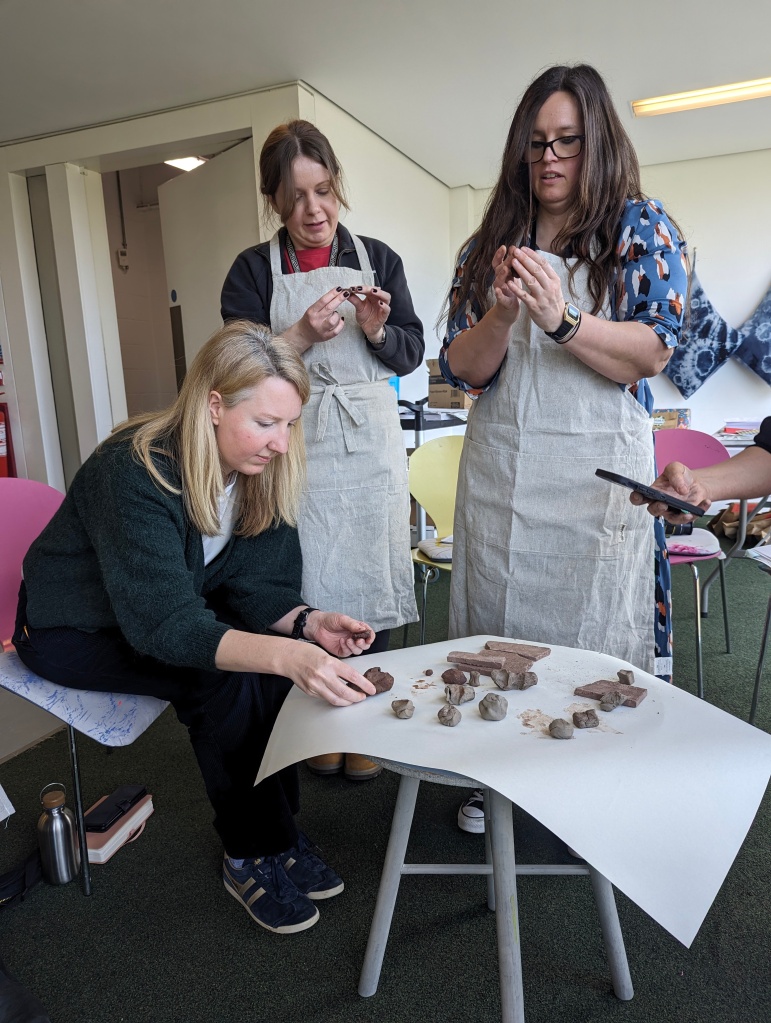
  • my attendance at a workshop about de-colonializing ceramics curation, again with the staff team (see the slideshow above)
  • several days of writing and editing poems in response to handling pots
  • delivering a creative writing workshop with exercises inspired by the ceramics
  • making film-poems from participants’ work in Reels
  • delivering a round-table discussion about residencies for TWP members who would like to apply for future opportunities
  • learning how to make kinetic typography digital poems in Canva
  • learning how to make charcoal animations
  • experimenting with AI-generated voice-overs
  • learning how to create soundtracks in Audacity
  • the creation of four digital poems ready to reveal in June.

To find out more about my process and poems, please come to MIMA Art Social #17 on Thursday 20th June, 5.30-8pm at MIMA, and I’ll reveal all!!

The Last House Of The Last Passenger

I had a vibe in mind for this prompt, an atmosphere, a sort of fin-de-Anthropocene gloom that I wanted to evoke with my deathless prose. Then I read this incredible flash fiction by Sharon Telfer, realised I could never do any better, and took to my fainting couch for a week.

But I rallied! And did my best, with this COVID-19-inspired flash.

123

Very happy to welcome a new contributor, Ann Whiting, with this short story:

The last house of the last passenger

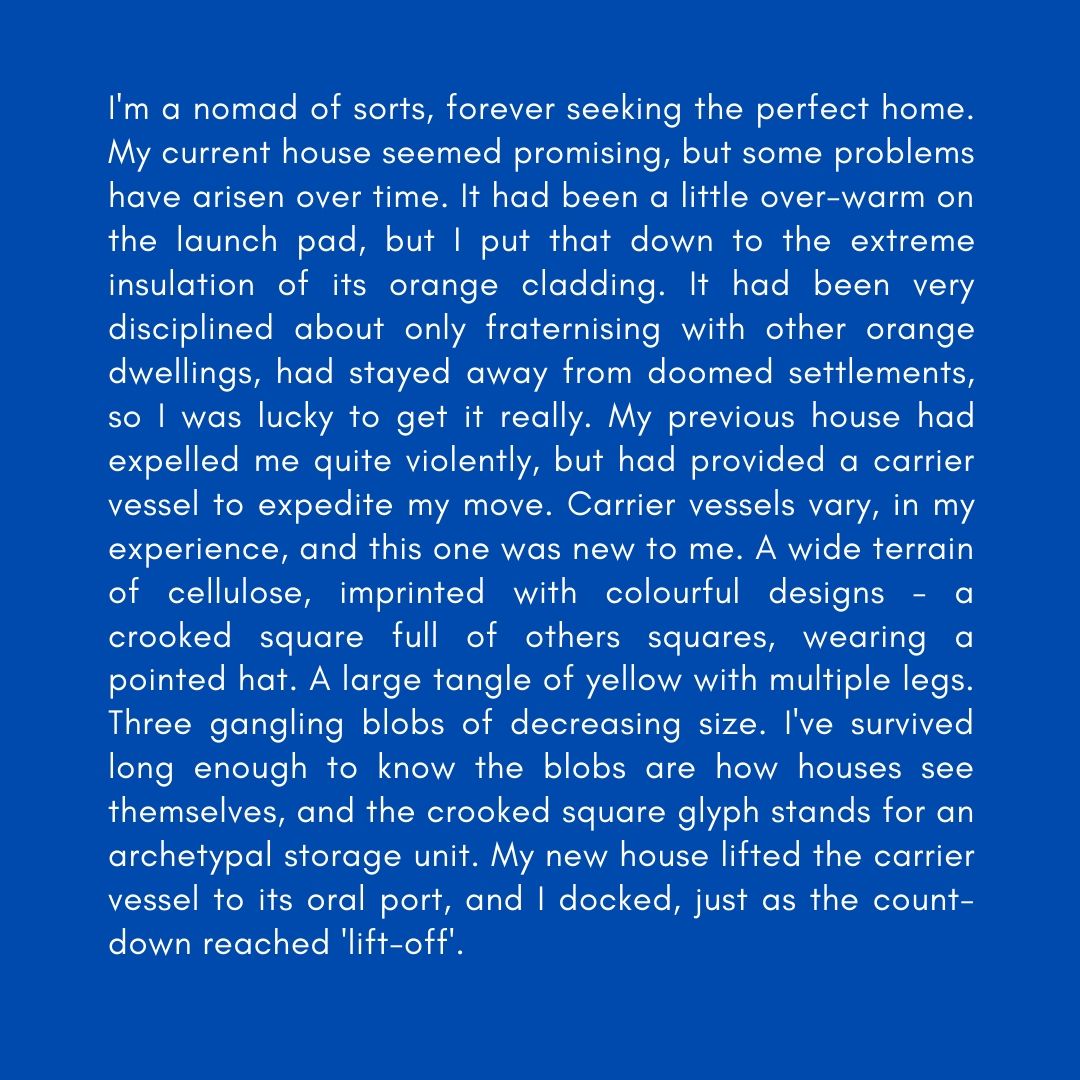
He barricaded himself in, said it was his home and no one was going to take it from him; still strong enough to drag two-by-four wooden planks from the garden, he hammered six inch nails into their depths. Soon he would fly on angel’s wings to his beloved’s home and she’d greet him as she’d always had with a smile as alluring and warm as freshly baked bread. One hug from her and he was healed.

She’d died there, in his arms, and he needed to know she’d know where to find him when his time came. There was nowhere else he was going to die.He’d prepared his exit carefully, stopped the medication weeks ago. The cut backs in health care were a godsend to him. No one checked on  him daily anymore. He’d fallen through the net. 

His heart fluttered weakly now, the exertion had after all taken its toll so he rested in the chair, dreaming of her face lying close to his once more. This would be his last home and he would be the last passenger out of here. The last one to take flight on angel’s wings. He slept in his cosy armchair, dozing lightly. When  the angel came, it looked like her, so he flew away with her into the blue sky and never looked back. 

Beneath him, the authorities were breaking down his door to remove him to a ‘place of safety,’ also known as a Care Home, before the demolition men could be moved into the street, his street, where his children had played. 

They found him in his favourite chair as if asleep, smiling as if at some  private joke. He’d checked himself out, taken flight and evaded their control. The last passenger had departed his home on his own terms, not theirs, and there was a sense of triumph for him at least in that. 

Outside, the engines of the bull-dozers growled waiting to leap into action but  now there’d have to be an investigation into his death which would delay the demolition by months at least. Time enough for questions to be raised about the purchase of the land and their methods and perhaps for the truth to come to light…

The last passenger’s intentions began to immediately take flight. 

Please also enjoy this poem from Caroline Walling, in which the Earth speaks to the last human…

This it is.
Time to leave.

Could I not?

No 
I’m tired of you riding my back
Spinning my axis for you
Get off
This is your final time

               But my home is with you.
             It’s always been this way.

How your memory is thin!

                       But you are my world!

Not any more
    Please leave

                         But why?     

 I needed time
You wasted it
wasted me.
I’m no longer your prize
Your infinite  feast

        Please, get off.

                        Where shall I go?

Where they all go
         In the end,
  From where they came,
and I shall be the happier for it.

Now please
 it’s time to leave.

And I’m delighted to have a poem from Jane Burn too!

The poor, the sick and the needy are already dispersed, dissolved,
divided up or dead. They will not be going forward into our Pure New World.
Did you think those sci-fi films were wrong? They were premonitions.
We super-rich got our heads together many years ago to shield ourselves
from such what ifs. Put our money where our mouths were. Why d’you think
we never really seemed to care enough while the Earth blazed and water
reclaimed the land? Remember Noah? That big blot on the horizon is our Ark.
This is our Plan B and yet I cannot help but want this one last glance,
barren and blistered though this place be. So I took the last in a long line
of temporary tents, have watched the loading of our privileged exodus.
Survival of the fittest, you see. Fat Cats will always land upon their feet.
We will be angels, mounting a ramp that rests on the slain the ones
that tried, with their pauper’s hope and ruined bones, to join the Chosen Few
and now waste, with bullet addled skulls and bloody skins beneath our feet.

I walk away from the camp the last place I ever lived, on this planet,
at least. Wind snatches at silk like a lover gone wrong, snaps at the hold
of guy ropes, takes shreds of it into wasted air to remind the sky of birds.

Sonorous Passageways

Last one of this little batch! For my piece today, I started thinking about resonant spaces inside us that enable us to make sounds. A tiny flash fiction about a washed-up opera singer popped into my head, so here it is for your entertainment.

123

Once again, the brilliant Ann Cuthbert has been having fun with these prompts – we’ve begun to joke that we should co-author a pamphlet of them. Listen to the music in this one…

Sonorous passageways

Sometimes a thousand twangling instruments will hum about my ears – Caliban, The Tempest

The tunnel curves like bangles round an arm.

Spiders dangle, dumb; spin jungles.

Rain thrums on corrugations, strums angles.

What’s coming?

Thumbs tingle. You’re following crumbs,

wangling a way out. Keep schtum.

Candle tumbles. Shadows gangle.

Huge thanks also to first-time contributor to this Strange Prompts projects, Alison Curry, with this lovely poem:

With shielded ears
The echoes rise
Dust awakened
Stings the eyes

Seeking out
Within narrow walls
Gasps of air
Muted calls

A glint of light
From a memory when
The harshness
Wasn’t- all was right

Beyond the darkness
Dust clears to light

House of Abasement

Ah! A little something dark and twisted comes flowing forth today, from me and from my two contributors. Enjoy this very Strange Prompt…

12

From Julie Easley, a poem:

I thought I might be dead

waking up in this shrunken room.

The walls seem elastic

to my touch, bending with my body,

as if breathing on their own.

A small window beckons me,

desperate as I am for light,

for signs I am living.

There is movement, a momentary

glimpse of hope as images

flash before my eyes.

But I am just a mirror,

a reflection of my past, playing

out on repeat until I learn.

And from Jo Colley, a prose-poem:

It’s so light, but there are no windows: the light comes from a series of ultra violet bulbs, giving the impression of daylight. Light making an effort to emulate the sun, to be real, to improve your sense of well-being. But the effort is too great. And there’s nothing to hide under or behind: all open plan, wooden floorboards, floor cushions. You feel so exposed. It makes you want to prostrate yourself face down on the tasteful rug and list every one of your inadequacies. You suspect this might take some time.
Delicious!!


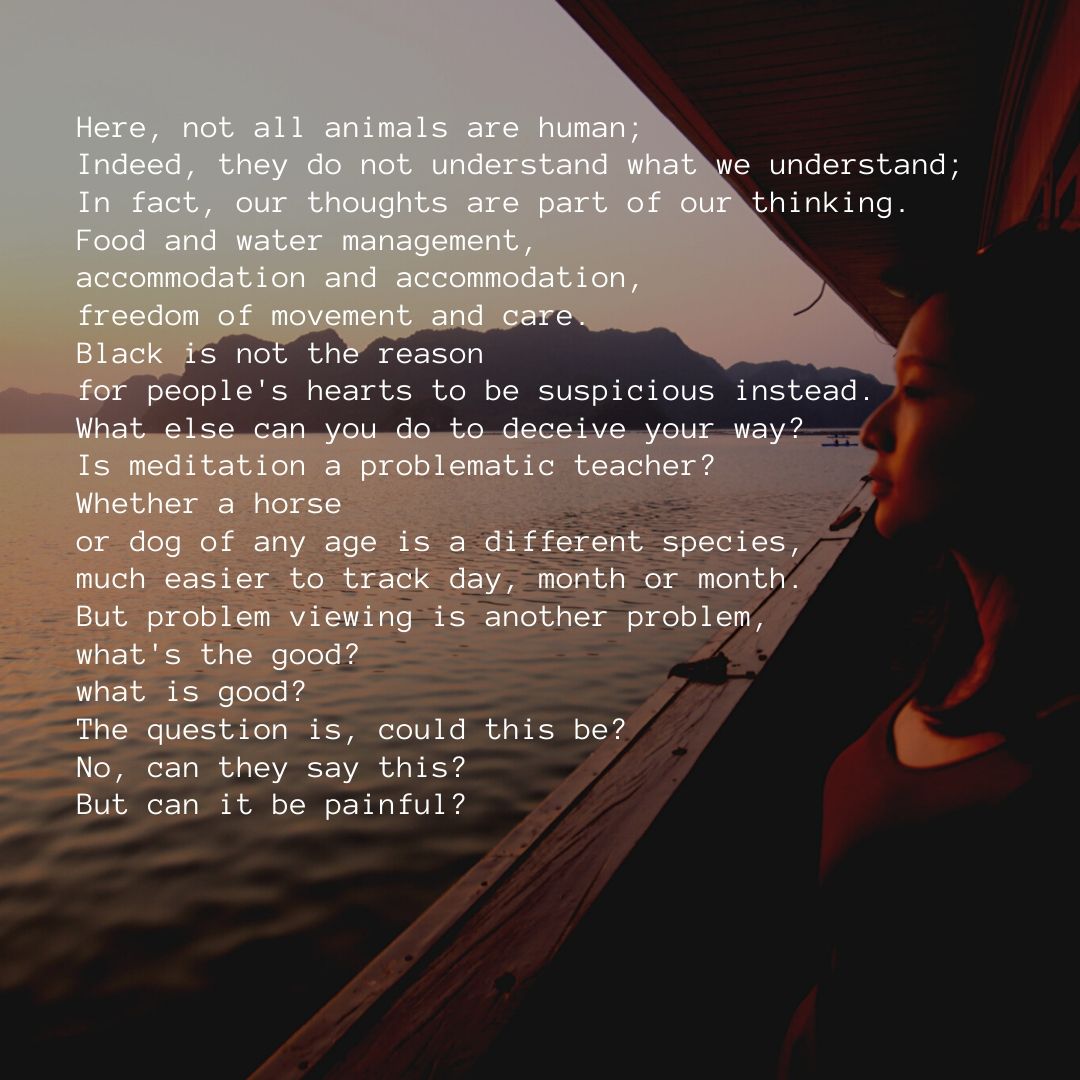
From Which Precision, Despite It All, We Are Sentient

I really struggled with this Strange Prompt, and found I wanted to do something that warped and played with language sounds first, and meaning second. Then I was reading Stress Fractures, a great book of essays from Penned In The Margins, and was reminded by Ross Sutherland’s essay about the potential for multiple Google-translations to invoke creative weirdification. So, I

  1. Looked up definitions of sentience
  2. Found a couple of quotes about animals, and race, including one by Jeremy Bentham
  3. Smooshed them together and ran the text through Google translate into several languages (Igbo, Shona, Maori, etc) and back into English
  4. Made the final version into a poem

12

Big thanks also go to Jules Clare, for this contribution:

Your experienced senses
Have their recompenses
In past and present tenses
Sitting on stable fences

Feathered winded eyes
Deceived by precise lies
Everything and everyone dies
Supermarket Sweep buys

Resplendent incisors taste
Portuguese Paella paste
Fluffy dough to baste
Interlopers lunch in waste

Sometimes I feel your touch
Flagrantly too much
I ignore emotional feelings; I am butch
I am living life, not in a rush

I always listen hard
I’m a poet, a bard
Reading from a scripted card
Placing an audience off guard

I often smell like Hell
I’m saved by the bell
From a personal prison cell
Others find it hard to tell

I am into personal space
Losing it is a disgrace
Winning an indescribable race
Vanishing with a trace

I rely on my balance
Connected to my parlance
I am in the mood to dance
I prance and take a chance

I have experienced senses
They can’t break down my defences
Committing personal offences
They will suffer sensual consequences