AI and poetry – a weird flirtation

Over at the Tees Women Poets, there have been some fascinating recent experiments with the relationship between AI, poetry, and ways to describe women. I’d like to share one of my experiments here.

The following poem is one I wrote for a TWP performance at Drake the Bookshop, for Feminist Book Fortnight. It is inspired by the non-fiction book Going with the Boys by Judith Mackrell, an account of six of the very first official female war correspondents, many of them from privileged yet problematic backgrounds, some of them trading on personal and sexual relationships (e.g. with Hemingway) to get their big breaks, and at least one of them ending up spying and smuggling people out of Nazi-held territories. All of them using femininity as a tool and a disguise, to divert danger and obtain information.

How To Get Ahead As A Female War Correspondent, 1930

So, daddy left mommy?
Daddy beat mommy?
Daddy didn’t love you?
Daddy loved you too much? – whatever,
Heiress, It Girl, bluestocking, black sheep,
Hitch your long legs around a brand new Daddy and make the wild leap.
You’re a bright girl, and you’re restless, so choose your ride judiciously –
Aristocrat? Diplomat? Editor? Author?
Who do you have to screw around here for the chance to prove
you are more than a gossip reporter?

Outrage them.
Hook Hemingway in Florida, and before you can say ‘exclusive’
you could be reporting the war in Spain, dancing
around the rubble and each morning’s wet and sudden stains,
your gold bangles clinking and your fox-fur neat.
Ignore the hacks and hounds who scoff no matter what
you wear on your pretty little feet.

Outdrink them, and outcharm them
in beleaguered Barcelona, in Berlin’s cellar bars,
at country house shoots and by candlelight
in Libya, Moscow, Bechtesgarten; play nice
with generalissimos of every stripe -
Hitler, Stalin, William Randolph Hearst,
some men are all the same, hungry for the bloodbath
that will make their name.

Feed their vainglory. Smile, darling, and they won’t refuse -
You’d look great if you made a little effort!
You gotta schmooze to get the news!
just don’t mention that your relatives are Jews –
that’s when the shadow men slide after you in their quiet cars
that’s when you feel your nape prick at the telephone’s flat click -

Outwit them.
They underestimate your brains, your bravery –
Pretty little polyglot
Cub reporter, trot, trot, trot
In the embassy limo, finesse your way through border lines
Bat your eyes, a shopping trip, too blonde for spies,
Just can’t get Schiaparelli in a city prepped for siege,
Just happen to glimpse the Panzer ranks, the massed Blitzkrieg,
Stash that in your boutique bags, quick
Glitz and ditz your way back ‘home’ to the last hotel open,
the one international phone, and –

Scoop! Outwrite them!
When they say you’re getting reckless, threaten to quit.
Forge exit visas for thousands, hold your nerve, get away with it,
You could not have covered society pages for one more minute!

So
When adrenalin gets you pumping,
When your mean heart’s bomb-blast-thumping,
When ambition gets you jumping to catastrophe’s rhythm, say
you don’t know where the boys are going
but by god you’re going with them.

I fed the poem into craiyon.com with the prompt “Create a photo based on this poem”. I tried the entire piece, and then experimented with using it in sections. Our hypothesis was that the first words were likely to influence the overall composition, like an ingredient list on a food packet showing you the highest percentage ingredient first.

What do you think of these images?

I wondered where some of the people of colour have come from, was the mention of Libya enough to get some of the North African vibes in the first slide? It’s much more than I expected. Why is the AI weighted in that direction? Where is Moscow, or Florida?

I was unsurprised to see that the bot is a leg man and a foot fetishist!

I was most irritated that I didn’t know to save screenshots, so was clicking the Save To Collection button only to lose everything several times. The very first results were incredible in their Paula Rego-esque looming dark surrealism, I felt like they absolutely captured the atmosphere of threat and danger I tried to portray in the poem. Each subsequent attempt got weaker results. Alas, you will have to take my word for it – that the long legs were flung higher and stranger, and there were orphanage-camps full of sheep-headed babies and women with slits in their feet…

My conclusions?

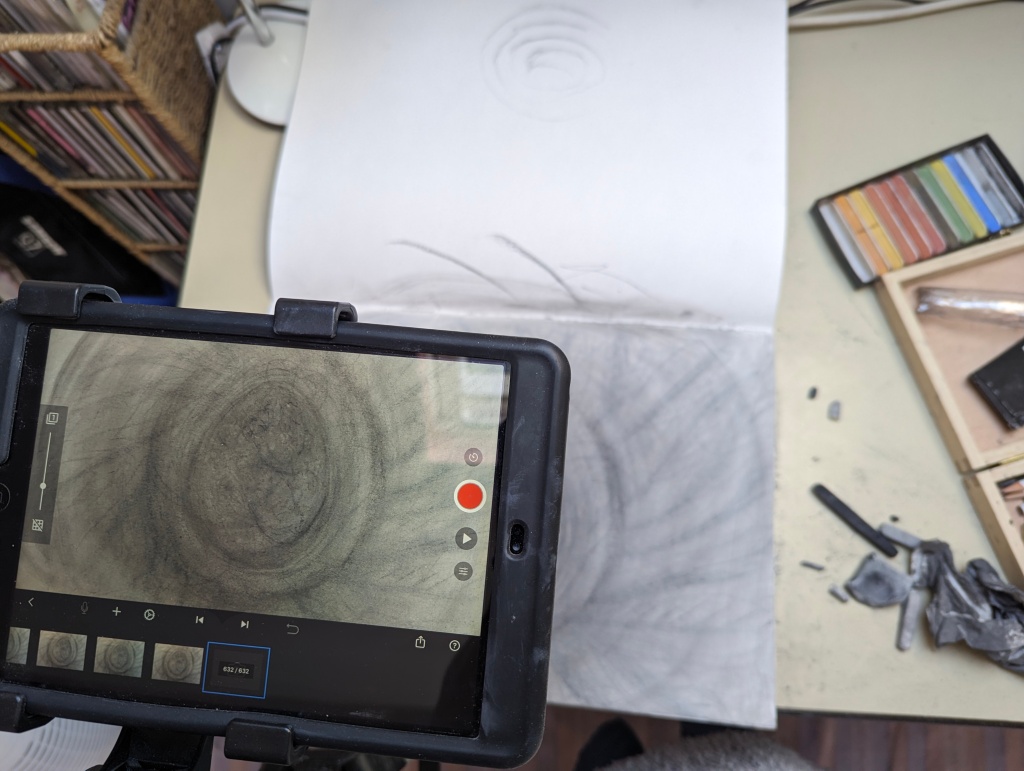
Still pending, but I know I’m not interested in generating sweet, neat, pretty and complete images, therefore I’m actually quite taken with these. I am still haunted by the images lost (the literally upholstered society lady, her eight hands caressing the limousine door, the slutty nurse with the several legs). What if I tried now to draw these images and the ones I remember, using charcoal perhaps? Is this essentially a good way of making preparatory sketches?

One thing I have learned – with the image-stream of AI, you really never can step into the same river twice.
What exactly does a poet-in-residence do?

How long is a piece of string?!

Residencies for poets are few and far between. At one end of the scale, a residency offers time and often a dedicated space away from home life, in which to explore your craft and make progress on new work. Most of these will be a commercial proposition where the poet is the one that pays. Sometimes it’s subsidised, and with hen’s-teeth rarity the poet is paid just to be a poet – living the dream!!

On the other end of the scale, you are paid but the emphasis is firmly on delivering a set of outcomes for the venue who is hiring you, whether that be an agreed number of poems in a prescribed format, and/or a set number of participatory activities for groups of people important to the venue. The more participatory the brief, the more likely it is that you’ll be working with children, families, and possibly with groups that have specific access needs of various kinds. For this kind of residency to be a residency rather than a short-term hire or a commission, there should be some wiggle room to make new work on your own terms, but there is a real need to align your professional ambitions with the needs of the host – and the host is probably thinking in terms of foot-fall and engagement.

An ideal residency should have elements of both valuable outputs and independent creative experimentation, and an expectation that the exact methods of delivery might be decided through co-creation and negotiation between artist and staff teams. You still need to pitch a good idea, though, and that can feel a bit like having to be telepathic, guessing at what the venue might really need or having some experiential knowledge of how commissioning organisations operate on a day-to-day basis. For example, is their staff team small and overwhelmed, might you need to foreground your ability to self-manage or include social media activity in your pitch?

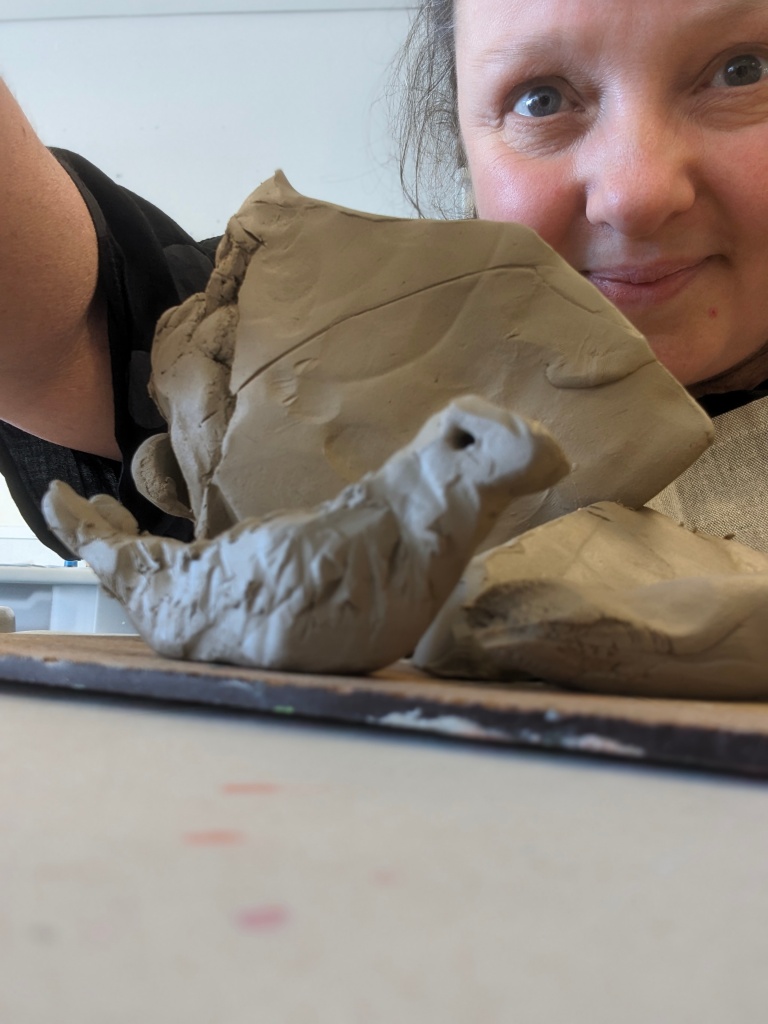
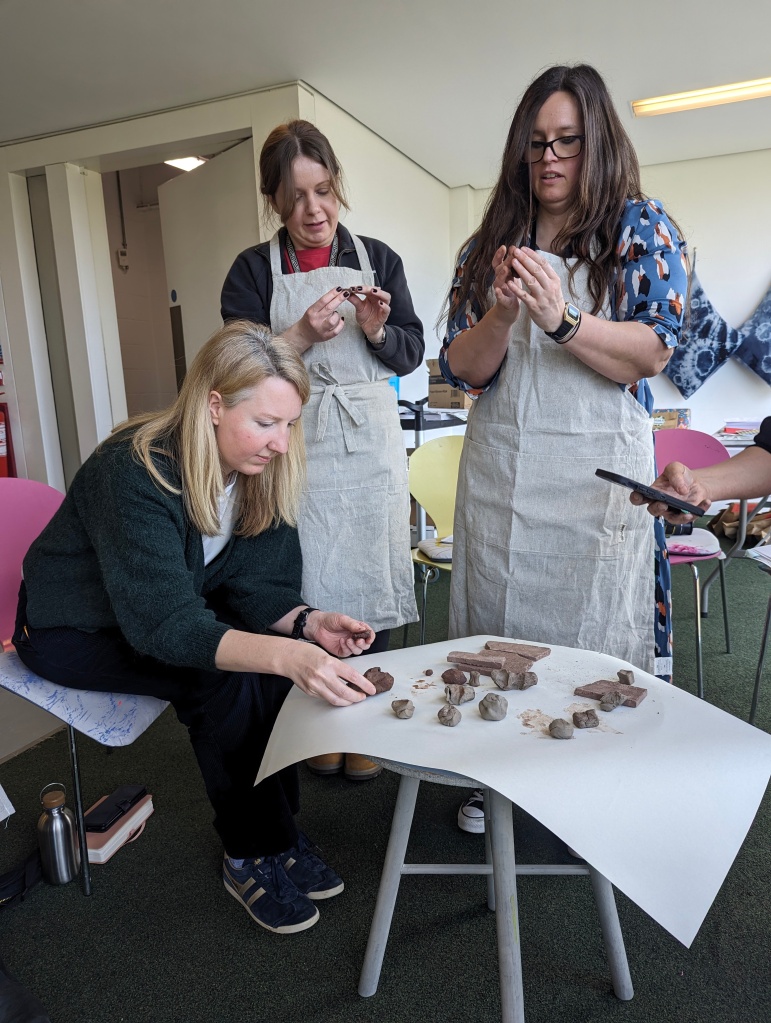
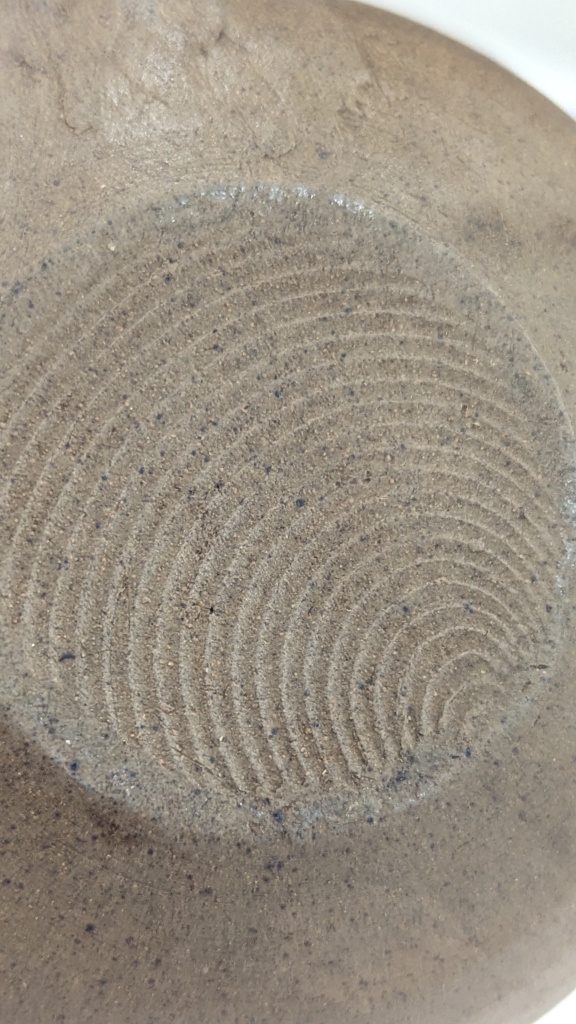
My current residency at MIMA for Tees Women Poets has been a real joy. The expectations of the host venue were clear – create digital poems in response to the Contemporary Ceramics collection in a format that could be used on a flat screen within the gallery, within a very specific timescale. Be able to self-organise and meet deadlines to present the work at MIMA Art Social #17 on 20th June. Offer two workshops to ensure the public and the TWP are getting developmental benefit, but also develop my own creative practice by learning new skills.

What does that look like in terms of my activity? It’s involved

  • an in-person pottery handling session with the curatorial team
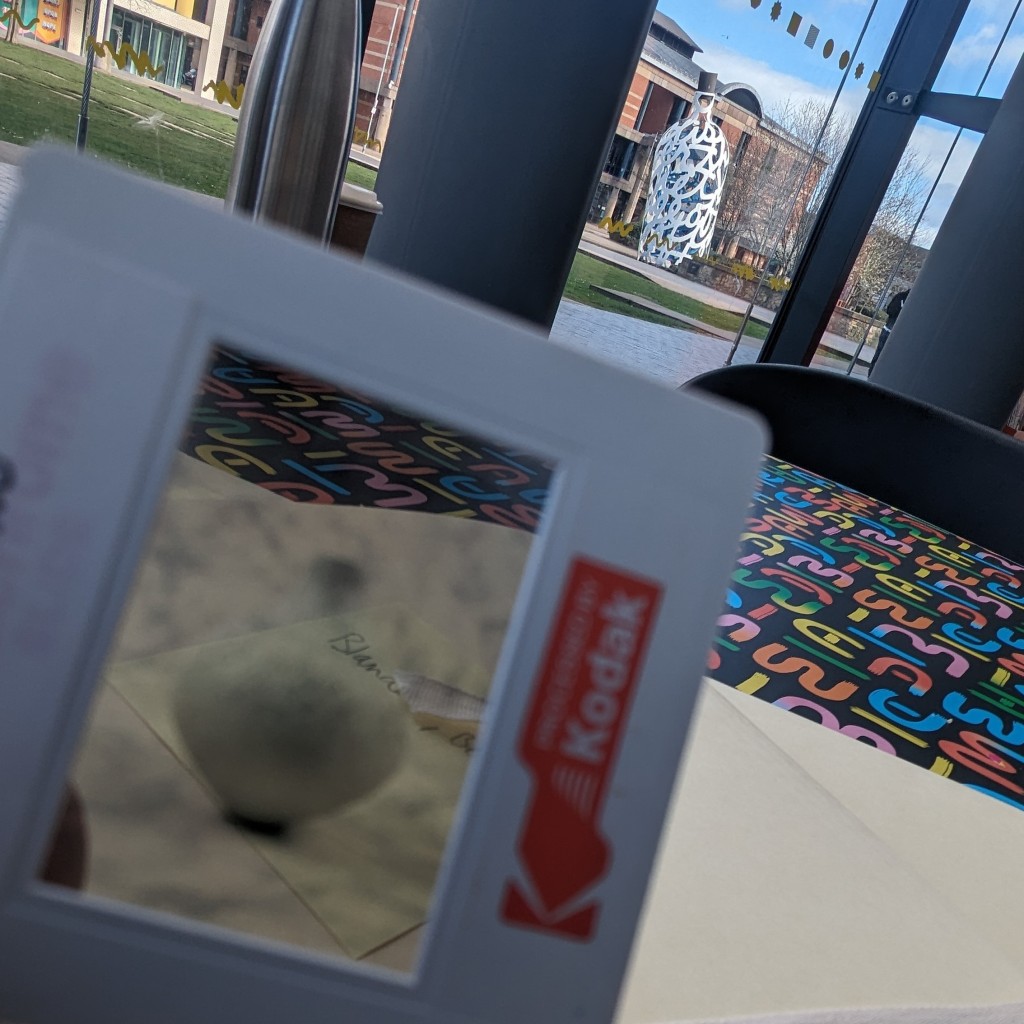
  • my attendance at a workshop about de-colonializing ceramics curation, again with the staff team (see the slideshow above)
  • several days of writing and editing poems in response to handling pots
  • delivering a creative writing workshop with exercises inspired by the ceramics
  • making film-poems from participants’ work in Reels
  • delivering a round-table discussion about residencies for TWP members who would like to apply for future opportunities
  • learning how to make kinetic typography digital poems in Canva
  • learning how to make charcoal animations
  • experimenting with AI-generated voice-overs
  • learning how to create soundtracks in Audacity
  • the creation of four digital poems ready to reveal in June.

To find out more about my process and poems, please come to MIMA Art Social #17 on Thursday 20th June, 5.30-8pm at MIMA, and I’ll reveal all!!

Reflections on Renga

Last month I led my first renga, or rather my first “quarter-renga”. We didn’t have the minimum five hours it takes to lead a group of poets through the collaborative creation of a linked chain of twenty haiku-alternating-with-couplets that is the shortest possible version of a traditional renga.

Now, I have a lot more learning to do about the intricacies of different renga patterns and how to lead people through them skillfully. They remind me of increasingly complex versions of card games – draw the Queen of Spades and pick up the discard, red sevens reverse the direction of play, mention the season once and you must mention it in the next 3 verses, only one verse about the moon per page.

The not-even-quarter renga we created in the sun-warmed vestry at 17nineteen in Sunderland (otherwise known as Holy Trinity church) cherry-picked some of the rules. We opened by establishing a sense of place, then deepened it in the next couplet. Then we allowed the moon to peek into a verse, before closing with a couplet open to any theme. As renga-master, those were the choices I made about the poem’s direction of flow. Four verses took just over an hour.

In keeping with the traditional method of renga, once the direction had been said for the verse in hand, everyone wrote, and everyone then read out the previous verse plus their new addition. As renga-master, I then chose the verse that would take us forward as a group. For the first two, I combined lines from two or more contributors; for the second two, the “correct” verse arrived fully-formed from a single source.

Eight poets took part, and although the final words only derive from five pens, all of us are considered to be co-authors of the resulting work, because it takes everyone’s energy, focus, and revealed words to weave the invisible field of connection in which the renga gestates.

It is a sacred space. It needs space.

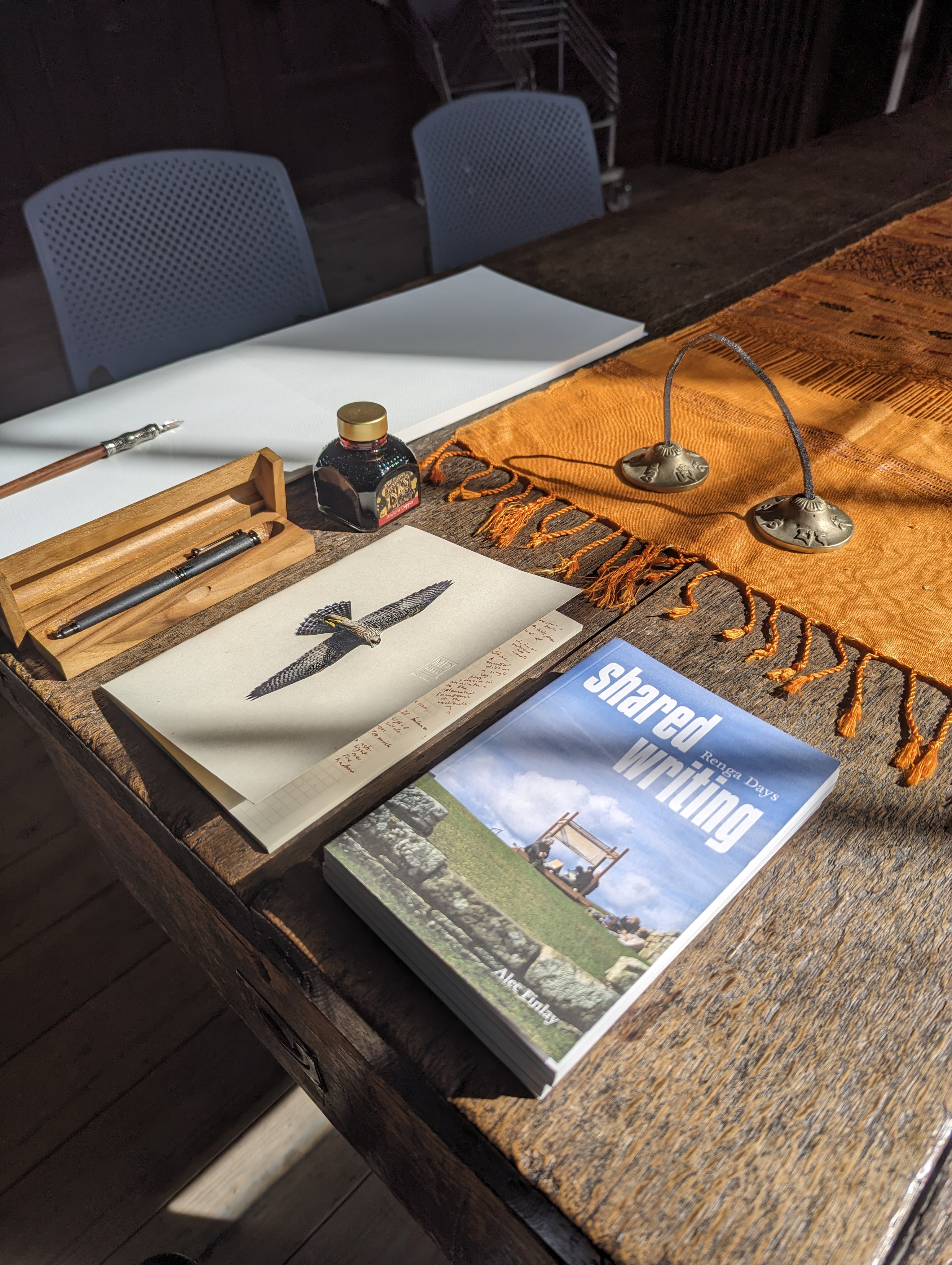
sunlight slants onto an old wood table, laid out beautifully with a deep yellow silk table runner, a fountain pen and ink bottle, a pair of Buddhist chimes, a notebook with a buzzard on the cover, and a copy of Shared Writing handbook of renga

With each circuit of the table, alternative poem-chains open out, fractal branching, seedlings of all possible poems grow ghostly, pale and eventually wither. Like my amateur gardening, I feel guilt and regret with every verse I thin out, death of so many. A smile when someone’s words are chosen, against their expectations. My inner wince away from too-clever, too-polished; my confused frustration when people get caught in syllables and don’t quite open the door to the poem – can you feel it? Like a birdcall, words at the right moment, and never too many. The unchoreographed sigh of recognition from everyone when the right lines arrive, when I choose correctly, when we are becoming the hivemind that spins together.

My approach to creating the conditions for the renga to arise was firstly to run two previous workshops about haiku, to provide renga participants with some insights and practice in the form. But several people turned up for the first time for the renga! So I also used Alec Finlay’s book Shared Writing and had us read out some 20-verse renga. I have two copies of the book, so we could do it in pairs, call and response, which was a beautiful way to hear how this way of writing unspools dreamlike dialogue resonant with association, echo and surprise.

A demarcated physical space really helps. Ours was a room, other projects have used a canopied platform. There is something qualitatively different about joint effort within a dedicated space, our combined attention builds an invisible structure that needs the trellis of a protective physical space up which to climb. I believe it would be possible to carry a mobile platform of stakes and flags, or meet in the wilds and create the space with foraged rocks or marks made in sand.

I also set up the energetic space for the renga by leading some brief meditation, and setting aside time for participants to move around the entire venue in silence in order to open their senses and minds to the latent poetry all around us. Even though the writing was done in the vestry, everyone brought with them details of everything from the wind in the trees outside to the halo lamps above the nave (white moons shining down).

In previous workshops I’d been able to do some basic qi gong with the poets, drawing on a previous life as a shiatsu/qi gong practitioner – it’s a useful, possibly essential preparation for poets who may be more used to starting with a focus on inner turmoil than on the observable world. Though makers in other disciplines would no doubt use the metaphors most related to their practices (haiku alternates with couplet, warp and weft, ones and zeroes) for me the rhythm of the chain felt very much like a walking qi gong where the weight must shift to the side before stepping forward. A quieter verse may make the better stepping stone. Not all can be Alpine grandeur, some must be saxifrage and gentian.

Here is what we wrote:

Three Gold Heads

Bright sunlight / Through high windows/ Inside, three gold heads

Water splashed on infants / Bless you, darling

On the dark side of the garden / A broken teacup saucer / In finger-nailed soil

The daffs need deadheading / Let’s leave them another week

And here are some favourite lines that didn’t make the cut – what would you have made with them?

Sun warms the wood / for centuries, this drawer / is it locked?

Sparrow chirp / ricochet on brick

Like the sky / my blue and white top / is colder than it looks

The lid of the poor box / is so heavy

Corinthian columns / the silver birches can’t quite touch / the window

Cholera corpses / standing room only

Lungs and moon full / I rub sleep from my eyes / another lonely night

The plural of haiku is haiku

Every so often, I get re-smitten by haiku.

They are simple, but not easy.

They are small, but contain vast spaces – like an atom.

They are a practice.

Last Saturday I led a workshop on writing them, in which we played with fridge magnet haikus to get that old 5-7-5 syllable counting thing off our chests before going out into the world for a walk to find our seasonal signifiers, our moments of subtle intersection with (urban) nature.

Here are some thoughts from that day…

  • Really do cut out words if they’re only there to make up the syllable count. Up to 17 syllables is fine – if you do this, you will find an expansive sense of ambiguity and open up the poem to reader interpretation. The space created when you cut an unnecessary ‘is’, ‘but’, or ‘that’ is much more haiku than finger-counting the dum-dum-dum.
  • Two things that don’t go together. Put them together. Do not try to build a bridge with words. Allow the reader to make the bridge for themselves, with resonance. Two things striking each other, like wind chimes. The poem is the note; the note is the white space.
  • Of all poetics, haiku care the least about what you mean. Stop meaning. Start looking and feeling simultaneously. In a glass building, having a complicated conversation, watching pigeons fly through their own reflection.
  • I say feeling, but this is not about getting it all out on paper. How Western! Stay still a little longer, the ivy may have something to say about that.

My next workshop on 13th April is going to be a mutual exploration space looking at how to bring haiku into film, using Reels. I’ve been trying and I have no firm conclusions!

This was my favourite out of the 5 haiku I wrote myself that day – why?

Complex birdsong
Simple flowers
I don’t know

Long time, no me!

Forgive me, for I have sinned, it’s been FOUR YEARS since my last blog! (Really? Really??)

Sorry to keep you waiting. I know you must have been desperate to hear from me. How am I? Yeah, good thanks, you? What have I been up to? Oh wow. How long have you got? …well, I set up a national network for women poets for the Rebecca Swift Foundation, did a big bunch of community art commissions, set up a new literature organisation for Teesside women during pandemic, ummm, what else? Wrote my first libretto, for Tall Ships, that was…yeah, words to music…mmhmm. Got longlisted for an eco-poetry prize, that was – what? no, didn’t win, but… oh yeah but I did I just literally just win a competition for the first ever ClassicsFest…a response to Ovid’s Heroides…yeah Ovid? Greek myth. Mmm. Old. But still relevah…what? He-row-id-ease. Mmm. And what else, let me see…ah…Oh, you’re just on your way to…oh yeah, sorry, Yep, yep, sure, okay well I’ll let you get off then…sure…sure…let’s do a proper catch-up soon…absolutely! Nice one.

Might be time to keep tabs on myself, what do you reckon? Re-committing to meeting myself and my professional practice here is something I’ve been struggling to do, but I see amazing women, poets, people putting their thoughts out there into the world and I’d like to be among them. So, give me a steer – what would you most like to read?

Creative drought and identity crisis – how to feel slightly less dreadful

Dear free-falling freelancers, the flock in which I find myself; are you frantic, too? Do you feel flightless?

What are we if not what we do, if not what we make? Commissions, projects and productions, a scant living but a joyful art. People! These things are our guide feathers, our winter down. We’re all so plucked.

I got together with fellow poet-theatre-maker-producer Zoe to interrogate these sensations of collapsing identity. What I mean is, we had a much-needed commiseration Zoom. We’re both trying so hard, but we just can’t write the poetry and theatre that we thought made us who we are. Were?

Nor can we scrape together enough success from the constant hustle to pay our bills. Nor can we slice our energy fine enough to feed the housework and exercise and good home cooking and social Skypeing AND survival.

Dear free-falling freelancers, do you feel you’re flailing, failing?

A magazine picture of a sad-looking woman in a glorious evening gown made of overlapping white petals edged with black sequins has been stuck into a scrapbook. Handwriting underneath reads "But will I ever write poetry again?"
A page from my sketchbook-scrapbook diary

Here are some of the most useful or uplifting straws Zoe and I gave each other to laugh and clutch at, perhaps they may help you too.

“Expect less of yourself”. This line and many others from this brilliant article on ‘surge capacity’ might speak to many. It’s difficult to apply patience when creativity is your selfhood and your livelihood, but even without a global pandemic you gotta fill the well sometimes. My fellows, lie fallow. Make like a daffodil and spend winter in a bulb of nurturing inactivity. Trust the art will grow again.

Appreciate what you’ve already made/take a holiday in a different art form. Pin your poems to your walls and read them aloud. Make them a gift of some illustrations. Sing them on your tea break. Imagine what they’d look like on the dance floor (good, I bet). Dance them. Turn to them when Zoom has eaten your brain. Trust the art will grow from unexpected directions.

Find a foul-weather friend. It’s hoying it down out there, psychologically. Is there anyone who would collaborate on something small and joyous with you? My friend Jo and I are posting each other envelopes of scrap papers and postcards every so often, as a collage challenge. She reached out to me, and I’m grateful she did. Could you reach out to someone else who is pretending to have their shit together? Trust the art will grow between you.

A slid-open matchbox. The outer cover has been collaged with a picture of a blackbird on a branch full of red berries, with a berry in his mouth. The inside box is lined with silver foil and has been collaged with the head of a blackbird and a scroll of musical score.
A matchbox collage made and posted to Jo during lockdown

Spend your energy wisely. My mentor told me, you can’t get out of a crisis like this by working harder. Decide – that thing you’re doing for money, is it a temporary life raft, or are you building an ark? Paddle accordingly. Zoe has found a life raft that is enjoyable and does good in the world. Right now, that’s all she needs to do – oh and watch out for any glimmer of creative enjoyment round the edges. I have the resources to gamble on a year of ark-building. I’m trying to focus and not go for every opportunity, because I know I can’t make a quilt out of those few scraps anyway. None of us can. This video of Elizabeth Gilbert may be helpful with anyone struggling with “I am what I do” and “I don’t want to find a life raft”. Trust the art will grow in the corners.

Be kind to your muse. Again with the Gilbert, though she uses the word ‘genius’. Your creativity isn’t down to you, it’s whispered to you by your genius. Your genius is tired and confused and over-stimulated by All The Everything. Reassure it that you will listen out for, and make a note of, any tiny sliver of inspiration they can pass your way. Draw a flattering portrait of your muse and put it on your wall in your peripheral vision. Ask your genius how they’re feeling, and if they might send you something in your dreams. Trust the art will grow again.

For networking and practical support (mostly north east UK) here are some links for you:

Tyne & Wear Cultural Freelancers

Freelance Taskforce

Freelance Lifestylers

Wor Culture

NE Creative Producers Network

Poetry Promotors

Creative Freelancers UK

I’ve started so I’ll finish

I love a fresh start, how about you? I love it so much that I have notebooks and rooms full of unfinished projects, and a head full of even more that I am definitely going to start, one of these days…

…which is why it’s a refreshing change to say I have finished something! I started this blackout poetry book back in 2012 perhaps? A lifetime ago. And last weekend I finished it. It’s not the most incredible thing in the world, but it’s mine, and I’m done. What project have you completed recently? How long did it take you?

In my imagined future I sit on a cushion rag-rug-covered in denim blues, looking at the neolithic horses I’ve sculpted out of papier mache and all those toilet roll innards. I’m relaxing after recording the seventh in my series of poetry review vlogs, and pondering the edits to my fourth collection of poems about geomancy, post-Apocalyptic shamanism and GPS. I’ve loved writing it, it’s been such a welcome break from the best-selling crime novels. On the wall behind me is a huge canvas covered with coral polyps fashioned from water-softened rail tickets I’ve collected over the past decade. My stop-motion filmpoem of hand-painted beetles has been selected for an international festival, and I pen a little celebratory sketch into one of the hand-made scrapbooks I fill each lunar month. Soon I will go out and contemplate the incredible living patterns I have painted on my garden wall in buttermilk and blended moss. Birds are bathing happily in the water feature I made from a reclaimed pedestal hand basin, encrusted with Gaudiesque mosaics. I think I may have lost a little weight…

Community Art In A Time Of Covid

As you’re no doubt aware, things are a little … unclear at the moment. We’re not locked down, but loads of people aren’t comfortable with the thought of nonessential socialising, like workshops or gigs. At the same time, we’re missing them and the specific emotional sustenance that comes from in-real-life connection. How can community artists bridge the gap between an activity made safe through digital distancing, and their desire to reach out to people?

It looks to me like hybrid project delivery is becoming a clear way forward, which can mix these elements: live digital workshops, pre-recorded instructional videos, materials kits delivered by post, and community displays either in our streets or online. Here are some thoughts about the pros and cons of all of that, based on work I’ve done so far since lockdown started.

Freelancer's desk
Our homes have become our workplaces, and our laptops are the portals to every aspect of our working and social lives.

Live connection via Zoom or similar group working platforms

Pros:

  • People get to meet in real time and hopefully have fun!
  • There are a lot of good functions to use as teaching tools and as ways to facilitate new relationships (screen share, annotate, breakout rooms)
  • You can record sessions (with participant permission) again as a simple way of collecting evidence for reports to funders

Cons:

  • Inaccessible to many, due to poor internet connection, Zoom fatigue, and other discomforts particularly difficulty processing online social cues for neurodivergent participants
  • No in-built auto-captioning facility on Zoom, though captions can be added if you are able to afford a speed typist. Streaming to third party live transcription services  is not without hitches
  • Combination of live talk, chat function and possibly captions as well creates utter chaos for any blind participant using a screen-reader app
  • Fatiguing for the artist as well!

Think about:

  • Having a tag team where one person delivers the Zoom workshop, and another one bridges between the Zoom and a live conversation on Facebook where people can access activities in text-only form. This is how the Tees Women Poets run their monthly writing group.
  • For a comprehensive look at providing access to digital meetings, check out this guide from disability artists and activists Little Cog.

Pre-recorded instructional videos, and handouts

Pros:

  • People can access the information at a time that suits them, and as many times as they want
  • It remains useful indefinitely, for both artist and commissioning organisation, beyond the funded life of a project
  • Can be a beautiful and fun thing to make, and to watch

Cons:

  • Making them requires an entirely new skillset for many artists, and the learning curve is steep
  • You need the kit – new iPad, tripod, ring light and clip-mic, anyone?
  • Downloadable patterns for craft projects are only useful if people have access to a printer

Think about:

  • Captions! So many organisations are putting out instructional videos on their social media, from the Royal Academy to local arts entrepreneurs, but not everyone is making them accessible through captioning. Try free online captioning for short videos.

Summer Streets zine
One of 15 tiny poetry zines I made for Summer Streets festival, in a project which combined one-to-one Zooms with physical making.

Postal kits

Pros:

  • It’s gorgeous and exciting getting something in the post
  • It is the bridge between a digital encounter and a material one

Cons:

  • Make sure your in-house packaging process is safe for Covid
  • For some artforms the postal costs might be prohibitive
  • Hard to see how this would work for people teaching pottery, for example
  • May not be able to send all equipment needed, e.g sharps, scalpels for collage

Think about:

  • The additional time needed to make up packages rather than take a big bag of stuff to a workshop – if you’re freelancing, factor it in to your fee!

Community displays

There have been some lovely projects emerging that build on our initial lockdown enthusiasm for putting stuff in our windows, such as Bloominart’s community gallery in Hartlepool.

Pros:

  • Fosters community, provides a talking point for neighbours
  • Democratises art, brings it out of galleries and into community ownership

Cons/ideas:

  • Same problem with access to home printers might arise for template-based arts activities

Think about:

  • How to build and prove audience as well as participation? Can we think about organising socially distanced street-viewings as well? As we move towards winter, what creative possibilities might exist around lit windows, silhouettes and ‘stained glass’ effects? Can we translate these ideas to non-domestic settings?


Later this year, I hope to set up a CUBO club using postal kits, as something to offer people who are still keeping social distance as we enter the dark months. Perhaps by the time we get there, it will no longer be needed, but my feeling is that this hybrid way of working will be with us for a long time. What do you think? And how do you plan to adapt?

Black Disruption / White Wash

Here’s my situation.

I’m a white woman, a nobody writer, an amateur at art. I’m writer-in-residence at mima, testing out some found poetry techniques on their archive documents.

Black-out. Erasure.

The artist whose file I’m currently working on is Lubaina Himid. A black woman, a lifelong activist for the empowerment of black artists specifically and black people universally, an internationally-acclaimed artist, a Turner Prize-winner.

I know for a fact that nothing I do will go down in history.

But I do not know for a fact that Himid’s magnificent achievements absolutely, positively will go down in history. They bloody should. Mima wants to be part of making sure they do. But history has a nasty tendency to white-wash. Might be something to do with who gets to write it…

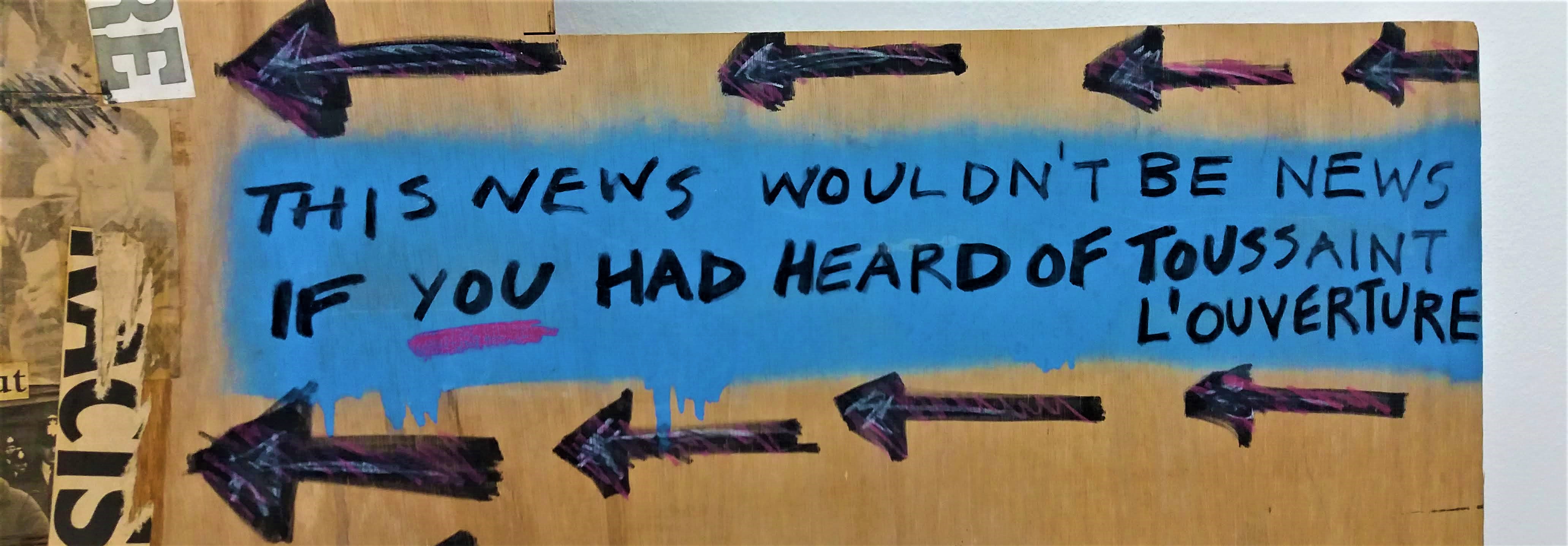
The picture I’m responding to is all about the white-washing of history, and how it perpetuates systemic racism. The subject of the painting is Toussaint L’Ouverture, leader of the Haitian Revolution, who in his lifetime was as famous as Napoleon.

Any English person has at least heard of Napoleon, right?

Have you heard of L’Ouverture?

This wouldn't be news

I took Himid’s biography, and made a stop-motion erasure called Black Disruption/White Wash. It’s supposed to be a comment on the thoughts I’ve written above. I’m not sure it works, and if you want to comment then please do. But please, please, as well as reading this blog (thanks if you’ve got this far) it’s way more important that you have a look at Himid and her phenomenal career.

Next week I’ll post my final thoughts on this section of my residency, and show you the bits that went a bit Pete Tong…

Lubaina Himid’s Sexy Slapdash Squares

I’m in the second-floor gallery at mima. I’m surrounded by an amazing array of art. I need to choose maybe half a dozen artworks as my focus. I’m a writer-in-residence. I’m going to use their archived records as source texts for erasure poems, but I have no idea what kind of documents are kept on file. What do I choose?

My first choice, without a moment’s hesitation, is Toussaint L’Ouverture by Lubaina Himid. It’s huge, bold, and contains loads of brilliant collage elements. I know that I want to use collage as an erasure technique in my found poems. Himid is definitely a good choice.

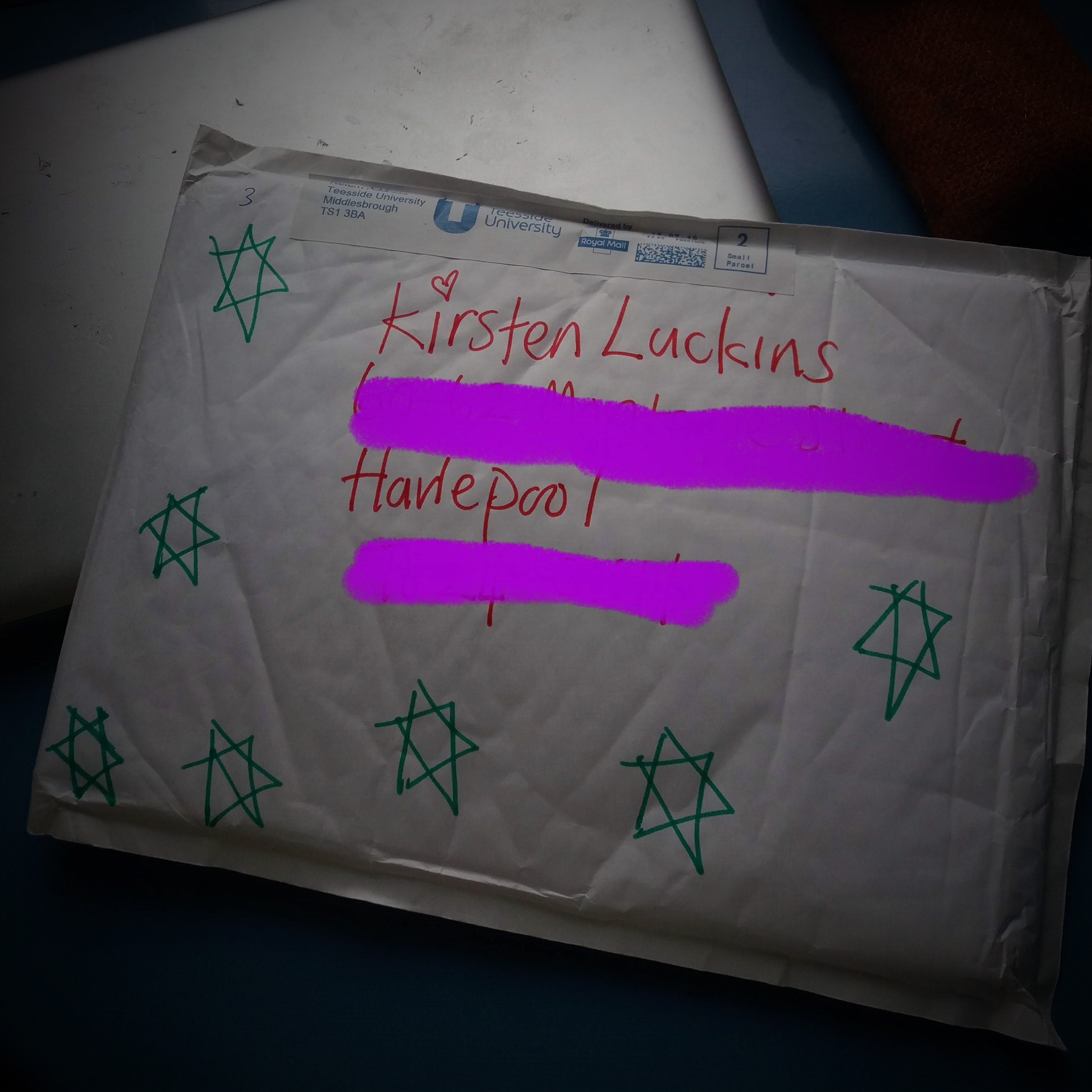
mima envelopeSkip forward a few weeks, and I’m at home when an enormous padded envelope arrives from the mima team. Inside is a ream of photocopied archive documents, including several about Himid’s work. There is an extensive biography, an acquisition statement, and a detailed condition report from a conservator. This last document includes a thorough treatment proposal, full of technical suggestions on how to repair and maintain the painting.

I start from waaaay inside my comfort zone – a tiny found poem spied in the condition report, simple and quite abstract. It’s all about colour, but not about race. I know I’ll have to work out how to respond to Himid with some shred of socio-political consciousness, but I haven’t thought it through yet. I just want to do some erasure using collage squares that are as exuberant as the ones that Himid has used to make the floor under Toussaint’s boots.

Himid collage squares

I ransack my stack of magazines for images featuring gold and yellow, cut them into rough squares, and set about it with a Pritt stick. Bliss.

“Gold has yellowed….yellowed…yellows”

Gold Yellows collage after Himid

Is this developing my creative practice? It’s not so far away from work I’ve made in the past, although I’ve never made a process video before. I love time lapse! OK, I will try to do more of these videos, and framed better, without so much of my belly-bulge showing. But first I have a hankering to do some stop-motion.

Tune in next week to find out what I manage to squeeze from a treatment proposal, and why I start regretting the whole endeavour…