A fascinating turn in the imagery this week, as new contributor Anathema McKenna picks up on the cut paper strips of week 7 and turns them into an abstraction. The choppy rhythm and ‘prison bar’ effect of the collaged lines is unexpected yet effective in conveying the actions and atmosphere of the verse, without ever becoming a direct illustration of the words.
We’d love to see your ideas for what might come next in this multi-authored film!
Hey hey, thanks for sticking with me on this one – week 7 of 11, and the contributor this week is…… me.
There’s a couple of reasons why it’s me. One is that I really wanted to create the ‘choking on strips of the Bible’ image idea I came up with in last week’s blog. Although when it came to it, I used newspapers to evoke the word ‘truth’ that is in the verse I’m illustrating.
The second reason is one of film quality-control. We received a couple of very intriguing concepts for imagery as a result of last week’s How-To guide, but unfortunately the execution did not do justice to the ideas. Common problems are:
Off-centre framing, or shots set up so that there is unwanted background detail
It can seem super-hard to get the framing right on a shot, but it’s worth playing around to get the perfect angle. It seems like most people would benefit from simply taking the camera closer in towards the objects and actions they’re filming. If you have a central action, you need to move the camera until the action or objects appears at the centre of the frame. This might take a fair amount of fiddling on! I’m lucky that I have a tripod, and a special attachment that allows me to put my iPad in any position I want. It wasn’t an expensive bit of kit, less than a tenner I think, and it makes a HUGE difference. It also completely eliminates the next biggest problem –
Shaky-cam and loss of focus
If you don’t have a tripod, then I really recommend you improvise some other ways to keep your device still, like propping it up on piles of books. It’s amazing how eliminating hand-held shake immediately makes your film look more engaging. And finally (for now) the other thing worth trying to resolve is –
Bad lighting
Of course we don’t have all the fancy-schmancy lights and reflectors that a serious film-maker has (although you can actually pick them up relatively cheaply). Nevertheless, you can make the most of the light you have and you absolutely should do so, because it makes everything look better. Arrange your cinematic composition so that it catches full sunlight, and add in more light using as many reading lamps as you can lay your sticky hands on.
So here is the latest version of Cherophobia – an Autumn Journal, with my 20 seconds added in. You’ll see that I’ve been a bit of a smart arse and have edited together a few different sections of film to make my 20 second clip. Notice how close in I’ve got the camera in order to get the effects I wanted – cropped right in on my hands, and then on my mouth and neck. Keeping the camera further away just wouldn’t have worked – the closer I am, the more intense the effect of the imagery.
And now it’s back over to you!
Below is the verse for week 8, for you to brainstorm into an eye-catching film snippet. Please send us your clips to sleeperpoems@gmail.com by 5pm this Friday 22nd May. And remember –
Illustrate/respond to the words and atmosphere of the poem – can you do this without filming someone chopping shallots??
Shoot in landscape orientation
Experiment until you have the shot framed right – come in closer, get things centred or in the right place, make sure unwanted details are kept out of frame
Welcome to week 6, the mid-point of this experimental project based on a poem by Jo Colley from her latest collection, Sleeper. The footage for this verse uses a combination of old photos featuring marbles, and video of raindrops falling on a dark puddle.
Every week we ask for contributions of film clips that might in some way illustrate or respond to the words, imagery, and above all the emotional tone of the poem. This last week we received several pieces of film, some very beautiful, but few seemed to really be in dialogue with the words of the prompt.
It can be hard to put images to words, but for this to work there must be some sense of connection. Here, the roundness and clustering of the marbles are a visual echo of the berries in the poem, described as “beads”. The rain on water stands in for the “cider vinegar”, and the sinister hints of the word “drowning” are suggested by both the darkness of the water and the earlier glimpse of a doll positioned face-down in a disturbing posture. Take a look, and see if you can catch what I mean.
So, here’s a hint for how to approach making a film clip for this week’s verse, because there are very few visual references in it!
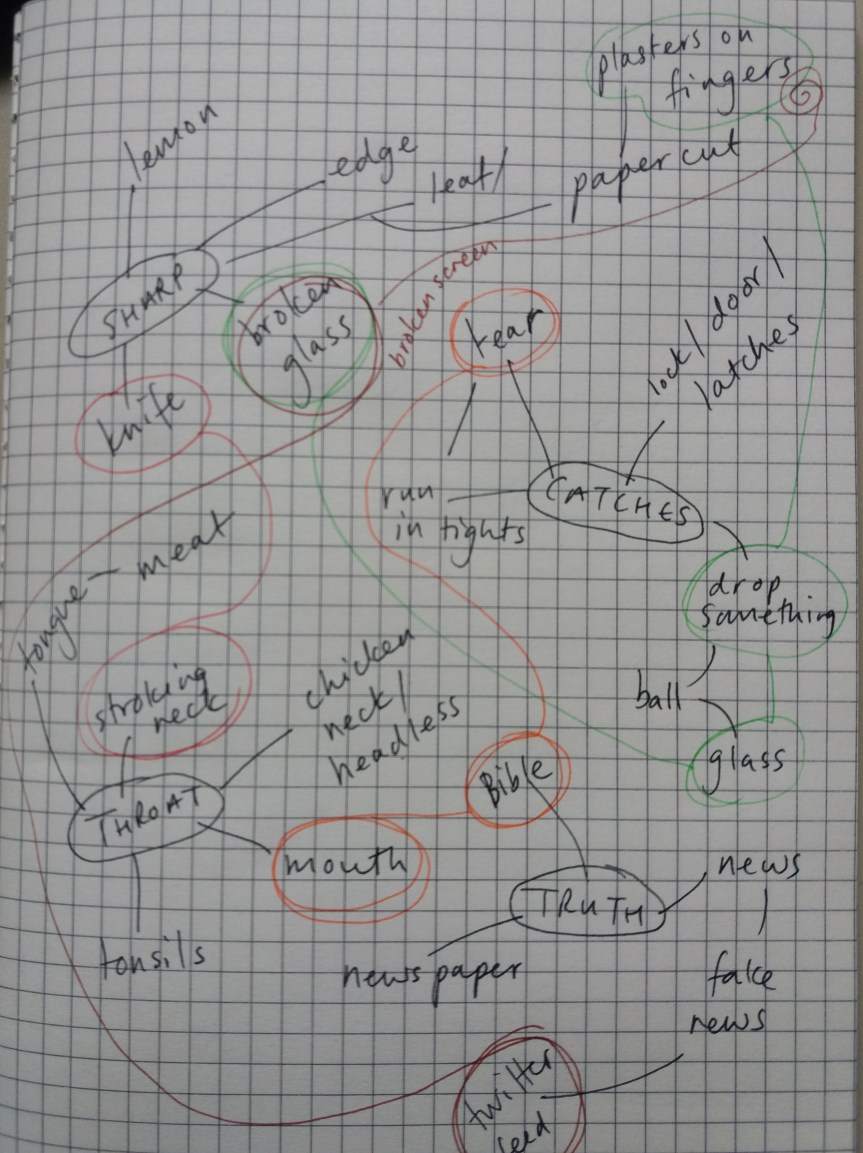
Take three or four of the words that seem to you to be most important for the atmosphere of the verse. For example, you might choose ‘sharp’, ‘catches’, ‘throat’ and ‘truth’.
Write them in a random way on a piece of paper, and then start to make a spider-web of associated words, images, objects, colours even. It might look like this:
Now try connecting two or three of your associated images together (ideally three), to create a possible moment of footage. For example:
Connecting ‘knife’ (sharp) with ‘stroking neck’ (throat) gives a strong image. Too strong?
Connecting ‘drop something’ (catches) with ‘broken glass’ and ‘plasters on fingers’ (sharp) suggests a scene of letting something drop and shatter, perhaps filmed from above; or a scene of injured fingers picking up shards.
Connecting ‘twitter feed’ (truth) with ‘broken glass’ (sharp) makes me imagine swiping a broken phone screen – perhaps the images on the phone could be staged to be relevant to the poem’s atmosphere of a relationship in trouble – photos of the couple in happier times?
Connecting ‘tear’ (catches) to ‘Bible’ (truth) to ‘mouth’ (throat) gets us perhaps the most art-house image, of someone ripping up and chewing the pages of a Bible.
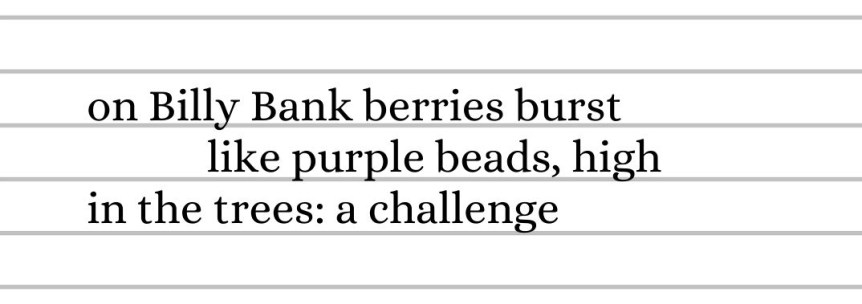
Have a go yourself, and see where your associations take you – and remember, ALWAYS film in landscape orientation, and send us your clip to sleeperpoems@gmail.com by 5pm this Friday! Here is the full verse of poetry to inspire you:
This week a contribution from Bernie McAloon takes us back towards imagery of nature, but purple and grainy with age. The road up through trees is the ‘Bank’ and perhaps the ‘challenge’ mentioned in the verse, the tint of the film stock is the stain of the burst berries.
Next week is our midpoint, verse 6, and we would love you to contribute a 20-second clip of video that responds to the following text:
Here is your challenge – can you send us something that shows neither forks, nor pots, not vinegar, but still illustrates the mood of the poetry. Repetitive action, the suggestion of unspoken hostilities in the word ‘drown’?
Send your landscape-oriented footage to sleeperpoems@gmail.com by 5pm Friday 8 May!
Our film-poem takes a new turn this week, as archive footage contributed by Wilf Wilson is spliced into the mix. When imagery of war appears inside the confines of what has so far been a domestic setting, what is the psychological impact? Where is this story going? Take a look at the film so far, and then read the verse for week five. We want your 20 second film clip to take us forwards!
We need 20 seconds of footage that reacts to this verse, but it doesn’t have to be a direct illustration of it. Bring us something that speaks of challenge, or bursting? Remember to film it in landscape orientation, and email it to sleeperpoems@gmail.com by 5pm on Friday 1st May.
This week’s clip is provided by Lilly Flypchuk, whose daily lockdown walk takes her along the banks of the upper Tyne.
Looking at how the film is progressing, it’s really interesting to notice how the mind forges links between the words of the text and images that may seem quite unconnected. In week one, there was a clear link between Ali’s film (light shining through a glass tumbler) and Jo’s words “dim light on a glass of brandy”, but also the way the light twisted and turned seemed to fit well with the text “incoherent babble”.
Natalie’s footage used spoons, which weren’t mentioned in Jo’s poem at all, but their silver shininess chimed with “kept for best”, the domestic nature of the object matched with “cupboarded”, and of course their Hall of Mirrors reflections gave us the “face…but folded”.
This week we see a river whilst reading “pond reeds” and our mind puts the sense impressions together. When the text gets to “fresh out of the cellophane” the transparent glisten of the water becomes the plastic wrapping – or it at least it did in my mind!
Have a look for yourself, and then please do spend 20 seconds this week recording a clip for verse 4, using these guidelines.
I’m a white woman, a nobody writer, an amateur at art. I’m writer-in-residence at mima, testing out some found poetry techniques on their archive documents.
Black-out. Erasure.
The artist whose file I’m currently working on is Lubaina Himid. A black woman, a lifelong activist for the empowerment of black artists specifically and black people universally, an internationally-acclaimed artist, a Turner Prize-winner.
I know for a fact that nothing I do will go down in history.
But I do not know for a fact that Himid’s magnificent achievements absolutely, positively will go down in history. They bloody should. Mima wants to be part of making sure they do. But history has a nasty tendency to white-wash. Might be something to do with who gets to write it…
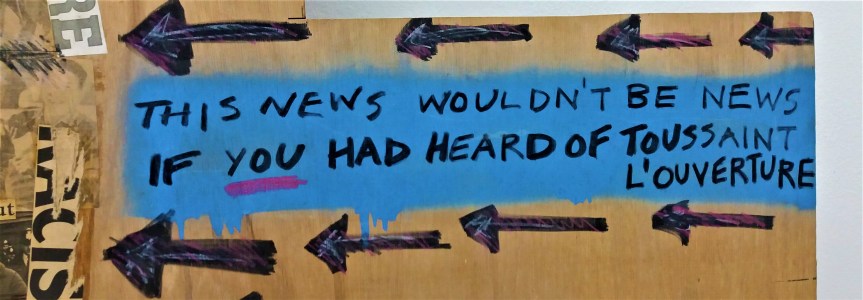
The picture I’m responding to is all about the white-washing of history, and how it perpetuates systemic racism. The subject of the painting is Toussaint L’Ouverture, leader of the Haitian Revolution, who in his lifetime was as famous as Napoleon.
Any English person has at least heard of Napoleon, right?
Have you heard of L’Ouverture?
I took Himid’s biography, and made a stop-motion erasure called Black Disruption/White Wash. It’s supposed to be a comment on the thoughts I’ve written above. I’m not sure it works, and if you want to comment then please do. But please, please, as well as reading this blog (thanks if you’ve got this far) it’s way more important that you have a look at Himid and her phenomenal career.
Next week I’ll post my final thoughts on this section of my residency, and show you the bits that went a bit Pete Tong…
It’s a truth universally acknowledged that one collaged found poem does not a writing residency make.
(To catch a hold of what I’m blethering on about, read how I am inventing my own residency, and have a neb at my first piece of work.)
Next steps, therefore, must be to produce more, more, more, MORE work. Dutifully, I turned my attention to the ‘treatment proposal’ document pertaining to Toussaint L’Ouverture by Lubaina Himid. I took that report, and I cut it into strips, and I shuffled it around, and I thought about how we should treat each other with the kind of loving attention that a conservator lavishes on an Old Master, and – well. Turns out either the language of art conservation is truly lacking in poetry, or I am much worse at this than I thought. Darnit.
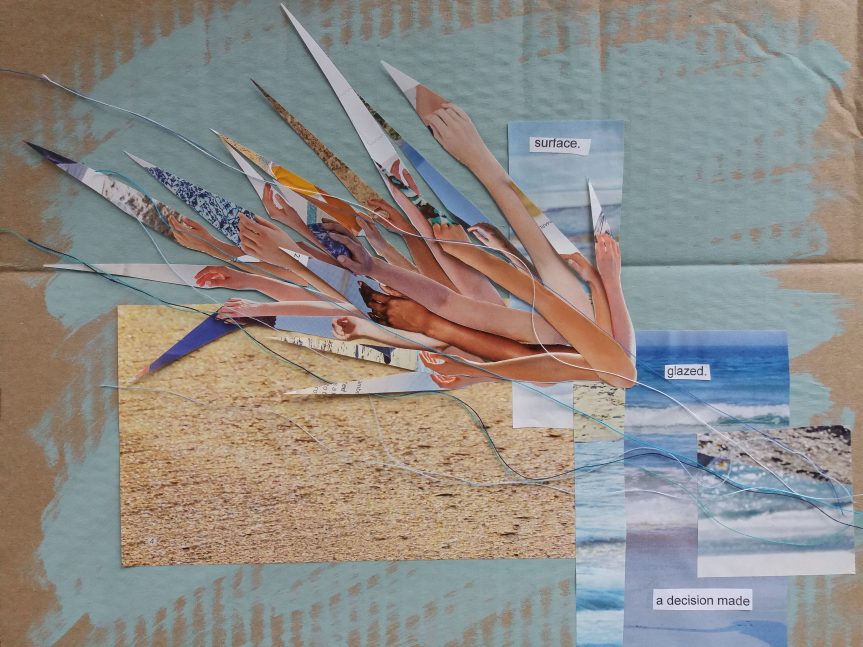
I managed to glean two micro-poems, two tiny little ‘treatment proposals’. The first is a kind of instruction about treating your own self with patience.
Surface, glazed – a decision made
The second is more about treating others with compassion.
Whilst inherently unstable,
small tears can be repaired by
supporting
Then, because they were so teeny-tiny, I spent some time bigging them up via the application of Some Slightly Flashier Techniques, making one into a stop-motion film,
and the other into both a stop-motion and a collage.
The upshot is that I quite like the end products! The collage is on cardboard, something I’ve been meaning to try for ages, and which I felt duty-bound to do now because Himid’s work is on cardboard. It’s a fantastically accessible material, which I’m sure is a political statement on her part, and of course it’s a better environmental choice than buying art paper especially. I think I’ll keep on using cardboard in future projects.
The stop-motions are fairly crude, but I do love the process. I played around with filters for the first time, and liked the way a black-and-white resulted in great gashes of light appearing in the animation. It’s good to know that even if my lighting conditions at home are desperately amateur, I might still be able to salvage or even improve footage by using the right built-in cheats.
Next time, I combine erasure poetry with stop-motion, and try to pay homage to Himid’s politics. While I’m gone, here’s an automatic haiku generator for you to play with.
I’m in the second-floor gallery at mima. I’m surrounded by an amazing array of art. I need to choose maybe half a dozen artworks as my focus. I’m a writer-in-residence. I’m going to use their archived records as source texts for erasure poems, but I have no idea what kind of documents are kept on file. What do I choose?
My first choice, without a moment’s hesitation, is Toussaint L’Ouverture by Lubaina Himid. It’s huge, bold, and contains loads of brilliant collage elements. I know that I want to use collage as an erasure technique in my found poems. Himid is definitely a good choice.
Skip forward a few weeks, and I’m at home when an enormous padded envelope arrives from the mima team. Inside is a ream of photocopied archive documents, including several about Himid’s work. There is an extensive biography, an acquisition statement, and a detailed condition report from a conservator. This last document includes a thorough treatment proposal, full of technical suggestions on how to repair and maintain the painting.
I start from waaaay inside my comfort zone – a tiny found poem spied in the condition report, simple and quite abstract. It’s all about colour, but not about race. I know I’ll have to work out how to respond to Himid with some shred of socio-political consciousness, but I haven’t thought it through yet. I just want to do some erasure using collage squares that are as exuberant as the ones that Himid has used to make the floor under Toussaint’s boots.
I ransack my stack of magazines for images featuring gold and yellow, cut them into rough squares, and set about it with a Pritt stick. Bliss.
“Gold has yellowed….yellowed…yellows”
Is this developing my creative practice? It’s not so far away from work I’ve made in the past, although I’ve never made a process video before. I love time lapse! OK, I will try to do more of these videos, and framed better, without so much of my belly-bulge showing. But first I have a hankering to do some stop-motion.
Tune in next week to find out what I manage to squeeze from a treatment proposal, and why I start regretting the whole endeavour…
2018 is, I hope, the year of TWO retreats. I spent the last week in January at Dhanakosa, marking my tenth annual retreat, enjoying snow, writing poems, and collecting footage for this filmpoem inspired by our discussions on environmental activism.
If you’re considering a retreat and would like to learn more about meditation or Buddhism, I really recommend Dhanakosa. They have wonderful week-long retreats throughout the year for beginners, and the meditation is always partnered with a sympathetic activity like yoga, writing, painting, photography or even hillwalking. Prices are also on a dana basis – you pay what you can. Go; you won’t regret it.







 Skip forward a few weeks, and I’m at home when an enormous padded envelope arrives from the mima team. Inside is a ream of photocopied archive documents, including several about Himid’s work. There is an extensive biography, an acquisition statement, and a detailed condition report from a conservator. This last document includes a thorough treatment proposal, full of technical suggestions on how to repair and maintain the painting.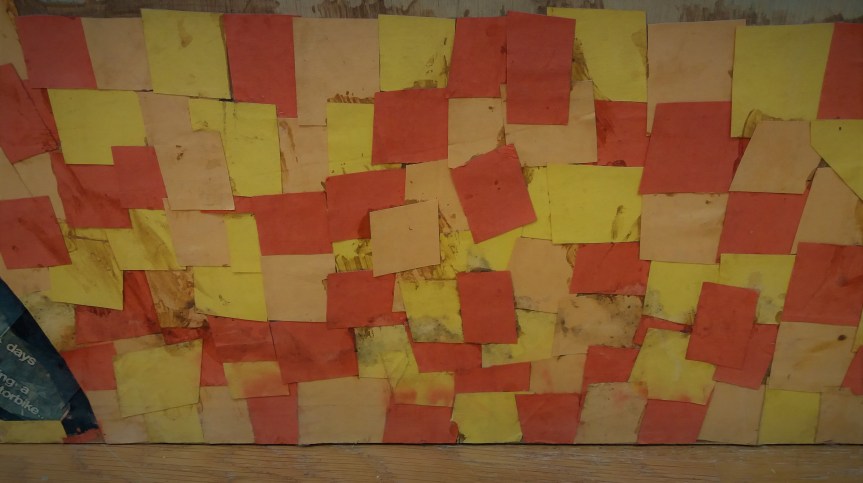


 Kirsten Luckins