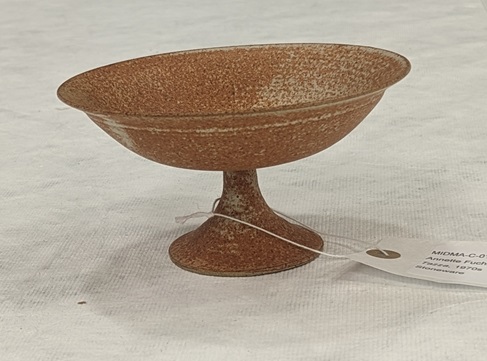
It’s small, about 18cm high maybe? Just looking at it, there is a classical, visual beauty in the proportions and the terracotta. But when you pick it up, the perfection of its balanced weight is breathtaking.
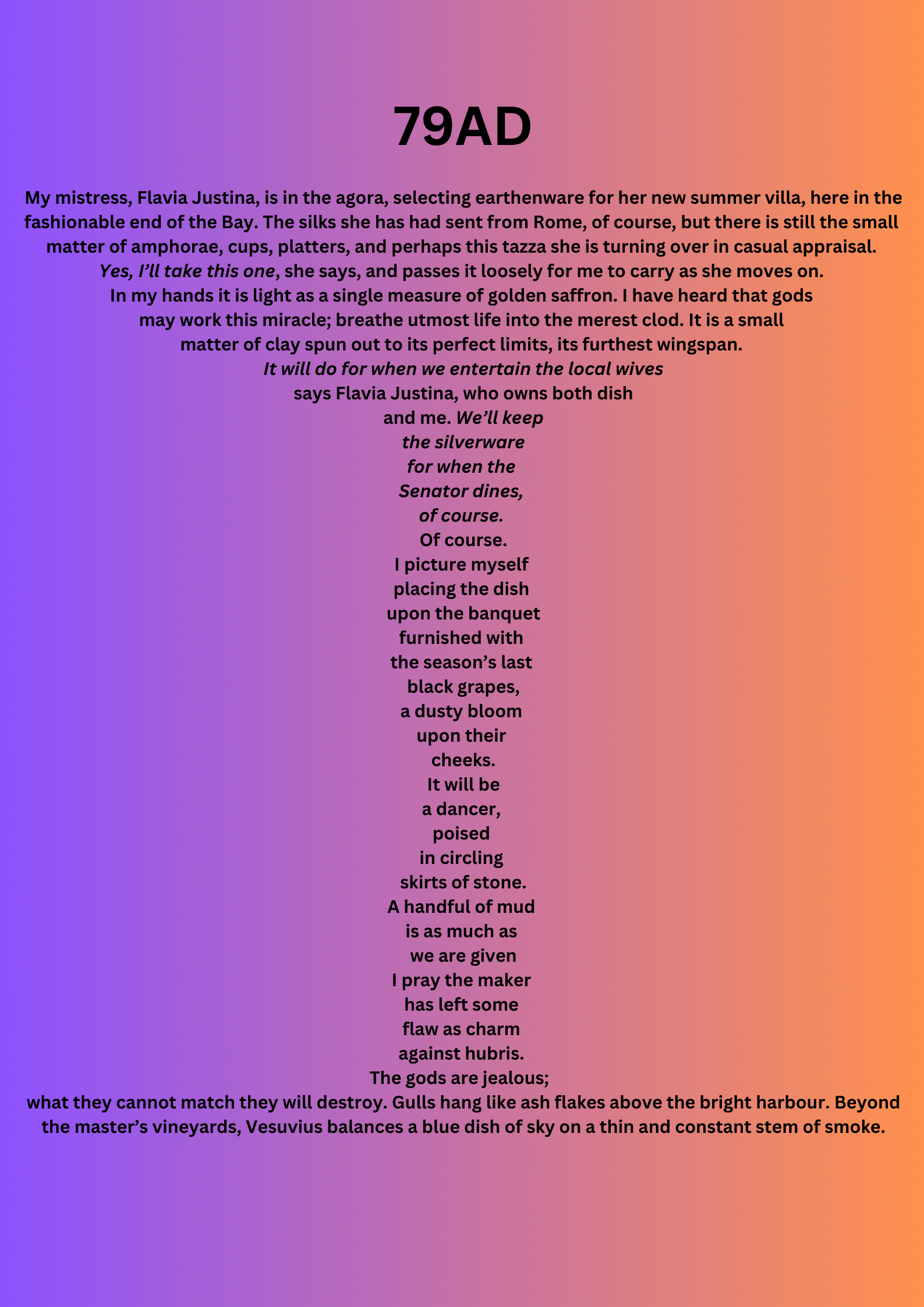
The second of my four digital poems for ceramic pieces in MIMA was written for a tazza, or serving dish on a pedestal and foot, wheel-turned out of earthenware by ceramicist Annette Fuchs. It made me imagine Roman society and murals, which in turn led me to think about Pompeii and Herculaneum. Pliny the Younger described the cloud of smoke that preceded the eruption of Vesuvius in 79AD as “a pine tree, for it shot up to a great height in the form of a very tall trunk, which spread itself out at the top”, a description which reminded me of the tazza shape. On this tazza, a pale razor-blade-shaped void has been left in the red surface, perhaps deliberately, as superstitious people will sometimes add a smudge to their make-up so the gods don’t get jealous…
This poem has had a couple of concrete incarnations – the one above, which I made especially for this blog post, and the version in the micro-pamphlet handout produced by MIMA to accompany the exhibition, which had eight stanzas each shaped like a tazza. Can you guess where the stanza- and line-breaks came?
This extract from the visuals of the digital poem should give you a clue!
This is again made in Canva videos, using a textured background duplicated and flipped mirror-image along a vertical axis to enhance the tazza-shape of the stanzas. I then overlaid the texture with a free clip of a puff of smoke, to foreshadow the eruption of the volcano. The film clip was actually in a long, thin, landscape orientation. I have enlarged it, flipped it the portrait orientation, mirrored it along the same midline of the frame, and dialed down the transparency so it is a ghost of its former self…
What sounds would you choose to accompany this digital poem?
I’ll post all four completed pieces, with soundtracks, in my fourth blog. Watch this space for curved kinetic typography, charcoal animation, and weird adventures in Audacity and AI…
If you’re a woman, a poet, and you live in Teesside, then why not apply to be the next TWP poet-in-residence at MIMA’s Towards New Worlds exhibition this autumn? Information and application form here.
Now that my digital poems have finished their run at MIMA, I’m bringing you all four of them with some info on my process.
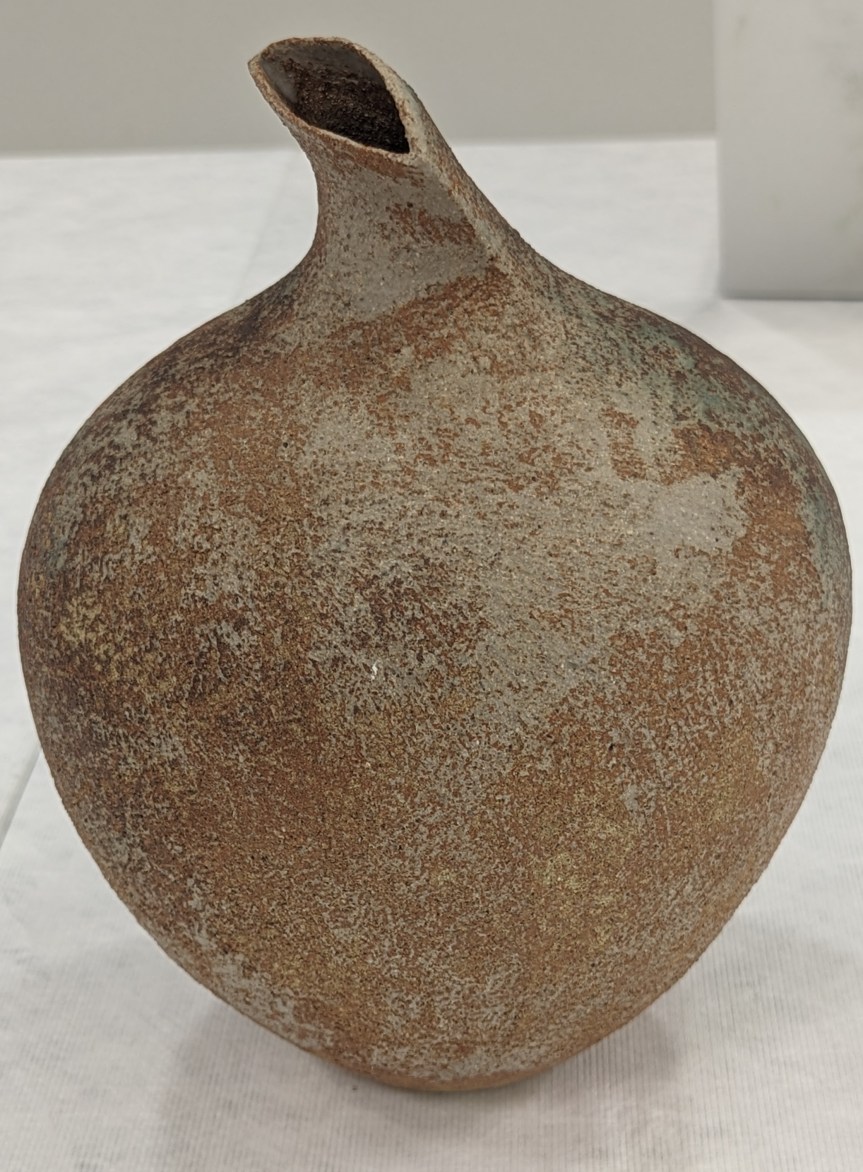
This first poem was written for a “leaning-neck vase” by Betty Blandino (1927-2011). As the poem states, the piece is made of coiled stoneware and is unexpectedly light when picked up – the rough finish makes it look like a natural stone, so the expectation of weight was there, and I did literally start talking to this pot when I held it.
My first step was to handle the pot, feel my responses, write notes, draw the vase to get its shape into my muscles…(and later use it for some gelli plate experiments, like you do)
Next step was to go away and write a poem from it. After a few edits, this poem then became a short film using a Canva video template (specifically, the Black White Minimalist the End template). I chose it because it features moving, soft focus lights with reddish-orange hues that made me think of the vase’s rusty-orange surface.
It also seemed to fit with an atmosphere of fairy stories/origin stories/when you were just a twinkle in my eye – the feelings of the poem, if not the specific details of the words. I changed the Canva template’s typefaces and text positioning, and played with how and where the text should arrive on each slide, changed the tempo to suit, and downloaded.
So far, everything I’ve used has been free and easily accessible. This was the result.
Now, that is not the final version of the digital poem – all four poems had soundtracks added before they were shown at MIMA, but you’ll have to wait because I’m going to talk about that, and show you the final looped installation, in a few blogs’ time! You could subscribe, if you like, then you won’t mis any of them?
But I will show you the last iteration of the poem right now, which is as a concrete poem. This was printed in the programme that accompanied the screening, with the following artist’s statement:
Origin Story was written for a coiled stoneware vase with a ‘leaning neck’ made by Betty Blandino (1927-2011). Handling this pot was a sensory overload for me, as it looks like a stone, feels like weathered rust, and is unexpectedly weightless. The shape is reminiscent of an amphora, a pot made specifically to store foodstuffs like wine or oil, but it is kept hollow, and sonorous. I found myself speaking to it like a sentient creature, and continued that conversation into the poem, imagining myself telling the vase myths about itself like bedtime stories for a child. Little pitchers have big ears.
The observant among you may notice that there are some differences between the texts of the two versions, which just goes to show that poems are never quite finished.
Watch out for the next digital poem, which will be 79AD, written in response to an earthenware tazza by Annette Fuchs.
11.01 Northbound, the song of the rails And footie fans
Bright tongue-punch of tamarind – I’d go miles for pani puri
New builds on brownfields Fennel glades, teazels, finches Unhomed
Kestrel’s cliff scraped clean of roots Bloody cranesbill
Street food, not sawdust In the covered market; ghosts… Skinned hares, white tripes
Kittiwakes scream from the bridge No-one wants a terraced house
Everyone is fine Talking to thin air these days – Pods. Buds. Our blue teeth.
Shop fronts like cast shells Waiting for crabs
Guts hanging out Sliding doors wedged open Cataract windows
The Laing’s a drum, deaf with rain Paintings sign to each other
Bloodlust and faith Objects in oils and suspense Gilt-framed
Gulls after a lightning strike – The Age Concern social group
Do you paint? Used to. But the girl I showed them to Never loved me back.
Sap green Scorched earth
Where you see a storm I see a girl tucking in To a ham sandwich
Things, alone in their thingness But, a field of attention
Smashed rainbow The old snooker hall windows Be Gay, Do Crime
Three white clouds; the blossom trees Next to Manors car park
Tall cakes, short coffees In your head, they’re still fighting – This cafe has changed
The basic anatomy Of buildings eludes my pen
I am surprised By the skyline we worked for; Its absences
Ten years in the mirror That body is lost to me
The hotel shower – Skylight in a downpour Headful of pictures
Looks like she ate all the pies Exhibition in a bathtub
Close to shame Wouldn’t do that one (After grabbing)
Shit on the pigeon netting Echoes fall down Dog Leap Stairs
Cities are dreams People too are mostly dreams, New builds on goldfields
The waters of Tyne… They run between me and me
Continuing experiments with renga, though this doesn’t really count as not many people believe a single poet can write a renga – you need at least one other person with whom to collaborate. Let’s say this is me collaborating with the ghosts of former selves as I take a writing day around Newcastle, where I lived and worked for twelve years.
I’ve now lived in Hartlepool longer than I lived in Newcastle, but of course with it being just up the road it’s still very current for me, so the disconnect is not as strong as I might find going back to other old haunts in search of psychogeography. I filled half an old journal with sense impressions and random free writes over the day, then pulled these fragments out. Like emptying your pockets after a foraging walk.
Residencies for poets are few and far between. At one end of the scale, a residency offers time and often a dedicated space away from home life, in which to explore your craft and make progress on new work. Most of these will be a commercial proposition where the poet is the one that pays. Sometimes it’s subsidised, and with hen’s-teeth rarity the poet is paid just to be a poet – living the dream!!
On the other end of the scale, you are paid but the emphasis is firmly on delivering a set of outcomes for the venue who is hiring you, whether that be an agreed number of poems in a prescribed format, and/or a set number of participatory activities for groups of people important to the venue. The more participatory the brief, the more likely it is that you’ll be working with children, families, and possibly with groups that have specific access needs of various kinds. For this kind of residency to be a residency rather than a short-term hire or a commission, there should be some wiggle room to make new work on your own terms, but there is a real need to align your professional ambitions with the needs of the host – and the host is probably thinking in terms of foot-fall and engagement.
An ideal residency should have elements of both valuable outputs and independent creative experimentation, and an expectation that the exact methods of delivery might be decided through co-creation and negotiation between artist and staff teams. You still need to pitch a good idea, though, and that can feel a bit like having to be telepathic, guessing at what the venue might really need or having some experiential knowledge of how commissioning organisations operate on a day-to-day basis. For example, is their staff team small and overwhelmed, might you need to foreground your ability to self-manage or include social media activity in your pitch?
looking at archive materials – slides of work by Betty Blandino
Eva Masterman teaches us about ways to approach a materials-led, decolonized curation of ceramics
amazing piece by Ian Godfrey, called ‘votive’ – it smelled of burnt wood from the firing process
my sketch of ‘votive’
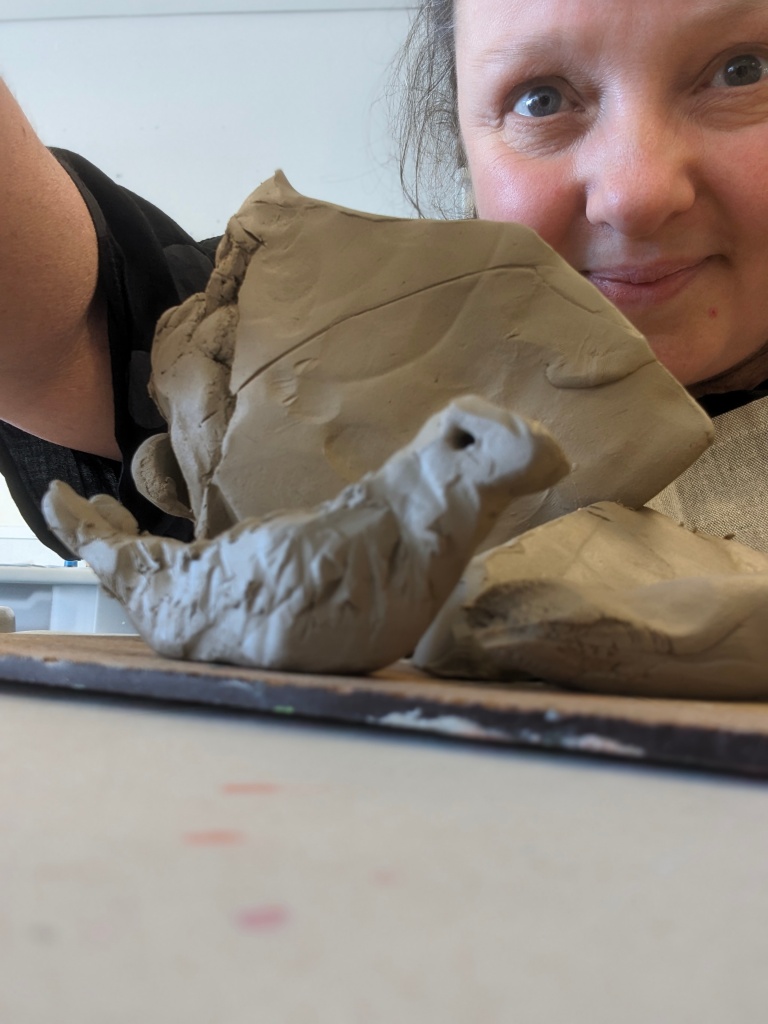
making a little clay seal in response to ‘votive’
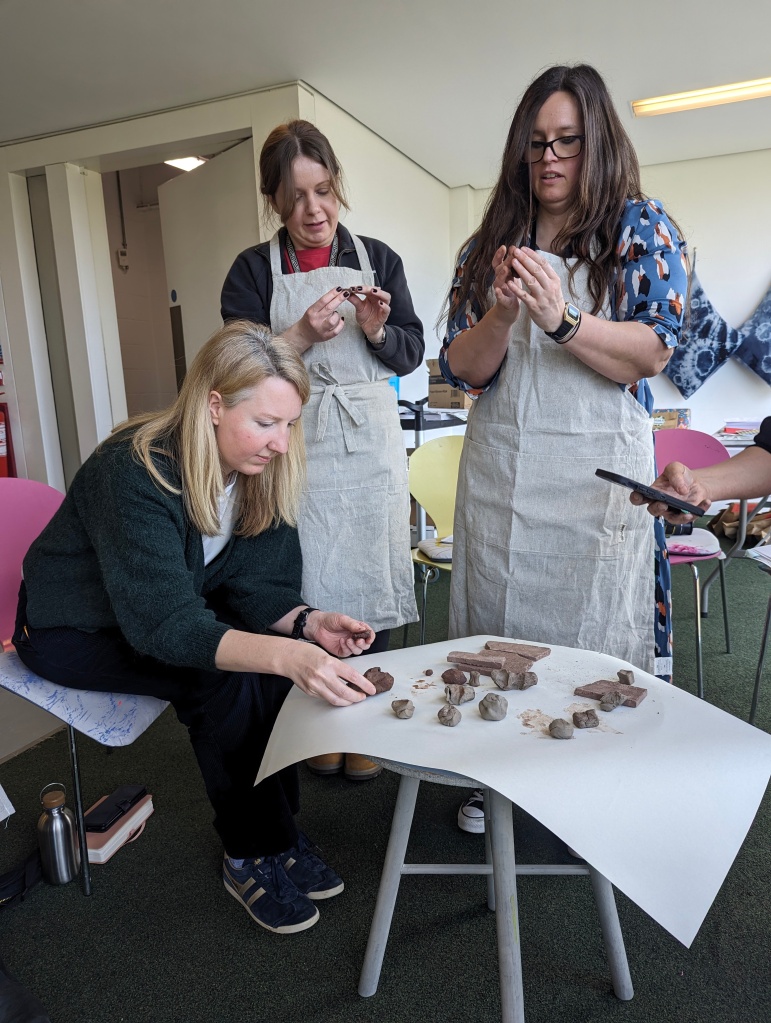
the MIMA staff team get hands-on with different types of clay
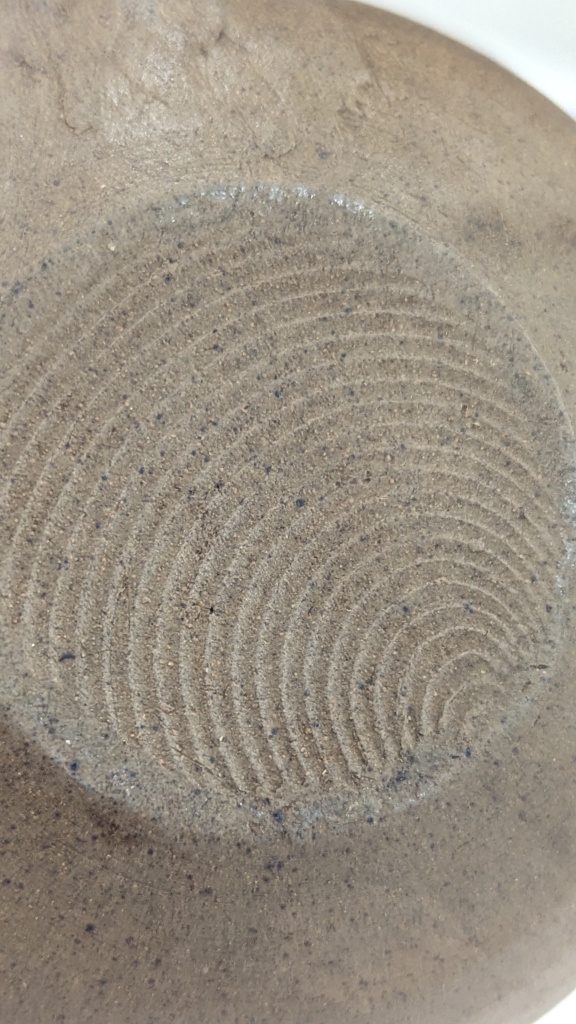
a detail from the ceramics collection that delighted me – a ‘fingerprint’ in the base of a vase
getting to grips with the nature of clay
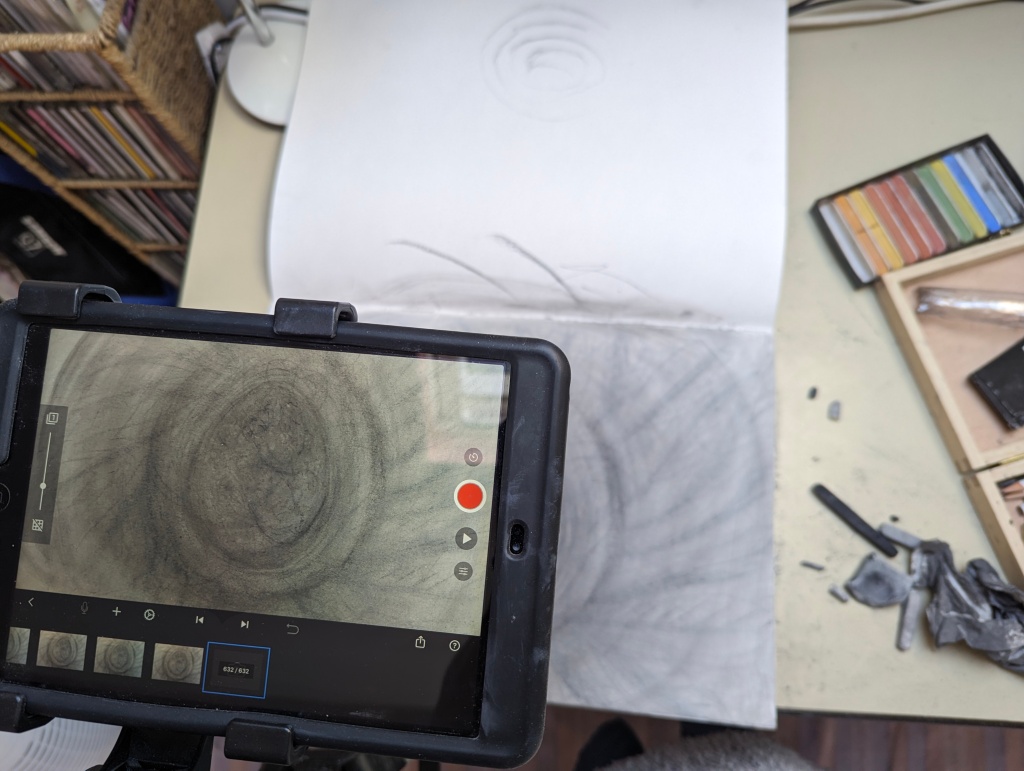
my set-up for making a chalk & charcoal animation for a poem inspired by a Deirdre Burnett bowl
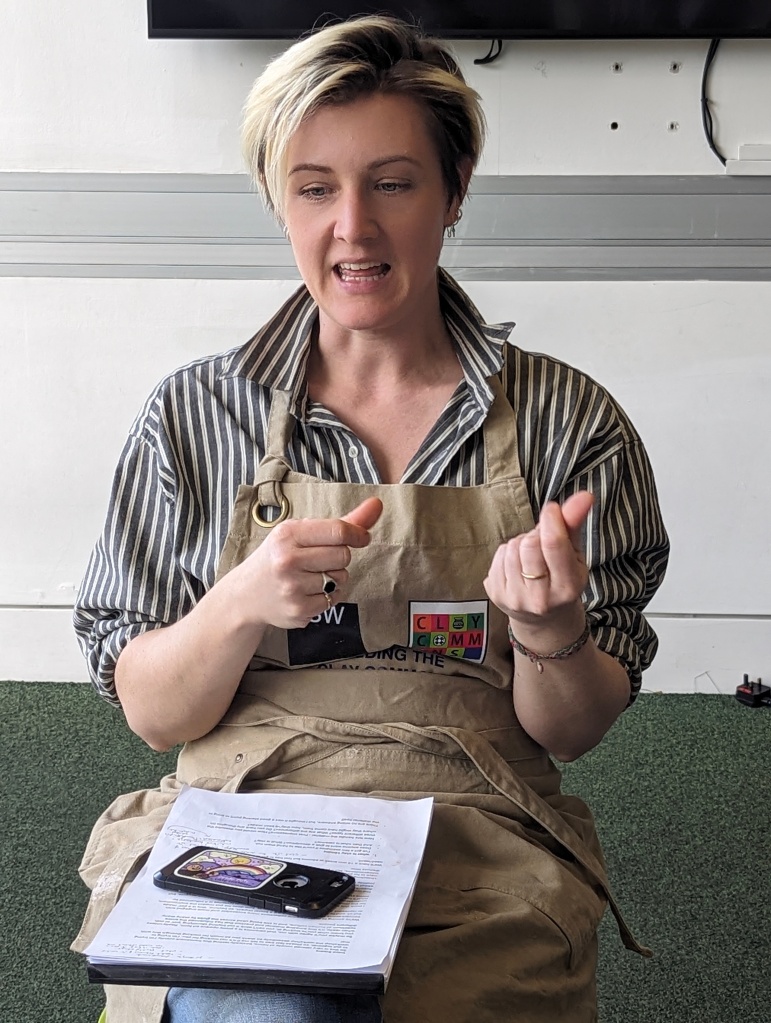
Playing about with ‘artist’s headshots’ in MIMA cafe
photo in MIMA archive of Betty Blandino, whose ‘leaning-neck vase’ inspired one of my new poems
My current residency at MIMA for Tees Women Poets has been a real joy. The expectations of the host venue were clear – create digital poems in response to the Contemporary Ceramics collection in a format that could be used on a flat screen within the gallery, within a very specific timescale. Be able to self-organise and meet deadlines to present the work at MIMA Art Social #17 on 20th June. Offer two workshops to ensure the public and the TWP are getting developmental benefit, but also develop my own creative practice by learning new skills.
What does that look like in terms of my activity? It’s involved
an in-person pottery handling session with the curatorial team
my attendance at a workshop about de-colonializing ceramics curation, again with the staff team (see the slideshow above)
several days of writing and editing poems in response to handling pots
delivering a creative writing workshop with exercises inspired by the ceramics
making film-poems from participants’ work in Reels
delivering a round-table discussion about residencies for TWP members who would like to apply for future opportunities
learning how to make kinetic typography digital poems in Canva
learning how to make charcoal animations
experimenting with AI-generated voice-overs
learning how to create soundtracks in Audacity
the creation of four digital poems ready to reveal in June.
To find out more about my process and poems, please come to MIMA Art Social #17 on Thursday 20th June, 5.30-8pm at MIMA, and I’ll reveal all!!
Last month I led my first renga, or rather my first “quarter-renga”. We didn’t have the minimum five hours it takes to lead a group of poets through the collaborative creation of a linked chain of twenty haiku-alternating-with-couplets that is the shortest possible version of a traditional renga.
Now, I have a lot more learning to do about the intricacies of different renga patterns and how to lead people through them skillfully. They remind me of increasingly complex versions of card games – draw the Queen of Spades and pick up the discard, red sevens reverse the direction of play, mention the season once and you must mention it in the next 3 verses, only one verse about the moon per page.
The not-even-quarter renga we created in the sun-warmed vestry at 17nineteen in Sunderland (otherwise known as Holy Trinity church) cherry-picked some of the rules. We opened by establishing a sense of place, then deepened it in the next couplet. Then we allowed the moon to peek into a verse, before closing with a couplet open to any theme. As renga-master, those were the choices I made about the poem’s direction of flow. Four verses took just over an hour.
In keeping with the traditional method of renga, once the direction had been said for the verse in hand, everyone wrote, and everyone then read out the previous verse plus their new addition. As renga-master, I then chose the verse that would take us forward as a group. For the first two, I combined lines from two or more contributors; for the second two, the “correct” verse arrived fully-formed from a single source.
Eight poets took part, and although the final words only derive from five pens, all of us are considered to be co-authors of the resulting work, because it takes everyone’s energy, focus, and revealed words to weave the invisible field of connection in which the renga gestates.
It is a sacred space. It needs space.
With each circuit of the table, alternative poem-chains open out, fractal branching, seedlings of all possible poems grow ghostly, pale and eventually wither. Like my amateur gardening, I feel guilt and regret with every verse I thin out, death of so many. A smile when someone’s words are chosen, against their expectations. My inner wince away from too-clever, too-polished; my confused frustration when people get caught in syllables and don’t quite open the door to the poem – can you feel it? Like a birdcall, words at the right moment, and never too many. The unchoreographed sigh of recognition from everyone when the right lines arrive, when I choose correctly, when we are becoming the hivemind that spins together.
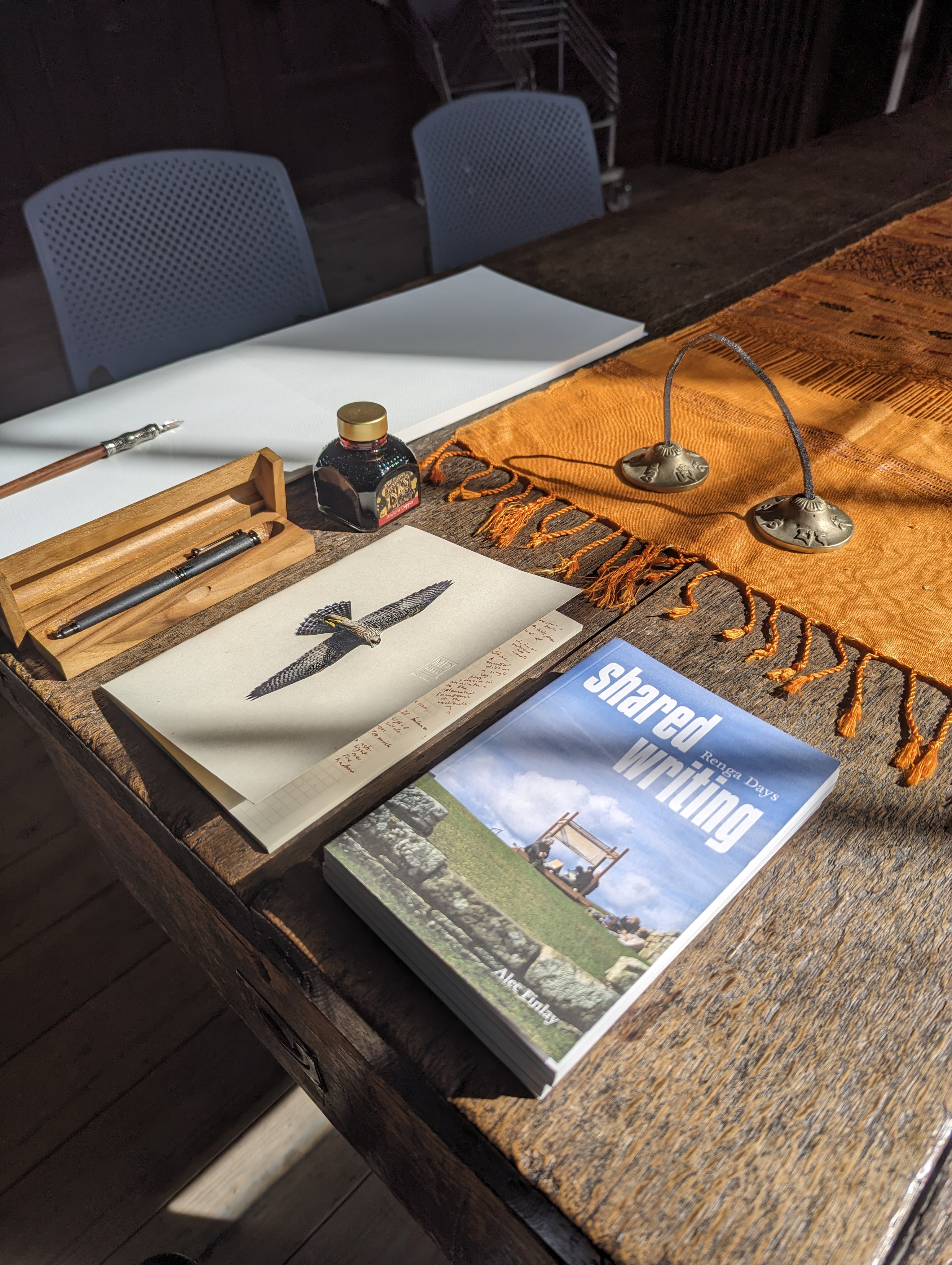
My approach to creating the conditions for the renga to arise was firstly to run two previous workshops about haiku, to provide renga participants with some insights and practice in the form. But several people turned up for the first time for the renga! So I also used Alec Finlay’s book Shared Writing and had us read out some 20-verse renga. I have two copies of the book, so we could do it in pairs, call and response, which was a beautiful way to hear how this way of writing unspools dreamlike dialogue resonant with association, echo and surprise.
A demarcated physical space really helps. Ours was a room, other projects have used a canopied platform. There is something qualitatively different about joint effort within a dedicated space, our combined attention builds an invisible structure that needs the trellis of a protective physical space up which to climb. I believe it would be possible to carry a mobile platform of stakes and flags, or meet in the wilds and create the space with foraged rocks or marks made in sand.
I also set up the energetic space for the renga by leading some brief meditation, and setting aside time for participants to move around the entire venue in silence in order to open their senses and minds to the latent poetry all around us. Even though the writing was done in the vestry, everyone brought with them details of everything from the wind in the trees outside to the halo lamps above the nave (white moons shining down).
In previous workshops I’d been able to do some basic qi gong with the poets, drawing on a previous life as a shiatsu/qi gong practitioner – it’s a useful, possibly essential preparation for poets who may be more used to starting with a focus on inner turmoil than on the observable world. Though makers in other disciplines would no doubt use the metaphors most related to their practices (haiku alternates with couplet, warp and weft, ones and zeroes) for me the rhythm of the chain felt very much like a walking qi gong where the weight must shift to the side before stepping forward. A quieter verse may make the better stepping stone. Not all can be Alpine grandeur, some must be saxifrage and gentian.
Here is what we wrote:
Three Gold Heads
Bright sunlight / Through high windows/ Inside, three gold heads
Water splashed on infants / Bless you, darling
On the dark side of the garden / A broken teacup saucer / In finger-nailed soil
The daffs need deadheading / Let’s leave them another week
And here are some favourite lines that didn’t make the cut – what would you have made with them?
Sun warms the wood / for centuries, this drawer / is it locked?
Sparrow chirp / ricochet on brick
Like the sky / my blue and white top / is colder than it looks
The lid of the poor box / is so heavy
Corinthian columns / the silver birches can’t quite touch / the window
Cholera corpses / standing room only
Lungs and moon full / I rub sleep from my eyes / another lonely night
They are small, but contain vast spaces – like an atom.
They are a practice.
Last Saturday I led a workshop on writing them, in which we played with fridge magnet haikus to get that old 5-7-5 syllable counting thing off our chests before going out into the world for a walk to find our seasonal signifiers, our moments of subtle intersection with (urban) nature.
Here are some thoughts from that day…
Really do cut out words if they’re only there to make up the syllable count. Up to 17 syllables is fine – if you do this, you will find an expansive sense of ambiguity and open up the poem to reader interpretation. The space created when you cut an unnecessary ‘is’, ‘but’, or ‘that’ is much more haiku than finger-counting the dum-dum-dum.
Two things that don’t go together. Put them together. Do not try to build a bridge with words. Allow the reader to make the bridge for themselves, with resonance. Two things striking each other, like wind chimes. The poem is the note; the note is the white space.
Of all poetics, haiku care the least about what you mean. Stop meaning. Start looking and feeling simultaneously. In a glass building, having a complicated conversation, watching pigeons fly through their own reflection.
I say feeling, but this is not about getting it all out on paper. How Western! Stay still a little longer, the ivy may have something to say about that.
My next workshop on 13th April is going to be a mutual exploration space looking at how to bring haiku into film, using Reels. I’ve been trying and I have no firm conclusions!
This was my favourite out of the 5 haiku I wrote myself that day – why?
Forgive me, for I have sinned, it’s been FOUR YEARS since my last blog! (Really? Really??)
Sorry to keep you waiting. I know you must have been desperate to hear from me. How am I? Yeah, good thanks, you? What have I been up to? Oh wow. How long have you got? …well, I set up a national network for women poets for the Rebecca Swift Foundation, did a big bunch of community art commissions, set up a new literature organisation for Teesside women during pandemic, ummm, what else? Wrote my first libretto, for Tall Ships, that was…yeah, words to music…mmhmm. Got longlisted for an eco-poetry prize, that was – what? no, didn’t win, but… oh yeah but I did I just literally just win a competition for the first ever ClassicsFest…a response to Ovid’s Heroides…yeah Ovid? Greek myth. Mmm. Old. But still relevah…what? He-row-id-ease. Mmm. And what else, let me see…ah…Oh, you’re just on your way to…oh yeah, sorry, Yep, yep, sure, okay well I’ll let you get off then…sure…sure…let’s do a proper catch-up soon…absolutely! Nice one.
Might be time to keep tabs on myself, what do you reckon? Re-committing to meeting myself and my professional practice here is something I’ve been struggling to do, but I see amazing women, poets, people putting their thoughts out there into the world and I’d like to be among them. So, give me a steer – what would you most like to read?
Friends, I am delighted to invite you to contribute to a new digital project while we are all in lockdown, and hopefully beyond.
I have been asked by the wonderful poet Jo Colley to work with her on some activities to launch her fourth collection, Sleeper from Smokestack Books. It’s a glorious book full of double lives, Cold War spies, masked relationships, and emotional distances.
While we can’t bring you a physical launch (yet), we would very much like you to take part in a film renga. A renga is a long poem of linked verses that are created by several poets in collaboration, under the guidance of a renga master. The renga master directs the flow of the chain, and will select each verse in turn from the selection put forward by the poets.
In our renga, we are providing you with a weekly prompt, which is a short verse from a long poem in the Sleeper collection. We are asking for a 20 second video clip that complements the text rather than directly illustrating it, and which also responds to the images already accrued. Each time we release a new prompt, we will also show you the film so far.
Here is your first prompt:
the table in your house
dim light on a glass of brandy
incoherent babble, justifications
And here are the instructions:
Read the prompt
Watch the film so far (applicable from week 2 onwards)
Take a 20 second piece of footage (to allow for editing)
Your video should contain images that complement the text, but not necessarily be a direct illustration of the images in the text
Your video should be responsive to the feel of the composite film so far
Please hold your device in landscape orientation when filming (like a TV screen)
Please email your video to sleeperpoems@gmail.com
Prompts and the film so far will be released every Monday for 11 weeks, and deadline for each week’s submission is 5pm every Friday
We’ve reached the last Strange Prompt! Thirty whole new pieces of writing from me, with multiple contributions from 24 other poets and flash-fiction writers. It’s been a very satisfying outcome from my writing residency, and not at all what I expected. I’ve played with some fun techniques and poetic forms. I’ve written more flash fiction prose than I would ever normally do. I’ve been delighted by the quality of the shared writing, and very much enjoyed seeing some writers become slightly addicted to the prompts (Ann Cuthbert, I’m looking at you!). So thank you to everyone who has contributed, read, shared, commented and enjoyed this little project – I’ll see if I can come up with something great to follow.
Thanks to Esther Bonner for this meditation on time…
Time passes.. Tick tock.
Seconds, minutes, hours. Tick tock.
Birthdays, anniversaries,
work, pleasure.
Life never stops. Tick tock.
The beating heart, like a clock. Tick tock.
Life slips away.
So STOP!
Grab a moment to lift your face to the sun, let its warmth caress you.
Blow on a pearly white feather, watch it float idly on.
Rest your weary eyes.
Listen to the wind sigh on an Autumn breeze.
Trail your hand though a cool, fresh mountain stream.
Let your senses be cossetted and renewed by life.
Time passes.. Tick tock
Julie Easley has a great take on the subject, fierce and feminist as usual!
she was adorned with bruises
ornaments of torture bejewelled about her body
but it was her poise that goaded him
her sealed room approaches
The doll, she said,
won’t dress herself, won’t sit to attention,
the doll won’t respond
if you tell her she’s miserable
Infinite gratitude to Tony Gadd, martial art guru and spoken word powerhouse, who sends us this wisdom from the depths of his own current, very serious, health struggles…
The mental image that inspired my poem for this prompt is a photograph taken at Bhopal, after the catastrophic chemical plant explosion. (The image I mean is number 7 in this article, but please be warned it is an image of a dead child and very upsetting, don’t go there if you don’t want that in your mind).
I’m extremely happy to be joined today by two more excellent poems. This one is by the wonderful Finola Scott:
He arrived late, but smelt so sweet
and forty years later he does it again
My bold boy, the Prodigal, I joke
to his sister. Her and I smile & sigh.
Today we high-wind hurtle city to city
across Scotland’s belted waist. He says
The Icelandic Symphony Orchestra play
capitally. As musician after musician
crowds the stage we giggle, so many tails.
Honey brass gleams, chestnut cellos wait
for sap-rise. He nudges, points at the timpani.
Then it soars, I’m swept into fiords, ice
melts, sea eagles swoop, glaciers calve.
Side by side we voyage out of ourselves
into each other.
And this one is donated by the equally wonderful Harry Gallagher:
The Sea
Today I almost gave my glasses to the sea
but the sea said no,
it could see where things were headed
and the ebb and the flow
hadn’t lost my address
it had just looked the other way
for a moment.
Today I tried to throw my stick into the sea
but the sea tossed it back
with a million tonnes of plastic,
said it was too full up for now
but if I stuck around
for at least another day
it could do with a hand itself.
Today I shot my slings at the sea wall
but all that came back
was an echo of a wave
as ancient as time,
a reminder that tomorrow is a choice
that will happen with or without
the sound of my voice.
Today I unloaded my woes to the sea.
The rage and the spray
of a world of injustice
was carried away on the westward wind
that battered and dropped me
then propped me back up
to await the turn of the tide.














 Kirsten Luckins