One good (little) tern deserves another, and another, and another…

How did Teesside’s little tern colony go from 3 successful fledglings in 2021, to 141 survivors in 2024? A case study in positive human intervention, dedication and persistence…

“That’s a nice lift” says Tony, as the adult slice upwards from their invisible nests among the sandy shingle at the southernmost end of Seaton Carew beach. A regular volunteer watching over the terns, he loves the way they barrel roll so their bellies catch the sun bright white, then suddenly flip their pale grey backs towards us so that against the blue-grey haze of the horizon the birds disappear.

They are a constant magic trick. Although I can hear their little raspy screeches before I even get out of the car, they are only easily visible when in motion, and they drop into rest on their nests like flipping the switch on a cloaking mechanism.

Today is a finer day than when I last came, bundled up against a sudden wind-harried drop in May’s temperature. On that day everything was grey, and the male terns were spending every ounce of their energy on constant forays to the tide for sand eels. For a courting tern, nothing says “have chicks with me” like a beakful of silvery sand eel. The warden that day, Emma, told me that the eel numbers seemed good and that mating was taking place all over the strand. Occasional flappings of raised wings like little white flares in all the grey showed me where breeding pairs were getting down to business. A month later and the same brief flashings of wing-white erupt where birds land and settle on their shallow scrapes – an estimated 80 nests – where both eggs and chicks are now present.

Colin volunteers to show me a chick through the huge tripod scope set up on the promenade for curious passers-by to learn more about this protected site. I’m looking at the fluffball for a good 20 seconds before I even see it, the speckled, sandy camouflage markings are so successful. More chicks hunker under one of the half-pipe ridge tiles laid out across the site as emergency shelters, looking like a clumpy sand-drift. Only movement gives them away; living as they do under a panopticon sky full of predatory larger gulls and hungry kestrels, their natural instinct is to stay very, very still.

The Tees Valley Wildlife Trust looks after this site, working together with Durham Wildlife Trust, which protected this tern colony when it was breeding north of here at Crimdon. Tony tells me how they migrate here in April from the Gambia, looking for shingle beaches and spits to inhabit. He waits for their arrival, and feel properly ’empty nest’ when they leave again.

Tidal activity being what it is, those shingles the terns seek can change their topography year on year, or disappear completely, and even during the course of a breeding season the colony can get washed out by high tides and storms – so the birds are flexible about where exactly they settle. When the colony started to fail in Crimdon, they moved south to Seaton. This year’s colony has been joined later in the season by birds believed to have been washed out of their first nests at Long Nanny near Beadnell.

The warden on duty today, Derek, tells me that in the six years this site has been active, the local people have taken it to heart. Teessiders have always pitched in to help protect the terns, whose eggs are so vulnerable to predators and accidental damage, and who will simply leave their nests to die if disturbed by humans. In volunteering to go on watch, I’m following in my mother’s footsteps – she watched them at weekends in the 1980s, when their breeding site was over the other side of the Tees mouth in South Gare.

Having a warden and volunteers is a huge part of the success story that has seen fledgings increase exponentially at Seaton. From 2021 to 2022, the jump in chick numbers surviving to migration stage was 3 to 89! What changed? The Trust got funding for a fence. A simple fence. Split cedar pales hammered into the sand to warn off dog-walkers, information signage, and paid wardens with the back up of dedicated and knowledgeable volunteers who can explain and engage. The global population of little terns is classified by the IUCN as ‘of least concern’, despite their acknowledgement of a 30% decrease in overall populations in the last decade – like every species, they definitely need protecting now, as rising sea levels and increased storm severity will undoubtedly make their survival difficult in the decades to come.

As I’m standing at the promenade wall, sketching the scene, a young lad jumps up onto the wall and is quickly warned down by Derek. But it’s not Derek’s style to be punitive, that gets you nowhere. Instead he always makes a point to talk with people encroaching on to the site, and in no time he has the whole family chatting, observing nests, and checking out the chicks through the scope. I talk to the mother and the younger sister, who are entranced by the fluffy babies and had no idea the birds came here every year. It’s excellent to pass on the little bit of information I’ve learned, tentatively trying to forge another link in the chain of connection between humans and nature. It’s a small start towards finding my own way to act as a custodian and a good ancestor.

If you’d like to do something positive, meaningful and sustainable about nature, biodiversity and climate, you should absolutely start by giving what you can (membership, donations, volunteering) to the organisations already on the ground, doing the work. That could be a global charity or your local wildlife trust.

For my fellow Teesside readers, please if you can, become a member of the Tees Valley Wildlife Trust and consider becoming a volunteer warden. If that’s not possible right now, check out other ways you can benefit from the Trust’s amazing work, for example by visiting one of their reserves or taking part in their 30 Days Wild challenge with the family.

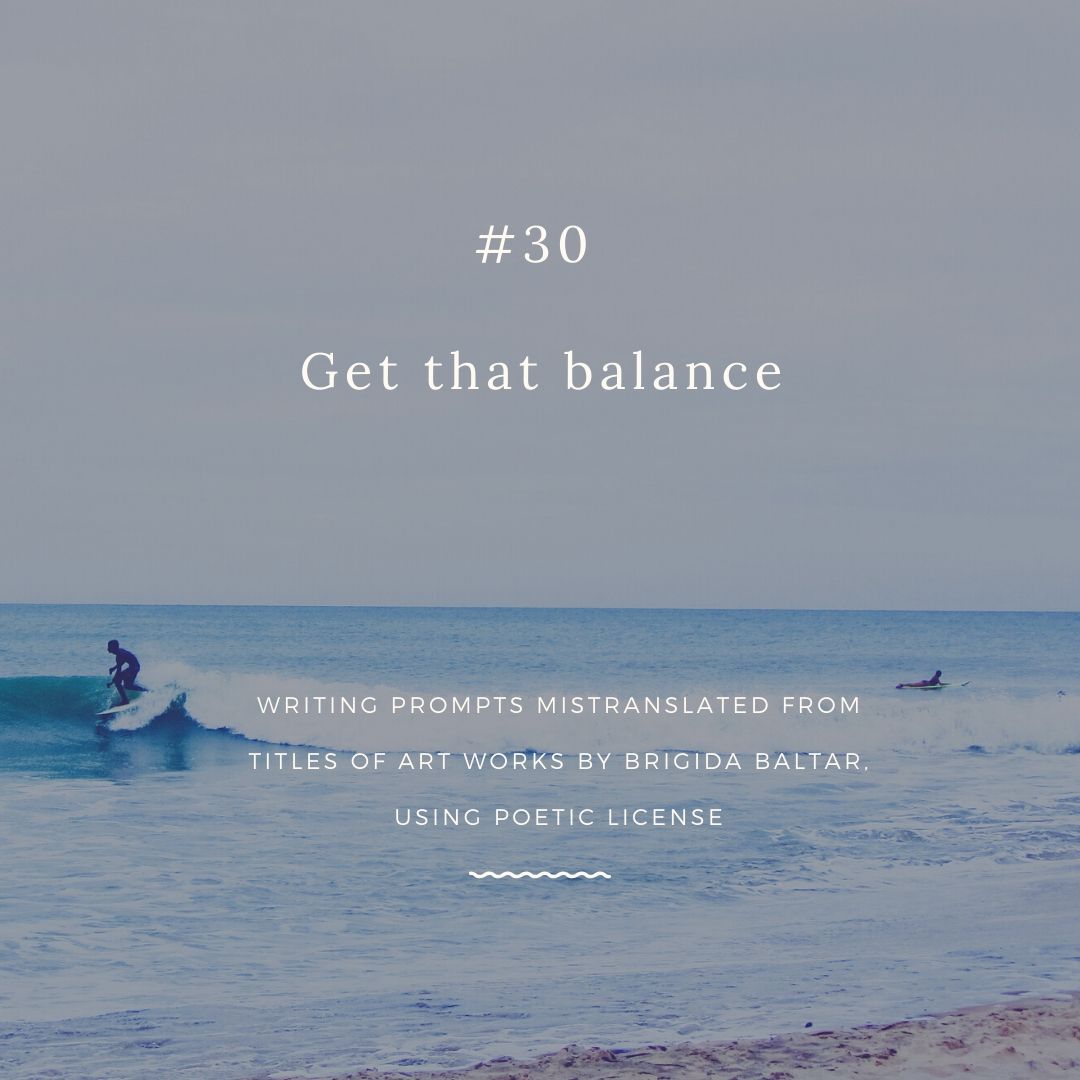
Get That Balance

We’ve reached the last Strange Prompt! Thirty whole new pieces of writing from me, with multiple contributions from 24 other poets and flash-fiction writers. It’s been a very satisfying outcome from my writing residency, and not at all what I expected. I’ve played with some fun techniques and poetic forms. I’ve written more flash fiction prose than I would ever normally do. I’ve been delighted by the quality of the shared writing, and very much enjoyed seeing some writers become slightly addicted to the prompts (Ann Cuthbert, I’m looking at you!). So thank you to everyone who has contributed, read, shared, commented and enjoyed this little project – I’ll see if I can come up with something great to follow.

Here’s my last one – just a little mesostic

12

Thanks to Esther Bonner for this meditation on time…

Time passes..
Tick tock.
Seconds, minutes, hours.
Tick tock.
Birthdays, anniversaries,
work, pleasure.
Life never stops.
Tick tock.

The beating heart, like a clock.
Tick tock.
Life slips away.
So STOP!

Grab a moment to lift your face to the sun, let its warmth caress you.
Blow on a pearly white feather, watch it float idly on.
Rest your weary eyes.
Listen to the wind sigh on an Autumn breeze.
Trail your hand though a cool, fresh mountain stream.
Let your senses be cossetted and renewed by life.

Time passes..
Tick tock

Julie Easley has a great take on the subject, fierce and feminist as usual!


she was adorned with bruises

ornaments of torture bejewelled about her body

but it was her poise that goaded him

her sealed room approaches


The doll, she said,

won’t dress herself, won’t sit to attention,

the doll won’t respond

if you tell her she’s miserable


Infinite gratitude to Tony Gadd, martial art guru and spoken word powerhouse, who sends us this wisdom from the depths of his own current, very serious, health struggles…

Walking the tightrope of an ECG

An emotional and bodily state

Balance in life

Like balancing stones

A lifetimes work

Practice the key

Physical and mental equilibrium

Unsettled by other

Forces and influences

Rebalance essential

Eyes closed, breathe and just be…


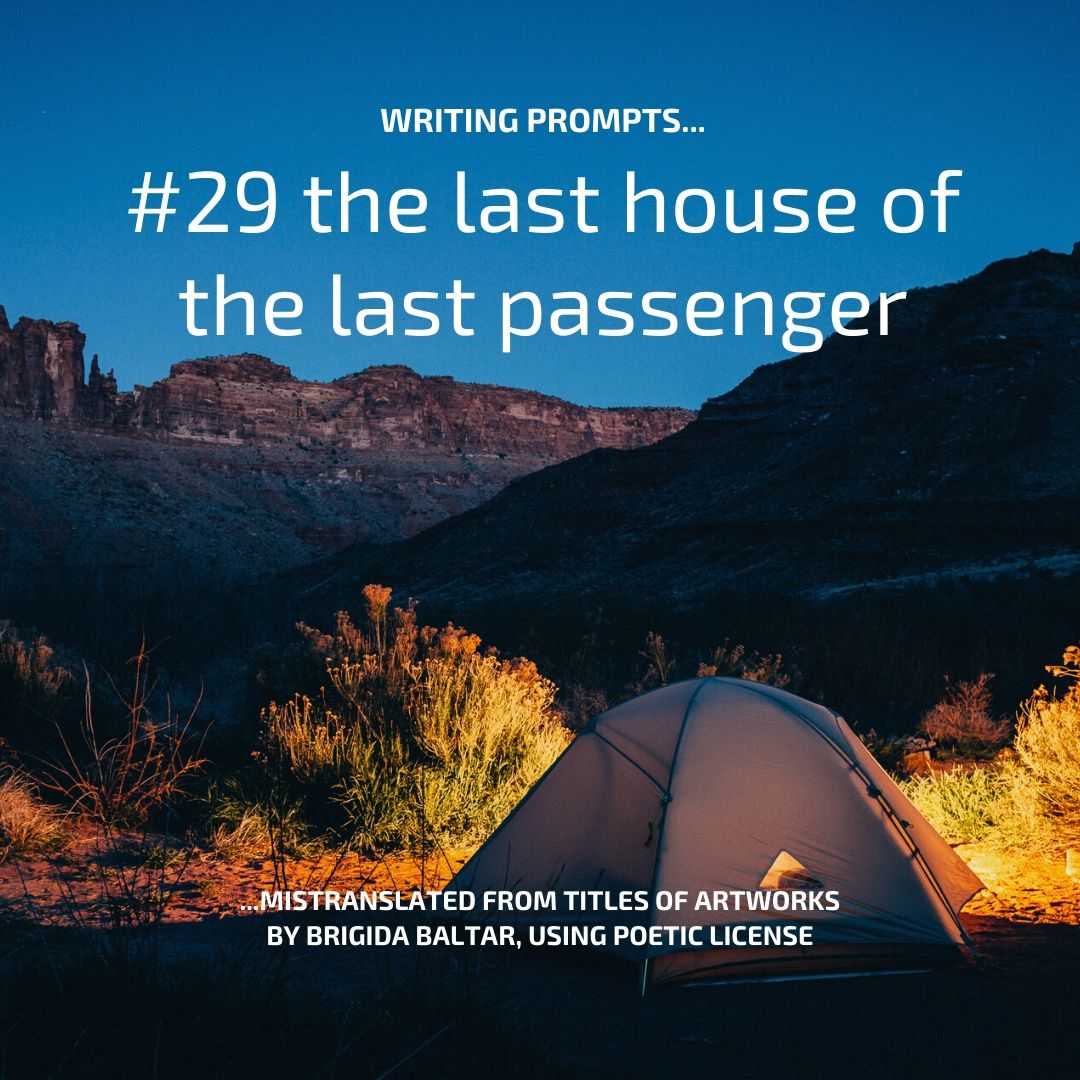
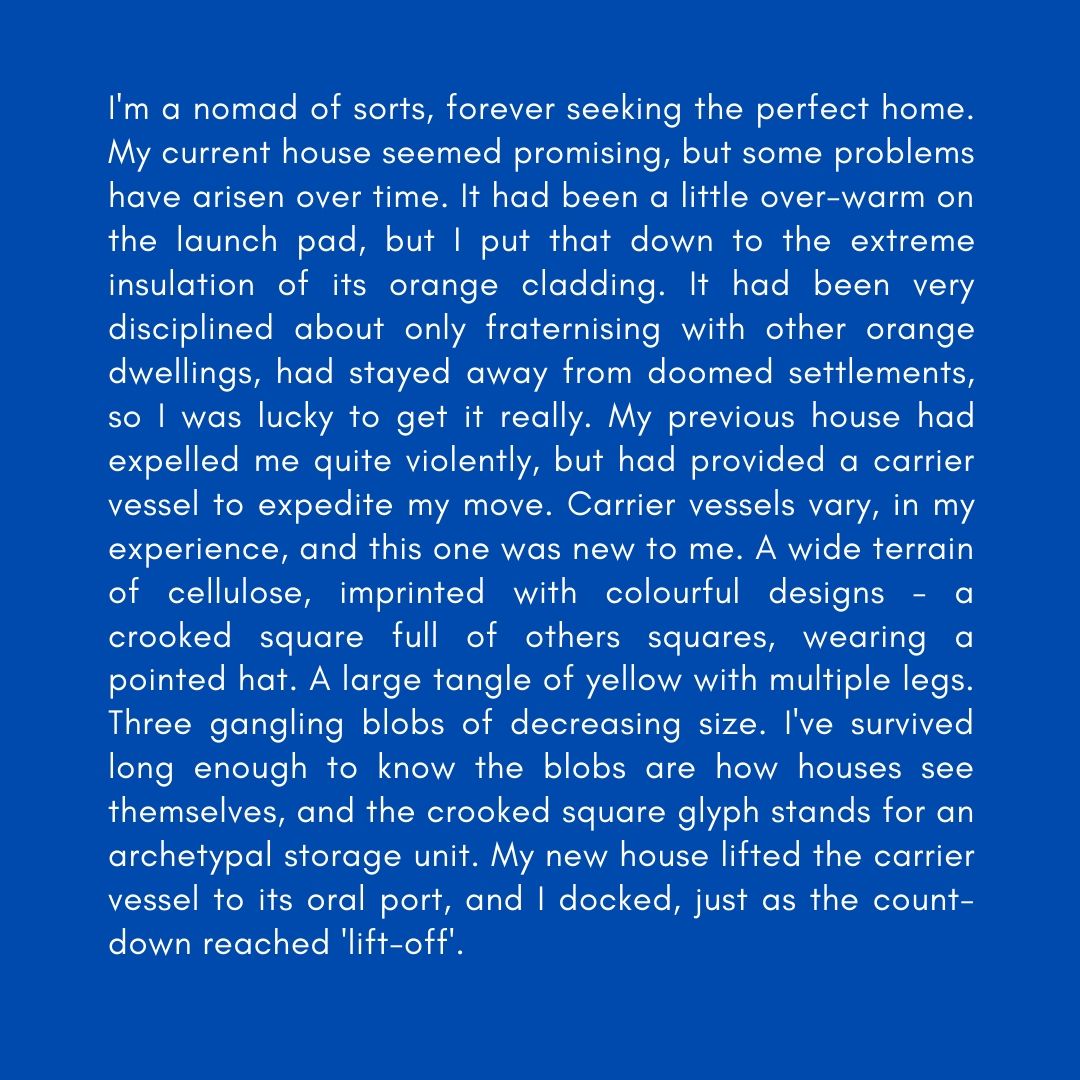
The Last House Of The Last Passenger

I had a vibe in mind for this prompt, an atmosphere, a sort of fin-de-Anthropocene gloom that I wanted to evoke with my deathless prose. Then I read this incredible flash fiction by Sharon Telfer, realised I could never do any better, and took to my fainting couch for a week.

But I rallied! And did my best, with this COVID-19-inspired flash.

123

Very happy to welcome a new contributor, Ann Whiting, with this short story:

The last house of the last passenger

He barricaded himself in, said it was his home and no one was going to take it from him; still strong enough to drag two-by-four wooden planks from the garden, he hammered six inch nails into their depths. Soon he would fly on angel’s wings to his beloved’s home and she’d greet him as she’d always had with a smile as alluring and warm as freshly baked bread. One hug from her and he was healed.

She’d died there, in his arms, and he needed to know she’d know where to find him when his time came. There was nowhere else he was going to die.He’d prepared his exit carefully, stopped the medication weeks ago. The cut backs in health care were a godsend to him. No one checked on  him daily anymore. He’d fallen through the net. 

His heart fluttered weakly now, the exertion had after all taken its toll so he rested in the chair, dreaming of her face lying close to his once more. This would be his last home and he would be the last passenger out of here. The last one to take flight on angel’s wings. He slept in his cosy armchair, dozing lightly. When  the angel came, it looked like her, so he flew away with her into the blue sky and never looked back. 

Beneath him, the authorities were breaking down his door to remove him to a ‘place of safety,’ also known as a Care Home, before the demolition men could be moved into the street, his street, where his children had played. 

They found him in his favourite chair as if asleep, smiling as if at some  private joke. He’d checked himself out, taken flight and evaded their control. The last passenger had departed his home on his own terms, not theirs, and there was a sense of triumph for him at least in that. 

Outside, the engines of the bull-dozers growled waiting to leap into action but  now there’d have to be an investigation into his death which would delay the demolition by months at least. Time enough for questions to be raised about the purchase of the land and their methods and perhaps for the truth to come to light…

The last passenger’s intentions began to immediately take flight. 

Please also enjoy this poem from Caroline Walling, in which the Earth speaks to the last human…

This it is.
Time to leave.

Could I not?

No 
I’m tired of you riding my back
Spinning my axis for you
Get off
This is your final time

               But my home is with you.
             It’s always been this way.
How your memory is thin!

                       But you are my world!

Not any more
    Please leave

                         But why?     

 I needed time
You wasted it
wasted me.
I’m no longer your prize
Your infinite  feast

        Please, get off.

                        Where shall I go?

Where they all go
         In the end,
  From where they came,
and I shall be the happier for it.

Now please
 it’s time to leave.

And I’m delighted to have a poem from Jane Burn too!

The poor, the sick and the needy are already dispersed, dissolved,
divided up or dead. They will not be going forward into our Pure New World.
Did you think those sci-fi films were wrong? They were premonitions.
We super-rich got our heads together many years ago to shield ourselves
from such what ifs. Put our money where our mouths were. Why d’you think
we never really seemed to care enough while the Earth blazed and water
reclaimed the land? Remember Noah? That big blot on the horizon is our Ark.
This is our Plan B and yet I cannot help but want this one last glance,
barren and blistered though this place be. So I took the last in a long line
of temporary tents, have watched the loading of our privileged exodus.
Survival of the fittest, you see. Fat Cats will always land upon their feet.
We will be angels, mounting a ramp that rests on the slain the ones
that tried, with their pauper’s hope and ruined bones, to join the Chosen Few
and now waste, with bullet addled skulls and bloody skins beneath our feet.

I walk away from the camp the last place I ever lived, on this planet,
at least. Wind snatches at silk like a lover gone wrong, snaps at the hold
of guy ropes, takes shreds of it into wasted air to remind the sky of birds.

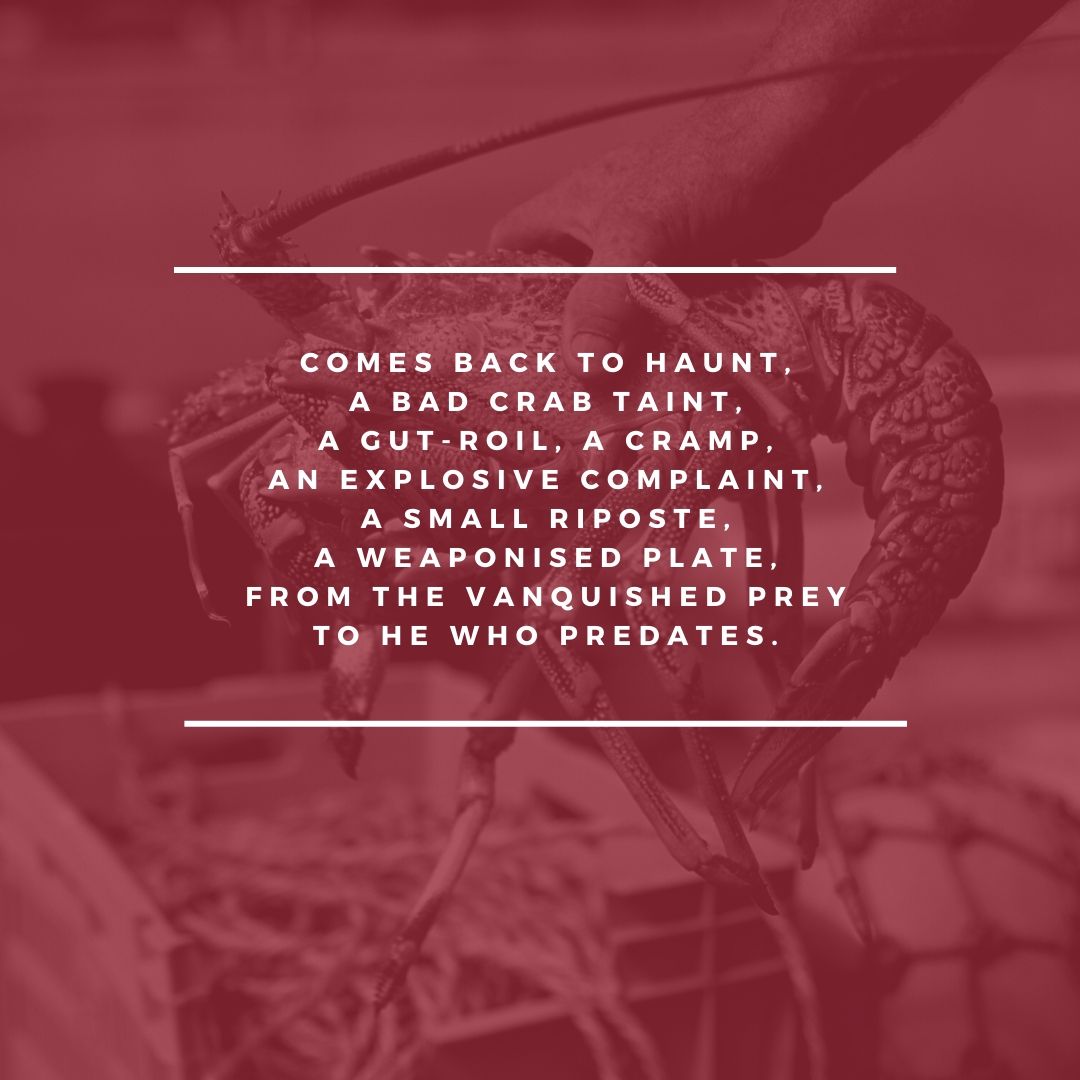
Ghost Crab

#11 Ghost Crab

Some splendid offerings for prompt number 11 of 30, which is very much a pair of ragged claws. Love this one from Charley Genever

A spiral of seaside under padlock;
patrolled itch, parted by transparent scuttle.
There’s no ignoring a haunting.
I don’t know which night’s ambush
is the patient with the pattern,
or which star is the blue-bollock to blame.
They’re all carriers of some kind of plague.
Pincers for the exorcist,
they speak like the police,
call the fucking mystery machine.
Try to wank it off.
Fail the phantom weight.
I am bound by plasma;
deep redded shame, melt the ghosts away.

… while Harry Gallagher comes at the prompt from a different angle with this ode to a friend with physical disabilities.

Crab
(im, Dean Wycherley, owner of Middlesbrough’s great Record Shop c.1980)

You were the chalk among cheese,
a crab amid speedwalkers,
a lonesome goalkeeper
in a world full of strikers.

Crutches thrown off like unwanted confetti
that never quite landed on your path.
No listener adoring your whistling vowels,
who knew the difference between a cry and a laugh.

No footsteps to echo through
the cathedral of your mind,
stacked with facts, top to toe,
colour coded, neatly filed.

All they saw were the signs
Keep Away From The Edge,
As if you led to some dangerous
contagion. Redfaced,

they stayed safe at
more than arm’s length;
away from incomprehension
and its attendant embarrassments.

Books and their covers
make uneasy bedfellows,
when laying straight
is more than a struggle.

Thanks for reading, if you’re enjoying these prompts then why not send me something of your own? Or follow to get a new batch of experimental writing every day. Tomorrow, we investigate The Nature Of Things.

OK, here’s my little offering, to finish up!

2


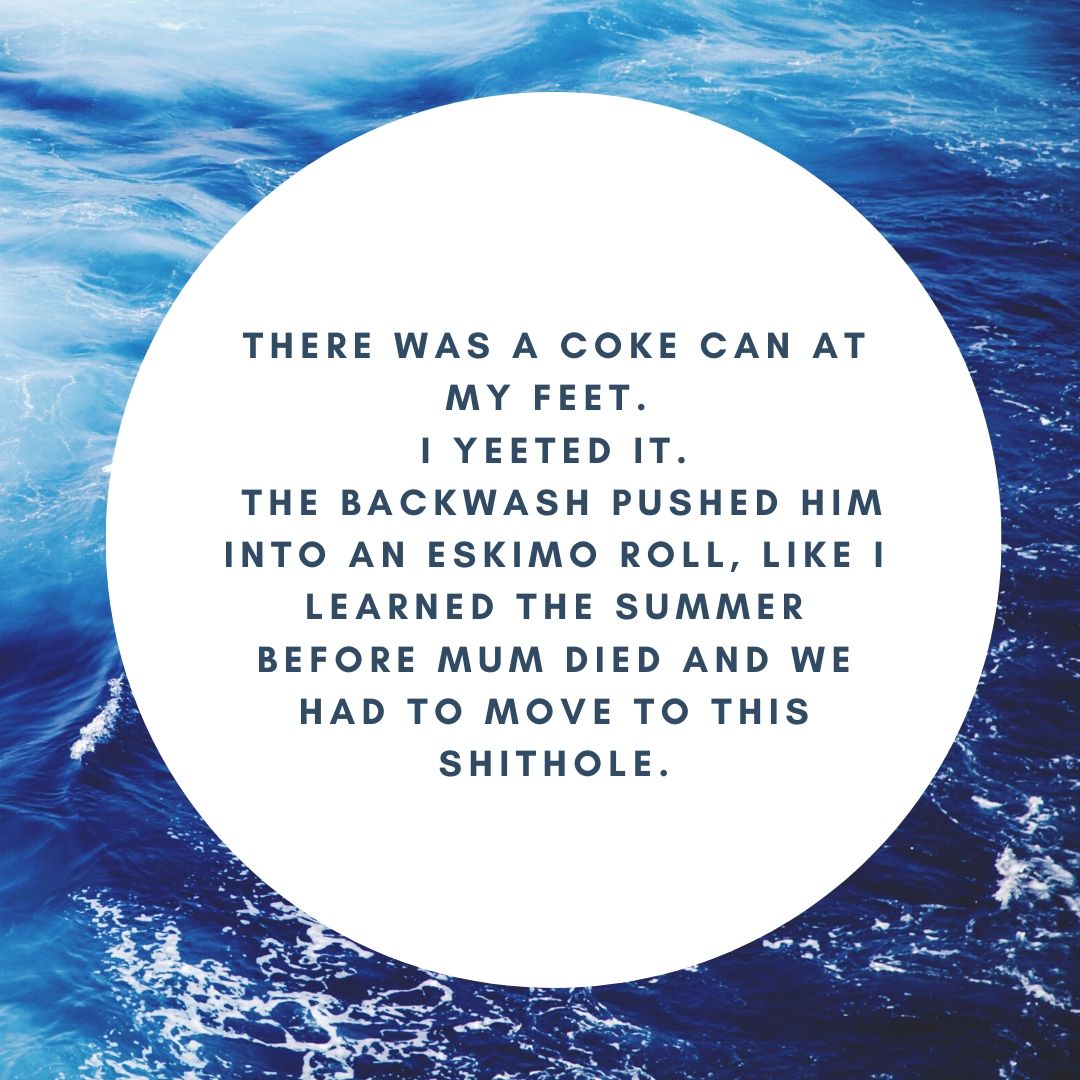
It Appeared Around The Corner

Now, I don’t really write stories. But I do like prose poems, and I’m getting into flash fiction. So maybe it’s not so surprising that one of these random thirty prompts finally made me get a bit narrative

1

2345678

I’d love to feature something you’ve written in response to the prompts – fancy sending me something? Comment below! Here’s another little bit sent in by my friend Lisette Auton

sneaking creeping,
not real not real not real
imagination
dead, gone.

Bernadette McAloon offers us this unsettling ditty

a blot on the vision
an apparition to the left
a doll like creature
a peg in a dress
a pestle in a tutu
a giant toe in tulle
a doubling, a trebling
the muse of a fool
an ocular aura
a tiny ghost in net
a premonition of pain
a commotion in the head

And Rob Walton‘s got in on the act too, with this

It appeared out of the corner
A right bloody angle
Must have been ninety degrees
If it was a minute
I tried suggesting it had been a bit obtuse
That drunken night at the geometry ball
But it was having none of it

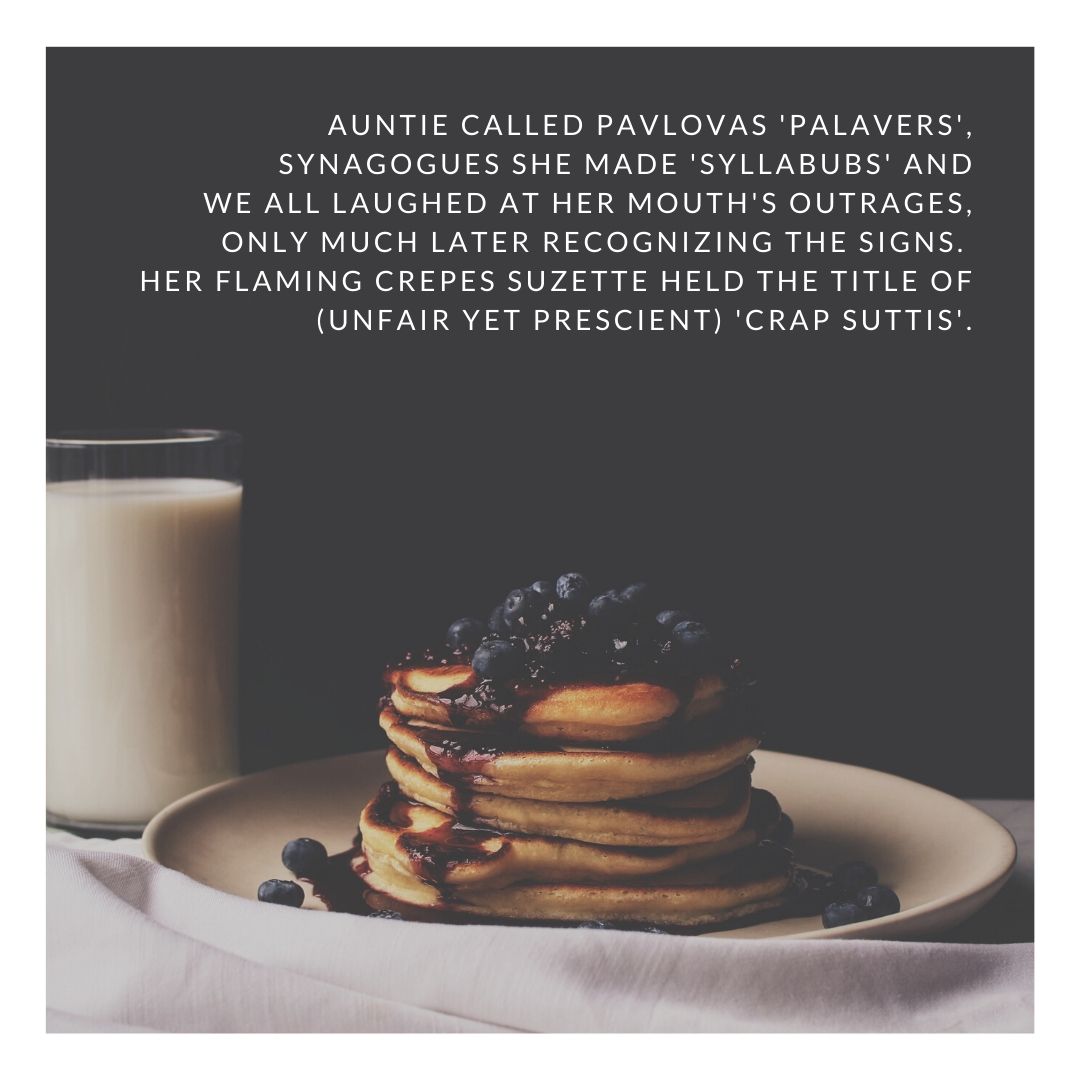
Palavers And Outrages, Signs Of Sutti

For my response to prompt number 4 of 30, I decided to write a golden shovel. This means that each of these words are used in turn as the last word of each line of my poem. It’s a wonderful brain-bending exercise that I recommend to anyone wanting to push their creative brain out of its ruts.

1

2

It seems I’m not alone in thinking about pavlovas – here’s a snippet from Lisette Auton.

I read this as pavlovas and wondered what meringue had to do with anything and then remembered meringues with homemade ice-cream in a kitchen warm with love and from a stomping beach walk. Meringues have everything to do with everything.


Titles for imaginary poems – JANUARY SALE!

If you’ve been following my blog recently, you’ll know that I’m undertaking a self-directed writing residency at MIMA. I’m using documents from their archives to inspire some experiments, like these in stop-motion animation, micro-poetry and found poetry collage.

But when I moved on to the file for my next chosen artist, Brazilian photographer Brigida Baltar, I found very little to work with. The main document was her CV of art works, exhibitions and galleries where she has been shown. It was a VERY long list, and a lot of it was in Portuguese.

There is a poetry technique called ‘homophonic translation’ or ‘the arrogant translator’. In it, the poet creates a new work by (mis)translating a poem written in a language they can’t understand.

I did this with the Portuguese phrases, thinking I might write one piece incorporating some or all of them. Instead, I ended up with the titles for swarms of new poems, short stories and flash fictions, which have been plaguing my brain ever since!

In an attempt to halve my torment by sharing it, here are 30 of them issued as writing prompts via the slightly trash-sarcastic medium of pre-designed Instagram slides. Please send me anything that comes out of any of these prompts, and I promise I’ll share it here alongside my own efforts!

1111111#8 In search of the miraculous - Copy - Copy#9 The art of delicate resistances - Copy - Copy#10 An indoor heaven - Copy - Copy#11 Ghost Crab - Copy - Copy#12 The nature of things - Copy - Copy#13 The peripatetic school - Copy - Copy#14 For love of the rebellious traveller - Copy - Copy#15 Itinerant line - Copy - Copy#16 after other utopias are planted - Copy#17 Paper Trail - Copy#18 The lift and aspirations of the line - Copy#19 Other flowers - Copy#20 More precious than prattle - Copy#21 The marketplace of earth and barricades - Copy#22 From which precision, despite it all, we are sentient - Copy#23 The subtle vertigo of images - Copy#24 House of abasement - Copy#25 Sonorous passageways - Copy#26 Resplendent incisors - Copy#27 radical handy-arms - Copy#28 O! Son Of Trauma - Copy#29 the last house of the last passenger

#30 Get that balance

Better Ways To Fail

Does anyone actually enjoy failing? In my first blog about my writing residency at MIMA, I said I was going to experiment with a really wide range of techniques, and fail as interestingly as possible. But of course, I secretly hoped that everything I touched would turn to gold.

Readers, it did not.

I’ve shown you some of what I feel are the better pieces to come out of the residency so far – now here are a couple of bits I’ve binned.

The power of this African life, this free life, crosses history

I’m happy enough with the content of this blackout poem, but as an object it is ugly and dull- it actually looks much better in photographs than it does in real life, thanks to the miracle of editing tools.


I tried first to erase text using a stippling technique, then when that didn’t work I covered over text with masking tape.

That was a really revolting mess of a white-out, so I started painting the masking tape with black ink, hoping for a sort of stormy sea effect. It dried and took on a patchwork leather effect, which looks like a mistake on this crappy bit of cardboard. I used some of the blackout squares from a previous film to try to create more interest. Meh.

Can it be turned around? I think the only thing that might work is if I were to apply this technique to a human figure or silhouette. Then it might be possible to think in terms of the literal scars of slavery, or dreadful stories about the use of human hides. Then the leathery, bandaged surface might become something powerful and moving. Am I the right person to do this? I think not. But that is what the final texture of the piece brought to my mind. If I were to do this with an anonymous human form, it would be an exercise in objectification. Himid’s life-sized figure works because he is named, reclaimed, celebrated in all his individual glory.

This second piece is a more convention blackout poem, using felt-tip pen. I was experimenting with a non-linear, non-grammatical construction. Basically a sort of mind-map springing out of the central phrase “questions of migration”. It’s  too random a cloud of words, requiring too much interpretation by the reader to have much of an impact.


So – there you have it, I have managed to fail as promised, though maybe not as interestingly as I would like. Not yet, anyway! Onwards! The next phase of the residency is inspired by Brazilian artist Brigida Baltar, and I’m still working on the written aspect. I’ll be back once I have some visuals for you! Plus, watch out for some writing prompts coming your way…

Black Disruption / White Wash

Here’s my situation.

I’m a white woman, a nobody writer, an amateur at art. I’m writer-in-residence at mima, testing out some found poetry techniques on their archive documents.

Black-out. Erasure.

The artist whose file I’m currently working on is Lubaina Himid. A black woman, a lifelong activist for the empowerment of black artists specifically and black people universally, an internationally-acclaimed artist, a Turner Prize-winner.

I know for a fact that nothing I do will go down in history.

But I do not know for a fact that Himid’s magnificent achievements absolutely, positively will go down in history. They bloody should. Mima wants to be part of making sure they do. But history has a nasty tendency to white-wash. Might be something to do with who gets to write it…

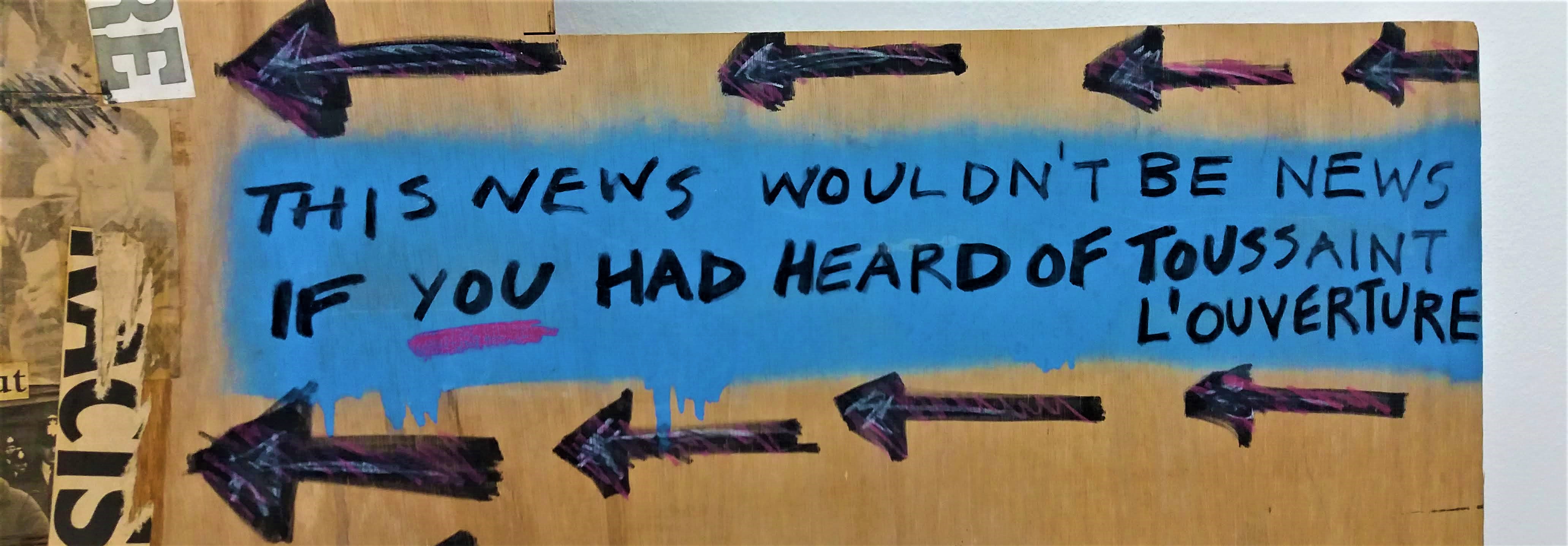
The picture I’m responding to is all about the white-washing of history, and how it perpetuates systemic racism. The subject of the painting is Toussaint L’Ouverture, leader of the Haitian Revolution, who in his lifetime was as famous as Napoleon.

Any English person has at least heard of Napoleon, right?

Have you heard of L’Ouverture?

This wouldn't be news

I took Himid’s biography, and made a stop-motion erasure called Black Disruption/White Wash. It’s supposed to be a comment on the thoughts I’ve written above. I’m not sure it works, and if you want to comment then please do. But please, please, as well as reading this blog (thanks if you’ve got this far) it’s way more important that you have a look at Himid and her phenomenal career.

Next week I’ll post my final thoughts on this section of my residency, and show you the bits that went a bit Pete Tong…

Teeny Tiny Writing

It’s a truth universally acknowledged that one collaged found poem does not a writing residency make.

(To catch a hold of what I’m blethering on about, read how I am inventing my own residency, and have a neb at my first piece of work.)

Next steps, therefore, must be to produce more, more, more, MORE work. Dutifully, I turned my attention to the ‘treatment proposal’ document pertaining to Toussaint L’Ouverture by Lubaina Himid. I took that report, and I cut it into strips, and I shuffled it around, and I thought about how we should treat each other with the kind of loving attention that a conservator lavishes on an Old Master, and – well. Turns out either the language of art conservation is truly lacking in poetry, or I am much worse at this than I thought. Darnit.

I managed to glean two micro-poems, two tiny little ‘treatment proposals’. The first is a kind of instruction about treating your own self with patience.

Surface, glazed – a decision made

The second is more about treating others with compassion.

Whilst inherently unstable,
small tears can be repaired by
supporting

Then, because they were so teeny-tiny, I spent some time bigging them up via the application of Some Slightly Flashier Techniques, making one into a stop-motion film,

and the other into both a stop-motion and a collage.

Treatment Proposal 1 collage after Himid
The upshot is that I quite like the end products! The collage is on cardboard, something I’ve been meaning to try for ages, and which I felt duty-bound to do now because Himid’s work is on cardboard. It’s a fantastically accessible material, which I’m sure is a political statement on her part, and of course it’s a better environmental choice than buying art paper especially. I think I’ll keep on using cardboard in future projects.

The stop-motions are fairly crude, but I do love the process. I played around with filters for the first time, and liked the way a black-and-white resulted in great gashes of light appearing in the animation. It’s good to know that even if my lighting conditions at home are desperately amateur, I might still be able to salvage or even improve footage by using the right built-in cheats.

Next time, I combine erasure poetry with stop-motion, and try to pay homage to Himid’s politics. While I’m gone, here’s an automatic haiku generator for you to play with.